
opalescence
Searching the Web
opalescence
"Opalescence" has a few meanings depending on context. Here's a quick rundown:
1. The optical phenomenon
Opalescence is the milky, iridescent shimmer seen in opals and certain other materials - caused by the scattering and diffraction of light as it passes through a medium with microscopic structures (like silica spheres in opal gemstones). The effect shifts color depending on the viewing angle. Tyndall scattering is the underlying physics: shorter blue wavelengths scatter more than longer red ones, producing that characteristic blue-white glow (similar to why the sky is blue).
2. In dentistry / teeth whitening
Opalescence is the #1-selling professional teeth whitening brand by Ultradent Products. Their product line includes:
- Opalescence Go - prefilled whitening trays, ready to use out of the box (available in 10% carbamide/hydrogen peroxide)
- Opalescence Custom - take-home gel in syringes (10%, 15%, 20%, 35%, 45% concentrations) for use with custom-fitted trays made by a dentist
- Opalescence Boost - in-office, dentist-applied whitening
- Opalescence PF - contains potassium nitrate and fluoride to reduce sensitivity during whitening
3. In optics / physics
The term is also used in scientific contexts to describe light scattering near phase transitions - particularly "critical opalescence," where a fluid near its critical point scatters light strongly and appears milky due to large-scale density fluctuations.
Could you let me know which context you're asking about? I can go deeper on the science, the dental product line, gemology, or anything else related to opalescence.
Context is microbiology.
Reading File
Finding Sources
Searching the Web
opalescence microbiology colony morphology meaning
Finding Sources
Searching the Web
opalescence bacterial colony optical property microbiology light scattering
Finding Sources
Searching the Web
opalescence microbiology urine turbidity serum lipemia definition
Reading File
In microbiology, opalescence refers to a milky, pearlescent, light-scattering appearance seen in biological fluids or cultures. Here are the main contexts where the term is used:
Opalescence in Microbiology
1. Urine - Bacterial Growth
The most direct microbiological use: when bacteria multiply in urine, they produce a uniform opalescence - a diffuse, milky turbidity distributed throughout the specimen. This is caused by light scattering off the suspended bacterial cells.
Key distinction from other causes of cloudy urine:
-
Bacterial opalescence is not removed by acidification or filtration (unlike phosphate crystals, which dissolve with acid)
-
Leukocytes cause a similar white cloud but remain after acidification
-
Turbidimetric methods (double-beam turbidimeter) can exploit this property for rapid urine infection screening
-
Henry's Clinical Diagnosis and Management by Laboratory Methods, p. 542
2. Serum/Plasma - Lipemia
In clinical microbiology and laboratory medicine, serum opalescence indicates elevated triacylglycerol-rich lipoproteins. As triglyceride levels rise, so does the degree of opalescence - making it a rough visual indicator of hyperlipidemia. The mechanism is the same: light scattering by lipid particles suspended in the serum.
- Basic Medical Biochemistry - A Clinical Approach, 6e
3. Colony/Fluid Appearance (Descriptive Morphology)
Opalescence is also used as a descriptive optical term for biological specimens and structures:
- Chyluria (lymph in urine): urine ranges from clear to opalescent to milky depending on the degree of lymphatic contamination
- Synovial fluid: large crystal concentrations can produce an opaque, milky, opalescent fluid
- Pleural fluid: milky white and opalescent fluid is a hallmark of chylothorax
The Underlying Physics (why it matters in micro)
Opalescence results from Tyndall scattering - particles (bacteria, lipid droplets, crystals) suspended in a liquid scatter incident light, producing a diffuse milky-white glow. This is directly useful in microbiology because:
- It can signal bacterial contamination visually before culture results return
- Turbidimetry measures this scattering quantitatively (e.g., McFarland standards used to calibrate bacterial inocula are based on exactly this principle)
In summary: in a microbiological context, when you see "opalescence" on a lab report or textbook, it most commonly means a uniform milky turbidity in a fluid specimen (especially urine) caused by bacterial growth, distinguishable from other causes by its persistence after acidification and filtration.
Show me some pics.
Searching the Web
opalescent urine bacterial growth turbidity microbiology
Searching the Web
opalescent serum lipemia turbid plasma sample laboratory
Loading Image
Loading Image
Searching the Web
opalescent turbid urine specimen vs clear urine comparison photo laboratory
Loading Image
Loading Image
Loading Image
Searching the Web
lipemic serum opalescent milky turbid blood sample vs clear
Loading Image
Here are the relevant visuals:
1. Urine Clarity Scale - from Clear to Opalescent/Cloudy
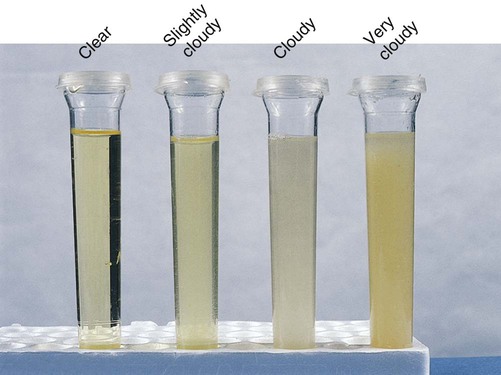
The "slightly cloudy" to "cloudy" range is where bacterial opalescence falls - a uniform milky haze throughout the specimen. Unlike crystal turbidity (which settles), bacterially-caused opalescence is evenly distributed and persists after acidification.
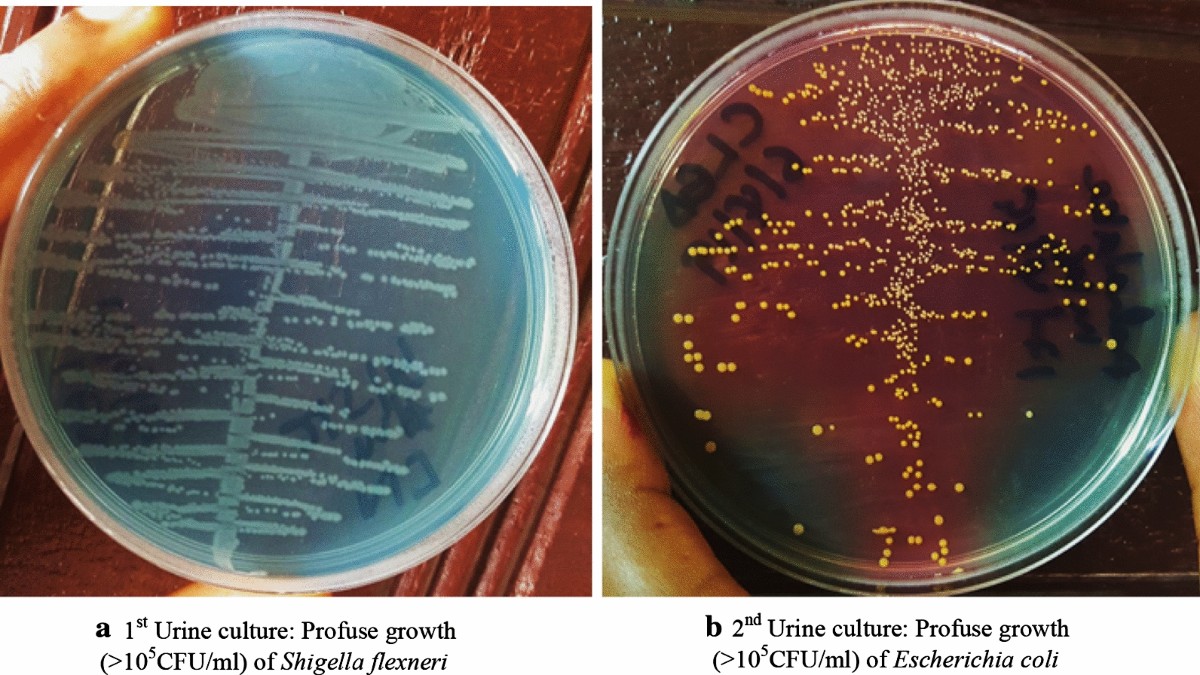
2. Urine Cultures - Bacteria Responsible for Opalescent Urine
These are culture plates from urine specimens that caused opalescence - the heavy bacterial loads (>10⁵ CFU/mL) of organisms like Shigella flexneri (left) and E. coli (right) are what produce that uniform turbidity in the raw urine sample:
3. Bacterial Colonies on Agar (Mixed Culture)
The opalescent/pearlescent sheen visible on certain colonies (right side, whitish colonies) under reflected light is classic colony-level opalescence:

The key visual to remember: opalescence in a fluid specimen looks like "slightly cloudy" to "cloudy" in that first image - a milky, light-scattering haze that is diffuse and uniform throughout, not settled at the bottom or floating on top.
This is a shared conversation. Sign in to Orris to start your own chat.