
I can see this is a pharmacology block exam notice from Multan Medical & Dental College. The exam is tomorrow (July 24, 2026) and covers Drugs acting on the neuromuscular junction (NMJ) - specifically the mechanisms by which drugs stimulate and block the NMJ.
Let me pull comprehensive content from the medical library to help you prepare.
Searching sources...
Reading File
Finding Sources
Finding Sources
Reading File
Reading File
Finding Sources
Reading File
Reading File
Reading File
Reading File
I now have excellent content from multiple authoritative pharmacology textbooks. Let me also fetch the NMJ diagram from Katzung for the visual.
Loading Image
Reading File
I now have comprehensive information from multiple pharmacology textbooks. Let me compile the full study guide.
Drugs Acting on the Neuromuscular Junction (NMJ)
MS-Ph-001 | Block Exam Prep | 1st Year MBBS Pharmacology
Part 1: Normal NMJ Physiology (Essential Background)
Before understanding drugs, you must know the normal transmission sequence:
Step-by-step NMJ transmission:
- A nerve impulse travels down the lower motor neuron to the presynaptic terminal
- The action potential opens voltage-gated Ca²+ channels (VGCa²+) at the nerve terminal
- Ca²+ influx causes ACh-loaded vesicles to fuse with the presynaptic membrane and release ACh into the synaptic cleft (~50-70 nm wide)
- ACh diffuses across the cleft and binds to nicotinic ACh receptors (nAChR) on the postjunctional muscle membrane
- Each nAChR is a pentamer: 2α + β + δ + ε (mature) - ACh must bind both α subunits simultaneously to open the ion channel
- Channel opening allows Na+ influx / K+ efflux → end-plate potential (EPP) → action potential propagated along muscle → contraction
- Acetylcholinesterase (AChE) in the synaptic cleft rapidly hydrolyzes ACh (within ~200 μsec) → end-plate repolarizes → channel closure → muscle relaxes
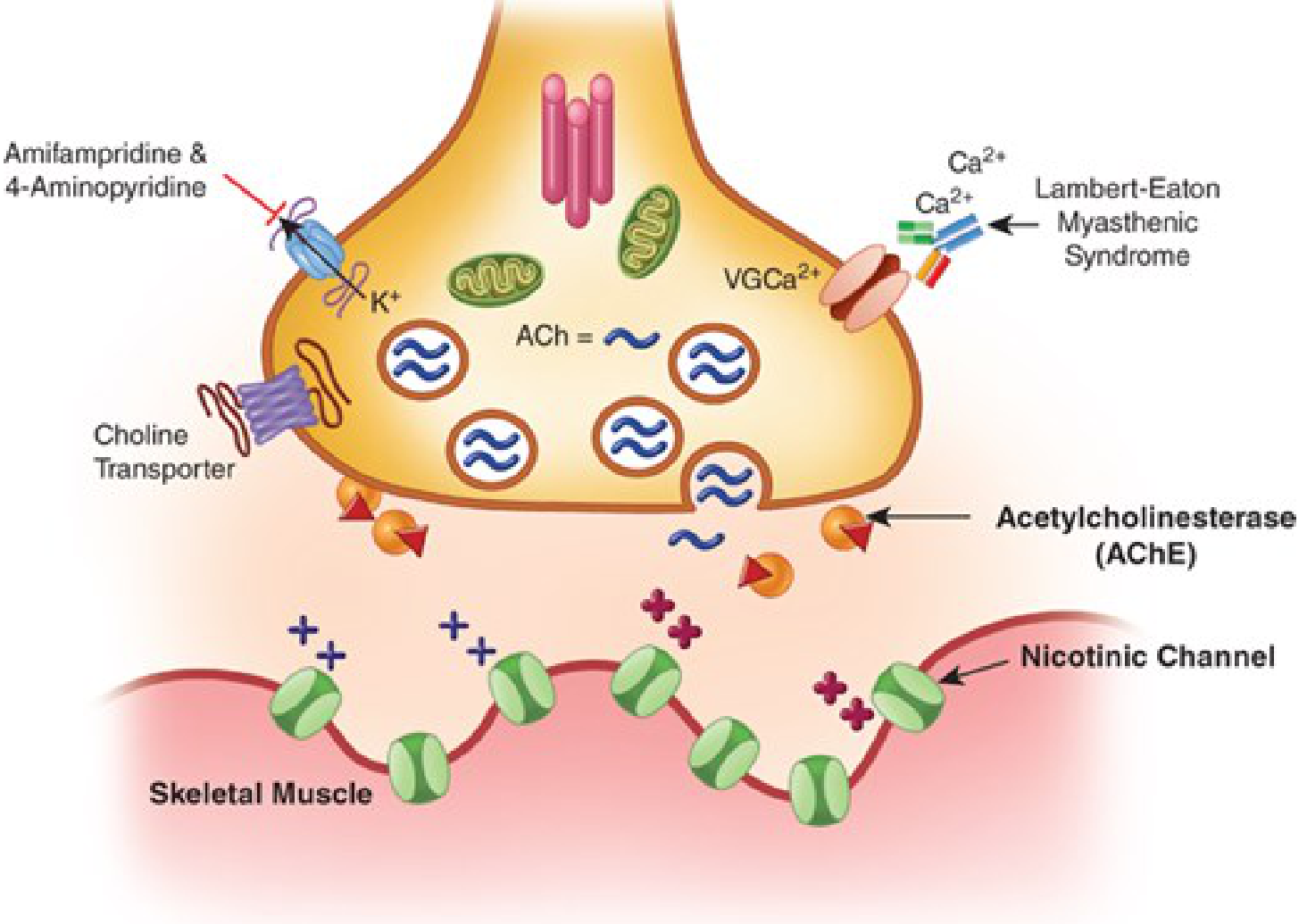
Learning Objective 1: Mechanism by Which Drugs STIMULATE the NMJ
Drugs can stimulate or enhance NMJ transmission by two main mechanisms:
A. Cholinesterase Inhibitors (Indirect Stimulation) - MOST IMPORTANT
These drugs inhibit AChE, preventing the breakdown of ACh. As a result, ACh accumulates in the synaptic cleft, repeatedly binds nAChRs, and prolongs/enhances end-plate depolarization.
Mechanism in detail (from Goodman & Gilman):
- After AChE inhibition, ACh remains in the synapse longer
- It diffuses laterally and cycles through multiple association-dissociation events with neighboring receptors
- This prolongs the end-plate potential decay time
- Quanta released by individual nerve impulses are no longer isolated
- Result: asynchronous excitation and muscle fasciculations
- With enough inhibition: continuous end-plate depolarization and, paradoxically, depolarizing blockade (see below)
- Anti-ChE agents also stimulate the axon terminal itself, causing antidromic firing of the motor neuron, contributing to fasciculations of the entire motor unit
| Drug | Type | Notes |
|---|---|---|
| Neostigmine | Quaternary amine (reversible) | Does NOT enter CNS; also has direct agonist action on skeletal muscle |
| Physostigmine | Tertiary amine (reversible) | Enters CNS |
| Edrophonium | Short-acting | Used diagnostically in myasthenia gravis |
| Organophosphates (e.g., DFP, sarin) | Irreversible | Cause sustained stimulation then paralysis |
Key clinical use: Anti-ChE agents reverse nondepolarizing NMJ blockade by increasing ACh to outcompete the blocker. They do NOT reverse and actually worsen depolarizing blockade (succinylcholine).
B. Depolarizing Agonists (Direct Stimulation then Block)
- Succinylcholine (and nicotine at high doses) acts as a nicotinic receptor agonist
- It binds nAChRs and generates a muscle action potential - initially causing muscle fasciculations (the "stimulation" phase)
- Because it is NOT metabolized by AChE, its concentration in the synaptic cleft remains high
- This is technically both stimulation AND the mechanism of its eventual block (see Part 2 below)
C. Presynaptic K+ Channel Blockers (Stimulate ACh Release)
- 4-Aminopyridine and amifampridine block presynaptic K+ channels
- This prolongs the nerve action potential, increases Ca²+ influx → more ACh vesicle release
- Used therapeutically in Lambert-Eaton Myasthenic Syndrome (LEMS) where antibodies attack VGCa²+ channels and reduce ACh release
Learning Objective 2: Mechanism by Which Drugs BLOCK the NMJ
There are two fundamentally different mechanisms of NMJ block:
Mechanism 1: Nondepolarizing Block (Competitive Antagonism)
Prototype: d-Tubocurarine (curare). Modern drugs: pancuronium, vecuronium, rocuronium, atracurium, cisatracurium, mivacurium.
Mechanism:
- These drugs are quaternary ammonium compounds structurally related to ACh
- They bind to both α-subunits of the nAChR (or even just one is enough to block)
- They do NOT activate the receptor - they prevent ACh from binding
- No ion channel opening occurs → no end-plate potential → flaccid paralysis
- They act as competitive antagonists - their block can be overcome by increasing ACh (e.g., with neostigmine)
- Nondepolarizing drugs also block presynaptic α3β2 nAChRs, reducing ACh mobilization for subsequent nerve signals - this causes "fade" on train-of-four (TOF) nerve stimulation testing
Key features of nondepolarizing block:
- No initial fasciculations
- Fade on TOF stimulation (because presynaptic receptors are blocked)
- Post-tetanic facilitation present
- Reversed by: anticholinesterases (neostigmine, edrophonium) or sugammadex (for rocuronium/vecuronium)
| Drug | Duration | Chemical family |
|---|---|---|
| Succinylcholine | Ultra-short (depolarizing) | -- |
| Mivacurium | Short | Isoquinoline |
| Atracurium, Cisatracurium | Intermediate | Isoquinoline |
| Vecuronium, Rocuronium | Intermediate | Steroid |
| Pancuronium | Long | Steroid |
Mechanism 2: Depolarizing Block (Phase I and Phase II)
Prototype: Succinylcholine (the only clinically used depolarizing blocker)
Mechanism - Phase I (Depolarizing Block):
- Succinylcholine mimics ACh and binds nAChRs as a full agonist
- It opens ion channels → initial fasciculations (brief muscle twitching)
- Unlike ACh, succinylcholine is NOT hydrolyzed by AChE - it persists at the end-plate
- Sustained end-plate depolarization → perijunctional Na+ channels become inactivated (they cannot reopen during continuous depolarization)
- The end-plate cannot repolarize because succinylcholine is still occupying receptors
- Result: flaccid paralysis despite the drug being a receptor agonist
This is the "paradox" - a drug that stimulates the receptor still causes paralysis because:
Sodium channels rapidly inactivate with continuing depolarization. After opening and initial depolarization, the Na+ channel's time-dependent lower gate closes and cannot reopen until the membrane repolarizes. As long as succinylcholine holds the receptor open, repolarization cannot occur and Na+ channels remain stuck inactivated. (Morgan & Mikhail's Clinical Anesthesiology, 7e)
Phase II Block (Desensitization Block):
- With prolonged or repeated succinylcholine exposure, the block transitions to Phase II
- Receptors enter a prolonged closed/desensitized state despite the agonist still being present
- Clinically resembles nondepolarizing block
- The exact mechanism is uncertain but involves receptor desensitization
Key features of depolarizing block:
- Initial fasciculations before paralysis (unlike nondepolarizing)
- No fade on TOF (depolarizers don't block presynaptic α3β2 receptors)
- No post-tetanic facilitation
- NOT reversed by anticholinesterases (neostigmine will worsen it)
- Reversed by: waiting for spontaneous recovery (succinylcholine is metabolized by pseudocholinesterase/plasma cholinesterase in blood)
Other Mechanisms of Block (Additional)
| Mechanism | Drugs | Notes |
|---|---|---|
| Open channel block ("use-dependent") | Some antibiotics, cocaine, quinidine, neostigmine (at high doses) | Drug enters the open receptor channel and physically plugs it |
| Closed channel block | Same drugs as above | Physically plugs channel whether or not ACh has activated it |
| Presynaptic ACh release inhibition | Botulinum toxin, aminoglycosides, Mg²+ excess | Prevent ACh from entering synaptic cleft |
| Direct membrane effect | Volatile anesthetics, local anesthetics, ketamine | Alter receptor-lipid membrane interface |
Summary Comparison Table
| Feature | Nondepolarizing Block | Depolarizing Block (Phase I) |
|---|---|---|
| Mechanism | Competitive antagonism of nAChR | Receptor agonism → sustained depolarization |
| Fasciculations on onset | No | Yes |
| TOF fade | Yes (presynaptic block) | No |
| Post-tetanic facilitation | Yes | No |
| Reversed by neostigmine | Yes | No (worsens) |
| Prototype drug | d-Tubocurarine, pancuronium | Succinylcholine |
High-Yield Points for Your Exam
- Two mechanisms of NMJ block: (1) competitive antagonism of nAChR (nondepolarizing) vs. (2) persistent depolarization via agonist (depolarizing)
- Succinylcholine = depolarizing blocker = ACh receptor agonist → causes initial fasciculations → then flaccid paralysis
- Nondepolarizing blockers = competitive antagonists at nAChR → no fasciculations
- Neostigmine stimulates NMJ indirectly by inhibiting AChE → reverses nondepolarizing block but worsens depolarizing block
- Botulinum toxin and Mg²+ excess block NMJ by preventing presynaptic ACh release
- 4-Aminopyridine stimulates NMJ by blocking presynaptic K+ channels → more Ca²+ influx → more ACh release (used in LEMS)
- ACh receptor structure: pentamer with 2α subunits - both must be bound by ACh to open; blocking even one α subunit prevents opening
Sources: Katzung's Basic & Clinical Pharmacology 16e, p. 745 | Morgan & Mikhail's Clinical Anesthesiology 7e, p. 373-375 | Goodman & Gilman's Pharmacological Basis of Therapeutics, p. 246 | Barash's Clinical Anesthesia 9e, p. 1600-1602
Good luck on your exam tomorrow! The exam is at 8:30 AM - get some rest tonight.
This is a shared conversation. Sign in to Orris to start your own chat.