
Membranoprolifeative glomerulonephritis only from harrison 22 edition acha se explain kro how it happens
Reading File
Now let me search Harrison's 22nd edition for MPGN content.
Finding Sources
Finding Sources
Good - Harrison's 22E ISBN is 9781265977061. Now let me search specifically within Harrison's.
Finding Sources
Finding Sources
I can see MPGN is discussed in block33 and block34. Let me read the dedicated sections on MPGN/C3 glomerulopathy from Harrison's.
Finding Sources
Finding Sources
I can see "C, GLOMERULOPATHIES" at line 1285 in block34 - that's likely "C3 Glomerulopathies" - and the GLOMERULONEPHRITIS section in block33. Let me read both sections plus the surrounding content in block34 around lines 1285-1400.
Reading File
Reading File
Excellent! I found the MPGN section. Let me read more of it, and also look at the pathogenesis section and the GLOMERULONEPHRITIS overview from block33 that mentions MPGN.
Reading File
Reading File
I now have excellent content from Harrison's 22E. Let me also fetch the MPGN schematic image and also check what the block33 says about MPGN in its GLOMERULONEPHRITIS section.
Reading File
Loading Image
I now have all the content needed from Harrison's 22E. Let me compile a thorough, structured explanation.
Membranoproliferative Glomerulonephritis (MPGN)
Harrison's Principles of Internal Medicine, 22nd Edition
Pehle Samjho - MPGN Kya Hai? (What Is It?)
Harrison's 22E ne MPGN ko ek pattern of glomerular injury bataya hai - ye ek single disease nahi hai, balki ek histological pattern hai jo kai alag-alag causes se ho sakti hai.
"MPGN is now considered a pattern of glomerular injury characterized by mesangial and subendothelial immune complexes, complement deposits and/or monoclonal protein deposits, or chronic endothelial cell injury."
- Harrison's 22E, p. 2464
MPGN Ka Core Structural Change (Microscopy)
Ye diagram Harrison's 22E se directly hai - dekho kya hota hai glomerulus mein:
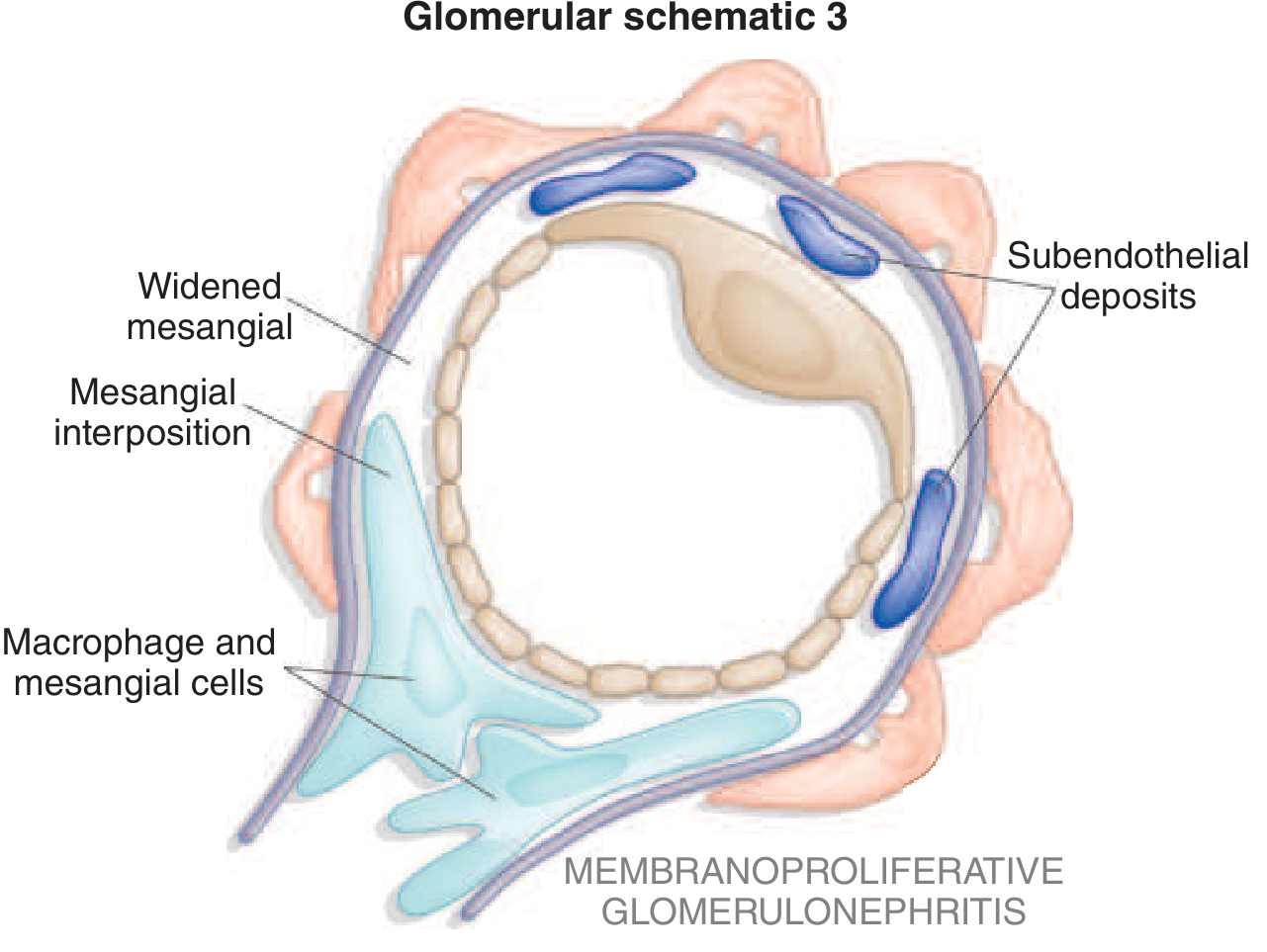
3 key structural changes jo MPGN define karti hain:
- Subendothelial deposits - endothelial cell aur GBM ke beech immune complexes/complement jam jaate hain
- Mesangial interposition (Tram-tracking) - mesangial cells GBM aur endothelium ke beech ghus jaati hain, double contour banaati hain - yahi "tram-track" appearance hai on PAS/silver stain
- Widened mesangium + hypercellularity - macrophages aur mesangial cells badh jaate hain
MPGN Kaise Hota Hai? - Pathogenesis (3 Major Mechanisms)
Harrison's 22E ne MPGN ke 3 distinct pathogenic mechanisms bataye hain, jo isi pattern ko alag-alag causes se produce karte hain:
Mechanism 1: Immune Complex-Mediated MPGN
Kaun kaun si diseases?
- Cryoglobulinemia (specially Hepatitis C se)
- Infection-associated GN (bacterial endocarditis, shunt nephritis)
- Hepatitis B and C
- Lupus (SLE) - class III/IV nephritis
Kaise hota hai:
- Circulating immune complexes (antigen + antibody) form hote hain blood mein
- Ye complexes glomerular capillary wall ke subendothelial space mein trap ho jaate hain
- Complement activate hota hai (classical pathway via C1q)
- C3 convert hoti hai, inflammatory mediators release hote hain
- Mesangial cells aur macrophages migrate karke deposits ko clear karne ki koshish karte hain
- Ye mesangial interposition GBM ko split kar deti hai - double contour (tram-track)
Mechanism 2: Complement-Mediated MPGN (C3 Glomerulopathy)
Yahi Harrison's ka naya classification hai - purana "MPGN Type II" ab "C3 Glomerulopathy" kehte hain.
2 subtypes hain:
- Dense Deposit Disease (DDD) - pehle MPGN Type II - primarily children aur young adults mein
- C3 Glomerulonephritis (C3GN) - older age group (mean age 30)
Key pathogenesis - Complement Dysregulation:
"Both are associated with the presence of a complement mutation believed to cause the kidney pathology, including mutations in the complement factor H regulatory (CFHR) protein genes."
- Harrison's 22E, p. 2464
Step by step:
- Normal mein Factor H complement ko regulate karta hai - alternative pathway ko rok-rok ke chalata hai
- CFHR gene mutations ya C3 nephritic factor (C3NeF - an autoantibody against C3 convertase) ki wajah se Factor H ka regulation fail ho jaata hai
- Alternative complement pathway dysregulated/overactivated ho jaata hai
- C3 continuously split hota rehta hai - serum C3 low, C4 normal (kyunki classical pathway affect nahi hoti)
- C3 fragments GBM mein jam jaate hain bina immunoglobulin ke - yahi C3 glomerulopathy ki defining feature hai
- DDD mein: C3 dense ribbons GBM ke andar form karte hain (seen on EM as dense osmiophilic deposits)
- Inflammatory response - mesangial proliferation aur MPGN pattern develop hoti hai
Biopsy finding jo C3G diagnose karta hai:
- Immunofluorescence: Sole/dominant C3 staining, little to no IgG/IgM
- Light microscopy: mesangial proliferative ya MPGN pattern
Additional associations:
- Partial lipodystrophy (fat tissue loss)
- Drusen bodies in retina
- C3 level low, C4 normal
- C3 nephritic factor positive (esp. DDD)
Prognosis: DDD mein - 50% patients ESKD tak pahunch jaate hain
Mechanism 3: Monoclonal Immunoglobulin-Mediated MPGN
"Monoclonal immunoglobulin mediated diseases including light and heavy chain deposition diseases."
- Harrison's 22E, p. 2464
Causes:
- Multiple myeloma
- Waldenstrom's macroglobulinemia
- MGUS (Monoclonal Gammopathy of Undetermined Significance)
Kaise hota hai:
- Monoclonal light chains ya heavy chains glomeruli mein deposit ho jaate hain
- Ye bhi same MPGN pattern produce karta hai
- Biopsy pe immunofluorescence mein kappa ya lambda restriction dikhi jaati hai
Genetic Mutations Ka Role (Harrison's 22E)
Harrison's specifically mention karta hai:
"Mutations in control of the complement pathway increasingly associate with various forms of membranoproliferative glomerulonephritis (MPGN) and C3 glomerulopathies including dense deposit disease, or atypical hemolytic-uremic syndrome (aHUS); type II partial lipodystrophy from mutations in genes encoding lamin A/C or PPARγ causes a metabolic syndrome associated with MPGN."
- Harrison's 22E, p. 2455
Matlab genetics bhi important hai:
- CFHR gene mutations - complement factor H related proteins
- Lamin A/C / PPARγ mutations - type II partial lipodystrophy + MPGN
Clinical Presentation
- Proteinuria (may be nephrotic range)
- Hematuria (macro ya micro)
- Mixed nephrotic-nephritic picture
- Low serum C3 (especially in complement-mediated)
- Normal C4 (if alternative pathway is the culprit)
- C3 nephritic factor present (most DDD cases)
Treatment (Harrison's 22E)
"The optimal therapies remain undefined but include inhibition of the renin-angiotensin system, lipid lowering, steroids, and other immunosuppressants. Evidence suggests a benefit of therapy with eculizumab, a monoclonal antibody directed at C3, which is activated by C3."
- Harrison's 22E, p. 2464
- RAAS inhibitors - proteinuria reduce karo
- Steroids + immunosuppressants
- Eculizumab (anti-C5 monoclonal Ab) - C3 glomerulopathy mein
- Treat the underlying cause - agar hepatitis C hai to antivirals, infection hai to antibiotics
Summary Table
| Feature | Immune Complex MPGN | C3 Glomerulopathy (DDD/C3GN) | Monoclonal Ig MPGN |
|---|---|---|---|
| Mechanism | IC deposition + classical complement | Alternative complement dysregulation | Monoclonal Ig deposits |
| IF | IgG, IgM, C3 | C3 only (no Ig) | Kappa/lambda restriction |
| C3 level | Low | Low | Normal/low |
| C4 level | Low | Normal | Normal |
| Cause | HCV, SBE, cryoglobulinemia | CFHR mutations, C3NeF | Myeloma, MGUS |
| Treatment | Treat underlying + IS | Eculizumab, IS | Treat plasma cell dyscrasia |
Bottom line: Harrison's 22E mein MPGN ko ek heterogeneous pattern maana gaya hai - "tram-tracking" on biopsy jo mesangial interposition se banti hai. Iska mechanism depend karta hai cause par - immune complex, complement dysregulation, ya monoclonal protein - lekin final common pathway hai subendothelial deposits + mesangial cell migration into GBM = double contour. Complement-mediated types (C3 glomerulopathy) mein purana "Type I/II/III" classification ab abandon kar diya gaya hai.
This is a shared conversation. Sign in to Orris to start your own chat.