
Physiology behind the dark circles around eyes, how lack of sleep may affect that and other habits to aggravate the condition and also treatment or steps to reduce them
Reading File
Now let me search the medical library and web in parallel for comprehensive coverage.
Finding Sources
Searching the Web
dark circles under eyes physiology causes sleep deprivation treatment 2024
Searching PubMed
periorbital dark circles pathophysiology treatment
Good. Let me now read the Fitzpatrick's dermatology section on periorbital hyperpigmentation (most relevant textbook hit) and search PubMed with a simpler query, in parallel.
Reading File
Finding Sources
Searching PubMed
periorbital hyperpigmentation dark circles
Let me fetch the clinical image, get the PubMed abstract for the systematic review, and also search for the Andrews' Dermatology section on drug-induced periocular pigmentation - all in parallel.
Loading Image
Reading Article
PMID: 37661041
Reading Article
PMID: 33272039
Reading Web Page
https://viaskincare.com/sleep-puffy-eyes-dark-circles
I now have enough comprehensive information to write a thorough, well-sourced answer. Let me compile it.
Dark Circles Around the Eyes: Physiology, Causes, and Treatment
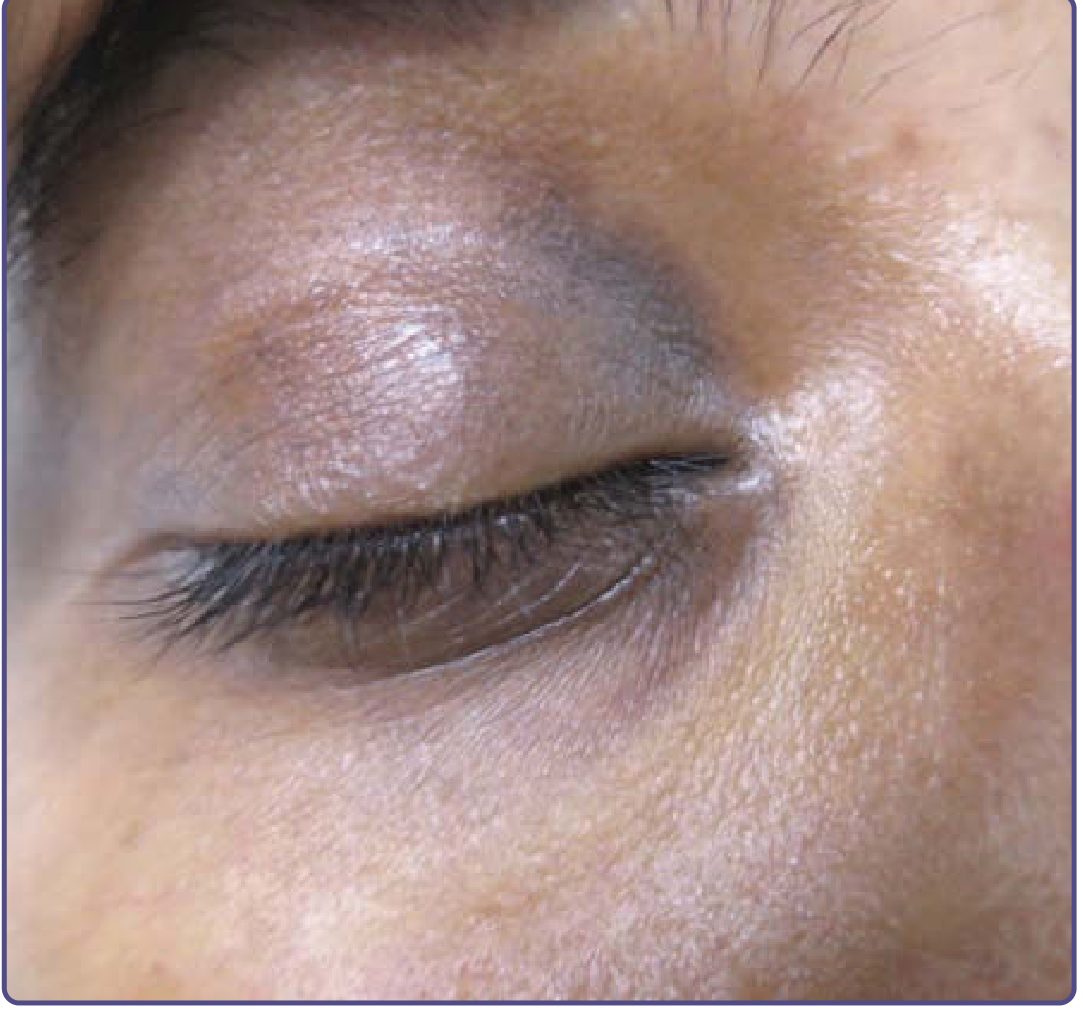
1. The Anatomy That Makes This Area Uniquely Vulnerable
The skin under and around the eyes is the thinnest on the entire face - approximately 0.5 mm, compared to 2 mm elsewhere. It has:
- Minimal subcutaneous fat - so little structural cushioning separates surface from deeper structures
- Loose connective tissue - readily accumulates interstitial fluid
- Superficially located blood vessels - dark deoxygenated blood in capillaries and venules shows through easily
- High melanocyte density - especially in people with darker skin phototypes
This structural vulnerability means that any disruption - vascular, pigmentary, or fluid-based - becomes visible here first and most prominently.
2. Physiology: Why Dark Circles Appear
Dark circles are genuinely multifactorial. Fitzpatrick's Dermatology identifies several distinct pathophysiological mechanisms, and more than one can operate simultaneously:
A. Melanin Pigmentation (Constitutional / Structural)
The most common type, especially in South Asian, Middle Eastern, and African skin types. Histologically, there is increased melanin deposition in the basal epidermis and melanophages in the upper dermis. This is a true pigmentary process, partly genetic and partly driven by sun exposure. Fitzpatrick's notes that constitutional periorbital pigmentation is usually progressive and strongly associated with darker skin phototypes. The exact etiology is not fully determined, but it is real melanin - not a vascular illusion.
B. Vascular / Hemoglobin-Related Darkness
The thin periorbital skin allows the color of deoxygenated hemoglobin in underlying venous and capillary blood to show through as a bluish-purple shadow. This is more pronounced in people with lighter, more translucent skin. Vascular pooling, sluggish microcirculation, or venous congestion - all of which worsen with fatigue - amplify this effect.
C. Structural / Shadow Effect
Loss of fat volume in the tear trough region (nasojugal groove) and age-related skin laxity creates a hollow shadow below the eye. This is not true pigmentation but a geometric/anatomical problem - the depression creates shadow at the infraorbital rim. This worsens significantly with age.
D. Post-Inflammatory Hyperpigmentation
Repeated eye-rubbing, eczema (atopic dermatitis), contact dermatitis, or allergic reactions cause inflammation, which triggers melanocyte activity. Andrews' Dermatology specifically flags that atopic subjects show "periorbital hyperpigmentation with facial pallor" as a characteristic sign. Each inflammatory episode can add cumulative melanin deposition.
E. Drug-Induced Periocular Pigmentation
Certain drugs cause periocular darkening as a side effect. Andrews' Dermatology specifically mentions hydroxychloroquine, imatinib, and topical ophthalmic prostaglandin analogues (latanoprost, bimatoprost - used in glaucoma) as documented causes. The prostaglandin-related effect typically appears 3-6 months after starting treatment and involves both pigmentation and periorbital fat atrophy.
3. How Sleep Deprivation Makes Dark Circles Worse
Sleep deprivation hits through multiple overlapping pathways:
HPA Axis Activation and Cortisol
Insufficient sleep (consistently below 7-9 hours) acts as a physiological stressor and activates the hypothalamic-pituitary-adrenal (HPA) axis, driving elevated cortisol that often persists into the next day. Cortisol:
- Activates mineralocorticoid receptors in the kidney, promoting sodium and water retention
- Increases extracellular fluid volume
- Creates osmotic shifts that favor interstitial fluid accumulation
During sleep, especially when lying flat, this retained fluid gravitates toward the periorbital area (a dependent, loosely supported tissue), producing periorbital edema - the "puffy" look of morning after a poor night.
Vasodilation and Vascular Pooling
Sleep deprivation causes cutaneous vasodilation in the periorbital vessels. More blood pools in this region, and with the skin being so thin, the dark color of venous blood shows through prominently. The skin overall becomes paler and more dull with fatigue, which increases the contrast and makes the dark vascular shadow more apparent.
Lymphatic Drainage Failure
During quality sleep, the lymphatic system actively drains interstitial fluid from the face. Disrupted sleep reduces this drainage, compounding fluid accumulation under the eyes.
Inflammatory Cytokine Release
Sleep deprivation increases systemic low-grade inflammation (elevated IL-6, TNF-alpha, CRP). This increased vascular permeability contributes to fluid leakage into periorbital tissues and, over time, may stimulate melanocyte activity.
The cycle reinforces itself: poor sleep → HPA activation → cortisol rise → fluid retention + vasodilation + inflammation → more pronounced dark circles.
4. Other Habits That Aggravate Dark Circles
| Habit | Mechanism |
|---|---|
| Excessive sun exposure | Stimulates melanin production in already-primed periorbital melanocytes; UV radiation is the main driver of progressive constitutional pigmentation |
| Eye-rubbing | Causes chronic low-grade trauma and post-inflammatory hyperpigmentation; common in allergy sufferers |
| Alcohol consumption | Causes vasodilation, disrupts sleep architecture, promotes dehydration (which makes skin appear thinner and veins more visible), and elevates cortisol |
| High-sodium diet | Promotes systemic fluid retention and periorbital edema |
| Smoking | Accelerates collagen breakdown, reduces skin thickness, impairs microcirculation, promotes pallor that increases contrast |
| Dehydration | Skin becomes less plump and vessels become more visible through thinner tissue |
| Chronic allergies | Repeated histamine-driven eye-rubbing and periorbital inflammation; the "allergic shiner" is a well-recognized clinical sign |
| Screen time and digital eye strain | Promotes eye-rubbing and worsens sleep quality via blue light-mediated melatonin suppression |
| Sleeping face-down or on one side | Fluid pools asymmetrically in dependent periorbital tissue overnight |
| Rapid weight loss | Loss of periorbital fat deepens the tear trough, worsening the shadow effect |
5. Treatment - Matching the Cause
Since dark circles have distinct subtypes, the right treatment depends on identifying the underlying mechanism. A single treatment rarely addresses all types.
Lifestyle (Foundation for All Types)
- 7-9 hours of quality sleep - directly reverses vascular and fluid-based circles
- Head elevation during sleep - reduces fluid pooling in periorbital tissue
- Cold compresses in the morning - causes vasoconstriction, reduces puffiness quickly
- Broad-spectrum SPF 30+ sunscreen around eyes daily - prevents UV-driven melanin buildup
- Reduce alcohol and sodium - less fluid retention
- Adequate hydration - improves skin plumpness and contrast
- Manage allergies - antihistamines reduce rubbing and histamine-driven pigmentation
Topical Agents (Pigmentary Type)
- Hydroquinone (2-4%) - the reference depigmenting agent; Fitzpatrick's notes it can "subtly lighten excessive pigmentation"
- Retinoids (tretinoin) - stimulate collagen, thin the stratum corneum to reduce melanin; also improve skin texture
- Vitamin C (ascorbic acid) - antioxidant, inhibits tyrosinase, lightens pigmentation
- Azelaic acid, kojic acid, niacinamide - tyrosinase inhibitors with fewer side effects than hydroquinone
- Caffeine-containing eye creams - vasoconstrictive, transiently reduce vascular pooling and puffiness
- Peptide complexes - stimulate collagen; evidence is limited but generally safe
Light-Based Treatments (Pigmentary + Vascular)
A 2024 systematic review (PMID 37661041, Montolío-Marzo et al.) reviewed 208 papers and found:
- Intense Pulsed Light (IPL) + depigmenting substances - best results for pigmented dark circles
- Ruby laser - effective for pigmentation
- CO2 or Er:YSGG laser - best when treating combined pigmentation, fine wrinkles, and skin laxity
- Nd:YAG, alexandrite, and diode lasers - gave the worst outcomes for pigmentation specifically
- The review recommends combining light devices with topical depigmenting agents for better results and to reduce post-inflammatory hyperpigmentation risk
Fillers (Structural / Shadow Type)
- Hyaluronic acid dermal fillers in the tear trough correct volume loss and eliminate the infraorbital shadow - very effective for the structural subtype
- A 2022 study (PMID 33272039, Kounidas et al.) found 82% of patients rated results as excellent with fillers, lasers, or a combination; patients with hollow tear troughs responded best to fillers alone
Radiofrequency
- Microneedle fractional radiofrequency (PMID 37326254) has shown effectiveness for periorbital dark circles, particularly by stimulating neocollagenesis and tightening loose skin
Surgical Options (Advanced)
- Lower blepharoplasty (surgical fat repositioning or removal) for prominent fat prolapse
- Autologous fat transplantation for volume restoration - Fitzpatrick's mentions this has been reported useful, though studies often don't specify the pigmentation subtype
Quick Summary
| Type | Key Mechanism | Best Treatment |
|---|---|---|
| Pigmentary | Excess melanin (epidermal/dermal) | Sunscreen, hydroquinone, retinoids, IPL, ruby laser |
| Vascular | Thin skin showing dark venous blood | Sleep, cold compresses, caffeine creams, Nd:YAG (long-pulse) |
| Structural/Shadow | Fat loss, hollow tear trough | HA fillers, blepharoplasty, fat transfer |
| Post-inflammatory | Allergy, rubbing, eczema | Antihistamines, stop rubbing, topical steroids (short-term), SPF |
Sources:
- Fitzpatrick's Dermatology, 9th Ed., Chapter 77: Periorbital Pigmentation
- Andrews' Diseases of the Skin, Drug-Induced and Atopic Periocular Pigmentation sections
- Montolío-Marzo et al. (2024). Treatment of periorbital hyperpigmentation using light devices - Systematic Review, PMID 37661041
- Kounidas et al. (2022). Decoding infraorbital dark circles with lasers and fillers - PMID 33272039
This is a shared conversation. Sign in to Orris to start your own chat.