
classify flaps. write in detail the various flaps used in head and neck surgery in detail for 50 marks with diagram and flow charts from Scott Brown, Cummings, stell and marans, Zakir Hussain, dhingra, hazarika and related articles with recent advances according to rguhs university
Reading File
Finding Sources
Finding Sources
Finding Sources
Finding Sources
Finding Sources
Finding Sources
Finding Sources
Now let me read the key sections from Scott-Brown and Cummings on flaps:
Reading File
Reading File
Reading File
Reading File
Reading File
Searching PubMed
flap reconstruction head neck surgery free flap pedicled flap
Reading File
Reading File
Now I have sufficient material from Scott-Brown, Cummings, and PubMed. Let me compose the comprehensive 50-mark answer.
CLASSIFICATION AND FLAPS IN HEAD & NECK SURGERY
A Comprehensive Answer (50 Marks) - RGUHS Standard
INTRODUCTION
A flap is a unit of tissue that is transferred from one site (donor) to another (recipient) while maintaining its own blood supply, either through an intact pedicle or through re-anastomosis of vessels. Flaps are the foundation of reconstructive surgery in head and neck oncology, trauma, and congenital deformity.
The reconstructive ladder (Mathes & Nahai) guides decision-making:
┌─────────────────────────────────────────────────────────┐
│           THE RECONSTRUCTIVE LADDER                     │
│                                                         │
│  SIMPLE ──────────────────────────────────── COMPLEX   │
│                                                         │
│  1. Secondary intention healing                         │
│       ↓                                                 │
│  2. Primary closure                                     │
│       ↓                                                 │
│  3. Split/Full thickness skin graft                     │
│       ↓                                                 │
│  4. Local flap                                          │
│       ↓                                                 │
│  5. Regional pedicled flap                              │
│       ↓                                                 │
│  6. Distant pedicled flap                               │
│       ↓                                                 │
│  7. Free microvascular tissue transfer                  │
└─────────────────────────────────────────────────────────┘
(Scott-Brown's ORL H&N Surgery, Vol 3; Cummings Otolaryngology H&N Surgery)
CLASSIFICATION OF FLAPS
A. Based on Blood Supply (Most Important - Mathes & Nahai, 1997)
┌──────────────────────────────────────────────────────────────┐
│              CLASSIFICATION BY BLOOD SUPPLY                   │
├──────────────────────┬───────────────────────────────────────┤
│   RANDOM PATTERN     │         AXIAL PATTERN                 │
│   (no named vessel)  │     (named vessel in pedicle)         │
├──────────────────────┼───────────────────────────────────────┤
│ • Rhomboid flap      │ • Forehead flap (supratrochlear a.)   │
│ • Z-plasty           │ • Nasolabial flap                     │
│ • Rotation flap      │ • PMMC (pectoral branch of            │
│ • Advancement flap   │   thoracoacromial a.)                 │
│ • Bilobed flap       │ • Deltopectoral flap (perforators of  │
│ • V-Y flap           │   internal mammary a.)                │
│                      │ • Free flaps (ALT, RFFF, fibula, etc) │
└──────────────────────┴───────────────────────────────────────┘
Random flaps depend on the subdermal plexus. The length:width ratio is classically 1:1 in the head and neck (blood supply here is superior to trunk, allowing ratios up to 3:1 or 4:1 in some areas). Axial flaps have a named artery running longitudinally and can be much larger.
B. Based on Tissue Composition
┌─────────────────────────────────────────────────────────────────┐
│                   TISSUE COMPOSITION                             │
├────────────────┬────────────────────────────────────────────────┤
│ Cutaneous      │ Skin + subcutaneous fat only                   │
│ Fasciocutaneous│ Skin + fascia (e.g., radial forearm free flap) │
│ Myocutaneous   │ Muscle + overlying skin (e.g., PMMC)           │
│ Osseocutaneous │ Bone + skin (e.g., fibula free flap)           │
│ Musculofascial │ Muscle + fascia only (e.g., temporalis)        │
│ Visceral       │ Stomach, jejunum, colon (pharyngeal recon.)    │
│ Composite      │ Multiple tissue types combined                 │
└────────────────┴────────────────────────────────────────────────┘
(Cummings Otolaryngology H&N Surgery, Chapter 78)
C. Based on Location of Donor Site
┌──────────────────────────────────────────────────────┐
│   LOCAL    │ Immediately adjacent to defect          │
│            │ e.g., nasolabial, forehead, rhomboid     │
├──────────────────────────────────────────────────────┤
│ REGIONAL   │ Same anatomical region                  │
│            │ e.g., PMMC, deltopectoral, SCM           │
├──────────────────────────────────────────────────────┤
│  DISTANT   │ Remote site transferred with pedicle    │
│            │ e.g., latissimus dorsi, trapezius        │
├──────────────────────────────────────────────────────┤
│   FREE     │ Completely detached, microsurgery needed │
│            │ e.g., ALT, RFFF, fibula, jejunum         │
└──────────────────────────────────────────────────────┘
D. Based on Method of Transfer (Most Clinically Used Classification)
┌──────────────────────────────────────────────────────────────────┐
│                    METHOD OF MOVEMENT                             │
├───────────────┬──────────────────────────────────────────────────┤
│ ADVANCEMENT   │ Moved forward in straight line to fill defect    │
│               │ e.g., V-Y plasty, H-flap, Rintala flap           │
├───────────────┼──────────────────────────────────────────────────┤
│ ROTATION      │ Pivots in an arc around a fixed point             │
│               │ e.g., Cervicofacial rotation flap                 │
├───────────────┼──────────────────────────────────────────────────┤
│ TRANSPOSITION │ Jumps over intervening tissue                     │
│               │ e.g., Rhomboid (Limberg), Z-plasty, bilobed       │
├───────────────┼──────────────────────────────────────────────────┤
│INTERPOLATION  │ Crosses intact skin on a pedicle (2 stages)      │
│               │ e.g., Forehead flap, Nasolabial interpolation     │
└───────────────┴──────────────────────────────────────────────────┘
(Scott-Brown's ORL H&N Surgery, block 11)
E. Mathes & Nahai Classification of Muscle Flaps (1981)
| Type | Description | Example |
|---|---|---|
| Type I | One vascular pedicle | Tensor fascia lata, Gastrocnemius |
| Type II | Dominant + minor pedicles | Gracilis, PMMC, Trapezius |
| Type III | Two dominant pedicles | Gluteus maximus, Rectus abdominis |
| Type IV | Segmental pedicles | Sartorius, Tibialis anterior |
| Type V | One dominant + secondary segmental | Latissimus dorsi, Pectoralis major |
FLOWCHART: APPROACH TO FLAP SELECTION IN HEAD & NECK
                    HEAD & NECK DEFECT
                          │
         ┌────────────────┼────────────────┐
         ▼                ▼                ▼
    SMALL (<2cm)     MEDIUM (2-6cm)   LARGE (>6cm)
  ± SUPERFICIAL      MODERATE DEPTH   DEEP / THROUGH
         │                │            AND THROUGH
    Primary           Local flap            │
    closure       (advancement,      ┌──────┴──────┐
    or FTSG       rotation,     REGIONAL       FREE FLAP
                  transposition) PEDICLED FLAP  (RFFF, ALT,
                                 (PMMC, DP,     Fibula, etc.)
                                 Trapezius)
                          │
                   Is previous surgery
                   or RT compromising
                   pedicle blood supply?
                    YES → FREE FLAP
                    NO → PEDICLED FLAP
I. LOCAL FLAPS IN HEAD & NECK
1. Advancement Flaps
Tissue advanced directly into the defect without rotation or lateral movement.
a. Rectangular Advancement Flap
- Burrow triangles excised at base to prevent dog-ears
- Used for small to medium scalp and forehead defects
b. V-Y Advancement Flap
- Island of tissue advanced forward; defect closed in Y-fashion
- Flap designed about twice the defect size
- Useful for nasal tip, columella, cheek defects
c. Rintala Flap (Vertical Forehead Advancement)
- Midline vertical incision from nasion to hairline
- Two advancement flaps advanced downward
- Useful for nasal dorsum defects
- (Scott-Brown's block 12, line 4160)
d. Cheek Advancement (Mustarde Type)
- Large rotation-advancement from cheek
- Used for lower eyelid and malar defects
- Supported by Z-plasty or back-cut for reach
2. Rotation Flaps
Semicircular flap that pivots around a fixed point into adjacent defect.
Cervicofacial Rotation Flap
- Skin from cheek and neck rotated superiorly
- Used for large cheek, malar, lower eyelid defects
- Based on facial artery perforators
- Danger: facial nerve branches must be preserved
3. Transposition Flaps
a. Z-plasty
- Two triangular flaps transposed
- Lengthens scars, releases contracture
- Central limb = scar; angle 60° gives 75% length gain
b. Rhomboid (Limberg) Flap
- Parallelogram-shaped transposition flap
- Four possible flap orientations for any rhomboid defect
- Useful: cheek, temple, lateral nose, scalp
    Defect (rhomboid shape)
    ╔══════╗
    ║      ║
    ║      ╟───── Flap donor
    ╚══════╝
           ↘
            Donor closes primarily
c. Bilobed Flap (Zitelli modification)
- Two lobes transposed: first lobe fills defect, second lobe fills first donor site
- Each lobe at 45° arc of rotation (Zitelli); originally 90° (McGregor)
- Primary use: nasal tip and alar reconstruction
- (Scott-Brown's block 11)
d. Banner Transposition Flap
- Long narrow flap transposed 90-180° from donor to defect
- Used for small defects of nose, eyelid
4. Interpolation Flaps
Two-stage flaps that cross over intact skin on a pedicle.
a. Forehead Flap (Paramedian Forehead Flap)
- Based on supratrochlear artery (axial)
- One of the oldest flaps in surgery (described by Susruta, 600 BC)
- Oblique or vertical design, up to full forehead height
- Two to three stages: Stage 1 - flap raised, tip inset; Stage 2 (3 weeks) - pedicle divided, reinset
- Third stage possible for nasal tip refinement (thinning)
- Donor site: primary closure if <2.5 cm width; otherwise STSG or secondary healing
- Primary indication: nasal reconstruction, especially subtotal and total nasal defects
- (Scott-Brown's block 12, line 4172-4175)
b. Nasolabial Flap
- Based on angular artery (facial artery branch) - superiorly based
- Or inferiorly based on labial vessels
- Rich blood supply allows multiple uses
- Uses: alar reconstruction, floor of mouth, buccal mucosa, palate
- Staged: pedicle divided at 3 weeks
- Can be folded on itself for through-and-through nasal defects
- (Scott-Brown's block 11, line 8174)
II. REGIONAL PEDICLED FLAPS
1. Deltopectoral (DP) Flap
- Described by Bakamjian (1965) - first major axial skin flap
- Based on 2nd, 3rd, 4th perforators of internal mammary artery
- Fasciocutaneous; can be raised from clavicle to deltoid
- Dimensions: 20 x 9 cm typically
- Uses: pharyngeal reconstruction, cervical esophagus, skin cover after neck dissection, salvage after PMMC failure
- Two-stage procedure; pedicle divided at 3 weeks
- Disadvantage: hair-bearing skin in men; limited arc of rotation; requires skin graft of donor site
   ┌──────────────────────────┐
   │  Internal mammary artery  │
   │    perforators (2,3,4)    │
   │         │                 │
   │    PEDICLE ZONE           │
   │         │                 │
   │    ┌────┴────┐           │
   │    │  FLAP   │           │
   │    │ (20x9cm)│←─deltoid  │
   │    └─────────┘           │
   └──────────────────────────┘
2. Pectoralis Major Myocutaneous Flap (PMMC)
- Described by Ariyan (1979) - revolutionized H&N reconstruction
- Based on pectoral branch of thoracoacromial artery (dominant) + lateral thoracic artery
- Mathes & Nahai Type V muscle
- Skin paddle designed over lower pectoralis
- Pivot point: below medial clavicle
- Reach: up to oropharynx, oral cavity, hypopharynx, neck
- Can be used as muscle-only flap for carotid coverage
Advantages:
- Reliable blood supply
- Large volume of tissue
- Can include rib segment (composite)
- Same operative field as H&N surgery
- One-stage procedure
Disadvantages:
- Bulky (especially in obese patients)
- Hair-bearing in males
- Limited reach to skull base
- Poor colour match
- Shoulder weakness
- Not ideal for complex 3D defects
Indications:
- Total glossectomy reconstruction
- Hypopharyngeal defects (combined with DP)
- Skin cover after radical neck dissection
- Carotid artery protection
- Salvage after free flap failure
PMMC FLAP ANATOMY:
                    ┌──────────────────┐
  Thoracoacromial ──►│ PECTORALIS MAJOR │
  artery (pectoral   │    MUSCLE        │
  branch)            │                  │
                     │   [SKIN PADDLE]  │
                     └──────────────────┘
                            │
                     TUNNELLED UNDER
                     SKIN OF CHEST/NECK
                            │
                       DEFECT SITE
3. Sternocleidomastoid (SCM) Flap
- Based on occipital artery (superior), superior thyroid artery (middle), transverse cervical artery (inferior)
- Used as muscle-only or myocutaneous flap
- Superior-based: for parotid region, lower face
- Inferior-based: for hypopharynx, tracheostoma reconstruction
- Limitation: Not reliable after radical neck dissection (Type III ND)
- Uses: small pharyngeal defects, parotidectomy skin cover, tracheal fistula closure
4. Trapezius Flap
Three variants based on vascular territory:
- Superior trapezius flap - occipital artery; for posterior neck and scalp
- Middle trapezius flap - transverse cervical artery; for neck and lower face
- Lower trapezius island flap - deep branch of transverse cervical (dorsal scapular) artery; greatest reach; for skull base, oropharynx
5. Latissimus Dorsi Flap
- Thoracodorsal artery (branch of subscapular)
- Mathes & Nahai Type V
- Large muscle; skin paddle up to 25 x 15 cm
- Used for scalp reconstruction, posterior neck, large skin defects
- Can be used as pedicled or free flap
6. Temporalis Muscle Flap
- Based on deep temporal artery (internal maxillary branch)
- Rotation through infratemporal fossa
- Uses: orbital exenteration, palate, maxillary reconstruction, facial reanimation
- Advantage: thin, pliable, good reach to midface
- Disadvantage: donor site temporal hollowing
7. Supraclavicular Artery Island (SAI) Flap
- Described by Lamberty (1979), expanded by Pallua
- Based on branch of transverse cervical artery
- Triangle: posterior border SCM + external jugular vein + clavicle
- Dimensions: up to 30 cm length, 12 cm width
- Fasciocutaneous flap from shoulder/supraclavicular area
- Uses: hypopharyngeal defects, cervical esophagus, skin resurfacing after neck dissection
- Advantage: thin, pliable, same skin colour as H&N, single-stage, avoids microsurgery
- (Scott-Brown's block 12, line 4941-4975)
  SUPRACLAVICULAR ISLAND FLAP ANATOMY:
  ┌─────────────────────────────────────────┐
  │     Sternocleidomastoid (posterior)      │
  │          ↓                               │
  │   [TRIANGLE] ←── Ext. jugular vein      │
  │          ↑                               │
  │        Clavicle                          │
  │          │                               │
  │  Transverse cervical artery branch       │
  │          │                               │
  │    FLAP (30 x 12 cm max)                │
  │    over shoulder/supraclavicular area    │
  └─────────────────────────────────────────┘
III. FREE FLAPS (MICROVASCULAR TISSUE TRANSFER)
Free flaps represent the gold standard for complex H&N reconstruction. Success rates exceed 95% at experienced centres. (Cummings, block 15)
Advantages of Free Flaps over Pedicled Flaps:
- Custom tissue selection (bone, mucosa, skin)
- No arc-of-rotation limitations
- Better tissue match
- Can reconstruct complex 3D defects in one stage
- Less donor site morbidity at H&N region
Disadvantages:
- Microsurgery required (special training, prolonged OR time)
- Flap failure = complete loss
- Recipient vessel availability (post-ND, post-RT)
- ICU monitoring required
1. Radial Forearm Free Flap (RFFF / "Chinese Flap")
- Described by Yang et al. (1981)
- Based on radial artery + paired venae comitantes + cephalic vein
- Fasciocutaneous; thin and pliable
- Dimensions: up to 10 x 35 cm
- Allen test mandatory before harvest (check ulnar dominance)
- Donor site: STSG required for defects >4 cm
Uses in H&N:
- Tongue (partial/total glossectomy) - most common
- Floor of mouth
- Buccal mucosa
- Soft palate
- Pharynx
- Can be tubed for pharyngeal/esophageal reconstruction
Advantages:
- Thin, pliable, excellent for mucosal lining
- Long pedicle (up to 20 cm)
- Reliable anatomy
- Can be sensate (medial or lateral cutaneous nerve)
Disadvantages:
- Donor site morbidity (STSG, cold intolerance)
- Sacrifice of radial artery
2. Anterolateral Thigh Flap (ALT Flap)
- Described by Song et al. (1984)
- Based on descending branch of lateral circumflex femoral artery (LCFA)
- Perforators through/between vastus lateralis and rectus femoris
- Can be raised as fasciocutaneous, musculocutaneous (with VL) or chimeric
- Dimensions: up to 25 x 15 cm
- Now the most commonly used free flap for H&N reconstruction worldwide
Uses:
- Large pharyngeal and hypopharyngeal defects
- Total glossectomy (with bulk)
- Cutaneous neck defects
- Base of tongue
- Facial/scalp resurfacing
- Can be tubed for pharyngeal reconstruction
Advantages:
- Large skin paddle, adjustable bulk
- Minimal donor site morbidity (primary closure if <8 cm)
- Can include fascia lata (sling), motor nerve (vastus lateralis)
- Chimeric flap option
Disadvantages:
- Variable perforator anatomy (5-10% require ALT abandonment)
- Thicker in obese patients
3. Fibula Free Flap (Osteocutaneous)
- Described by Hidalgo (1989)
- Based on peroneal artery (septocutaneous perforators to skin paddle)
- Provides up to 25 cm of bicortical bone
- Gold standard for mandibular reconstruction (Cummings, block 16; Molteni et al. 2023, PMID 37269408)
- Preoperative CTA/Duplex to confirm 3-vessel flow (anterior tibial, posterior tibial, peroneal)
- Multiple osteotomies possible (periosteum preserved)
- Dental implants possible (adequate bone height)
- Skin paddle from lower lateral leg (variable perforators)
Uses:
- Mandibular reconstruction (primary indication)
- Maxillary reconstruction
- Skull base reconstruction
Disadvantages:
- Limited soft tissue (may need 2nd flap for large soft tissue defects)
- Variable skin paddle reliability
- Prolonged ambulation difficulty postoperatively
FIBULA FREE FLAP:
  Peroneal artery → septocutaneous perforators
                         │
              ┌──────────┴───────────┐
              │    FIBULA BONE       │
              │   (up to 25 cm)      │──── Skin paddle
              │   Multiple osteo-    │
              │   tomies allowed     │
              └──────────────────────┘
              Recipient: facial/inferior alveolar vessels
4. Rectus Abdominis Free Flap (TRAM/DIEP)
- TRAM (Transverse Rectus Abdominis Myocutaneous): superior or inferior epigastric artery
- Free DIEP (Deep Inferior Epigastric Perforator): pure perforator flap, less morbidity
- Large volume of tissue with large skin paddle
- Uses in H&N: total glossectomy, skull base, massive scalp reconstruction, post-laryngectomy defects
- Disadvantage: bulky, abdominal hernia risk, long pedicle needed
5. Jejunal Free Flap
- Segment of jejunum transferred on superior mesenteric vessels
- Used for pharyngeal/esophageal reconstruction (circumferential defects)
- Provides mucosal-lined tube
- Requires laparotomy (bowel harvest)
- Advantages: mucosa resembles esophageal mucosa, good functional result for swallowing
- Disadvantages: laparotomy morbidity, "wet" speech, vulnerable to radiation, limited monitoring options
- Being replaced by tubed RFFF or ALT in many centres
6. Scapular / Parascapular Free Flap
- Based on circumflex scapular artery (branch of subscapular system)
- Fasciocutaneous, thin
- Can be combined as chimeric flap with latissimus dorsi and/or scapular bone (subscapular system)
- Provides up to 14 x 10 cm of thin, pliable skin
- Uses: oral cavity, neck resurfacing, scalp
- Donor site: directly closed usually; shoulder morbidity possible
- Recent meta-analysis (PMID 39045822, McGregor 2024): donor site morbidity is acceptable, with shoulder range limitation being the main concern
7. Temporoparietal Fascia (TPF) Free Flap
- Based on superficial temporal artery and vein
- Thin, vascularized fascial sheet (2-3 mm) with hair follicles possible
- Can also be used as regional pedicled flap (rotated to ear, orbit, skull base)
- Uses: ear reconstruction (cartilage framework cover), tracheal reconstruction, orbital reconstruction
- Systematic review (PMID 34387574, Horen 2021): reliable flap for complex 3D defects
IV. FLOWCHART: FREE FLAP SELECTION BY DEFECT TYPE
┌──────────────────────────────────────────────────────────────────┐
│              FREE FLAP SELECTION IN H&N SURGERY                  │
└──────────────────────────┬───────────────────────────────────────┘
                           │
        ┌──────────────────┼──────────────────┐
        ▼                  ▼                  ▼
   SOFT TISSUE          BONY DEFECT      VISCERAL TUBE
   DEFECT ONLY          (+/- soft tissue) (pharynx/esophagus)
        │                  │                  │
   ┌────┴────┐        ┌────┴────┐        ┌────┴────┐
   │ THIN    │        │MANDIBLE │        │Jejunum  │
   │ DEFECT  │        │→ Fibula │        │OR       │
   │ → RFFF  │        │  Free   │        │Tubed    │
   │   or    │        │  Flap   │        │RFFF/ALT │
   │ Scapular│        │         │        └─────────┘
   └────┬────┘        │MAXILLA  │
        │             │→ Fibula │
   ┌────┴────┐        │  or     │
   │ BULKY   │        │Scapula/ │
   │ DEFECT  │        │Iliac    │
   │→ ALT or │        └─────────┘
   │  TRAM/  │
   │  DIEP   │
   └─────────┘
V. SPECIFIC DEFECT-BASED APPROACH
Oral Cavity Reconstruction
| Defect | Preferred Flap | Alternative |
|---|---|---|
| Tongue (partial) | RFFF | ALT |
| Total glossectomy | ALT (bulk) | RFFF + PMMC |
| Floor of mouth | RFFF | Nasolabial |
| Buccal mucosa | RFFF | Nasolabial, PMMC |
| Hard palate | RFFF | PMMC |
| Mandible (lateral) | Fibula free flap | Iliac crest |
| Mandible (anterior) | Fibula (with osteo.) | Scapula |
Pharyngeal/Laryngeal Reconstruction
| Defect | Preferred Flap | Alternative |
|---|---|---|
| Partial pharynx | PMMC | ALT |
| Total pharyngectomy | Jejunum | Tubed RFFF / ALT |
| Cervical esophagus | Jejunum | Gastric pull-up |
| Laryngotracheal | PMMC | SCM, DP |
Nasal Reconstruction
| Defect Size/Layer | Preferred Flap |
|---|---|
| Skin only, small | Bilobed, rhomboid |
| Skin only, large | Forehead flap |
| Tip/ala | Bilobed, nasolabial interpolation |
| Through-and-through | Forehead + folded nasolabial + cartilage graft |
| Total nose | Forehead flap + internal lining (nasolabial) |
Scalp Reconstruction
| Defect | Preferred Flap |
|---|---|
| <30 cm² | Rotation-advancement (local scalp flap) |
| Medium | Latissimus dorsi regional/free |
| Large (>100 cm²) | ALT free flap or Latissimus + STSG |
VI. FLAP PHYSIOLOGY AND SURVIVAL
(Based on Cummings, block 15)
Zones of Perfusion (Johnson & Barker):
- Zone I - Macrovascular (arteries, veins, neural control) - "delay phenomenon" occurs here
- Zone II - Capillary microcirculation - "no-reflow phenomenon"
- Zone III - Interstitial space
- Zone IV - Cellular level
Flap Delay Phenomenon:
- Preliminary surgical delay (partial elevation of flap) done 2-3 weeks before definitive transfer
- Leads to adrenergic receptor desensitization → vasodilation of choke vessels
- Converts random portions to axial pattern
- Increases flap survival by 30-40%
Causes of Flap Failure:
| Cause | Management |
|---|---|
| Arterial thrombosis | Urgent re-exploration, thrombectomy |
| Venous congestion | Leech therapy, heparin |
| Vasospasm | Papaverine, warming |
| Haematoma | Evacuation |
| Infection | Debridement, antibiotics |
| Tension at inset | Re-inset, skin graft |
VII. MONITORING FREE FLAPS
(Cummings, block 16)
| Method | Principle | Advantage |
|---|---|---|
| Clinical (hourly) | Colour, capillary refill, turgor, temperature | Free, always available |
| Implantable Doppler | Monitoring of pedicle flow | Continuous, reliable |
| Near infrared spectroscopy | Tissue oxygen saturation | Non-invasive, continuous |
| Handheld Doppler | Skin paddle perforator signal | Simple, bedside |
| Cook-Swartz implantable | Gold standard for buried flaps | Accurate; bulky probe |
VIII. SPECIFIC NAMED FLAPS - QUICK SUMMARY TABLE
| Flap | Blood Supply | Type | Primary H&N Use |
|---|---|---|---|
| Forehead (paramedian) | Supratrochlear a. | Axial local | Nasal reconstruction |
| Nasolabial | Angular/facial a. | Axial local | Alar, floor of mouth |
| Glabellar | Angular a. | Axial local | Nasal root |
| Rhomboid (Limberg) | Random subdermal | Random local | Cheek, temple, neck skin |
| Bilobed (Zitelli) | Random subdermal | Random local | Nasal tip/ala |
| Cervicofacial rotation | Facial artery perforators | Random/axial | Cheek, lower eyelid |
| Deltopectoral (Bakamjian) | Internal mammary perforators 2-4 | Axial fasciocutaneous | Pharynx, neck skin |
| PMMC (Ariyan) | Thoracoacromial pectoral br. | Myocutaneous | Oral cavity, pharynx, neck |
| SCM myocutaneous | Occipital a. / sup. thyroid | Myocutaneous regional | Parotid, hypopharynx |
| Trapezius | Transverse cervical / occipital | Myocutaneous | Skull base, posterior neck |
| Latissimus dorsi | Thoracodorsal a. | Myocutaneous (free/pedicled) | Scalp, posterior neck |
| Temporalis | Deep temporal a. | Musculofascial | Orbit, palate, midface |
| SAI flap | Transverse cervical branch | Fasciocutaneous | Hypopharynx, neck skin |
| RFFF (free) | Radial a. | Fasciocutaneous | Tongue, floor of mouth, pharynx |
| ALT (free) | LCFA descending branch | Fasciocutaneous/myocutaneous | Pharynx, oral cavity, skin |
| Fibula (free) | Peroneal a. | Osseocutaneous | Mandible, maxilla |
| Jejunum (free) | Superior mesenteric a. | Visceral | Pharynx, cervical esophagus |
| Rectus abdominis (free) | Deep inferior epigastric a. | Myocutaneous | Total glossectomy, skull base |
| Scapular (free) | Circumflex scapular a. | Fasciocutaneous | Oral cavity, neck skin |
| TPF (free/pedicled) | Superficial temporal a. | Fascial | Ear, orbit, trachea |
IX. RECENT ADVANCES
(Based on current PubMed evidence)
-
Perforator Flaps - Pure fasciocutaneous flaps based on single perforating vessels (DIEP, ALT, PAP); reduce donor site morbidity by sparing underlying muscle. ALT is now the most versatile perforator flap in H&N surgery.
-
Chimeric and Conjoined Flaps - Multiple tissue components on a single subscapular axis (scapula bone + LD muscle + parascapular skin) for complex 3D composite defects in a single free flap.
-
Virtual Surgical Planning (VSP) + CAD/CAM - Computer-planned osteotomies for fibula reconstruction with pre-bent plates; improves accuracy of mandibular reconstruction and symmetry. Now standard of care at major centres.
-
Pre-fabricated and Pre-laminated Flaps - Tissue engineered over several weeks with cartilage or bone components implanted at donor site before transfer; used for nasal and auricular reconstruction.
-
Robotic and Endoscopic Flap Harvest - Minimally invasive harvest of latissimus dorsi using video-assisted or robotic techniques; smaller donor scars, faster recovery.
-
Implantable Continuous Monitoring - Cook-Swartz Doppler probe for buried free flaps; near-infrared spectroscopy (NIRS) for real-time perfusion monitoring (PMID 34992114).
-
Supermicrosurgery - Anastomosis of vessels <0.8 mm diameter; enables super-thin perforator-to-perforator anastomoses; reduces need for conventional recipient vessels in irradiated fields.
-
Radiation Effects on Flap Volume - Meta-analysis (Pfister et al. 2024, PMID 38401274): adjuvant radiochemotherapy causes significant free flap volume reduction over time; impacts functional outcomes of tongue and pharyngeal reconstruction.
-
Scapula Free Flap Outcomes - Meta-analysis (McGregor et al. 2024, PMID 39045822): scapular free flap has acceptable donor site morbidity, but shoulder abduction and flexion are significantly limited postoperatively; physiotherapy essential.
-
Mandibular Reconstruction - Systematic review (Molteni et al. 2023, PMID 37269408): fibula free flap remains gold standard; iliac crest used when fibula unavailable; scapula preferred for composite midface defects.
SUMMARY FLOWCHART - COMPLETE OVERVIEW
┌─────────────────────────────────────────────────────────────────────┐
│                    CLASSIFICATION OF FLAPS                           │
└─────────────────────────────┬───────────────────────────────────────┘
                              │
         ┌────────────────────┼─────────────────────┐
         ▼                    ▼                     ▼
   BY BLOOD SUPPLY      BY TISSUE TYPE        BY MOVEMENT
   ─────────────       ─────────────────      ────────────
   Random pattern      Cutaneous             Advancement
   Axial pattern       Fasciocutaneous       Rotation
                       Myocutaneous          Transposition
                       Osseocutaneous        Interpolation
                       Visceral
                              │
         ┌────────────────────┼─────────────────────┐
         ▼                    ▼                     ▼
     LOCAL FLAPS        REGIONAL FLAPS        FREE FLAPS
     ──────────         ──────────────        ──────────
   Advancement         Deltopectoral         RFFF
   Rotation            PMMC                  ALT
   Transposition        SCM                   Fibula
   Interpolation        Trapezius             Jejunum
   Forehead             Latissimus dorsi      TRAM/DIEP
   Nasolabial           Temporalis            Scapular
   Rhomboid             SAI flap              TPF
   Bilobed
REFERENCES
- Scott-Brown's Otorhinolaryngology Head & Neck Surgery (8th Ed) - Vol 1, 2, 3 - Flap design, reconstruction chapters
- Cummings Otolaryngology Head and Neck Surgery (7th Ed) - Chapters 77, 78 - Skin flap physiology, free tissue transfer
- Ariyan S. The pectoralis major myocutaneous flap. Plast Reconstr Surg 1979
- Bakamjian VY. A two-stage method of pharyngoesophageal reconstruction. Plast Reconstr Surg 1965
- Hidalgo DA. Fibula free flap: a new method of mandible reconstruction. Plast Reconstr Surg 1989
- Mathes SJ, Nahai F. Classification of the vascular anatomy of muscles. Plast Reconstr Surg 1981
- Molteni G et al. Mandibular reconstruction in head and neck cancer: which is the gold standard? Eur Arch Otorhinolaryngol 2023 [PMID 37269408]
- Pfister P et al. Impact of adjuvant radiochemotherapy on free flap volume in head and neck reconstruction. J Plast Reconstr Aesthet Surg 2024 [PMID 38401274]
- McGregor S et al. Donor site morbidity after scapula free flap surgery of head and neck reconstruction. Head Neck 2024 [PMID 39045822]
- Horen SR et al. Temporoparietal Fascial Free Flap: A Systematic Review. Ann Plast Surg 2021 [PMID 34387574]
- Dhingra PL & Dhingra S - Diseases of ENT (for regional flap principles)
- Hazarika P - Ear, Nose and Throat (for pharyngeal reconstruction principles)
Examiner Note (RGUHS): For a 50-mark question, cover: (1) Introduction + Reconstructive ladder, (2) Full classification (at least 4 axes), (3) Local flaps with named examples, (4) Regional pedicled flaps - DP, PMMC, SCM in detail, (5) Free flaps - RFFF, ALT, Fibula in detail, (6) Selection principles/flowchart, (7) Flap failure and monitoring, (8) Recent advances. Diagrams for PMMC anatomy, forehead flap, bilobed flap, and the classification flowchart will attract full marks.Here are some key images from the textbooks to complement the answer:
Loading Image
Loading Image
The images loaded perfectly. Here is the complete, exam-ready answer:
CLASSIFICATION AND FLAPS IN HEAD & NECK SURGERY
Comprehensive Answer for 50 Marks (RGUHS Standard)
INTRODUCTION
A flap is a unit of tissue transferred from a donor site to a recipient site while maintaining its own blood supply, either through an intact vascular pedicle or through microvascular re-anastomosis. Flaps are essential in head and neck (H&N) surgery for reconstruction after oncologic resection, trauma, and congenital anomalies.
The approach to reconstruction is guided by the Reconstructive Ladder (Mathes & Nahai):
╔═══════════════════════════════════════════════════════╗
║            THE RECONSTRUCTIVE LADDER                  ║
║  SIMPLE ─────────────────────────────── COMPLEX      ║
║                                                       ║
║  1. Secondary intention healing                       ║
║  2. Primary closure                                   ║
║  3. Skin graft (STSG / FTSG)                         ║
║  4. Local flap                                        ║
║  5. Regional pedicled flap                            ║
║  6. Distant pedicled flap                             ║
║  7. Free microvascular tissue transfer               ║
╚═══════════════════════════════════════════════════════╝
(Scott-Brown's ORL H&N Surgery; Cummings Otolaryngology H&N Surgery)
CLASSIFICATION OF FLAPS
A. Based on Blood Supply (Mathes & Nahai, 1997)
┌─────────────────────────────────────────────────────────────┐
│              CLASSIFICATION BY BLOOD SUPPLY                  │
├─────────────────────┬───────────────────────────────────────┤
│  RANDOM PATTERN     │        AXIAL PATTERN                   │
│  (subdermal plexus) │    (named vessel in pedicle)           │
├─────────────────────┼───────────────────────────────────────┤
│ • Rhomboid flap     │ • Forehead flap (supratrochlear a.)   │
│ • Z-plasty          │ • Nasolabial (facial/angular a.)       │
│ • Rotation flap     │ • PMMC (thoracoacromial a.)            │
│ • Advancement flap  │ • Deltopectoral (int. mammary perfs.) │
│ • Bilobed flap      │ • RFFF (radial artery)                 │
│                     │ • ALT (LCFA descending branch)         │
│                     │ • Fibula (peroneal artery)             │
└─────────────────────┴───────────────────────────────────────┘
In H&N, the superior blood supply allows random flap length:width ratios up to 3:1 (vs. 1:1 in the trunk).
B. Based on Tissue Composition
| Type | Components | Example |
|---|---|---|
| Cutaneous | Skin + subcutaneous fat | Rhomboid, forehead |
| Fasciocutaneous | Skin + fascia | RFFF, SAI flap |
| Myocutaneous | Muscle + overlying skin | PMMC, latissimus dorsi |
| Osseocutaneous | Bone + skin | Fibula free flap |
| Musculofascial | Muscle + fascia (no skin) | Temporalis flap |
| Visceral | Hollow organ | Jejunum |
| Composite/Chimeric | Multiple types on one pedicle | Subscapular chimeric flap |
(Cummings Otolaryngology H&N Surgery, Chapter 78)
C. Based on Location
LOCAL → Immediately adjacent to defect (nasolabial, forehead, bilobed)
    ↓
REGIONAL → Same anatomical region (PMMC, deltopectoral, SCM, trapezius)
    ↓
DISTANT → Remote site with intact pedicle (latissimus dorsi pedicled)
    ↓
FREE → Completely detached; microsurgical anastomosis (RFFF, ALT, fibula)
D. Based on Method of Transfer (KEY FOR EXAMS)
┌────────────────────────────────────────────────────────────────┐
│                    METHOD OF MOVEMENT                           │
├──────────────┬─────────────────────────────────────────────────┤
│ ADVANCEMENT  │ Tissue moved forward in straight line            │
│              │ e.g., V-Y plasty, Rintala flap, H-flap          │
├──────────────┼─────────────────────────────────────────────────┤
│ ROTATION     │ Pivots in an arc around a fixed pivot point      │
│              │ e.g., Cervicofacial rotation, scalp rotation     │
├──────────────┼─────────────────────────────────────────────────┤
│TRANSPOSITION │ Jumps laterally over intervening intact skin     │
│              │ e.g., Rhomboid (Limberg), Z-plasty, bilobed      │
├──────────────┼─────────────────────────────────────────────────┤
│INTERPOLATION │ Crosses intact skin on a pedicle; 2-stage        │
│              │ e.g., Forehead flap, nasolabial interpolation    │
└──────────────┴─────────────────────────────────────────────────┘
(Scott-Brown's ORL H&N Surgery, block 11)
E. Mathes & Nahai Classification of Muscle Flaps (1981)
| Type | Vascular Pattern | Example |
|---|---|---|
| I | One vascular pedicle | Gastrocnemius, tensor fascia lata |
| II | One dominant + minor pedicles | Gracilis, PMMC, trapezius |
| III | Two dominant pedicles | Gluteus maximus, rectus abdominis |
| IV | Segmental pedicles | Sartorius, tibialis anterior |
| V | One dominant + secondary segmental | Latissimus dorsi, pectoralis major |
FLAP SELECTION FLOWCHART
              HEAD & NECK DEFECT REQUIRING RECONSTRUCTION
                               │
          ┌────────────────────┼───────────────────┐
          ▼                    ▼                   ▼
     SMALL (<2cm)        MEDIUM (2-6cm)      LARGE / COMPLEX
     Superficial         Moderate depth      Deep or composite
          │                    │                   │
    Primary closure       Local flap          ┌────┴─────┐
    or FTSG/STSG      (advancement,       REGIONAL   FREE FLAP
                      rotation,            PEDICLED
                      transposition,      (PMMC, DP,
                      interpolation)      Trapezius,
                                          SAI flap)
                                               │
                                    Previous surgery / RT?
                                    YES → FREE FLAP preferred
                                    NO → Pedicled acceptable
I. LOCAL FLAPS IN HEAD & NECK
1. Advancement Flaps
a. V-Y Advancement Flap
- Island of tissue advanced forward; V-shaped incision closed as Y
- Flap designed ~2x defect size
- Uses: nasal tip, columella, cheek, periorbital defects
b. Rintala Flap (Vertical Forehead Advancement)
- Midline vertical advancement from nasion to hairline
- Used for nasal dorsum defects up to 2 cm
- (Scott-Brown's block 12, line 4160)
c. Cheek Advancement (Mustarde)
- Large skin mobilized from cheek and neck
- Used for lower eyelid and malar defects
- Extended with Z-plasty / back-cut for better reach
2. Rotation Flaps
Cervicofacial Rotation Flap
- Skin from cheek-neck rotated superiorly
- Based on facial artery perforators
- Uses: large cheek, malar, lower eyelid defects
- Danger: facial nerve branches in the flap
3. Transposition Flaps
a. Z-plasty
- Two equilateral triangular flaps transposed across central limb
- 60° angles give 75% scar lengthening
- Uses: scar revision, contracture release, lengthening oral commissure
b. Rhomboid (Limberg) Flap
- Parallelogram-shaped transposition flap
- Four possible flap orientations for any rhomboid defect
- Uses: cheek, temple, lateral nose, postauricular, scalp
c. Bilobed Flap (Zitelli Modification)
- Two lobes: first fills primary defect, second fills first donor
- Each lobe at 45° arc (Zitelli); originally 90° (McGregor)
- Uses: nasal tip, alar reconstruction - preferred for defects <1.5 cm alar
- (Scott-Brown's block 11)
d. Banner Transposition Flap
- Long, narrow flap transposed 90-180°
- Used for small nasal, eyelid defects
4. Interpolation Flaps
a. Forehead (Paramedian Forehead) Flap
- Based on supratrochlear artery (axial pattern)
- Oldest flap in surgery - described by Susruta, 600 BC
- Oblique or vertical design across forehead
- Two-stage procedure: Stage 1 - flap raised, tip inset; Stage 2 at 3 weeks - pedicle divided
- Optional Stage 3 for nasal tip thinning and refinement
- Donor: primary closure if width <2.5 cm; STSG or secondary healing if wider
- Primary indication: nasal reconstruction (subtotal and total nasal defects)
- (Scott-Brown's ORL H&N Surgery, block 12, line 4172-4175)
b. Nasolabial Flap
- Superiorly based: angular artery (branch of facial artery)
- Inferiorly based: labial vessels
- Rich blood supply; one of the most reliable local flaps
- Can be folded on itself for through-and-through defects
- Uses: alar reconstruction, floor of mouth, buccal mucosa, palate
- Pedicle divided at 3 weeks
- (Scott-Brown's block 11, line 8174)
II. REGIONAL PEDICLED FLAPS
1. Deltopectoral (DP) Flap
- Described by Bakamjian (1965) - first major axial skin flap described
- Based on 2nd, 3rd, 4th perforators of internal mammary artery
- Fasciocutaneous; extends from sternum across chest to deltoid
- Dimensions: ~20 x 9 cm
- Two-stage: flap raised and inset → pedicle divided at 3 weeks
- Uses: pharyngeal reconstruction, cervical esophagus, neck skin cover, salvage after PMMC failure
- Disadvantage: hair-bearing in men; limited arc of rotation; donor site requires STSG
2. Pectoralis Major Myocutaneous Flap (PMMC)
- Described by Ariyan (1979) - transformed H&N reconstruction
- Blood supply: Pectoral branch of thoracoacromial artery (dominant) + lateral thoracic artery
- Mathes & Nahai Type V muscle
- Pivot point: below medial clavicle
- Skin paddle designed over lower pectoralis muscle, overlying 4th-6th ribs
- Can include a segment of rib (composite flap)
PMMC FLAP ANATOMY:
                    ┌──────────────────────────┐
  Thoracoacromial ──►   PECTORALIS MAJOR        │
  artery                   MUSCLE               │
  (pectoral branch)        │                    │
                           │   [SKIN PADDLE]     │
                           │  (over lower 1/3)  │
                    └──────────────────────────┘
                                  │
                          TUNNELLED UNDER
                          SKIN OF CHEST/NECK
                                  │
                             DEFECT SITE
                             (oral cavity /
                              pharynx / neck)
Advantages:
- Reliable blood supply
- Large volume of tissue
- Single-stage, same operative field
- Can protect carotid artery (muscle-only)
- Can include rib for composite reconstruction
Disadvantages:
- Bulky (especially obese, large-breasted patients)
- Hair-bearing in males
- Limited reach to skull base
- Poor colour/texture match for face
- Shoulder weakness in some patients
Indications:
- Total/subtotal glossectomy
- Hypopharyngeal defects
- Skin cover post-neck dissection
- Carotid blowout protection
- Salvage after free flap failure
3. Sternocleidomastoid (SCM) Flap
- Blood supply: occipital artery (superior third), superior thyroid artery (middle), transverse cervical artery (inferior)
- Used as muscle-only or myocutaneous flap
- Superior-based SCM flap: parotid region, lower face
- Inferior-based SCM flap: hypopharynx, tracheostoma reconstruction
- Critical limitation: NOT reliable after radical neck dissection (Type III) - accessory nerve divided; SCM devascularized
- Uses: small pharyngeal defects, parotidectomy cover, orocutaneous fistula closure
4. Trapezius Flap
Three anatomically distinct variants:
| Variant | Blood Supply | Reach | Use |
|---|---|---|---|
| Superior trapezius | Occipital artery | Posterior scalp, occiput | Posterior scalp/neck |
| Middle trapezius | Transverse cervical artery | Neck, lower face | Lateral neck skin |
| Lower trapezius island | Deep branch transverse cervical (dorsal scapular a.) | Skull base, oropharynx | Greatest reach |
5. Latissimus Dorsi Flap
- Thoracodorsal artery (branch of subscapular system)
- Mathes & Nahai Type V
- Can provide up to 25 x 15 cm skin paddle + large muscle volume
- Can be used as pedicled (posterior neck, scalp) or free flap
- Uses: scalp reconstruction (entire scalp), posterior neck, large trunk defects
6. Temporalis Muscle Flap
- Deep temporal artery (branch of internal maxillary artery)
- Rotation through infratemporal fossa (coronoid removed for access)
- Provides thin, pliable musculofascial tissue
- Uses: orbital exenteration lining, palate reconstruction, maxillary defects, facial nerve reanimation
- Disadvantage: temporal hollowing at donor site
7. Supraclavicular Artery Island (SAI) Flap
- Described by Lamberty (1979), systematized by Pallua
- Based on branch of transverse cervical artery
- Pedicle origin within the triangle: posterior border SCM (anterior), external jugular vein (posterior), clavicle (inferior)
- Dimensions: up to 30 cm length, 12 cm width
- Fasciocutaneous flap from shoulder and supraclavicular area
(Diagram from Scott-Brown's ORL H&N Surgery, Vol 3):
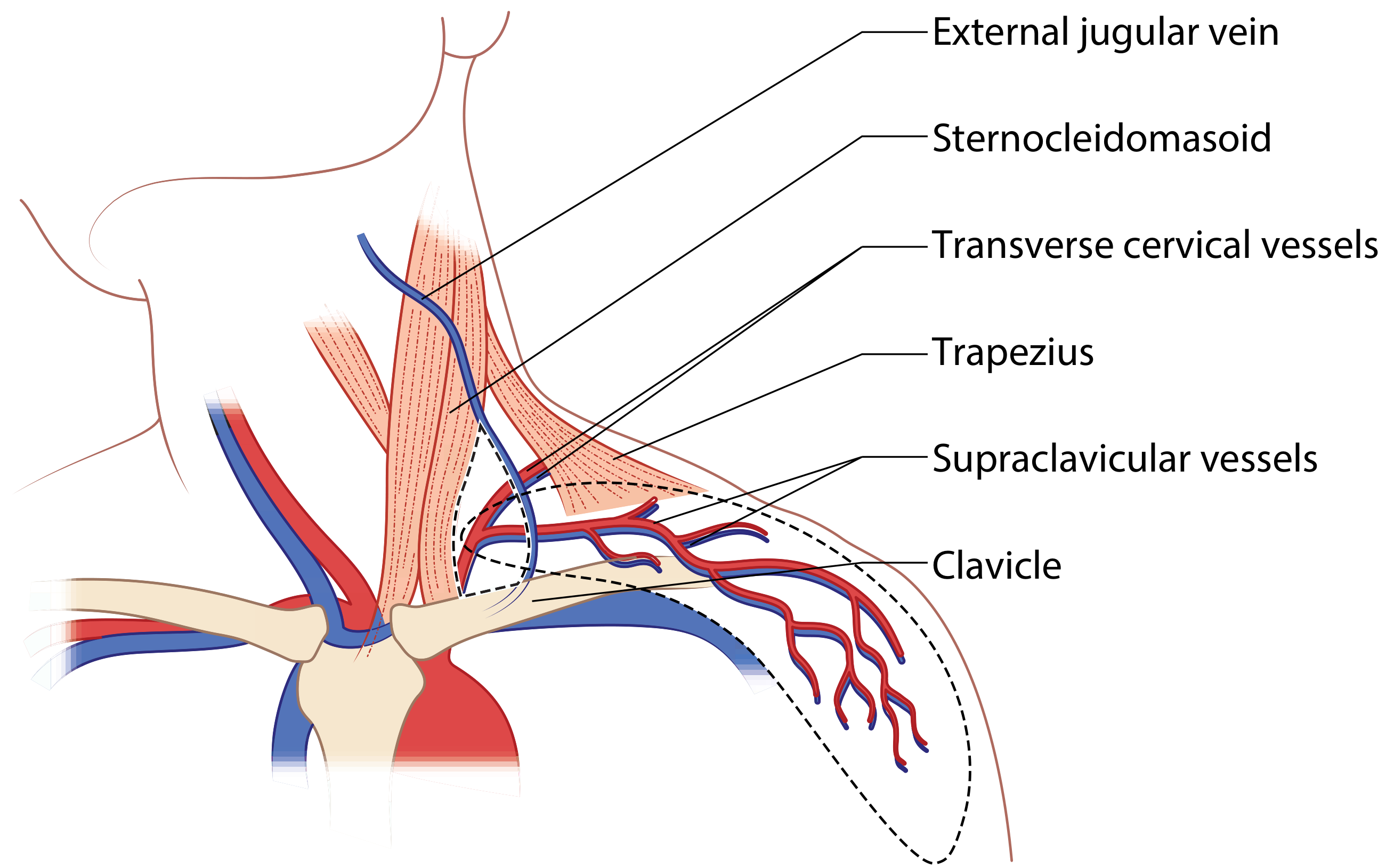
Uses: hypopharyngeal defects, cervical esophagus, neck skin cover after radical resection
Advantages: thin/pliable, same skin colour as H&N, single-stage, avoids microsurgery
(Scott-Brown's block 12, lines 4941-4975)
III. FREE FLAPS (MICROVASCULAR TISSUE TRANSFER)
Free flaps represent the standard of care for complex H&N reconstruction. Success rates exceed 95% at experienced centres.
FREE FLAP SELECTION FLOWCHART:

            COMPLEX H&N DEFECT REQUIRING FREE FLAP
                           │
       ┌───────────────────┼──────────────────┐
       ▼                   ▼                  ▼
  SOFT TISSUE           BONY DEFECT      VISCERAL TUBE
  DEFECT ONLY           (+/- soft tissue) (pharynx/esophagus)
       │                   │                  │
  ┌────┴────┐         ┌────┴────┐        ┌────┴────┐
  │  THIN   │         │MANDIBLE │        │Jejunum  │
  │→ RFFF   │         │→ Fibula │        │OR tubed │
  │  or     │         │  free   │        │RFFF/ALT │
  │Scapular │         │  flap   │        └─────────┘
  └────┬────┘         │MAXILLA  │
       │              │→ Fibula │
  ┌────┴────┐         │ Scapula │
  │  BULKY  │         │ Iliac   │
  │→ ALT or │         └─────────┘
  │  TRAM/  │
  │  DIEP   │
  └─────────┘
1. Radial Forearm Free Flap (RFFF / "Chinese Flap")
- Described by Yang et al. (1981)
- Based on radial artery + paired venae comitantes + cephalic vein
- Fasciocutaneous; thin and pliable
- Dimensions: up to 10 x 35 cm
- Allen test mandatory before harvest (confirm ulnar collateral adequacy)
- Donor site requires STSG for defects >4 cm
Advantages:
- Thin, pliable - ideal for mucosal lining
- Long pedicle (up to 20 cm)
- Reliable, consistent anatomy
- Can be made sensate (medial/lateral cutaneous nerve of forearm)
- Can be tubed for pharyngeal/cervical esophageal reconstruction
Disadvantages:
- Sacrifice of radial artery
- Donor site morbidity (cold intolerance, STSG cosmesis)
- Not suitable for large volumetric defects
Uses in H&N: tongue (most common), floor of mouth, buccal mucosa, soft palate, pharynx
2. Anterolateral Thigh Flap (ALT Flap)
- Described by Song et al. (1984)
- Based on descending branch of lateral circumflex femoral artery (LCFA)
- Perforators run through or between vastus lateralis and rectus femoris
- Can be raised as fasciocutaneous, myocutaneous (with vastus lateralis), or chimeric
- Dimensions: up to 25 x 15 cm
- Now the most commonly used free flap for H&N reconstruction worldwide
Advantages:
- Large, adjustable skin paddle
- Minimal donor morbidity (primary closure if <8 cm width)
- Can include fascia lata as sling, or include motor nerve to VL
- Chimeric options (multiple paddles, muscle component)
- Can be thinned for mucosal lining
- Simultaneous two-team surgery possible
Disadvantages:
- Variable perforator anatomy (5-10% may need to abandon ALT)
- Thick in obese patients (may need thinning/defatting)
Uses: large pharyngeal/hypopharyngeal defects, total glossectomy, base of tongue, massive skin defects, facial/scalp resurfacing; can be tubed for pharyngeal reconstruction
3. Fibula Free Flap (Osteocutaneous Fibula)
- Described by Hidalgo (1989)
- Based on peroneal artery (septocutaneous or musculocutaneous perforators to skin paddle)
- Provides up to 25 cm of bicortical bone (most donatable bone in the body)
- Gold standard for mandibular reconstruction (Cummings, block 16; Molteni et al. 2023 systematic review [PMID 37269408])
- Preoperative CTA or Duplex to confirm 3-vessel flow and perforator location
- Multiple osteotomies possible (periosteum preserved between cuts)
- Adequate bone stock for dental implants
(From Cummings Otolaryngology H&N Surgery, Chapter 78 - Osteocutaneous fibula free flap):
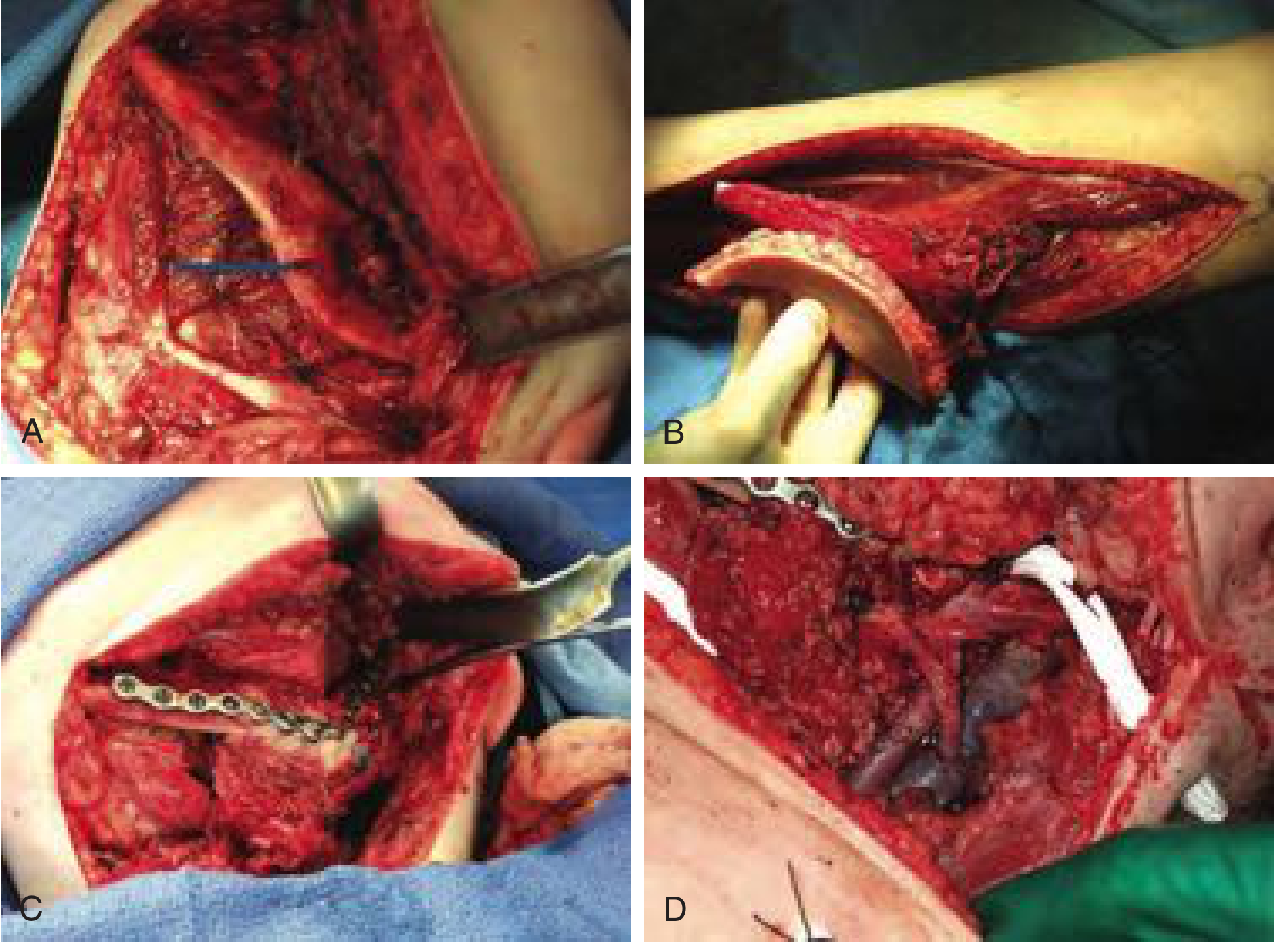
Uses: mandibular reconstruction (primary), maxillary reconstruction, skull base
Disadvantages: variable skin paddle, limited soft tissue bulk, prolonged ambulation difficulty postop
4. Rectus Abdominis Free Flap (TRAM / DIEP)
- TRAM: Transverse Rectus Abdominis Myocutaneous - based on deep inferior epigastric artery
- DIEP: pure perforator flap (skin + fat only, muscle spared) - less donor morbidity
- Large skin paddle with substantial soft tissue volume
- Uses in H&N: total glossectomy, skull base, massive scalp reconstruction, laryngectomy defects
- Disadvantage: bulky; abdominal hernia risk with TRAM; longer OR time
5. Jejunal Free Flap
- Segment of jejunum on superior mesenteric vessels
- Used for circumferential pharyngeal/esophageal reconstruction
- Provides mucosa-lined tube resembling native esophagus
- Requires laparotomy (bowel harvest + intestinal anastomosis)
- Being increasingly replaced by tubed RFFF or tubed ALT in experienced centres
- Disadvantages: laparotomy morbidity; "wet" pharyngeal voice; poor radiation tolerance; monitoring difficult
6. Scapular / Parascapular Free Flap
- Based on circumflex scapular artery (branch of subscapular system)
- Thin fasciocutaneous; skin paddle up to 14 x 10 cm
- Can be combined as chimeric subscapular system flap (with LD muscle and/or scapular bone)
- Uses: oral cavity, neck skin, scalp, composite midface
- Recent meta-analysis (McGregor et al. 2024, [PMID 39045822]): acceptable donor site morbidity, but shoulder abduction and flexion limited; physiotherapy is essential postoperatively
7. Temporoparietal Fascia (TPF) Flap
- Based on superficial temporal artery and vein
- Can be used as regional pedicled or free flap
- Thin vascularized fascial sheet (2-3 mm) - excellent for covering cartilage frameworks
- Uses: auricular reconstruction, tracheal reconstruction, orbital reconstruction, facial contouring
- Systematic review (Horen et al. 2021, [PMID 34387574]): highly reliable for complex 3D defects
IV. FLAP PHYSIOLOGY AND SURVIVAL
(Cummings Otolaryngology H&N Surgery, Chapter 77)
Zones of Perfusion (Johnson & Barker):
| Zone | Components | Clinical Relevance |
|---|---|---|
| Zone I | Macrovascular (arteries, veins, neural control) | Flap delay phenomenon occurs here |
| Zone II | Capillary microcirculation (arterioles, venules) | "No-reflow phenomenon" |
| Zone III | Interstitial space | Nutrient diffusion/convection |
| Zone IV | Cellular level | Ischemia-reperfusion injury |
Flap Delay Phenomenon:
- Preliminary surgery 2-3 weeks before definitive transfer
- Causes adrenergic desensitization → choke vessel vasodilation
- Converts random zones to axial pattern → increases survival 30-40%
Causes and Management of Flap Failure:
| Cause | Sign | Management |
|---|---|---|
| Arterial thrombosis | Pale, cool, no Doppler signal | Urgent re-exploration (<6 hrs) |
| Venous congestion | Dusky, swollen, brisker cap refill | Leech therapy, heparin |
| Vasospasm | Pale, intermittent Doppler | Papaverine, warming |
| Haematoma | Tense swelling | Surgical evacuation |
| Infection | Cellulitis, discharge | Debridement, antibiotics |
| Pedicle kinking/tension | Variable | Re-inset, release compression |
V. FREE FLAP MONITORING
(Cummings Otolaryngology H&N Surgery)
| Method | Principle | Advantage |
|---|---|---|
| Clinical (hourly) | Colour, turgor, capillary refill, temperature | Free, always available |
| Handheld Doppler | Perforator signal in skin paddle | Simple bedside tool |
| Implantable Doppler (Cook-Swartz) | Continuous pedicle monitoring | Gold standard for buried flaps |
| Near-infrared spectroscopy (NIRS) | Tissue oxygen saturation | Non-invasive, continuous |
| Fluorescein/ICG angiography | Perfusion mapping intraoperatively | Real-time perfusion assessment |
VI. COMPREHENSIVE NAMED FLAP SUMMARY TABLE
| Flap | Blood Supply | Type | Primary H&N Indication |
|---|---|---|---|
| Paramedian forehead | Supratrochlear a. | Axial local | Nasal reconstruction |
| Nasolabial | Angular/facial a. | Axial local | Alar, floor of mouth |
| Glabellar | Angular a. | Axial local | Nasal root/upper bridge |
| Rhomboid (Limberg) | Random subdermal | Random local | Cheek, temple, scalp |
| Bilobed (Zitelli) | Random subdermal | Random local | Nasal tip and ala |
| Cervicofacial rotation | Facial perforators | Random/axial | Cheek, lower eyelid |
| Deltopectoral (Bakamjian 1965) | Int. mammary perforators 2-4 | Axial fasciocutaneous | Pharynx, neck skin |
| PMMC (Ariyan 1979) | Thoracoacromial pectoral br. | Myocutaneous | Oral cavity, pharynx, neck |
| SCM myocutaneous | Occipital / sup. thyroid a. | Myocutaneous | Parotid cover, hypopharynx |
| Trapezius | Transverse cervical / occipital | Myocutaneous | Skull base, posterior neck |
| Latissimus dorsi | Thoracodorsal a. | Myocutaneous | Scalp, posterior neck |
| Temporalis | Deep temporal a. | Musculofascial | Orbit, palate, midface |
| SAI flap (Lamberty 1979) | Transverse cervical branch | Fasciocutaneous | Hypopharynx, neck skin |
| RFFF (Yang 1981) | Radial artery | Fasciocutaneous free | Tongue, floor of mouth |
| ALT (Song 1984) | LCFA descending branch | Fasciocutaneous free | Pharynx, oral cavity, skin |
| Fibula (Hidalgo 1989) | Peroneal artery | Osseocutaneous free | Mandible, maxilla |
| Jejunum | Superior mesenteric a. | Visceral free | Pharynx, cervical esophagus |
| TRAM/DIEP | Deep inf. epigastric a. | Myocutaneous/perforator free | Total glossectomy, skull base |
| Scapular | Circumflex scapular a. | Fasciocutaneous free | Oral cavity, neck skin |
| TPF | Superficial temporal a. | Fascial (free/pedicled) | Ear, orbit, trachea |
VII. RECENT ADVANCES
-
Perforator Flaps - Pure fasciocutaneous flaps (DIEP, ALT, PAP) that spare underlying muscle; reduce donor site functional morbidity significantly compared to myocutaneous flaps.
-
Chimeric / Conjoined Free Flaps - Multiple tissue components harvested on a single vascular axis (e.g., subscapular system: scapula bone + LD muscle + parascapular skin) for complex composite 3D defects in a single-stage free flap.
-
Virtual Surgical Planning (VSP) + CAD/CAM Cutting Guides - Computer-planned osteotomies with pre-bent titanium plates and cutting guides for fibula mandibular reconstruction; now standard of care at major centres; improves symmetry and accuracy.
-
Pre-fabricated and Pre-laminated Flaps - Cartilage or bone frameworks implanted at donor site weeks before transfer; used for total nasal and auricular reconstruction.
-
Supermicrosurgery - Anastomosis of vessels <0.8 mm; enables perforator-to-perforator anastomoses; valuable in irradiated fields with limited conventional recipient vessels.
-
Robotic / Video-assisted Flap Harvest - Minimally invasive latissimus dorsi harvest; smaller scars, faster recovery.
-
Impact of Adjuvant Radiotherapy on Free Flaps - Meta-analysis (Pfister et al. 2024, [PMID 38401274]): adjuvant radiochemotherapy causes significant free flap volume reduction over time; counselling needed regarding long-term functional outcomes.
-
Mandibular Reconstruction - Systematic review (Molteni et al. 2023, [PMID 37269408]): fibula free flap confirmed gold standard; scapula preferred for composite midface; VSP improves outcomes.
-
Scapula Free Flap Morbidity - Meta-analysis (McGregor et al. 2024, [PMID 39045822]): scapular donor site shoulder abduction and flexion limitations; early physiotherapy is mandatory.
-
Postoperative ICU vs. Non-ICU Care for Free Flaps - Meta-analysis (Mashrah et al. 2022, [PMID 34992114]): non-ICU monitored settings with dedicated nursing protocols show comparable flap survival to ICU; enables resource optimization.
COMPLETE SUMMARY FLOWCHART
╔══════════════════════════════════════════════════════════════════╗
║                   CLASSIFICATION OF FLAPS                        ║
╠══════════════════════════════════════════════════════════════════╣
║                           │                                      ║
║    ┌──────────────────────┼──────────────────────┐              ║
║    ▼                      ▼                      ▼              ║
║ BY BLOOD            BY TISSUE TYPE          BY MOVEMENT         ║
║ SUPPLY              ────────────────        ────────────        ║
║ ─────────           Cutaneous               Advancement         ║
║ Random pattern      Fasciocutaneous         Rotation            ║
║ Axial pattern       Myocutaneous            Transposition       ║
║                     Osseocutaneous          Interpolation       ║
║                     Visceral                                     ║
║                     Chimeric/Composite                          ║
║                                                                  ║
║         ┌────────────────┼───────────────────┐                 ║
║         ▼                ▼                   ▼                 ║
║     LOCAL FLAPS    REGIONAL FLAPS       FREE FLAPS             ║
║     ──────────     ──────────────       ──────────             ║
║   Advancement      Deltopectoral        RFFF                   ║
║   Rotation         PMMC                 ALT                    ║
║   Transposition    SCM                  Fibula                 ║
║   Interpolation    Trapezius            Jejunum                ║
║   Forehead         Latissimus dorsi     TRAM/DIEP              ║
║   Nasolabial       Temporalis           Scapular               ║
║   Rhomboid         SAI flap             TPF                    ║
║   Bilobed                                                       ║
╚══════════════════════════════════════════════════════════════════╝
REFERENCES
- Scott-Brown's Otorhinolaryngology Head & Neck Surgery (8th Ed, Gleeson) - Chapters 85, 91, 92: Local flaps, nasal reconstruction, supraclavicular flap
- Cummings Otolaryngology Head and Neck Surgery (7th Ed, Flint) - Chapters 77-78: Skin flap physiology, free tissue transfer, osteocutaneous flaps
- Ariyan S. The pectoralis major myocutaneous flap. Plast Reconstr Surg 1979; 63:73-81
- Bakamjian VY. A two-stage method for pharyngoesophageal reconstruction. Plast Reconstr Surg 1965; 36:173
- Hidalgo DA. Fibula free flap: a new method of mandible reconstruction. Plast Reconstr Surg 1989; 84:71-79
- Song YG et al. The free thigh flap: a new free flap concept based on the septocutaneous artery. Br J Plast Surg 1984
- Mathes SJ, Nahai F. Classification of the vascular anatomy of muscles. Plast Reconstr Surg 1981; 67:177-187
- Molteni G et al. Mandibular reconstruction in HNC: which is the gold standard? Eur Arch Otorhinolaryngol 2023 (PMID 37269408)
- Pfister P et al. Impact of adjuvant radiochemotherapy on free flap volume in H&N reconstruction. J Plast Reconstr Aesthet Surg 2024 (PMID 38401274)
- McGregor S et al. Donor site morbidity after scapula free flap in H&N reconstruction. Head Neck 2024 (PMID 39045822)
- Mashrah MA et al. Postoperative care after head and neck free-flap surgery. BMJ Open 2022 (PMID 34992114)
- Horen SR et al. Temporoparietal Fascial Free Flap: A Systematic Review. Ann Plast Surg 2021 (PMID 34387574)
- Dhingra PL & Dhingra S - Diseases of ENT Head and Neck Surgery (6th Ed)
- Hazarika P - Textbook of ENT and Head & Neck Surgery (clinical integration)
RGUHS Exam Tip: This is a standard 50-mark question. Cover all four main sections: Classification (10 marks) → Local flaps with diagrams (10 marks) → Regional pedicled flaps - PMMC and DP in particular detail (15 marks) → Free flaps - RFFF, ALT, Fibula (10 marks) → Flap failure + monitoring + recent advances (5 marks). The Reconstructive Ladder, classification flowchart, PMMC anatomy diagram, and bilobed flap diagram are mandatory for full marks.
This is a shared conversation. Sign in to Orris to start your own chat.