
Hello
Im USMLE step 1 aspirant and looking forward to use this platform for my preparation
What I Can Do For You
How to Get Started
- "Explain the urea cycle and its enzyme deficiencies"
- "What are the key features of Type I vs Type II hypersensitivity?"
- "Walk me through the coagulation cascade"
- "Show me histology of different types of glomerulonephritis"
I'm currently doing renal system
Which area of Renal are you working on right now? · How would you like to study?
🫘 Renal System — Step 1 High-Yield Map
| # | Topic | Key Concepts |
|---|---|---|
| 1 | Renal Physiology | GFR, filtration, tubular reabsorption/secretion, starling forces, autoregulation |
| 2 | Fluid Compartments | ICF vs ECF, osmolarity, tonicity calculations |
| 3 | Acid-Base Disorders | Metabolic vs respiratory, compensation rules, anion gap |
| 4 | Electrolytes | Na⁺, K⁺, Ca²⁺, Mg²⁺, phosphate disorders |
| 5 | Glomerulopathies | Nephritic vs nephrotic syndrome, specific diseases, LM/EM/IF findings |
| 6 | Tubular Disorders | RTA types, Fanconi syndrome, Bartter, Gitelman |
| 7 | AKI & CKD | Pre/intra/post-renal, FENA, urinalysis findings |
| 8 | Renal Tumors | RCC, Wilms tumor, transitional cell carcinoma |
| 9 | Diuretics | Site of action, mechanism, side effects, clinical uses |
| 10 | Renal Pharmacology | ACEi, ARBs, contrast nephropathy, NSAIDs on kidney |
So can you make a diagram of diuretics and all the info which is tested
A comprehensive medical education diagram titled "DIURETICS — USMLE Step 1 High-Yield" showing the nephron tubule from top to bottom with labeled segments. Each diuretic class is shown acting on its specific nephron site with color-coded boxes containing: drug names, mechanism of action, key electrolyte effects, major side effects, and clinical uses. Include: 1) Proximal Convoluted Tubule — Carbonic Anhydrase Inhibitors (Acetazolamide): blocks HCO3 reabsorption, causes metabolic acidosis, used for glaucoma/altitude sickness/pseudotumor cerebri. 2) Loop of Henle (Thick Ascending Limb) — Loop Diuretics (Furosemide, Bumetanide, Torsemide, Ethacrynic acid): block Na-K-2Cl transporter, most potent, cause hypokalemia/hypomagnesemia/hypocalcemia/ototoxicity/hyperuricemia, used for edema/CHF/hypercalcemia. 3) Distal Convoluted Tubule — Thiazides (Hydrochlorothiazide, Chlorthalidone): block NaCl cotransporter, cause hypokalemia/hyperuricemia/hyperglycemia/hypercalcemia/hyperlipidemia, used for HTN/nephrogenic DI/osteoporosis. 4) Collecting Duct — Potassium-Sparing Diuretics split into two: ENaC blockers (Amiloride, Triamterene) and Aldosterone antagonists (Spironolactone, Eplerenone): both cause hyperkalemia/metabolic acidosis; Spironolactone also causes gynecomastia; used for hyperaldosteronism/heart failure. 5) Osmotic Diuretics (Mannitol): act throughout nephron, increase osmolarity, used for cerebral edema/acute glaucoma, cause pulmonary edema. Use clean clinical style with color-coded sections per diuretic class, arrows pointing to nephron sites, and a mnemonic box at the bottom: "OH DANG — Osmotic, hctz, loop Diuretics Act on Nephron Gradient"
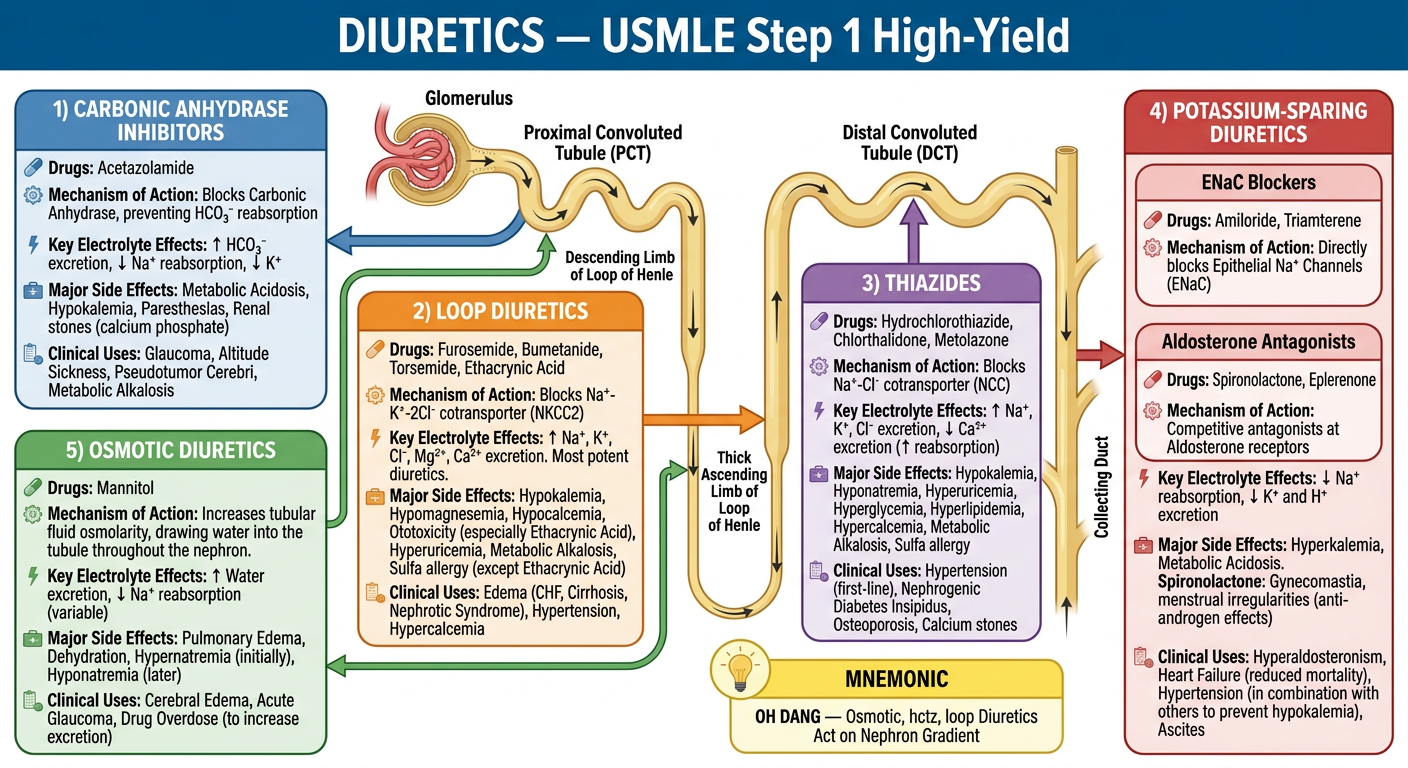
Diuretics — USMLE Step 1 Master Summary
1. Carbonic Anhydrase Inhibitors
| Feature | Detail |
|---|---|
| Drug | Acetazolamide |
| Site | Proximal convoluted tubule |
| Mechanism | Inhibits CA → ↓ HCO₃⁻ reabsorption → NaHCO₃ diuresis |
| Side Effects | Metabolic acidosis, hypokalemia, sulfa allergy |
| Uses | Glaucoma, altitude sickness, pseudotumor cerebri, alkalinize urine |
2. Loop Diuretics ⭐ (Most Potent)
| Feature | Detail |
|---|---|
| Drugs | Furosemide, Bumetanide, Torsemide, Ethacrynic acid |
| Site | Thick ascending limb of Loop of Henle |
| Mechanism | Block Na⁺-K⁺-2Cl⁻ cotransporter (NKCC2) |
| Electrolyte effects | ↓K⁺, ↓Mg²⁺, ↓Ca²⁺, ↓Na⁺ |
| Side Effects | Ototoxicity (esp. ethacrynic acid), hyperuricemia, hypovolemia, metabolic alkalosis |
| Uses | Acute pulmonary edema, CHF, hypercalcemia, hypertensive emergency |
| Mnemonic | "Loops Lose Calcium" |
3. Thiazide Diuretics
| Feature | Detail |
|---|---|
| Drugs | Hydrochlorothiazide (HCTZ), Chlorthalidone |
| Site | Distal convoluted tubule |
| Mechanism | Block NaCl cotransporter (NCC) |
| Electrolyte effects | ↓K⁺, ↓Na⁺, ↑Ca²⁺ (retain calcium) |
| Side Effects | Hypokalemia, hyperglycemia, hyperlipidemia, hyperuricemia, hyponatremia |
| Uses | HTN, nephrogenic DI, osteoporosis, hypercalciuria |
| Mnemonic | "Thiazides — Calcium stays" |
4. Potassium-Sparing Diuretics
| Feature | Amiloride / Triamterene | Spironolactone / Eplerenone |
|---|---|---|
| Mechanism | Block ENaC (epithelial Na channel) | Aldosterone receptor antagonist |
| Site | Collecting duct | Collecting duct |
| Side Effects | Hyperkalemia, metabolic acidosis | Hyperkalemia + gynecomastia (spiro only) |
| Uses | Combine with loop/thiazide to prevent K⁺ loss | Hyperaldosteronism, heart failure, cirrhosis with ascites |
5. Osmotic Diuretics
| Feature | Detail |
|---|---|
| Drug | Mannitol |
| Site | Proximal tubule + Loop of Henle |
| Mechanism | Increases tubular osmolarity → ↓ water reabsorption |
| Side Effects | Pulmonary edema, hypernatremia (initial), hyponatremia (later) |
| Uses | Cerebral edema, acute angle-closure glaucoma, reduce ICP |
Quick Electrolyte Memory Table
| Diuretic | K⁺ | Ca²⁺ | Uric Acid |
|---|---|---|---|
| Loop | ↓↓ | ↓ | ↑ |
| Thiazide | ↓ | ↑ | ↑ |
| K-sparing | ↑ | — | — |
| Acetazolamide | ↓ | — | — |
Classic Step 1 Associations
- Ototoxicity → Loop (especially ethacrynic acid, safe in sulfa allergy)
- Gynecomastia → Spironolactone
- Nephrogenic DI → Thiazides (paradoxical)
- Gout flare → Loop or Thiazide (both raise uric acid)
- Hypercalcemia treatment → Loop diuretics
- Hypercalciuria/stones → Thiazides (prevent)