
TIBolone ?
Reading File
Tibolone is a synthetic steroid used as hormone replacement therapy (HRT) in postmenopausal women. It has weak estrogenic, progestogenic, and androgenic activity - essentially acting as a "tissue-selective" compound. It is used for vasomotor symptoms, prevention of osteoporosis, and may improve mood and libido.
Searching sources...
Finding Sources
Searching PubMed
tibolone hormone replacement therapy
Reading File
Finding Sources
Reading File
Searching the Web
tibolone pharmacology uses clinical indications risks 2024
Here is a thorough overview of Tibolone:
Tibolone
What It Is
Tibolone (brand names: Livial, Tibella, Xyvion) is a synthetic steroidal compound used as hormone therapy in postmenopausal women. It is structurally related to norethynodrel (a steroidal progestin). Tibolone itself is a prodrug - it has no pharmacologic activity until it is converted in the body to three active metabolites.
It is approved in approximately 90 countries but is not available in the United States.
Mechanism of Action (Pharmacodynamics)
Tibolone is converted to three active metabolites in the body:
- 3α-hydroxy-tibolone - estrogenic activity
- 3β-hydroxy-tibolone - estrogenic activity
- Δ4-isomer - progestogenic and androgenic activity
Because these metabolites behave differently across tissues, tibolone is termed a "Selective Tissue Estrogenic Activity Regulator" (STEAR) or "Selective Estrogen Enzyme Modulator" (SEEM). It acts like an estrogen in some tissues (bone, brain, vagina) and like a progestogen/androgen in others (breast, endometrium - theoretically).
Indications / Uses
| Indication | Notes |
|---|---|
| Vasomotor symptoms (hot flashes, night sweats) | As effective as conventional HRT |
| Urogenital/vaginal atrophy | Improves vaginal dryness, dyspareunia |
| Osteoporosis prevention | Reduces fracture risk (SOR: A) |
| Libido / sexual function | Improves sexual desire and arousal in postmenopausal women; superior to conventional HRT in some trials |
| Mood enhancement | May help mood/well-being |
| Add-back therapy with GnRH agonists | Used with goserelin in endometriosis treatment to counteract hypoestrogenic side effects |
| Iatrogenic menopause (e.g., surgical) | ESHRE recommends tibolone or combined E/P as HRT option |
Dose: Typically 2.5 mg orally once daily
Advantages Over Conventional HRT
- Less vaginal bleeding/spotting than estrogen-progestogen combinations - studies show 12% spotting with tibolone vs. 51% with E2/NETA combinations
- Does not require a separate progestogen (it has built-in progestogenic activity)
- Reduces total cholesterol (~9.3%)
- Improves sexual parameters including desire, arousal, and fantasy
Risks and Safety Profile
| Risk | Evidence |
|---|---|
| Stroke (increased) | LIFT trial (Cummings 2008, SOR: A); 2024 Swedish nationwide trial (n=919,614): HR 1.52 (95% CI 1.11-2.08); Large Korean cohort (n=1,120,705): HR 1.17 |
| Endometrial cancer | Most studies show increased risk; tibolone increases endometrial wall thickness |
| Breast cancer | Conflicting data - LIFT trial showed reduced risk, but product monographs warn of increased risk |
| HDL cholesterol decrease | Drops HDL by ~21.7% (unlike conventional HRT which raises HDL) - worsens cardiovascular lipid profile |
| Cardiovascular disease | Recent 2024 data suggests increased CVD risk, especially in women in their 50s |
Important 2024 update: New large prospective data from Sweden and Korea consistently show tibolone is associated with increased cardiovascular and stroke risk, particularly in younger postmenopausal women. Clinicians should exercise caution and individualize prescribing - (see Journal of Menopausal Medicine 2025).
Contraindications
- Known or suspected hormone-sensitive cancers
- Undiagnosed vaginal bleeding
- History of thromboembolic disease or stroke
- Severe liver disease
- Pregnancy / breastfeeding
Key Comparisons
| Feature | Tibolone | Conventional HRT (E+P) |
|---|---|---|
| Vasomotor symptom relief | Equivalent | Equivalent |
| Vaginal bleeding | Significantly less | More |
| Libido | Better | Less benefit |
| HDL cholesterol | Decreases | Increases |
| Stroke risk | Increased | Variable |
| Breast cancer risk | Possibly lower (conflicting) | Increased |
| Endometrial cancer | Increased | Progestogen protects |
Summary
Tibolone occupies a unique niche in menopausal hormone therapy due to its tissue-selective, multi-hormone-like profile. It is particularly valued for improving libido and reducing bleeding compared to standard HRT. However, the stroke and cardiovascular risk - reinforced by large 2024 registry data - means it should be prescribed cautiously, with individual risk-benefit assessment, especially in women with pre-existing cardiovascular risk factors.
- Textbook of Family Medicine 9e, p. 1050
- Campbell-Walsh-Wein Urology, p. 2192
- Berek & Novak's Gynecology
Melkerson Rosenthal syndrome ?
Melkersson-Rosenthal syndrome (MRS) is a rare neurological disorder characterized by the classic triad of recurrent facial palsy, recurring facial/lip swelling (orofacial granulomatosis), and fissured (plicated/scrotal) tongue. It is a granulomatous condition of unknown etiology.
Searching sources...
Finding Sources
Searching PubMed
Melkersson-Rosenthal syndrome
Reading File
Reading File
Reading File
Reading File
Loading Image
Loading Image
Here is a comprehensive overview of Melkersson-Rosenthal Syndrome (MRS):
Melkersson-Rosenthal Syndrome
Definition & History
First described by Melkersson in 1928 and further characterized by Rosenthal in 1930, MRS is a rare neurocutaneous/granulomatous disorder presenting with a classic triad. The cause is unknown.
Classic Triad
| Feature | Details |
|---|---|
| 1. Recurring facial paralysis/paresis | Unilateral or bilateral; recurrent episodes |
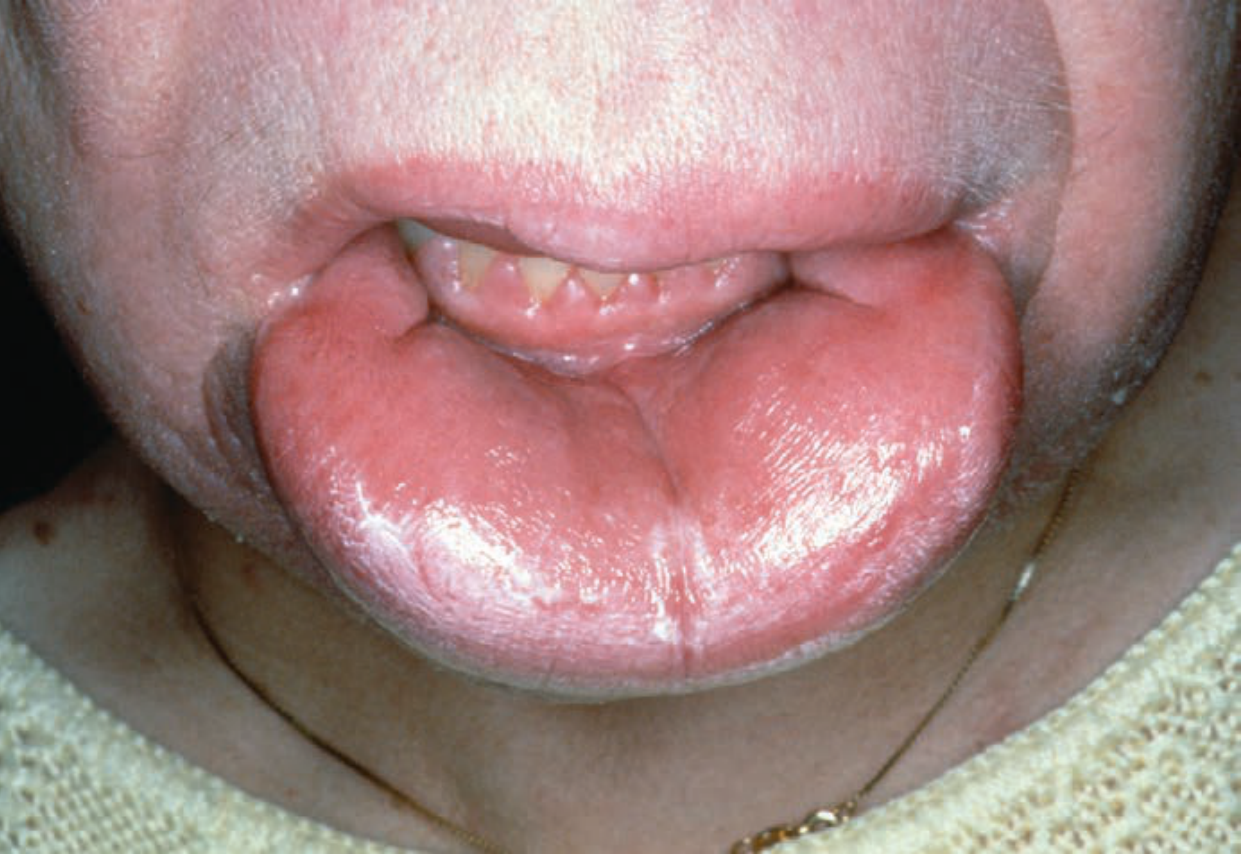
| 2. Orofacial edema | Soft, non-pitting swelling of lips, cheeks, and face |
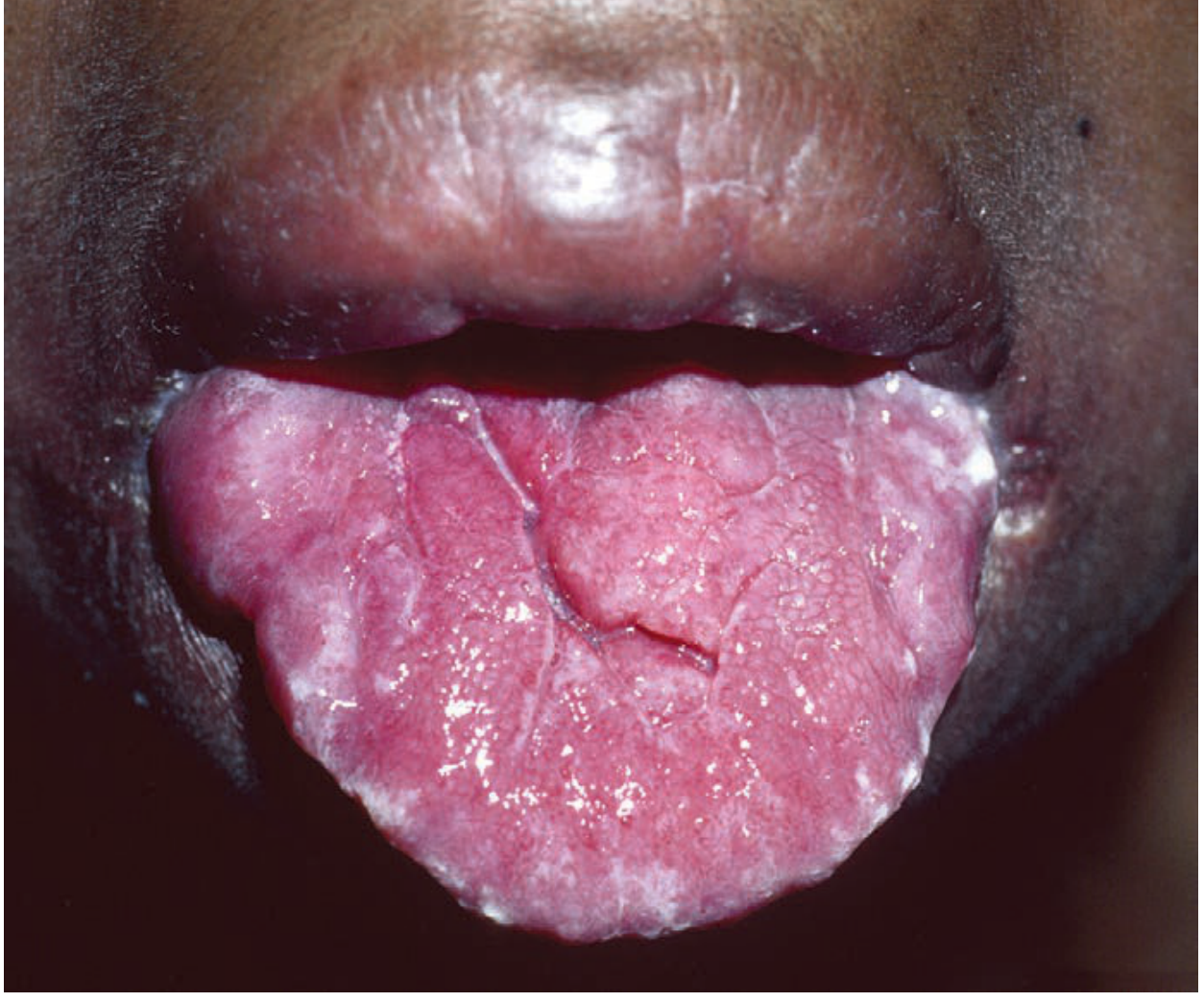
| 3. Scrotal (plicated/fissured) tongue | Lingua plicata - deep fissures on tongue dorsum |
The complete triad is actually uncommon - the syndrome is frequently seen in incomplete form. Orofacial swelling (especially lip swelling = cheilitis granulomatosa) is the most consistent and dominant finding.
Clinical Features
Onset: Early childhood to adolescence - predominantly in the second decade of life
Orofacial swelling (most important diagnostic feature):
- Sudden onset, recurrent, progressive
- Order of frequency: upper lip > lower lip > cheeks > circumoral tissues
- Ultimately becomes permanent due to overgrowth of connective tissue
- Chronic eyelid swelling may occur (isolated bilateral eyelid swelling is a rare presentation)
- Palatal mucosa also involved
Facial paralysis:
- Present in only ~20% of cases
- Recurring course
- Can be unilateral or alternating
Other features:
- Extrafacial swellings on dorsal hands, feet, lumbar region
- Pharyngeal/respiratory tract involvement (mucosal thickening)
- Associated with recurrent migraines
- Reported associations: megacolon, otosclerosis, craniopharyngioma (supporting a neurotrophic theory)
- May be familial
Clinical Images
Orofacial swelling with lip enlargement (MRS):
Fissured/scrotal tongue (lingua plicata):
Histopathology
- Tuberculoid-type (non-caseating) granulomas with epithelioid cells and Langerhans giant cells
- Lymphedema and banal perivascular infiltrate
- Lymphocytes, histiocytes, and plasma cells
- Intralymphatic granulomas - these may be responsible for the clinical swelling
Pathophysiology / Etiology
- Unknown etiology
- Associations with megacolon, otosclerosis, and craniopharyngioma suggest a neurotrophic origin
- May be familial in some cases
- Intralymphatic granulomas are thought to obstruct lymphatic drainage, causing the swelling
Relationship to Orofacial Granulomatosis (OFG)
MRS is classified under the broader group of orofacial granulomatosis (OFG):
- Cheilitis granulomatosa (Miescher's cheilitis) = isolated lip swelling without facial palsy or fissured tongue - considered a monosymptomatic form of MRS
- MRS = cheilitis granulomatosa + facial palsy + fissured tongue
- Cheilitis granulomatosa may be the first sign of Crohn disease or sarcoidosis developing later
Differential Diagnosis
| Condition | Distinguishing Features |
|---|---|
| Crohn disease / oral Crohn | Cobblestoning of mucosa; GI symptoms |
| Sarcoidosis | Systemic granulomas, elevated ACE |
| Angioedema | Rapid onset/resolution; allergic trigger |
| Cheilitis glandularis | Glandular hyperplasia of lips |
| Lymphangioma / hemangioma | Imaging differentiates |
| Ascher syndrome | Lip + eyelid swelling (blepharochalasis) + goiter |
| Bell's palsy | No orofacial swelling |
| Granulomatosis with polyangiitis | ANCA+, systemic vasculitis |
Treatment
Local:
- Intralesional corticosteroid injections - usually successful but temporary
Systemic (long-term control):
- Doxycycline
- Dapsone
- Colchicine
- Sulfasalazine
- Hydroxychloroquine
- Anti-TNF agents (for refractory cases)
- Topical tacrolimus ointment
Other:
- Clofazimine and thalidomide (limited by availability/side effects)
- Compression therapy - adjuvant, no significant side effects
- Surgical reduction of the lip (mucosal approach) - for established cases; best combined with intralesional steroids and oral medications
- Facial nerve decompression - for recurrent facial palsy (substantiated by preliminary reports)
- Antibiotic therapy - if odontogenic infection is triggering the condition
Key Points Summary
-
Rare, chronic relapsing granulomatous condition
-
Classic triad: facial palsy + orofacial edema + fissured tongue (complete triad is uncommon)
-
Onset in adolescence; orofacial swelling is the dominant feature
-
Histology: non-caseating granulomas + intralymphatic granulomas
-
Part of the "orofacial granulomatosis" spectrum
-
Treatment is largely symptomatic; combination therapy works best
-
Andrews' Diseases of the Skin, p. 920
-
Scott-Brown's Otorhinolaryngology Head & Neck Surgery Vol. 2
-
Andrews' Diseases of the Skin Clinical Atlas, 2e
This is a shared conversation. Sign in to Orris to start your own chat.