
Explain the class 1 of anti arrhythmic drug’s
I'll start by reading the medical library skill before answering this medical/pharmacology question.
Reading File
Now I'll search the medical library and web in parallel for Class 1 antiarrhythmic drugs.
Finding Sources
Searching the Web
Class 1 antiarrhythmic drugs mechanism subclasses 1a 1b 1c
The library has excellent content. Let me read the relevant blocks from Lippincott Pharmacology in parallel.
Reading File
Finding Sources
Good content found. Let me continue reading for Class IB and IC drugs, and also fetch the action potential diagram.
Reading File
Loading Image
Excellent! Now let me read the rest of the Class IB and IC sections and fetch the IB diagram.
Reading File
Loading Image
Now let me read the Class IC section and fetch its diagram.
Reading File
Reading File
I now have all the information needed for a complete, high-quality answer. Let me also fetch the Class IC diagram.
Loading Image
I now have all the content needed for a thorough, well-illustrated answer. Here it is:
Class I Antiarrhythmic Drugs (Na⁺ Channel Blockers)
Core Mechanism
Class I antiarrhythmic drugs block voltage-sensitive Na⁺ channels. They bind preferentially to open or inactivated channels rather than fully repolarized ones. This property is called "use-dependence" (or state-dependence) - they exert greater blockade in rapidly depolarizing tissues, allowing them to suppress abnormally firing cells without interfering with the normal heartbeat.
Their use has declined significantly due to proarrhythmic effects, especially in patients with reduced left ventricular function or atherosclerotic heart disease.
Class I is divided into three subclasses based on their effect on the duration of the action potential:
Class IA - Quinidine, Procainamide, Disopyramide
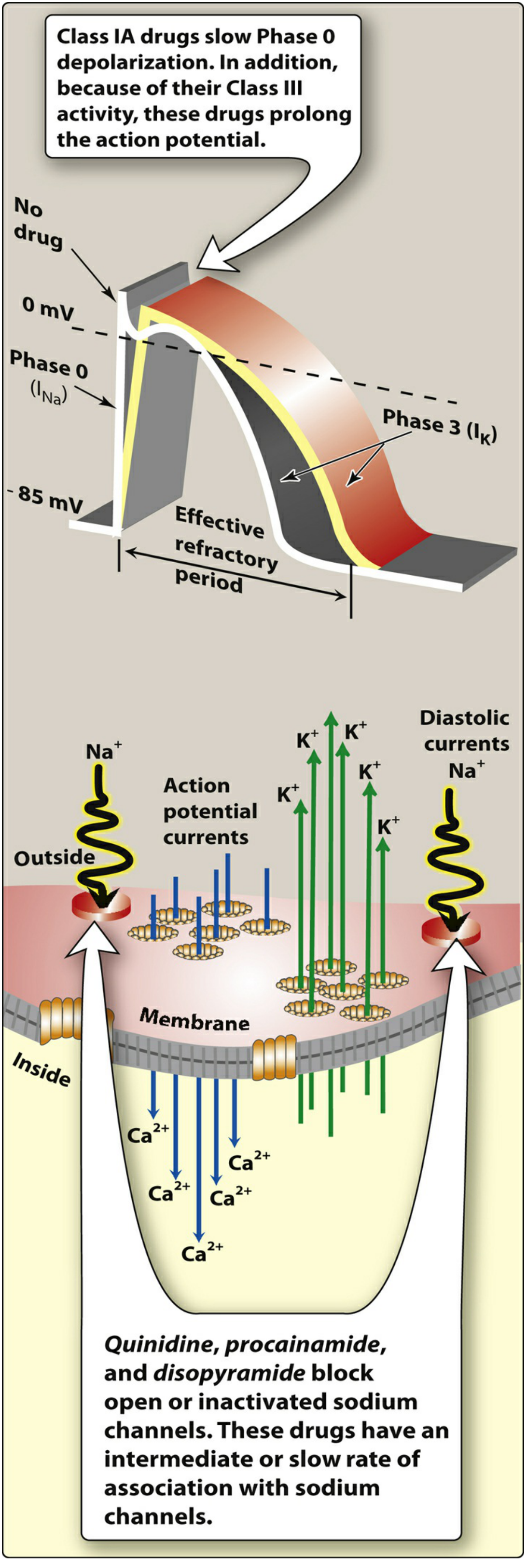
Mechanism
- Block open and inactivated Na⁺ channels - slow the Phase 0 upstroke
- Also inhibit K⁺ channels (giving them Class III activity as well) → prolong the action potential and effective refractory period (ERP)
- Block Ca²⁺ channels
- Decrease slope of Phase 4 spontaneous depolarization
- Net result: slowed conduction velocity + increased refractoriness
| Drug | Special Properties |
|---|---|
| Quinidine | Prototype; mild α-blocker + anticholinergic; CYP2D6 + P-gp inhibitor |
| Procainamide | Less anticholinergic; metabolized to NAPA (Class III activity); IV only now |
| Disopyramide | Most anticholinergic (dry mouth, urinary retention); greatest negative inotropy; peripheral vasoconstriction |
Therapeutic Uses
- Atrial, AV junctional, and ventricular tachyarrhythmias
- Procainamide: acute atrial/ventricular arrhythmias (IV)
- Disopyramide: alternative for ventricular arrhythmias; rhythm control in AF/atrial flutter
Key Adverse Effects
- Proarrhythmic - worsen heart failure, contraindicated with atherosclerotic heart disease
- Quinidine: cinchonism (tinnitus, blurred vision, headache, disorientation, psychosis); multiple drug interactions
- Procainamide: hypotension with IV use; NAPA accumulates in renal failure
- Disopyramide: strong anticholinergic effects (dry mouth, urinary retention, blurred vision, constipation)
Class IB - Lidocaine, Mexiletine
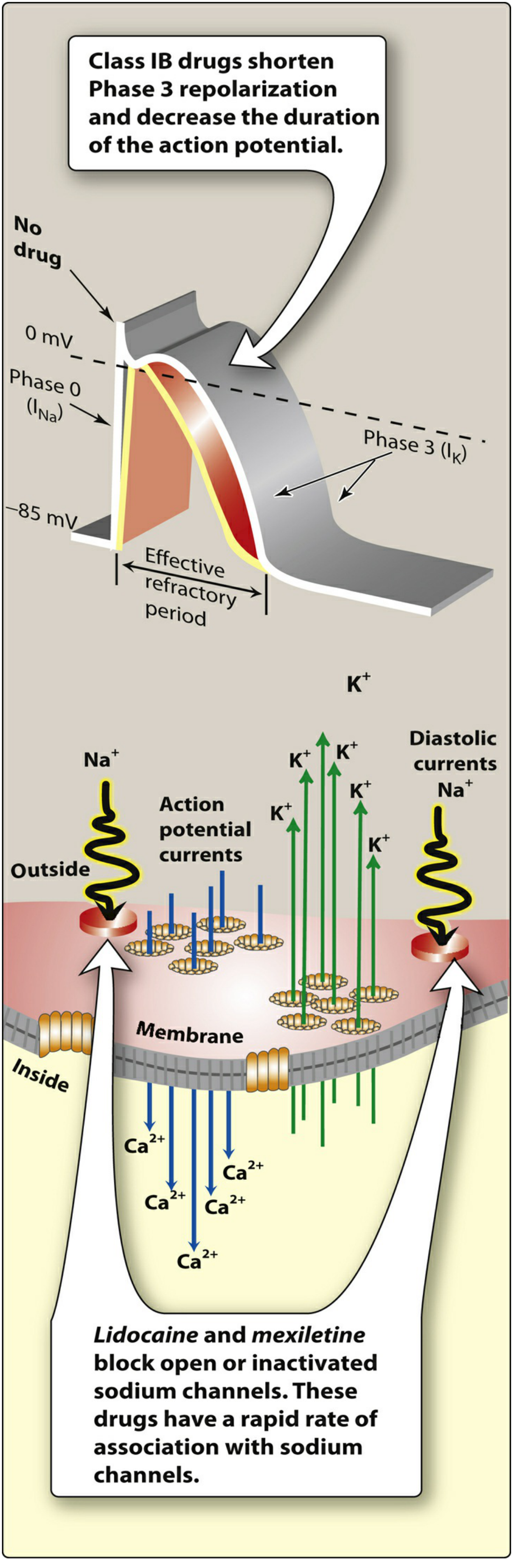
Mechanism
- Rapidly associate and dissociate from Na⁺ channels (fast kinetics)
- Greater effect when the cell is depolarized or firing rapidly
- Shorten Phase 3 repolarization → decrease action potential duration (APD)
- No negative inotropic effect
- Selective for ventricular tissue; minimal effect on atrial arrhythmias
Therapeutic Uses
- Lidocaine: alternative to amiodarone for ventricular fibrillation or ventricular tachycardia; used in "VT storm" combined with amiodarone
- Mexiletine: oral chronic treatment of ventricular arrhythmias, often combined with amiodarone
Pharmacokinetics
- Lidocaine: IV only (extensive first-pass hepatic metabolism); metabolized by CYP1A2/CYP3A4
- Mexiletine: oral; metabolized by CYP2D6; biliary excretion
Key Adverse Effects
- Lidocaine: CNS toxicity - nystagmus (early warning sign), drowsiness, slurred speech, paresthesia, convulsions
- Mexiletine: narrow therapeutic index; nausea, vomiting, dyspepsia; caution with CYP2D6 inhibitors
Class IC - Flecainide, Propafenone
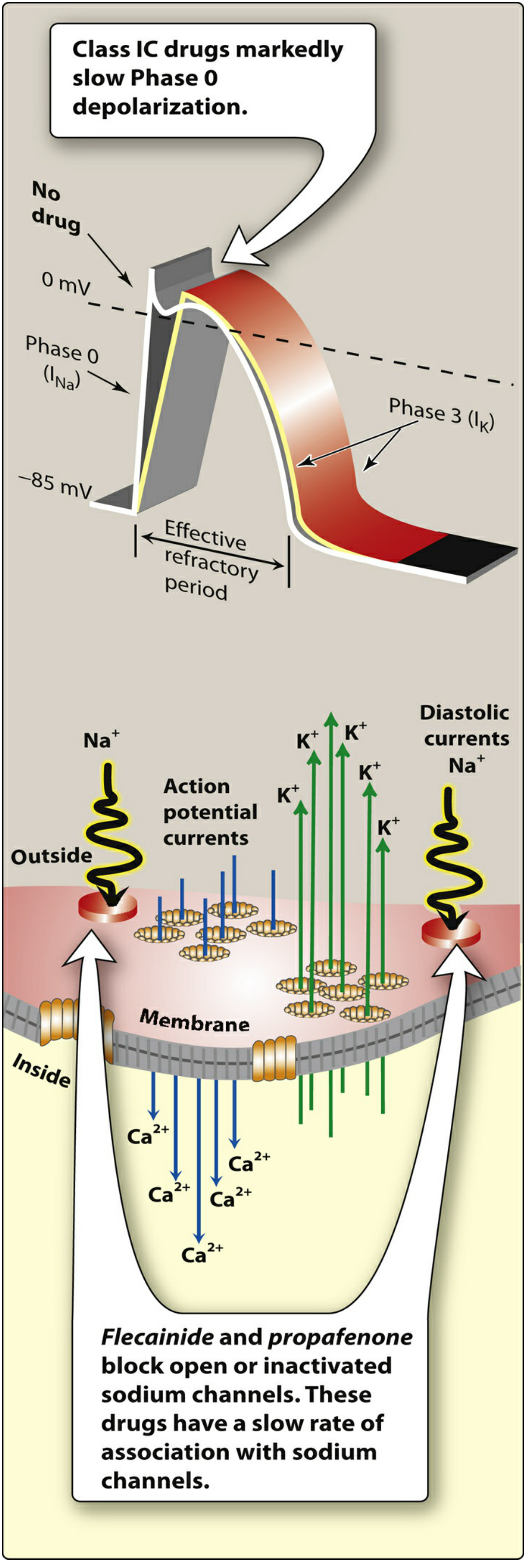
Mechanism
- Slowly dissociate from resting Na⁺ channels - prominent effects even at normal heart rates
- Most potent Na⁺ channel blockers - markedly slow Phase 0 (conduction in ALL cardiac tissues)
- Reduce automaticity by raising threshold potential (not by slowing Phase 4)
- Flecainide also blocks K⁺ channels → slightly prolongs APD
- Propafenone additionally has weak β-blocking properties; does NOT block K⁺ channels
Therapeutic Uses
- Flecainide: maintaining sinus rhythm in AF/atrial flutter (no structural heart disease); refractory ventricular arrhythmias
- Propafenone: rhythm control of AF/flutter; paroxysmal SVT prophylaxis in AV reentrant tachycardia
Key Adverse Effects
- Blurred vision, dizziness, nausea (both drugs)
- Propafenone: bronchospasm - avoid in asthma; P-gp inhibitor
- Both: avoided in structural heart disease (LVH, heart failure, atherosclerotic disease) due to negative inotropy and proarrhythmic risk
- Both metabolized by CYP2D6 - caution with CYP2D6 inhibitors
Comparison Summary Table
| Feature | Class IA | Class IB | Class IC |
|---|---|---|---|
| Drugs | Quinidine, Procainamide, Disopyramide | Lidocaine, Mexiletine | Flecainide, Propafenone |
| Na⁺ channel kinetics | Intermediate | Fast (rapid on/off) | Slow (slow on/off) |
| Action potential duration | Prolonged (↑ ERP) | Shortened (↓ APD) | Minimal change |
| Phase 0 slowing | Moderate | Minimal | Most marked |
| Also blocks | K⁺, Ca²⁺ channels | - | K⁺ (flecainide only) |
| Main arrhythmia target | Atrial + ventricular | Ventricular only | Atrial (mainly) |
| Route | Oral/IV | IV (lido), Oral (mex) | Oral |
| Structural heart disease | Avoid | Lidocaine relatively safer | Strictly avoid |
Source: Lippincott Illustrated Reviews: Pharmacology, pp. 390-398
Why class 1 A produce moderate delay and 1C produce max delay in QT
This is actually a common misconception worth clarifying directly. Class IA prolongs the QT interval, while Class IC primarily widens the QRS (not QT). Let me search the library to give you a precise, textbook-backed explanation.
Searching sources...
Finding Sources
Finding Sources
Finding Sources
Finding Sources
Reading File
Finding Sources
Finding Sources
Reading File
I now have everything needed. This Harrison's passage is the key to the entire explanation. Here is the complete, corrected answer:
Correcting the Premise: Class IA vs IC Effects on the ECG
Your question contains a common misconception taught in some simplified summaries. The full picture is more nuanced:
- Class IA → prolongs the QT interval (moderate)
- Class IC → widens the QRS complex (maximally) - NOT the QT
They affect different parts of the ECG because they target different phases of the action potential.
The Key Principle: Action Potential Phases Map to ECG Intervals
From Harrison's Principles of Internal Medicine (22e):
"Factors that decrease the slope of Phase 0 by impairing the influx of Na⁺ (e.g., drugs such as flecainide) tend to increase QRS duration. Factors that prolong Phase 2 or 3 (e.g., amiodarone, hypocalcemia) increase the QT interval."
This is the foundational rule that explains everything:
| Action Potential Phase | ECG Representation | What prolongs it |
|---|---|---|
| Phase 0 (rapid Na⁺ upstroke) | QRS complex | Na⁺ channel blockers (especially IC) |
| Phase 2 (plateau) | ST segment | Ca²⁺ channel effects |
| Phase 3 (repolarization) | T wave / QT interval | K⁺ channel blockade |
Why Class IA Prolongs the QT (Moderately)
Class IA drugs (quinidine, procainamide, disopyramide) do two things simultaneously:
- Block Na⁺ channels → slow Phase 0 → slightly widens QRS
- Also block K⁺ channels (this is their concomitant "Class III activity") → delay Phase 3 repolarization → prolongs the action potential duration (APD) → extends the QT interval
The QT prolongation from Class IA is moderate because:
- The Na⁺ channel block is intermediate in kinetics (neither too fast nor too slow)
- The K⁺ channel block is partial - it is a secondary/additional effect, not the primary one
- The two effects (Na⁺ block shortening APD slightly vs K⁺ block prolonging it) partially oppose each other
The result: QT prolongs enough to cause Torsades de Pointes (TdP) risk - quinidine syncope is a classic example - but the effect is not the most extreme among antiarrhythmics.
Why Class IC Causes Maximum QRS Widening (Not Maximum QT Prolongation)
Class IC drugs (flecainide, propafenone) are the most potent Na⁺ channel blockers. They:
- Slowly dissociate from resting Na⁺ channels - channels stay blocked even at normal heart rates
- This profoundly slows Phase 0 depolarization across ALL cardiac tissue
- Phase 0 → QRS; therefore QRS widens maximally
Critically, Class IC drugs do NOT significantly block K⁺ channels (except flecainide has a minor K⁺ blocking effect). Because Phase 3 repolarization is largely intact, the QT interval does not prolong significantly in the pure sense. What you may see is a "pseudo-QT prolongation" - the QT appears longer on the ECG, but this is almost entirely due to the widened QRS being included within the measured QT, not because repolarization is actually delayed.
Side-by-Side Comparison
| Class IA | Class IB | Class IC | |
|---|---|---|---|
| Primary channel | Na⁺ + K⁺ | Na⁺ (fast kinetics) | Na⁺ (slow kinetics - most potent) |
| Effect on Phase 0 | Moderate slowing | Minimal slowing | Maximum slowing |
| Effect on Phase 3 | Prolonged (K⁺ block) | Shortened | Minimal change |
| ECG: QRS | Slightly widened | No change | Maximally widened |
| ECG: QT | Prolonged (moderate) | Shortened | Apparent prolongation (mostly from wide QRS) |
| Risk | Torsades de Pointes | - | Ventricular tachycardia (use-dependent block) |
Simple Memory Anchor
Think of it this way:
-
QRS = ventricular depolarization = Phase 0 = Na⁺ dependent
- Class IC blocks Na⁺ maximally → QRS widens most
-
QT = depolarization + repolarization = also includes Phase 3 = K⁺ dependent
- Class IA blocks K⁺ additionally → QT prolongs
The reason Class IC does NOT prolong QT is simply that it has no meaningful K⁺ channel blockade - it is a pure, potent Na⁺ blocker. The reason Class IA prolongs QT is because it is a "dirty" blocker that also hits K⁺ channels.
Sources: Harrison's Principles of Internal Medicine 22e, p. 1911; Braunwald's Heart Disease (Quinidine: QT prolongation, TdP); Lippincott Illustrated Reviews: Pharmacology, pp. 390-398
Why class 1 A produce moderate delay and 1C produce max delay in Depolarisation
Great question - this gets to the heart of why the Vaughan Williams subclasses behave so differently. The answer lies entirely in channel kinetics - specifically how fast each drug binds to and unbinds from the Na⁺ channel.
Searching sources...
Finding Sources
Finding Sources
Finding Sources
Finding Sources
Reading File
Reading File
Finding Sources
Finding Sources
Finding Sources
I have all the key textbook material from Katzung and Lippincott from the previous sessions, plus the crucial Katzung passage on kinetics. Let me now compose the definitive answer.
Why Class IA = Moderate and Class IC = Maximum Delay in Depolarization (Phase 0 / QRS)
The entire answer comes down to one concept: how long the drug stays stuck to the Na⁺ channel during diastole.
The Core Concept: "Guarded Receptor" & Channel Kinetics
Na⁺ channels cycle through three states during each heartbeat:
RESTING (closed) → OPEN (during Phase 0) → INACTIVATED (during plateau) → back to RESTING
All Class I drugs bind to the channel when it opens or is inactivated, and they must unbind (dissociate) during diastole (when the channel returns to resting state) for the channel to be fully available for the next beat.
The key variable between subclasses is the dissociation time constant (τ) - how fast the drug lets go of the channel during diastole:
| Subclass | Drugs | Dissociation Time (τ) | Relative to Diastole |
|---|---|---|---|
| Class IB | Lidocaine, Mexiletine | < 1 second (fast) | Fully unblocks between beats |
| Class IA | Quinidine, Procainamide | ~1-10 seconds (intermediate) | Partially unblocks between beats |
| Class IC | Flecainide, Propafenone | > 10 seconds (slow) | Barely unblocks even between beats |
Why This Directly Determines the Degree of Phase 0 Depression
At a normal resting heart rate (~60-70 bpm), the diastolic interval is about ~700-800 ms between beats.
Class IB (Fast kinetics, τ < 1 sec)
- Drug binds during each action potential
- During diastole (~700 ms), the drug completely dissociates - the channel is fully recovered
- At the next beat, most channels are unblocked and available
- Phase 0 upstroke is barely affected at normal rates
- Minimal Phase 0 depression → minimal QRS widening
Class IA (Intermediate kinetics, τ ~1-10 sec)
- Drug binds during the action potential
- During diastole (~700 ms), the drug partially dissociates - some channels recover, but a fraction remains blocked going into the next beat
- This "residual block" carries forward beat-to-beat
- Moderate Phase 0 depression → moderate QRS widening and conduction slowing
Class IC (Slow kinetics, τ > 10 sec)
- Drug binds during the action potential
- During diastole (~700 ms), the drug barely dissociates at all - the 700 ms diastole is far too short for the drug to let go
- Nearly ALL blocked channels remain blocked going into the next beat
- The block accumulates with every successive beat - drug is essentially "stuck" on channels even at rest
- Maximum Phase 0 depression → maximum QRS widening and conduction slowing
Visual Analogy: A Revolving Door
Think of the Na⁺ channel as a revolving door and the drug as a person standing in it:
- Class IB: The person walks in and walks out quickly. The door is free and spinning normally for the next customer.
- Class IA: The person walks slowly. By the time the next customer arrives, they've mostly left, but the door is still a bit obstructed.
- Class IC: The person sits down inside and barely moves. Every customer (every beat) finds the door partially or fully blocked. It makes no difference how many beats pass - the drug just won't leave.
Why Class IC Even Blocks at Normal Heart Rates
This is the clinically important point. From Katzung's Basic and Clinical Pharmacology (16e):
"Class 1C drugs have no effect on the APD and have slow dissociation."
Because τ >> diastolic interval, Class IC drugs produce tonic block (block present even at normal resting heart rates), whereas Class IA and IB produce predominantly use-dependent block (block accumulates more at faster heart rates). This is why:
- Class IC widens the QRS at normal resting rates on a routine ECG
- Class IC is particularly dangerous in structural heart disease - even at rest it suppresses conduction maximally, promoting fatal reentrant ventricular tachycardia (the CAST trial showed this)
- Class IA effects are more rate-dependent and show less block at rest
The Rate-Dependence Spectrum
Heart Rate Effect on Block:
Class IB: Low rate → almost no block | High rate → mild block
Class IA: Low rate → mild block | High rate → moderate block
Class IC: Low rate → ALREADY max block | High rate → slightly more block
Summary in One Sentence Per Class
-
Class IA causes moderate Phase 0 depression because its intermediate dissociation kinetics allow partial recovery of Na⁺ channels during diastole, leaving only a fraction blocked at the next beat.
-
Class IC causes maximum Phase 0 depression because its extremely slow dissociation kinetics mean the drug barely leaves the channel during diastole, keeping channels persistently blocked beat after beat even at normal heart rates.
Sources: Katzung's Basic and Clinical Pharmacology 16e, p. 369; Lippincott Illustrated Reviews: Pharmacology, pp. 390-398
This is a shared conversation. Sign in to Orris to start your own chat.