
Gastric lavage referred from standard book of forensic medicine.
Reading File
Gastric lavage is a key topic in forensic medicine, covered under management of poisoning cases. Let me search the medical library now.
Searching sources...
Finding Sources
Finding Sources
I have three forensic medicine textbooks. Let me search for gastric lavage in all of them simultaneously.
Finding Sources
Finding Sources
Finding Sources
Excellent - found rich content in PC Dikshit, Parikh's, and Essentials of Forensic Medicine. Let me now read the main sections from PC Dikshit (most detailed) and Parikh's simultaneously.
Reading File
Finding Sources
I have the main section from Dikshit. Now let me read the full gastric lavage procedure, agents, complications and contraindications sections from Dikshit, and also the detailed section from Parikh's:
Reading File
Reading File
I have good content. Let me read the rest of the Dikshit section (complications, contraindications) and continue the Parikh section:
Reading File
Reading File
Excellent content. I also found an image of the stomach tube in Parikh's. Let me fetch that image and read the remaining Parikh's content:
Loading Image
Reading File
I now have comprehensive content from both PC Dikshit and Parikh's textbooks. I have all the information needed to compose a thorough answer. Let me now write the complete response.
Gastric Lavage (Stomach Wash) - Forensic Medicine
Sources: PC Dikshit Textbook of Forensic Medicine and Toxicology; Parikh's Textbook of Medical Jurisprudence, Forensic Medicine and Toxicology; The Essentials of Forensic Medicine and Toxicology (36th Ed.)
Definition
Gastric lavage (stomach wash) is the procedure of washing out the stomach contents via a tube to remove ingested poisons before they are absorbed.
Indications / Time Window
- Indicated in patients who present within 3 hours of ingestion of poison.
- Can be performed when gastric secretions are present, gastric emptying is delayed, or sustained-release medications were ingested.
- Gastric lavage beyond 6-12 hours is still recommended for ingestion of: salicylates, tricyclics, carbamazepine, and barbiturates (due to their delayed gastric emptying).
- Parikh's states it may be life-saving if undertaken within 4-6 hours of poison ingestion.
(PC Dikshit, p. 434)
Gastric Lavage Tube (Equipment)
The classic tube used is the Ewald or Boas tube - a soft rubber tube with a funnel at one end.
Components (Fig. 36.1 from Parikh's):
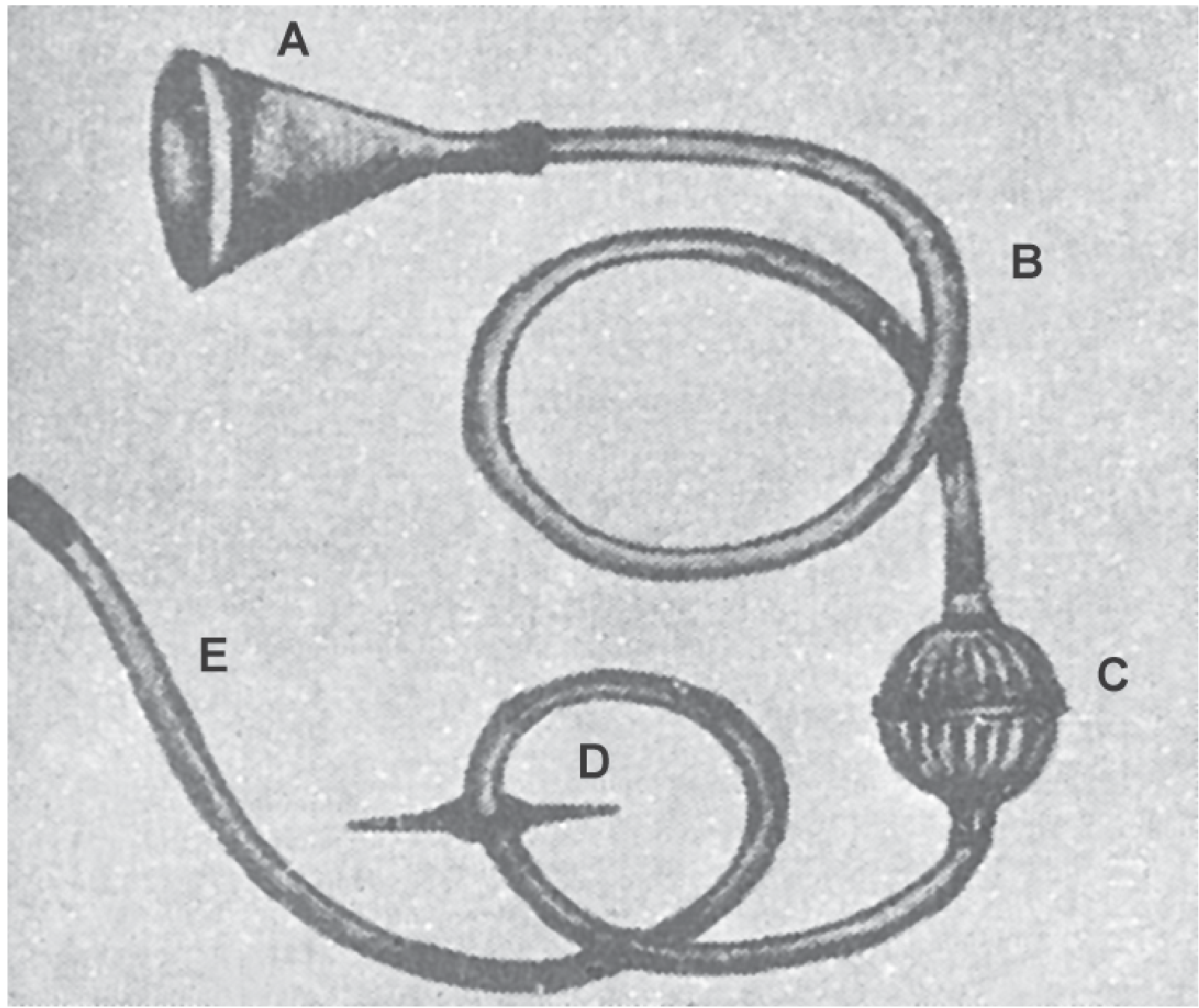
Fig: Stomach tube. (A) Filter funnel attached to upper end of rubber tube (B); (C) Suction bulb; (D) Mouth gag with a central hole; (E) Lower end - rounded and perforated. The mouth gag covers the 50 cm mark from the lower end.
Adult tube specifications:
- Soft, non-collapsible rubber tube
- 36-40 French size in diameter
- 1.5 m in length
- Glass/filter funnel at upper end
- Suction bulb at midpoint to pump out stomach contents
- Rounded, blunt, perforated lower end (multiple side openings)
- Mark at 50 cm from the lower end (distance from lips to cardiac stomach in adults ~45 cm)
Children: Use 22-28 French (Ryle's tube). In emergencies, a French rubber catheter with attached syringe is used.
(PC Dikshit, p. 434; Parikh's, p. 559)
Procedure (Step by Step)
1. Patient Positioning
- Left lateral (recovery) position OR prone/semiprone with hips higher than head and face pointing downward so the mouth is at a lower level than the larynx.
- This prevents aspiration of regurgitated fluid into the respiratory tract.
- Dentures must be removed.
- A mouth gag with a central hole is inserted (especially in unconscious patients) to prevent the tube being bitten through.
2. Tube Insertion
- Lubricate the lower end with glycerin, Vaseline jelly, liquid paraffin, glycerine, milk, or similar substance.
- Pass the tube through the hole in the mouth gag, over the tongue, down the oesophagus.
- In adults, insert up to 50 cm; in children, up to 25 cm.
3. Confirming Tube Position in Stomach
Two methods:
- Stethoscope method: Inject a puff of air - bubbling sounds heard over the stomach confirm correct placement.
- Water test: Dip the upper end in a cup of water - if the tube is in the trachea, air bubbles will emerge. A hissing noise at the funnel end also suggests tracheal placement.
4. Initial Washings
- Instill 250-300 mL of warm (35°C) saline or plain water by holding the funnel above the patient's mouth level (gravity flow).
- In children: use 10-15 mL/kg body weight of warm saline (NOT plain water - risk of hyponatremia and water intoxication).
- Lower the funnel below the level of the stomach over a receptacle to siphon out gastric contents.
- Using too much fluid for the first wash may sweep poison onwards into the duodenum.
Important: The first washing sample must be preserved for chemical analysis.
5. Subsequent Washings
- Repeat with 500 mL of fluid (warm water or specific antidote solution).
- Continue until the returning fluid is clear, odourless, colourless, and free of particulate matter.
- At the end, a small quantity of activated charcoal (1 g/kg body weight) suspension and/or an ionic cathartic is left in the stomach.
(PC Dikshit, p. 434-435; Parikh's, p. 559-560)
Lavage Fluids - Specific Antidotes for Different Poisons
| Lavage Fluid | Concentration | Used For |
|---|---|---|
| Potassium permanganate (KMnO4) | 1:5,000 or 1:10,000 | Oxidizable poisons - alkaloids, salicylates; continue until fluid is colourless |
| Sodium bicarbonate | 5% | Acid poisoning (e.g., carbolic acid/phenol) |
| Tannic acid | 4% | Alkaloids (precipitates them) |
| Sodium thiosulfate | 25% | Cyanide poisoning |
| Calcium gluconate | - | Oxalate poisoning |
| Castor oil + warm water | 1:2 ratio | Carbolic acid and phenolic group of poisons |
| Desferrioxamine | 2 g in 1 L water | Iron poisoning |
| 3-5% Sodium bicarbonate | - | Cantharides (Parikh's) |
(PC Dikshit, p. 434-435)
Complications of Gastric Lavage
(PC Dikshit, p. 435)
- Laryngeal spasm
- Aspiration pneumonitis
- Perforation of stomach or oesophagus
- Sinus bradycardia and ST elevation on ECG
Contraindications of Gastric Lavage
Absolute Contraindications
(PC Dikshit, p. 435)
- Corrosive poisoning (except carbolic acid) - risk of perforation
- Convulsant poisons - risk of precipitating convulsions
- Comatose patient - risk of aspiration
- Volatile poisons - risk of inhalation
- Hypothermia - body temperature must be addressed first
Note from Parikh's: In strychnine (convulsant) poisoning, convulsions should be controlled before lavage; in kerosene/volatile poisons or comatose states, the airway must first be secured with a cuffed endotracheal tube.
Relative Contraindications
(PC Dikshit, p. 435)
- Alimentary tract diseases (e.g., oesophageal varices)
- Comatose patients
- Ingestion of alkali
- Advanced pregnancy
- Haemorrhagic diathesis
- Recent surgical operation (history)
Contraindications to Emesis (for Comparison)
Emetics are avoided when: corrosives ingested, strychnine poisoning, petroleum distillates, comatose patients, severe cardiac or respiratory disease, advanced pregnancy.
Key Forensic Points to Remember
- First washing is preserved for chemical analysis - medicolegally important.
- Gastric lavage is part of decontamination of the body from ingested poisons; the other methods are: emesis, catharsis, activated charcoal, whole bowel irrigation.
- Ewald or Boas tube = the standard tube used.
- 50 cm = insertion depth in adults; 25 cm in children.
- Warm water (35°C) is the standard lavage fluid; specific antidote solutions are added based on the poison.
- Even after lavage, an antidote should be given - some poisons are secreted back into the stomach after systemic absorption.
(PC Dikshit Textbook of Forensic Medicine and Toxicology, pp. 434-435; Parikh's Textbook of Medical Jurisprudence, Forensic Medicine and Toxicology, pp. 559-560)
This is a shared conversation. Sign in to Orris to start your own chat.