

My 2nd year final external exam is in November i am h physiotherapy student in 2nd year please explain in detail from exam pov section I
Section I - Introductory Physics (BPT 2nd Year Electrotherapy)
Exam tip: Section I is the foundation. Questions from this section are typically short answers (5 marks) or part of long answers. Definitions, types, laws, and formulas are highly repeatable and predictable.
Topic 1: Electricity - Definition and Types (1 Hour)
Definition
Types of Electricity
| Type | Description |
|---|---|
| Static Electricity | Charges at rest; no continuous flow; produced by friction |
| Current Electricity | Charges in motion (flow of electrons through a conductor) |
- Direct Current (DC) - unidirectional, constant flow (e.g., galvanic current)
- Alternating Current (AC) - flow reverses direction periodically (e.g., mains supply, interferential)
- Pulsed Current - interrupted DC or AC delivered in discrete pulses (e.g., TENS, FES)
Topic 2: Static Electricity (2 Hours)
a. Production of Electrical Charges
-
Friction (Triboelectric effect): When two different materials are rubbed together, electrons transfer from one to the other.
- Example: Rubbing glass with silk - glass loses electrons (becomes +ve), silk gains electrons (becomes -ve)
- Example: Rubbing ebonite rod with fur - ebonite becomes -ve
-
Induction: A charged body brought near a neutral conductor causes redistribution of charges in the neutral body without direct contact.
-
Contact/Conduction: A charged body touches a neutral conductor, sharing charges.
- Positive charge - loss of electrons
- Negative charge - gain of electrons
b. Characteristics of a Charged Body
- It attracts small, light, uncharged objects (by induction)
- It exerts a force on other charged bodies (attraction or repulsion)
- Charge resides on the surface - in a conductor, all excess charge distributes on the outer surface
- It can leak charge through moist air or imperfect insulators
- It produces an electric field in the surrounding space
- A charged body at higher potential can transfer charge to a body at lower potential
- Pointed conductors have higher surface charge density (charge concentrates at sharp points - used in lightning rods)
c. Characteristics of Lines of Force (Electric Field Lines)
- Lines of force originate from positive charge and terminate on negative charge
- They are continuous curves - they never start or end in space
- They never intersect each other (at any point, the field has only one direction)
- They are perpendicular to the surface of the charged conductor
- Closer lines indicate a stronger electric field; widely spaced lines indicate a weaker field
- They tend to contract longitudinally (like stretched rubber bands) - this explains attraction between opposite charges
- They tend to expand laterally - this explains repulsion between like charges
- In a uniform field, lines of force are parallel and equidistant
d. Potential Difference and EMF
- The work done in bringing a unit positive charge from infinity to a given point against the electric field
- Unit: Volt (V)
- Symbol: V
- It is a scalar quantity
- The difference in electric potential between two points
- Defined as: Work done per unit charge in moving a positive charge from one point to another
- Formula: V = W/Q (Volts = Joules / Coulombs)
- Unit: Volt (V)
- It is the "driving force" for current flow - current flows from high potential to low potential
- The total energy per unit charge supplied by a source (battery/generator) to drive current through a complete circuit
- It is the maximum PD - measured when no current is drawn (open circuit)
- Symbol: ε (epsilon)
- Unit: Volt (V)
- EMF > Terminal voltage (because some voltage is lost in internal resistance)
| Feature | Potential Difference | EMF |
|---|---|---|
| Definition | Energy per unit charge between two external points | Total energy per unit charge given by source |
| Measured when | Current flowing in circuit | No current (open circuit) |
| Always | Less than or equal to EMF | Greater than or equal to PD |
| Cause | Effect of EMF | Cause of current flow |
Topic 3: Current Electricity (5 Hours) - Partially visible in syllabus
Key Definitions
- Defined as the rate of flow of charge
- Formula: I = Q/t (Amperes = Coulombs / seconds)
- Unit: Ampere (A)
- Types: DC, AC, Pulsed
- At constant temperature, the current through a conductor is directly proportional to the potential difference across it
- Formula: V = IR
- Where: V = voltage, I = current, R = resistance
- Unit of resistance: Ohm (Ω)
- Resistance (R) - opposes DC
- Impedance (Z) - opposes AC (includes resistance + reactance)
- Reactance comes from capacitance and inductance in AC circuits
High-Yield Exam Summary
| Formula | Name | What it means |
|---|---|---|
| V = W/Q | Potential | Volts = Work/Charge |
| I = Q/t | Current | Amperes = Charge/Time |
| V = IR | Ohm's Law | Voltage = Current x Resistance |
| F = kQ₁Q₂/r² | Coulomb's Law | Force between two charges |
- Charge: Coulomb (C)
- Current: Ampere (A)
- Voltage/PD/EMF: Volt (V)
- Resistance: Ohm (Ω)
- Power: Watt (W)
- Energy: Joule (J)
Exam Strategy for Section I
- Definitions are always asked - define electricity, static electricity, current, PD, EMF, and lines of force precisely
- Distinguish PD vs EMF, static vs current electricity, DC vs AC - these are easy marks
- Properties of lines of force - list format gets full marks; memorize all 7-8 points
- Production of static electricity - explain triboelectric effect with examples
- Characteristics of charged body - link to clinical applications where possible (impresses examiners)
- Coulomb's Law - know the formula even if derivation is not asked
I want with diagram
Educational physiotherapy electrotherapy diagram: Types of Electricity - a clean labeled diagram showing two branches: Static Electricity (charges at rest, showing a glass rod being rubbed with silk cloth, positive charges on glass, negative on silk) and Current Electricity (charges in motion, showing a circuit with battery, wire, bulb, and arrows showing electron flow direction). Include DC (straight arrow), AC (sine wave), and Pulsed Current (square wave pulses) waveforms labeled clearly. White background, black text, color-coded branches, exam study style
Educational physics diagram for physiotherapy students: Production of Static Electricity - showing three methods: 1) Friction/Triboelectric effect - glass rod rubbed with silk showing electron transfer with + and - labels, 2) Induction - charged rod near neutral conductor showing charge redistribution with arrows, 3) Contact/Conduction - charged body touching neutral body sharing charges. Each method in a separate box with clear labels. White background, clean scientific diagram style, exam study
Educational physics diagram: Electric Field Lines (Lines of Force) - showing multiple scenarios: 1) Isolated positive charge with lines radiating outward, 2) Isolated negative charge with lines pointing inward, 3) Two opposite charges (dipole) with curved field lines connecting them, 4) Two like charges (both positive) with lines repelling, 5) Uniform electric field with parallel equidistant lines between two charged plates. Each scenario clearly labeled, arrows on field lines showing direction, white background, black ink, exam study diagram for BPT students
Educational electrotherapy diagram for physiotherapy exam: Potential Difference and EMF - showing a battery circuit diagram with: EMF (epsilon symbol) labeled at battery source, internal resistance (r) inside battery, external resistance (R) in circuit, terminal voltage/potential difference (V) labeled across external circuit, current (I) with arrows showing direction of flow. Formula boxes showing: V = W/Q, EMF = Total energy/charge, V = EMF - Ir. Also a comparison table showing PD vs EMF differences. White background, professional educational style
Educational physics diagram for BPT physiotherapy exam: Characteristics of a Charged Body - a central circle labeled "Charged Body" with 7 labeled arrows pointing outward each showing a characteristic: 1) Attracts light uncharged objects (shown with small paper bits), 2) Charge resides on surface (cross-section of conductor with + charges on outer surface only), 3) Exerts force on other charges (attraction/repulsion), 4) Produces electric field (field lines shown), 5) Can leak through moisture, 6) Higher charge at pointed surfaces (sharp tip of conductor with dense charge), 7) Transfers charge to lower potential body. White background, neat labeled diagram, exam study style
Educational diagram for physiotherapy students: Ohm's Law and Current Electricity - showing 1) A simple circuit with battery (V), resistor (R), ammeter showing current I, with formula V = IR in a box. 2) A triangle diagram showing V at top, I and R at bottom - the Ohm's Law triangle. 3) A table of important units: Charge-Coulomb(C), Current-Ampere(A), Voltage-Volt(V), Resistance-Ohm, Power-Watt(W). 4) Graph showing linear relationship between V and I (straight line through origin). White background, color coded sections, clean exam diagram for BPT 2nd year
Error calling model 'gemini-3-pro-image' (RESOURCE_EXHAUSTED): 429 RESOURCE_EXHAUSTED. {'error': {'code': 429, 'message': 'Resource has been exhausted (e.g. check quota).', 'status': 'RESOURCE_EXHAUSTED'}}
We encountered an error while processing your request. Please try again or reach out to us for help.
I want diagram
Diagram 1: Types of Electricity
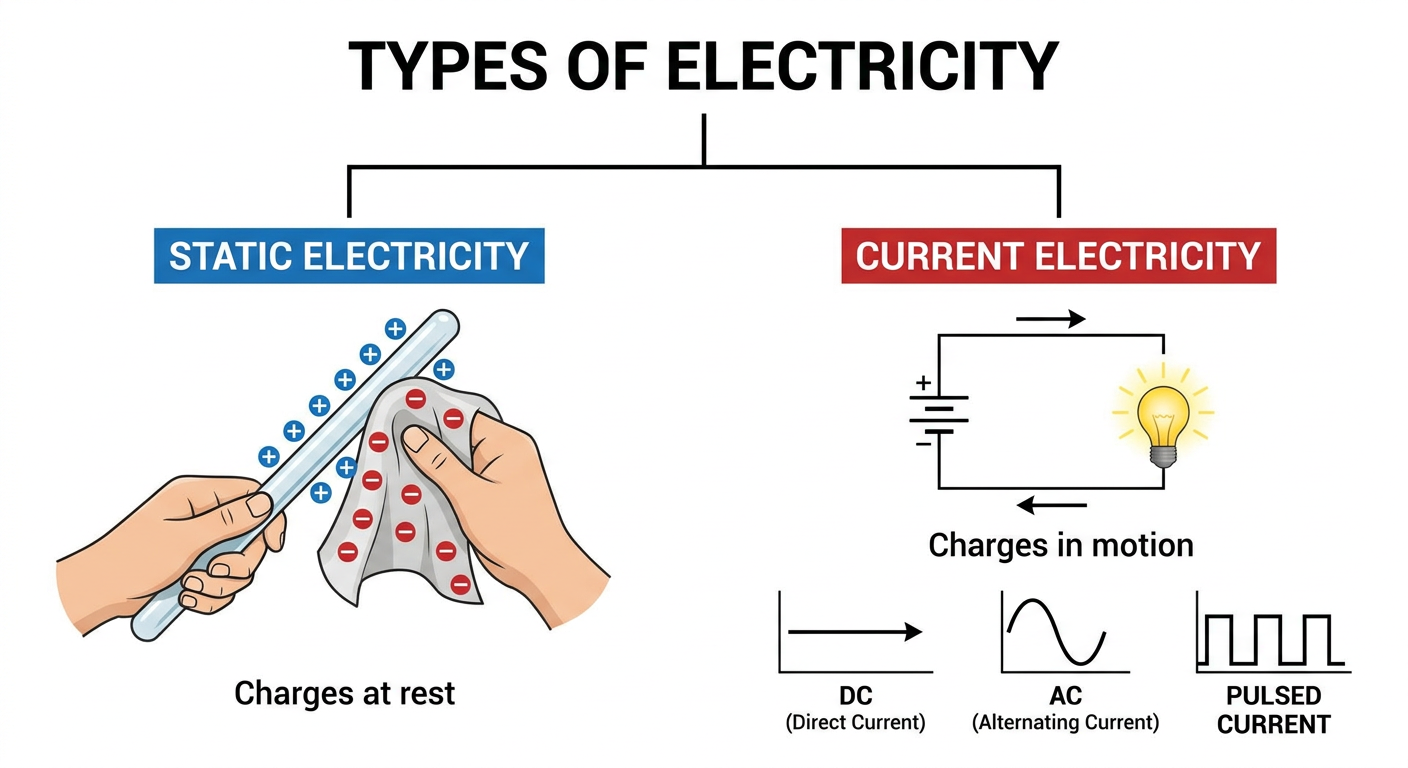
- Static = charges at rest (no flow)
- Current = charges in motion (flow through conductor)
- DC = unidirectional (galvanic) | AC = bidirectional (sine wave) | Pulsed = interrupted bursts
Diagram 2: Production of Static Electricity
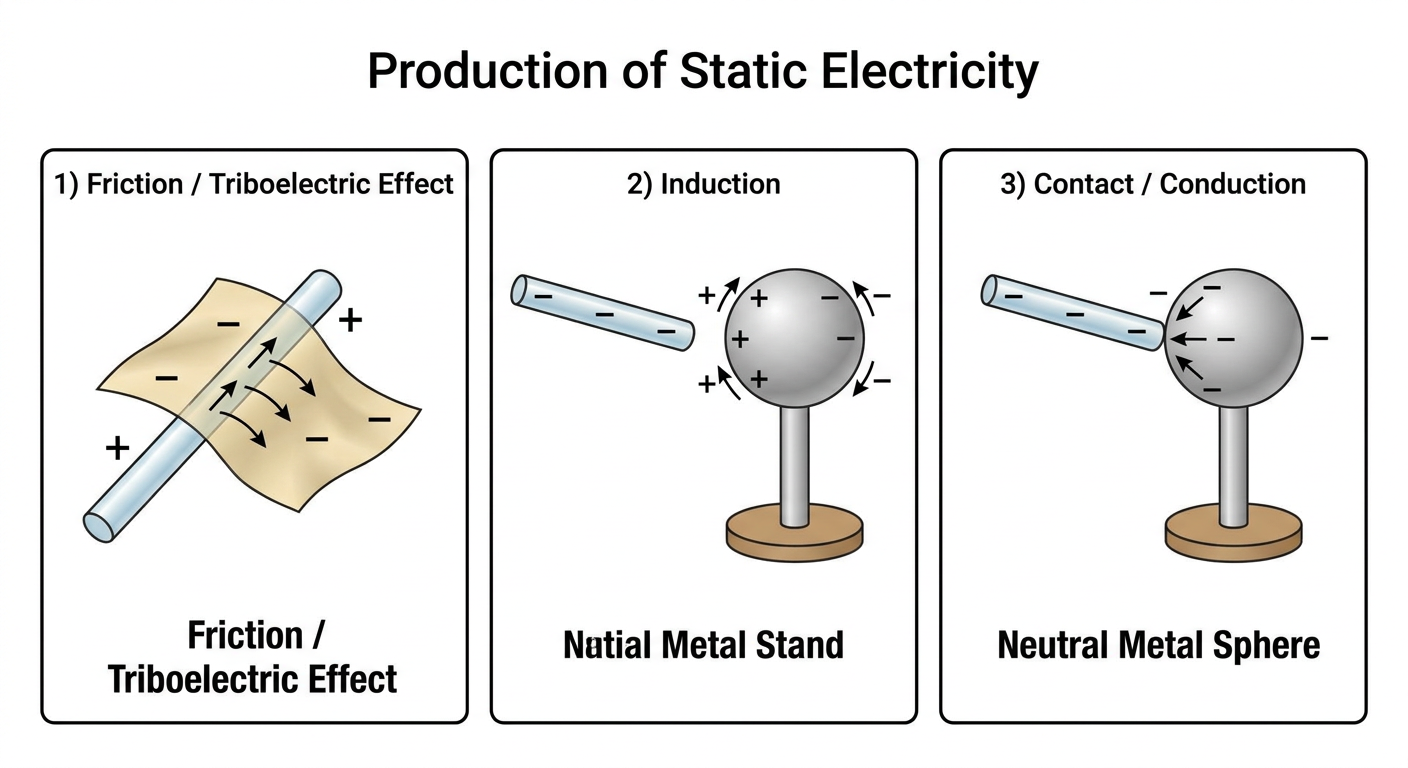
- Friction: Glass + silk → glass loses electrons (+ve), silk gains (-ve)
- Induction: No contact needed; near charged body causes redistribution
- Conduction: Direct contact shares charges
Diagram 3: Electric Field Lines (Lines of Force)
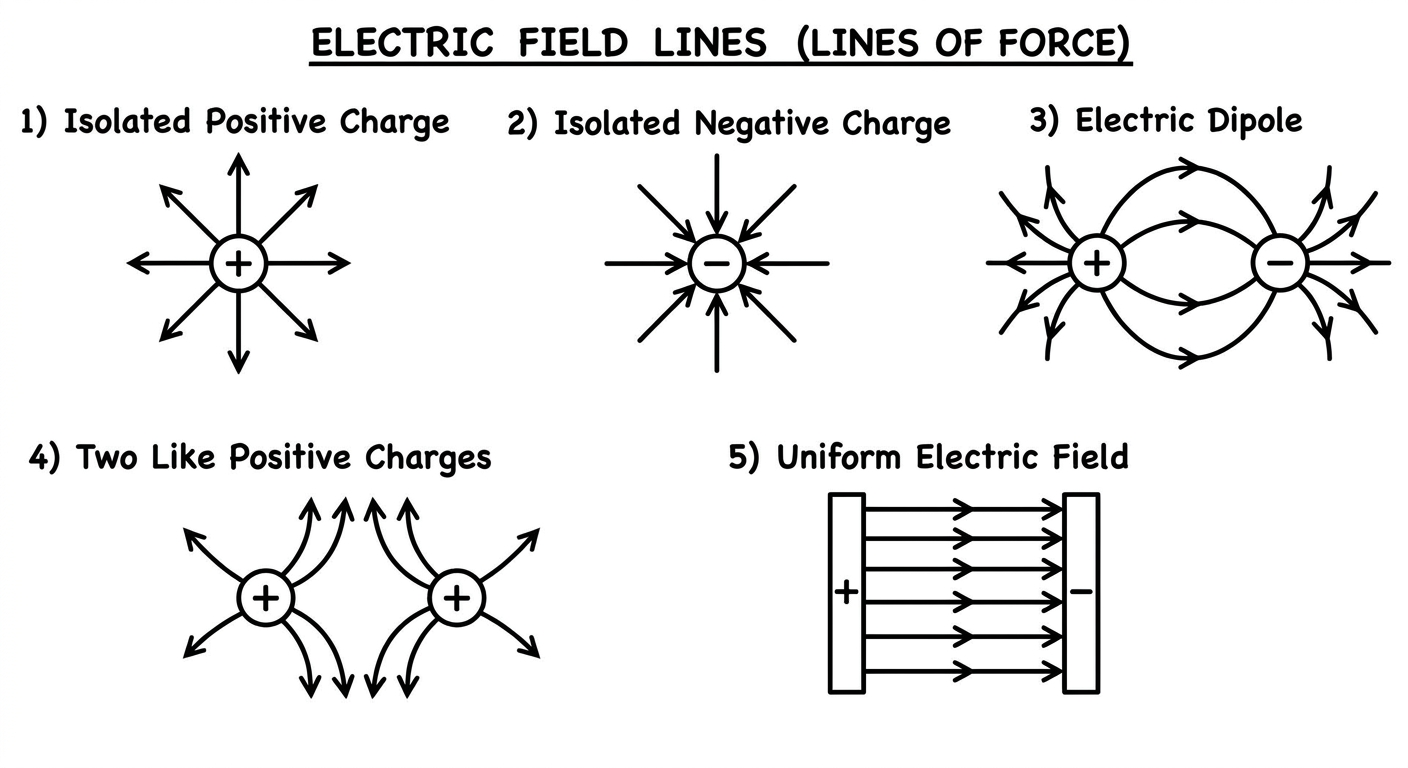
- Lines go FROM +ve TO -ve
- Never cross each other
- Closer lines = stronger field
- Perpendicular to conductor surface
- Parallel lines = uniform field (between parallel plates)
Diagram 4: Potential Difference and EMF
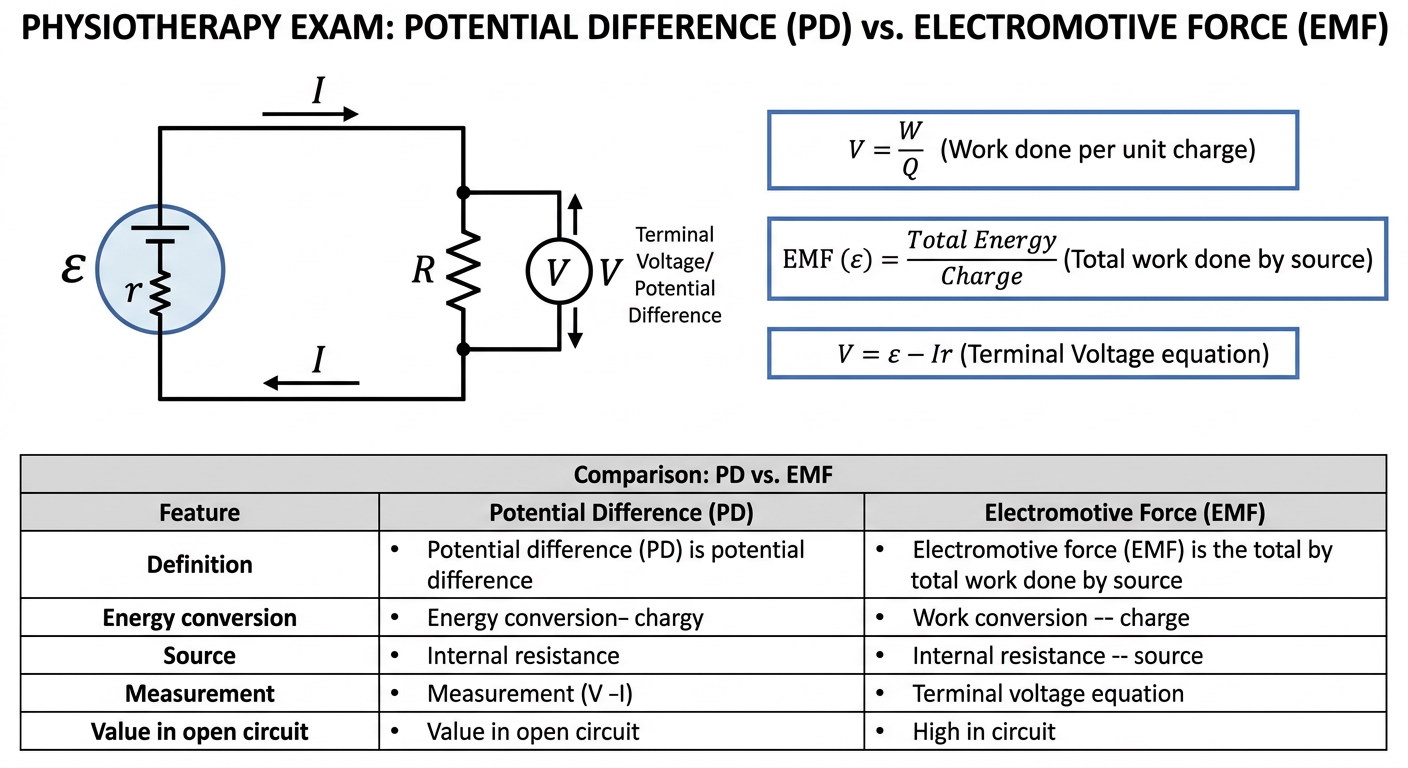
- PD (V) = W/Q (work done per unit charge between two external points)
- EMF (ε) = total energy per unit charge supplied by source
- V = EMF - Ir (terminal voltage is always less than EMF due to internal resistance)
- EMF is measured on open circuit; PD is measured when current flows
Quick Revision Summary Table
| Topic | Key Word | Formula/Unit |
|---|---|---|
| Electric Charge | Coulomb | C |
| Current | Rate of charge flow | I = Q/t, Ampere (A) |
| Potential Difference | Work per unit charge | V = W/Q, Volt (V) |
| EMF | Source energy per charge | Volt (V) |
| Resistance | Opposition to current | V = IR, Ohm (Ω) |
| Lines of Force | + to -, never cross | No unit |