
Rheumatoid arthritis treatment
"rheumatoid arthritis"[MeSH Terms] AND "drug therapy"[MeSH Terms]
rheumatoid arthritis treatment algorithm DMARD biologic
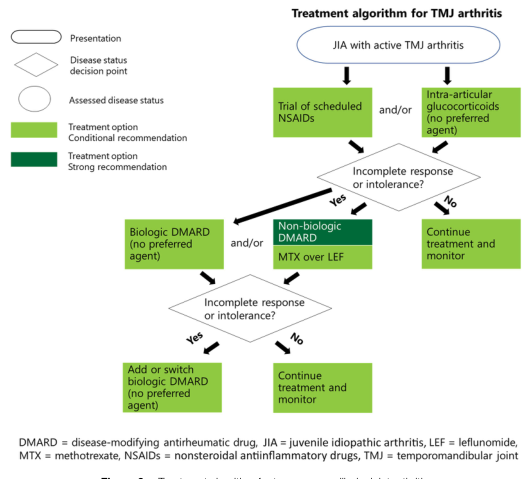
Summary : This flowchart presents a treatment algorithm for temporomandibular joint (TMJ) arthritis in patients with juvenile idiopathic arthritis (JIA), outlining conditional and strong recommendations for medication choices based on response or intolerance. flowchart: # Nodes : • Start (ellipse): "JIA with active TMJ arthritis" • Treatment options (rectangles, light green): "Trial of scheduled NSAIDs", "Intra-articular glucocorticoids (no preferred agent)" • Decision point (diamond): "Incomplete response or intolerance?" • Treatment options (rectangles, light green): "Biologic DMARD (no preferred agent)" • Treatment option (rectangle, dark green): "Non-biologic DMARD MTX over LEF" • Decision point (diamond): "Incomplete response or intolerance?" • Treatment option (rectangle, light green): "Add or switch biologic DMARD (no preferred agent)" • Treatment option (rectangle, light green): "Continue treatment and monitor" # Connectors : • Downward arrows from "JIA with active TMJ arthritis" to both "Trial of scheduled NSAIDs" and "Intra-articular glucocorticoids (no preferred agent)" (parallel options). • Both treatment options lead to the decision point "Incomplete response or intolerance?" • "No" branch from decision point leads to "Continue treatment and monitor". • "Yes" branch leads to two parallel options: "Biologic DMARD (no preferred agent)" and "Non-biologic DMARD MTX over LEF". • Both DMARD options lead to a second decision point: "Incomplete response or intolerance?" • "No" branch from second decision point leads to "Continue treatment and monitor". • "Yes" branch leads to "Add or switch biologic DMARD (no preferred agent)". # Layout : • Top-down flow, starting with disease presentation, followed by initial treatment options, then branching based on response. • Parallel options for initial and secondary treatments. • Decision diamonds split into "Yes" and "No" branches. • Strong recommendations (dark green) and conditional recommendations (light green) are visually distinguished. • Legend at top left explains shapes and colour codes. # Analysis : • The algorithm prioritises NSAIDs and intra-articular glucocorticoids as initial treatments, with escalation to DMARDs if response is incomplete or intolerance occurs. • Methotrexate (MTX) is preferred over leflunomide (LEF) for non-biologic DMARDs. • Biologic DMARDs are recommended if non-biologic DMARDs are insufficient, with further switching if needed. • Monitoring is advised for patients who respond adequately at any stage. • The flowchart visually separates strong recommendations (non-biologic DMARD, MTX over LEF) from conditional ones, guiding clinicians through a stepwise escalation based on patient response.
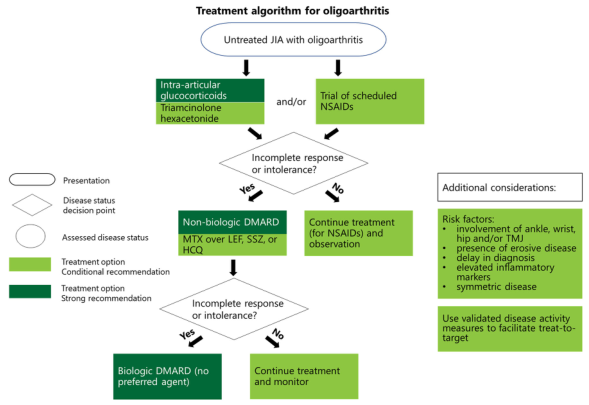
Summary : This flowchart presents a treatment algorithm for oligoarthritis in patients with untreated juvenile idiopathic arthritis (JIA), outlining stepwise therapeutic options and decision points based on response or intolerance, with additional considerations for risk factors and disease activity assessment. flowchart: # Nodes : • Start (ellipse): "Untreated JIA with oligoarthritis" • Treatment options (rectangles): – "Intra-articular glucocorticoids Triamcinolone hexacetonide" (dark green, strong recommendation) – "Trial of scheduled NSAIDs" (light green, conditional recommendation) • Decision point (diamond): "Incomplete response or intolerance?" • Treatment options (rectangles): – "Non-biologic DMARD MTX over LEF, SSZ, or HCQ" (dark green, strong recommendation) – "Continue treatment (for NSAIDs) and observation" (light green, conditional recommendation) • Decision point (diamond): "Incomplete response or intolerance?" • Treatment options (rectangles): – "Biologic DMARD (no preferred agent)" (dark green, strong recommendation) – "Continue treatment and monitor" (light green, conditional recommendation) • Additional considerations (rectangles): – "Risk factors: involvement of ankle, wrist, hip and/or TMJ; presence of erosive disease; delay in diagnosis; elevated inflammatory markers; symmetric disease" – "Use validated disease activity measures to facilitate treat-to-target" • Legend (rectangle): Explains shapes and colour codes for presentation, decision points, assessed disease status, and recommendation strength. # Connectors : • Downward arrows from "Untreated JIA with oligoarthritis" to both "Intra-articular glucocorticoids Triamcinolone hexacetonide" and "Trial of scheduled NSAIDs" (parallel, "and/or"). • Both treatment options converge to the first decision diamond: "Incomplete response or intolerance?" • "Yes" branch leads to "Non-biologic DMARD MTX over LEF, SSZ, or HCQ"; "No" branch leads to "Continue treatment (for NSAIDs) and observation". • From "Non-biologic DMARD MTX over LEF, SSZ, or HCQ", arrow to second decision diamond: "Incomplete response or intolerance?" • "Yes" branch leads to "Biologic DMARD (no preferred agent)"; "No" branch leads to "Continue treatment and monitor". • Additional considerations and legend are placed to the right, not directly connected to the main flow. # Layout : • Vertical flow from top (presentation) to bottom (advanced treatment options). • Parallel initial treatment options, merging at first decision point. • Two sequential decision diamonds, each splitting into two branches. • Additional considerations and legend are in side boxes, visually separated from the main algorithm. # Analysis : • The algorithm is structured to escalate therapy based on incomplete response or intolerance, starting with intra-articular glucocorticoids and/or NSAIDs, then progressing to non-biologic DMARDs, and finally to biologic DMARDs if needed. • Strong recommendations (dark green) are given for intra-articular glucocorticoids, non-biologic DMARDs (MTX preferred), and biologic DMARDs, while NSAIDs and continued monitoring are conditional (light green). • Risk factors and validated disease activity measures are highlighted as important considerations for tailoring treatment and monitoring. • The flowchart provides a clear, stepwise approach to managing oligoarthritis in JIA, emphasizing treat-to-target strategies and escalation based on patient response.
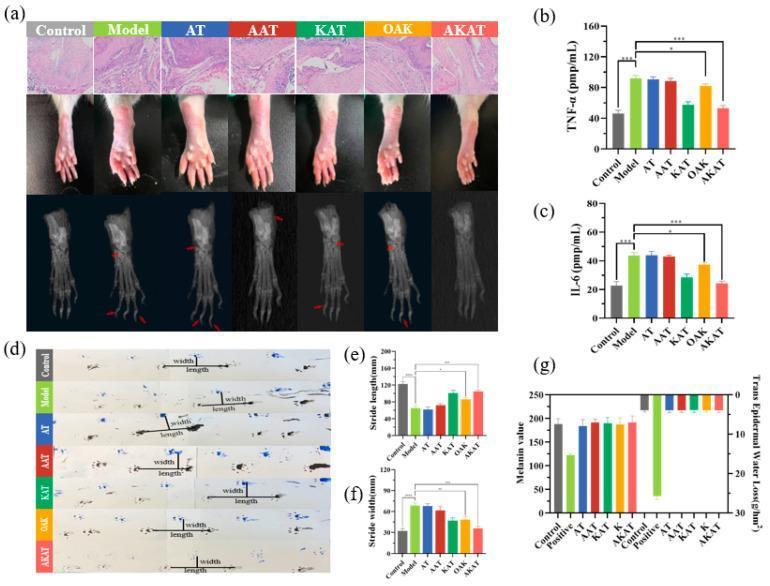
This composite educational figure illustrates the anti-inflammatory and joint-protective effects of various drug treatments (Actarit and Ketoprofen formulations) in a rat model of Rheumatoid Arthritis (RA). Section (a) features H&E-stained histological sections of knee joints, clinical photographs of hind paw edema, and radiographic (X-ray) images of the tarsometatarsal joints across seven groups (Control, Model, AT, AAT, KAT, OAK, AKAT). Red arrows on the X-rays highlight areas of bone erosion and joint space narrowing, most prominent in the Model group and least in the AKAT group. (b) and (c) are bar graphs showing serum concentrations of pro-inflammatory cytokines TNF-α and IL-6, illustrating therapeutic downregulation. (d) presents footprint analysis with labeled stride length and width, while (e) and (f) provide the corresponding statistical gait analysis, showing functional motor recovery. (g) depicts skin barrier function through melanin and trans-epidermal water loss (TEWL) measurements. This figure demonstrates the synergistic efficacy of combined DMARD and NSAID topical treatment in suppressing synovial proliferation and cartilage destruction.
"rheumatoid arthritis"[MeSH Terms] AND "biological therapy"[MeSH Terms]
Rheumatoid Arthritis (RA) Treatment
Core Principle: Treat-to-Target
- Tender joint count ≤1
- Swollen joint count ≤1
- CRP ≤1 mg/dL
- Patient global assessment ≤2 cm (0-10 cm VAS)
Three Categories of Medical Therapy
1. NSAIDs
- Celecoxib 100-200 mg/day, Naproxen 500 mg twice daily, Ibuprofen 400 mg four times daily
- COX-2 inhibitors reduce GI bleeding risk but carry cardiovascular concerns (though celecoxib was non-inferior to naproxen/ibuprofen in the PRECISION trial for CV outcomes)
- Always consider adding a proton pump inhibitor when using NSAIDs in RA patients
2. Glucocorticoids
- Prednisone ≤10 mg/day for articular manifestations (rarely exceed this dose)
- A 25% increased risk of serious infection occurs even at 5 mg/day; risk doubles at 5-10 mg/day
- Role: bridge therapy while waiting for DMARDs to take effect (2-6 months)
- Intra-articular injections useful for individual flaring joints
- Goal: taper off or to the lowest possible dose once DMARD control is established
- Higher doses may be needed for extra-articular manifestations (vasculitis, scleritis)
- Consider osteoporosis prophylaxis for all patients on long-term glucocorticoids
3. DMARDs (The Backbone of RA Treatment)
Conventional DMARDs
| Drug | Dose | Key Toxicities | Monitoring |
|---|---|---|---|
| Methotrexate (anchor drug) | 10-25 mg/week PO or SQ + folic acid 1 mg/day | Hepatotoxicity, myelosuppression, infectious pneumonitis | CBC, LFTs, creatinine every 2-3 months |
| Hydroxychloroquine | 200-400 mg/day (≤5 mg/kg) | Irreversible retinal damage, cardiotoxicity | Annual optical coherence tomography + visual field testing |
| Sulfasalazine | 500 mg twice daily → 2 g/day maintenance | Granulocytopenia, hemolytic anemia (G6PD def.) | CBC every 2-4 weeks x 3 months, then every 3 months |
| Leflunomide | 10-20 mg/day | Hepatotoxicity, teratogenicity (Category X), myelosuppression | CBC, LFTs every 2-3 months |
| Azathioprine | 1-2.5 mg/kg/day | Myelosuppression, infection | CBC regularly |
Biologic DMARDs
- Adalimumab 40 mg SQ every 2 weeks
- Etanercept 50 mg SQ weekly
- Infliximab 3-5 mg/kg IV at weeks 0, 2, 6, then every 4-8 weeks (always with MTX)
- Certolizumab 400 mg SQ at weeks 2 and 4, then 200 mg every 2 weeks
- Golimumab 50 mg SQ monthly
- Risks: reactivation of latent TB (screen before starting), serious bacterial/fungal infections, possible increased lymphoma risk, drug-induced lupus, demyelinating disease
- Tocilizumab 4-8 mg/kg IV every 4 weeks (also available SC)
- Can be used as monotherapy (unlike most biologics)
- Watch for lipid elevation within 3 months of starting; avoid in history of GI perforation
- Abatacept 500-1000 mg IV at weeks 0, 2, 4, then every 4 weeks
- Rituximab two 1000 mg IV infusions separated by 2 weeks, every 16-24 weeks (always with MTX)
- Useful in patients who failed TNF inhibitors or have concerns about infection risk with TNF inhibitors
Targeted Synthetic DMARDs (JAK Inhibitors)
- Tofacitinib, Baricitinib, Upadacitinib, Filgotinib
- Comparable efficacy to biologics, oral administration advantage
- Monitoring: LFTs, creatinine kinase, creatinine
- Caution: increased risk of herpes zoster, thrombosis risk in high-risk patients (post-2021 FDA safety updates have restricted first-line use in patients with cardiovascular risk factors or malignancy history - prefer TNF inhibitors in such patients)
Treatment Algorithm (TICORA Principle)
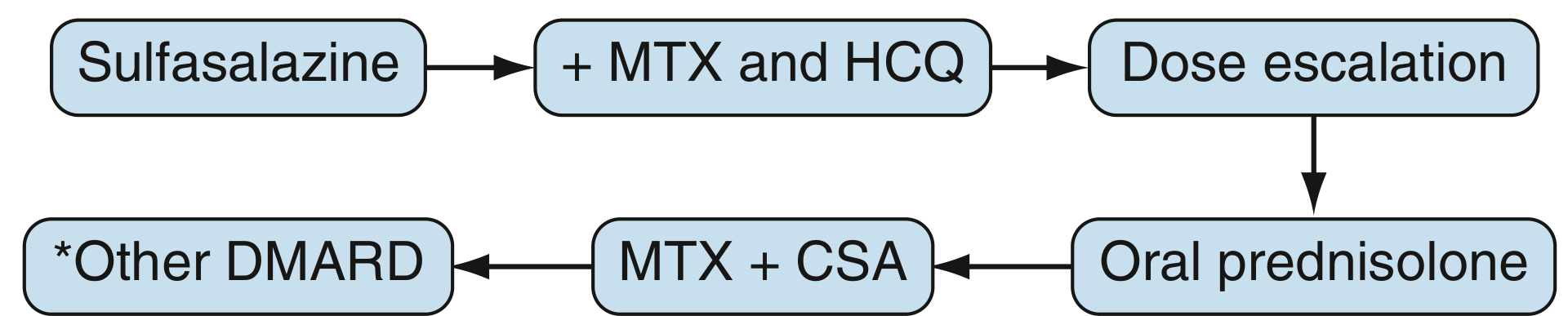
- Diagnose early and start a conventional DMARD (usually MTX) promptly
- Reassess every 4-8 weeks; escalate therapy if target not reached
- Add/switch conventional DMARDs or triple therapy (MTX + HCQ + SSZ)
- If inadequate response after 3-6 months of optimized conventional DMARD therapy, add a biologic DMARD (TNF inhibitor preferred first-line) or JAK inhibitor
- If one biologic fails, switch to a different class
- Glucocorticoids as bridge at any stage; taper as soon as disease is controlled
Keys to Optimizing Outcomes
- Early, accurate diagnosis
- Start DMARD therapy without delay
- Aim for remission in all patients
- Monitor carefully for treatment toxicities
- Treat important comorbidities: cardiovascular disease (RA roughly doubles CV risk), infection susceptibility, osteoporosis
- Regular disease activity measurement at every visit - the specific tool matters less than consistent use
Special Considerations
| Situation | Recommendation |
|---|---|
| Pregnancy | Stop MTX and leflunomide (both teratogenic - Category X); hydroxychloroquine generally safe; use sulfasalazine with caution; avoid biologics near delivery |
| Pre-biologic workup | Screen for latent TB (TST/IGRA), hepatitis B and C serology, chest X-ray |
| Active infection | Hold biologics and JAK inhibitors until resolved |
| Severe extra-articular disease (vasculitis) | Higher-dose glucocorticoids + MTX or rituximab |
| Refractory disease | Combination biologic + conventional DMARD, or switch biologic class |