
Hrparin vs low molecular heparibn for 10 marks
Reading File
Now let me search the medical library for heparin vs LMWH content in parallel:
Finding Sources
Finding Sources
Excellent results. Let me read the most relevant sections from Goodman & Gilman's (pharmacology), Braunwald's (cardiology), and Fuster's Heart in parallel:
Reading File
Reading File
Reading File
I have rich content from Braunwald's. Let me now get the Goodman & Gilman pharmacology content and the UFH section for a complete comparison:
Finding Sources
Reading File
I now have excellent content from Braunwald's with a mechanism diagram. Let me also fetch the Harrison's diagram and read the UFH section from Braunwald's block 14:
Reading File
Reading File
Excellent! I now have comprehensive data from Harrison's and Braunwald's. I have everything I need to write a thorough 10-mark answer. Let me compile the complete comparison now.
Loading Image
I now have all the information needed for a comprehensive 10-mark answer. Here is the complete, well-structured comparison:
Heparin (UFH) vs Low Molecular Weight Heparin (LMWH) - 10 Marks
1. Introduction
Both unfractionated heparin (UFH) and low molecular weight heparin (LMWH) are parenteral anticoagulants that work via antithrombin activation. LMWH is prepared from UFH by controlled enzymatic or chemical depolymerization, producing smaller, more uniform fragments. Due to its pharmacokinetic and clinical advantages, LMWH has largely replaced UFH for most indications.
2. Mechanism of Action
UFH (Unfractionated Heparin):
- A sulfated polysaccharide isolated from porcine intestinal mucosa; polymer of alternating D-glucuronic acid and N-acetyl-D-glucosamine residues
- Works by binding to antithrombin III (a serine protease inhibitor / serpin) via a unique pentasaccharide sequence present on one-third of UFH chains
- This conformational change in antithrombin accelerates its inhibition of clotting enzymes - primarily thrombin (Factor IIa) and Factor Xa, but also Factors IXa, XIa, XIIa
- UFH chains must be long enough to bridge both thrombin and antithrombin simultaneously to inhibit thrombin - requires at least 18 saccharide units
- Anti-Xa : Anti-IIa ratio = 1:1
LMWH:
- Mean molecular weight ~5000 Da (one-third of UFH's ~15,000 Da); corresponds to ~17 saccharide units
- Also activates antithrombin via the pentasaccharide sequence
- Because many LMWH chains are too short to bridge thrombin to antithrombin, they preferentially inhibit Factor Xa only
- Can still inhibit Factor Xa because this requires only the conformational change in antithrombin (not bridging)
- Anti-Xa : Anti-IIa ratio = 2:1 to 4:1 depending on the preparation
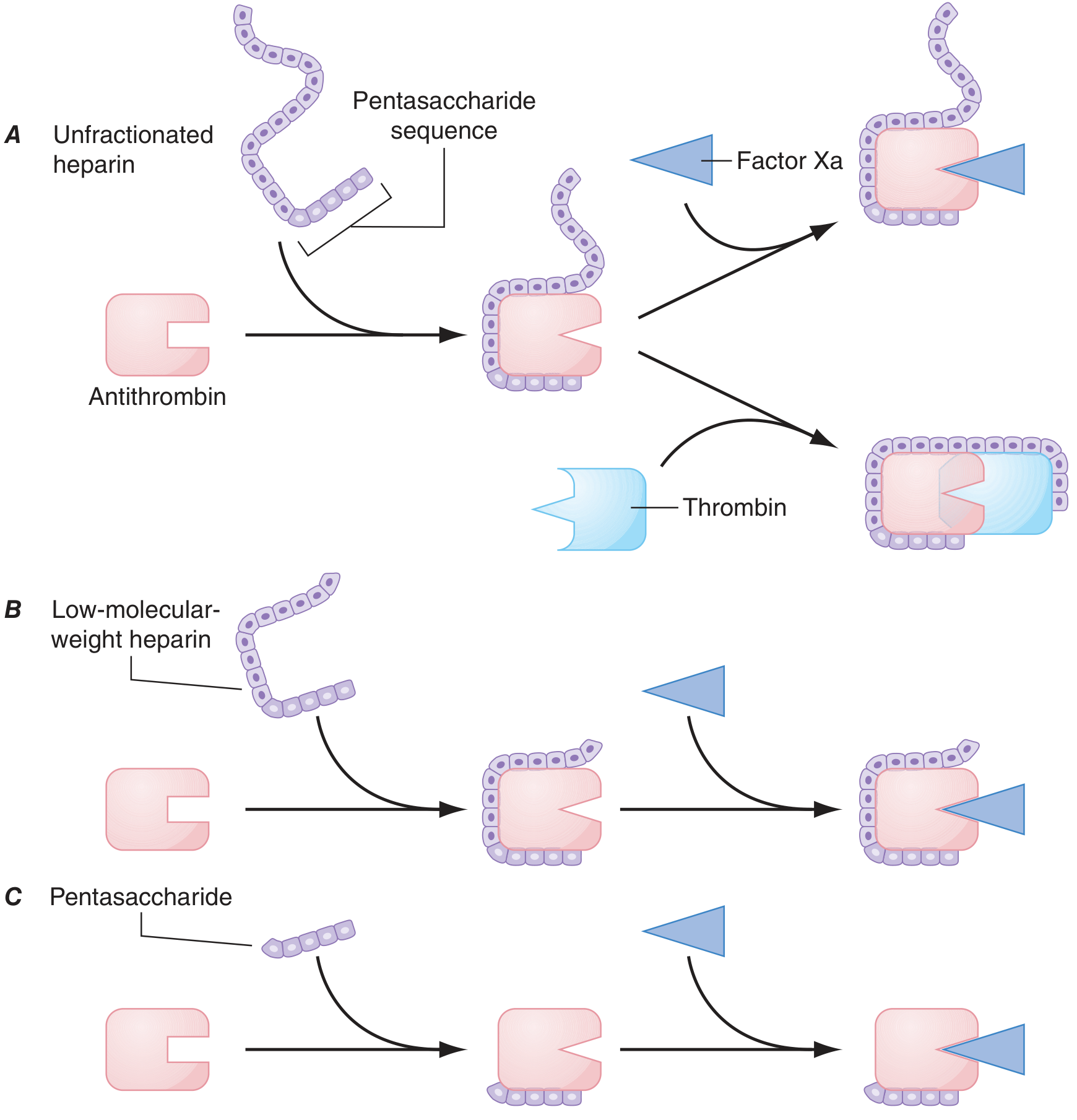
Figure: Mechanism of action of heparin, LMWH, and fondaparinux. (A) UFH contains the pentasaccharide sequence and is long enough to bridge antithrombin to both Factor Xa and thrombin. (B) LMWH activates antithrombin to inhibit Factor Xa but most chains are too short to bridge thrombin. - Harrison's Principles of Internal Medicine, 22e
3. Comparison Table
| Feature | UFH | LMWH |
|---|---|---|
| Source | Porcine intestinal mucosa | Depolymerized from UFH |
| Molecular weight | ~15,000 Da (range 5,000-30,000) | ~5,000 Da (range 1,000-10,000) |
| Anti-Xa : Anti-IIa | 1 : 1 | 2:1 to 4:1 |
| Route | IV (infusion) or SC | SC (usually); IV if needed |
| Bioavailability (SC) | ~30% (variable) | ~90% (predictable) |
| Half-life | ~1 hour (dose-dependent) | ~4 hours (fixed) |
| Clearance | Dose-dependent (saturable - endothelium + macrophages); also renal | Non-dose-dependent; predominantly renal |
| Plasma protein binding | High - binds many plasma proteins | Low - less protein binding |
| Monitoring | aPTT (target 1.5-2.5x control) | Not required routinely; anti-Xa level if needed (target 0.5-1.2 U/mL for treatment; 0.2-0.5 U/mL for prophylaxis) |
| Dose response | Variable / unpredictable | Predictable |
| Resistance | Can occur (heparin-binding proteins) | Rare |
| HIT risk | Higher (~1-5% in surgical patients) | Lower |
| Reversal | Protamine sulfate (1 mg per 100 U heparin) - full reversal | Protamine sulfate - only partial reversal (~60% of anti-Xa activity) |
| Placental crossing | Does NOT cross | Does NOT cross |
| Renal failure | Safer (hepatic clearance predominates) | Accumulates - use with caution if CrCl <30 mL/min |
| Cost | Cheap | More expensive |
| Administration | Requires hospitalization (continuous IV) | Outpatient possible |
4. Pharmacokinetics - Key Differences
UFH has a complex, dose-dependent clearance:
- Binds endothelial cells, macrophages, and plasma proteins - a rapid, saturable phase
- Also cleared renally, but renal clearance is less dominant
- Unpredictable dose-response; requires continuous aPTT monitoring
- Half-life is dose-dependent: ~30 min at low doses, ~150 min at very high doses
LMWH has simpler, predictable kinetics:
- Shorter chains bind less avidly to endothelial cells and macrophages - eliminates the saturable clearance pathway
- Clearance is renal and non-dose-dependent
- ~90% bioavailability after SC injection
- Half-life ~4 hours; can be given once or twice daily
- Predictable response allows fixed weight-based dosing without monitoring in most patients
- Braunwald's Heart Disease: "Capitalizing on this feature, studies in patients with VTE have shown that home treatment with LMWH is as effective and safe as in-hospital treatment with continuous intravenous infusions of heparin."
5. Adverse Effects
Bleeding
- Major side effect of both agents
- UFH: reversible with protamine sulfate (complete neutralization)
- LMWH: protamine only partially reverses (~60%) - this is a clinical limitation
Heparin-Induced Thrombocytopenia (HIT)
- More common with UFH than LMWH
- Platelet count falls 5-14 days after starting heparin (earlier if previous exposure)
- Mediated by IgG antibodies against heparin-PF4 complex - activate platelets, generate procoagulant microparticles
- Associated with paradoxical thrombosis (venous > arterial)
- Management: stop heparin immediately and switch to a non-heparin anticoagulant (argatroban, bivalirudin, fondaparinux)
- LMWH should NOT be used to treat HIT (cross-reactive antibodies)
- If prophylaxis with LMWH instead of UFH - HIT risk is much lower
Osteoporosis
- UFH causes more osteoporosis (long-term use) than LMWH
- Mechanism: UFH activates osteoclasts and suppresses osteoblasts
Hypersensitivity
- Anaphylaxis possible with protamine reversal (administer slowly)
6. Monitoring
| Drug | Test | Target |
|---|---|---|
| UFH | aPTT | 1.5 - 2.5x control |
| UFH | Anti-Xa (alternative) | 0.3-0.7 U/mL |
| LMWH | Usually none needed | - |
| LMWH | Anti-Xa (if monitoring required) | 0.5-1.2 U/mL (treatment); 0.2-0.5 U/mL (prophylaxis) |
LMWH monitoring is indicated in:
- Renal insufficiency (CrCl <30 mL/min)
- Extremes of body weight (morbid obesity, very low weight)
- Pregnancy
7. Clinical Indications
| Indication | Preferred Agent |
|---|---|
| DVT / PE treatment (stable) | LMWH (outpatient possible) |
| DVT / PE - high bleeding risk (need rapid reversal) | UFH |
| PE in pregnancy | LMWH preferred (both safe - neither crosses placenta) |
| ACS / STEMI | Both used; UFH in cath lab setting |
| Cardiopulmonary bypass / cardiac surgery | UFH only (LMWH not used; protamine needed) |
| Renal failure (CrCl <30) | UFH preferred |
| HIT management | Neither - switch to argatroban/bivalirudin |
| VTE prophylaxis | LMWH preferred |
8. Reversal
- UFH: Complete reversal with protamine sulfate (1 mg neutralizes 100 U heparin). Anaphylactoid reactions possible - administer slowly.
- LMWH: Protamine only partially reverses (~60% anti-Xa activity). No complete antidote available (andexanet alfa has activity but is not universally available for LMWH).
9. Specific Preparations of LMWH
| Drug | Anti-Xa : Anti-IIa ratio |
|---|---|
| Enoxaparin | ~3.8:1 |
| Dalteparin | ~2.7:1 |
| Tinzaparin | ~1.9:1 |
| Nadroparin | ~3.2:1 |
10. Summary
LMWH offers multiple advantages over UFH:
- More predictable pharmacokinetics
- Higher SC bioavailability (~90% vs ~30%)
- Longer half-life - once/twice daily dosing
- No routine coagulation monitoring needed
- Lower risk of HIT
- Lower risk of osteoporosis
- Outpatient treatment possible (reduces hospitalization)
UFH remains preferred when:
- Rapid onset and reversibility are needed (e.g., surgical or bleeding risk scenarios)
- Renal failure is present
- Cardiopulmonary bypass is planned
Sources: Braunwald's Heart Disease 11e (Table 95.7, Ch. 95); Harrison's Principles of Internal Medicine 22e (Ch. 123); Goodman & Gilman's Pharmacological Basis of Therapeutics (Ch. 36)
This is a shared conversation. Sign in to Orris to start your own chat.