
Murmur basic to advanced
Reading File
Before diving in - let me clarify so I give you exactly what's useful.
Asking for Preferences
What aspect of cardiac murmurs do you want covered? · What's your level?
Good. I'll build a complete murmur guide from the ground up - physiology, grading, every major murmur type, and clinical approach. Let me pull from the textbooks now.
Finding Sources
Finding Sources
Finding Sources
Finding Sources
Excellent finds. Let me read the most valuable sources in parallel - Harrison's assessment chapter, Guyton's murmur physiology, and Braunwald's valvular disease.
Reading File
Reading File
Reading File
Now let me get the Harrison's dedicated murmur chapter and Tintinalli's approach, plus search for specific valvular murmur content.
Reading File
Reading File
Finding Sources
Excellent content from Harrison's. Now let me get more from this chapter - the grading section, maneuvers, and specific murmurs.
Reading File
Finding Sources
I now have rich content from Harrison's. Let me read the Schwartz table on maneuvers and the Miller's anesthesia section, plus fetch the Harrison's diagram image.
Reading File
Loading Image
I have all the key content. Let me also get the Harrison's grading scale and the diagnostic flowchart image, then compile the full guide.
Loading Image
Finding Sources
I now have all the content I need from authoritative sources. Let me compile the comprehensive guide.# Cardiac Murmurs: Basic to Advanced
1. What is a Murmur?
A heart murmur is an audible vibration produced by turbulent blood flow. Three mechanisms generate turbulence:
- Accelerated flow through a normal or abnormal orifice (e.g., high-output states, stenotic valves)
- Flow into a dilated chamber or vessel downstream of a narrowing (post-stenotic dilation)
- Backward (regurgitant) flow through an incompetent valve, VSD, or PDA
The duration of a murmur depends on how long a pressure difference exists between two cardiac structures. That pressure gradient determines the velocity, turbulence, and resulting frequency and intensity of the sound. - Harrison's Principles of Internal Medicine 22E
2. Cardiac Cycle: The Framework
Understanding timing requires knowing the cardiac cycle:
| Phase | Valves Open | Valves Closed |
|---|---|---|
| Systole (S1 → S2) | Aortic, Pulmonic | Mitral, Tricuspid |
| Diastole (S2 → S1) | Mitral, Tricuspid | Aortic, Pulmonic |
- S1 = closure of mitral and tricuspid valves (onset of systole)
- S2 = closure of aortic (A2) and pulmonic (P2) valves (onset of diastole)
First step in characterizing any murmur: identify S1 vs. S2. In tachycardia where this is difficult, palpate the carotid pulse simultaneously - it closely follows S1.
3. Grading (Levine Scale, Grade 1-6)
| Grade | Description |
|---|---|
| 1/6 | Faint; appreciated only by careful auscultation in a quiet room |
| 2/6 | Soft but readily audible |
| 3/6 | Moderately loud; NOT accompanied by a palpable thrill |
| 4/6 | Loud; accompanied by a palpable thrill |
| 5/6 | Very loud; heard with stethoscope partly off the chest; thrill present |
| 6/6 | Audible without a stethoscope at all; thrill present |
Key threshold: A thrill first appears at grade 4. Any murmur with a thrill is at minimum 4/6.
Clinical rule: Grades ≥ III/VI, holosystolic, or late systolic murmurs warrant echocardiography. Any diastolic or continuous murmur also warrants echo. - Harrison's 22E, Tintinalli's Emergency Medicine
4. Murmur Characteristics to Describe
Every time you hear a murmur, characterize it by all 8 attributes:
| Attribute | Examples |
|---|---|
| Timing | Systolic, diastolic, continuous |
| Duration | Early, mid, late, holo/pan |
| Intensity | Grade 1-6 |
| Quality/Pitch | Harsh, blowing, rumbling, musical |
| Configuration | Crescendo, decrescendo, crescendo-decrescendo (diamond), plateau |
| Location | RUSB, LUSB, LLSB, apex |
| Radiation | To neck (AS), axilla (MR), back |
| Response to maneuvers | Inspiration, Valsalva, standing, squatting |
5. Murmur Types - The Master Diagram
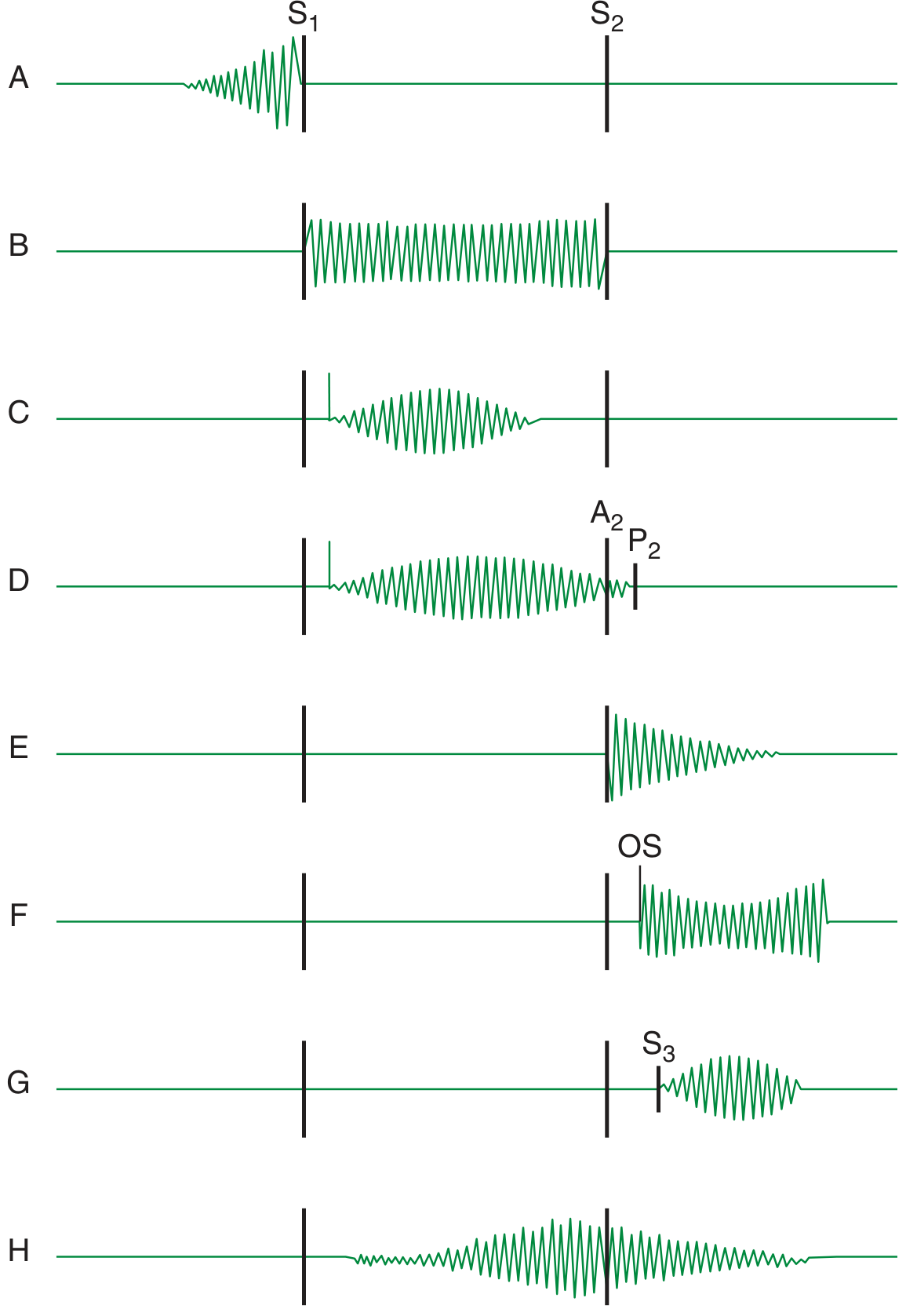
Figure: (A) Presystolic murmur of MS/TS in sinus rhythm. (B) Holosystolic murmur of MR/TR/VSD. (C) Aortic ejection murmur with ejection click. (D) Pulmonic stenosis murmur spilling through A2. (E) Aortic/pulmonary diastolic decrescendo. (F) Long diastolic murmur of MS after opening snap. (G) Short mid-diastolic murmur after S3. (H) Continuous PDA machinery murmur. - Harrison's 22E
6. SYSTOLIC Murmurs
A. Midsystolic (Ejection) Murmurs
- Timing: Begin just after S1, crescendo-decrescendo ("diamond") shape, end before S2
- Mechanism: Outflow tract obstruction or increased ejection flow
Aortic Stenosis (AS)
- Where: Right upper sternal border (RUSB, 2nd intercostal space)
- Radiation: To carotids bilaterally
- Quality: Harsh, crescendo-decrescendo
- Associated findings: Pulsus parvus et tardus (slow-rising, low-amplitude carotid pulse), soft/absent A2, S4, sustained apical impulse
- Gallavardin effect: The murmur sounds higher-pitched and more musical at the apex - can mimic MR
- Key point: The murmur does NOT reliably reflect severity in severe AS with low-output states (the murmur can become soft as CO falls)
Pulmonary Stenosis (PS)
- Where: Left upper sternal border (LUSB)
- Radiation: To left shoulder/back
- Quality: Harsh, crescendo-decrescendo; murmur spills through A2 (delayed P2)
- Associated: Pulmonic ejection click (decreases with inspiration - unique to pulmonic), wide split S2
Hypertrophic Obstructive Cardiomyopathy (HOCM/HCM)
- Where: LLSB and apex; does NOT radiate to neck
- Quality: Harsh, crescendo-decrescendo
- Classic distinguishing feature: Murmur INCREASES with Valsalva and standing (decreased preload reduces LV volume, worsening obstruction); DECREASES with squatting and passive leg raise
Innocent/Benign ("Still's") Murmur
- Who: Children, adolescents, high-output states (pregnancy, anemia, fever, thyrotoxicosis)
- Character: Grade 1-2, soft, vibratory or musical, midsystolic
- Location: Mid-LLSB, best heard supine
- No radiation, no associated cardiac findings - disappears with Valsalva or sitting up
B. Holosystolic (Pansystolic) Murmurs
- Timing: Begin with S1 and continue through all of systole to S2 (plateau configuration)
- Mechanism: Persistent large pressure gradient throughout systole between two chambers
Mitral Regurgitation (MR)
- Where: Apex
- Radiation: To left axilla (posterior leaflet prolapse/flail) OR to base/neck (anterior leaflet flail - can mimic AS)
- Quality: High-pitched, blowing, holosystolic plateau
- Associated: S3 (severe MR), hyperdynamic apex
- In MVP: Murmur is late systolic, preceded by a nonejection click; with standing the click moves earlier (toward S1) and murmur gets louder; with squatting the opposite occurs
Tricuspid Regurgitation (TR)
- Where: Lower left sternal border (LLSB) or xiphoid
- Key feature: Increases with inspiration (Carvallo's sign) - more blood returns to right heart
- Associated: Pulsatile liver, prominent v waves in JVP
Ventricular Septal Defect (VSD)
- Where: LLSB (3rd-4th interspace)
- Quality: Harsh, holosystolic
- Radiation: Often across the precordium
- Thrill: Common even with smaller defects
C. Late Systolic Murmurs
Mitral Valve Prolapse (MVP)
- Character: Mid-to-late systolic murmur at the apex, often preceded by one or more mid-systolic clicks
- Dynamic changes: A critical distinguishing feature:
- Standing / Valsalva strain phase → click moves earlier toward S1, murmur becomes louder and longer
- Squatting / passive leg raise → click moves later toward S2, murmur becomes softer and shorter
- This is because MVP timing depends on LV volume: smaller LV = earlier prolapse
7. DIASTOLIC Murmurs
All diastolic murmurs are pathologic until proven otherwise.
A. Early Diastolic (Decrescendo, High-Pitched)
Aortic Regurgitation (AR)
- Where: Left sternal border (3rd-4th interspace), lean forward, breath held in expiration
- Quality: High-pitched, blowing, decrescendo - best with diaphragm
- Radiation: Along left sternal border
- Associated signs (all due to wide pulse pressure):
- Corrigan's (water-hammer) pulse - bounding, collapsing
- De Musset's sign - head bobbing
- Quincke's sign - capillary pulsations in nail beds
- Hill's sign - popliteal SBP > brachial SBP by ≥20 mmHg
- Austin Flint murmur - mid-diastolic rumble at apex (regurgitant jet vibrates anterior mitral leaflet, mimicking MS)
Pulmonary Regurgitation (PR)
- Graham-Steell murmur: High-pitched early diastolic murmur at LUSB in pulmonary hypertension (elevated PA pressure causes PR)
B. Mid-Diastolic (Rumbling, Low-Pitched)
Mitral Stenosis (MS)
- Where: Apex, patient in left lateral decubitus position
- Quality: Low-pitched, rumbling, mid-diastolic with presystolic accentuation (in sinus rhythm, just before S1 as atrium contracts)
- Best heard with: Bell of stethoscope with light pressure
- Associated findings:
- Loud S1 (valve closes from a wide-open position)
- Opening snap (OS) - high-pitched, best heard medial to apex; the shorter the S2-OS interval, the more severe the stenosis (higher LA pressure closes the gap)
- Left atrial enlargement → AF → presystolic accentuation disappears
- Cause: Rheumatic fever (most common worldwide), mitral annular calcification
- Symptoms: Exertional dyspnea, orthopnea, hemoptysis, systemic emboli
Tricuspid Stenosis (TS)
- Similar to MS but at LLSB; increases with inspiration
8. CONTINUOUS Murmurs
Patent Ductus Arteriosus (PDA)
- Character: Begins in systole, continues through S2, into diastole - the classic "machinery murmur"
- Why: Because the aorta-to-PA pressure gradient persists throughout the cardiac cycle (aortic pressure always exceeds pulmonary in normal anatomy)
- Where: Left infraclavicular area / LUSB
- Waxes and wanes with the cardiac cycle (louder in systole when aortic pressure peaks, quieter in diastole)
- Guyton: "The murmur is much more intense during systole, when the aortic pressure is high, and much less intense during diastole, when the aortic pressure falls low" - Guyton & Hall Medical Physiology
- Complication: Progressive pulmonary hypertension → Eisenmenger syndrome (reversal of shunt, cyanosis)
9. Dynamic Auscultation - Bedside Maneuvers
These are high-yield for exams and clinical practice.
| Maneuver | Physiology | Most Murmurs | HCM | MVP |
|---|---|---|---|---|
| Valsalva (strain phase) | Decreases venous return → ↓ preload → ↓ LV volume | Softer | Louder | Louder, longer |
| Standing | Decreases venous return → ↓ preload | Softer | Louder | Louder, earlier click |
| Squatting | Increases preload AND afterload → ↑ LV volume | Louder | Softer | Softer, later click |
| Passive leg raise | Increases venous return → ↑ preload | Louder | Softer | Softer |
| Inspiration | Increases right heart filling | Right-sided louder | - | - |
| Expiration | Increases left heart filling | Left-sided louder | - | - |
| Post-PVC | Longer filling time → ↑ SV next beat | Semilunar stenosis louder; AV regurgitation unchanged | - | - |
| Amyl nitrite | Decreases afterload → ↓ BP | AS, PS, HCM louder; MR, AR softer | Louder | Variable |
| Isometric exercise (handgrip) | Increases afterload → ↑ BP | MR, VSD, AR louder; AS softer | Softer | Softer |
The HCM rule: Any maneuver that decreases LV volume increases the HCM murmur. The opposite decreases it. MVP follows the same directional rule.
10. Summary Table - All Key Murmurs
| Condition | Timing | Location | Quality | Radiation | Key Feature |
|---|---|---|---|---|---|
| Aortic Stenosis | Mid-systolic | RUSB | Harsh, crescendo-decrescendo | Carotids | Pulsus parvus et tardus; soft A2 |
| Mitral Regurgitation | Holosystolic | Apex | Blowing, plateau | Axilla | S3; hyperdynamic apex |
| MVP | Late systolic | Apex | Variable + click | Axilla | Click moves earlier with standing |
| Pulmonic Stenosis | Mid-systolic | LUSB | Harsh | Left shoulder | Ejection click ↓ with inspiration; wide split S2 |
| VSD | Holosystolic | LLSB | Harsh | Across precordium | Thrill common |
| Tricuspid Regurgitation | Holosystolic | LLSB/xiphoid | Blowing | - | ↑ with inspiration (Carvallo's) |
| HCM | Mid-systolic | LLSB | Harsh | - | ↑ with Valsalva/standing |
| Aortic Regurgitation | Early diastolic | LLSB (lean forward) | Blowing, decrescendo | - | Wide pulse pressure; Austin Flint |
| Mitral Stenosis | Mid-diastolic | Apex (left lateral) | Low rumble | - | Loud S1, OS, presystolic accentuation |
| PDA | Continuous | LUSB/infraclavicular | Machinery | - | Persists through S2 |
11. Clinical Approach - Decision Flowchart
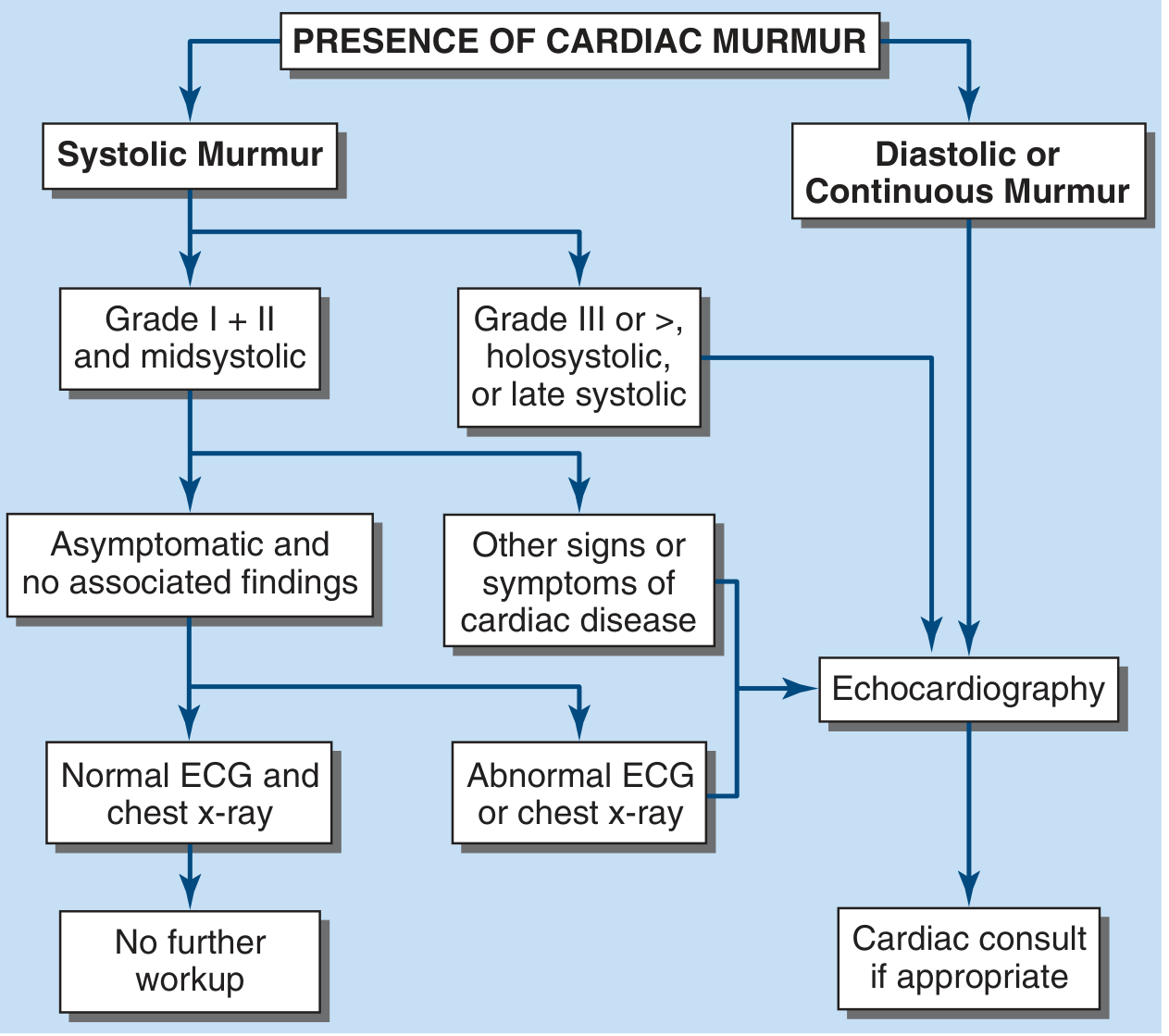
Practical decision rules:
- Soft midsystolic (grade 1-2) murmur, asymptomatic, no cardiac signs, normal ECG/CXR → No further workup needed
- Grade ≥ III/VI systolic, holosystolic, or late systolic → Echocardiography
- Any diastolic or continuous murmur → Always pathologic → Echo + cardiology referral
- New murmur + fever → Think endocarditis
- New murmur + acute dyspnea → Emergency - could be acute MR (papillary muscle rupture post-MI), acute AR (endocarditis, aortic dissection) → emergent echo
12. Innocent vs. Pathologic - Quick Checklist
Features suggesting INNOCENT:
- Grade 1-2, midsystolic
- Soft, vibratory, or musical
- LLSB in children
- Disappears with Valsalva, sitting, or standing
- No radiation, no associated clicks/extra sounds
- Asymptomatic patient, normal ECG
Red flags suggesting PATHOLOGIC:
- Diastolic or continuous
- Grade ≥ 3 or associated thrill
- Holosystolic or late systolic
- Radiation to neck or axilla
- Associated S3, S4, click, opening snap
- Any cardiac symptoms (dyspnea, syncope, chest pain, edema)
- Abnormal ECG or CXR
Sources: Harrison's Principles of Internal Medicine 22E (2025) | Guyton & Hall Textbook of Medical Physiology | Tintinalli's Emergency Medicine | Schwartz's Principles of Surgery 11E | Goldman-Cecil MedicineThat's the complete murmur guide, structured from first principles to advanced clinical application. Here's a quick orientation to what's covered:
Sections at a glance:
- What causes murmurs - the 3 turbulence mechanisms
- Cardiac cycle - the timing framework everything hangs on
- Levine grading scale - 1-6 with the thrill threshold
- 8 attributes to describe any murmur
- Master diagram from Harrison's 22E showing all murmur waveform patterns
- Systolic murmurs - AS, PS, HCM, innocent murmurs, MR, TR, VSD, MVP
- Diastolic murmurs - AR (with all peripheral signs), PR, MS, TS
- Continuous murmurs - PDA machinery murmur
- Dynamic maneuvers table - the HCM/MVP rule is the highest-yield exam topic here
- Master summary table - all murmurs in one place
- Diagnostic flowchart from Harrison's
- Innocent vs. pathologic checklist
The two things most students get wrong early on:
- Confusing timing (HCM murmur is systolic, not diastolic despite being due to obstruction)
- The MVP/HCM maneuver rule: decreased LV volume = louder murmur for both; just remember Valsalva and standing do that, while squatting reverses it
This is a shared conversation. Sign in to Orris to start your own chat.