
I need a similar yet different types of like amine amide With structure activity diffrence
bioisosteres of amine amide groups structure activity relationship medicinal chemistry
https://www.iis.u-tokyo.ac.jp/~kkudo/Bioisosterism.pdf
bioisosteres amine amide functional groups structure activity relationship medicinal chemistry table
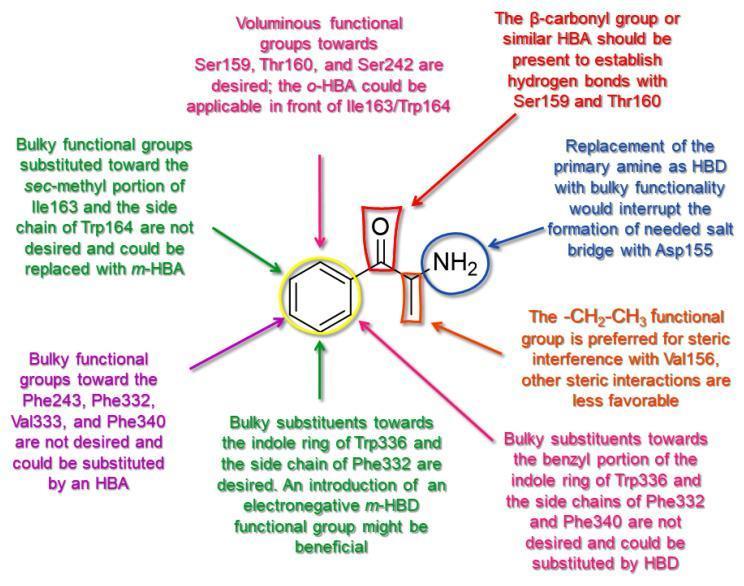
This 2D medicinal chemistry diagram illustrates a Structure-Activity Relationship (SAR) model for substituted cathinones (SCs) acting as ligands for the human 5-HT2A receptor. The central chemical scaffold consists of a benzene ring core connected to a beta-carbonyl (C=O) group, an alkyl chain with an ethyl (-CH2-CH3) substituent, and a primary amine (-NH2). Colored arrows and annotations detail specific pharmacophoric requirements for receptor binding and agonizing activity. Key features include: the beta-carbonyl group required for hydrogen bonding with Ser159 and Thr160; the primary amine acting as a hydrogen bond donor (HBD) to form a critical salt bridge with Asp155; and the ethyl group providing optimal steric interference with Val156. Around the benzene ring, the model highlights specific zones for substitutions: voluminous functional groups are favored toward Ser159, Thr160, Ser242, and the indole ring of Trp336, while bulky substituents are discouraged in regions directed toward Ile163, Trp164, Phe243, Phe332, Val333, and Phe340. This diagram serves as an educational tool for pharmacodynamic profiling and virtual screening of potential psychostimulant or psychedelic agents.
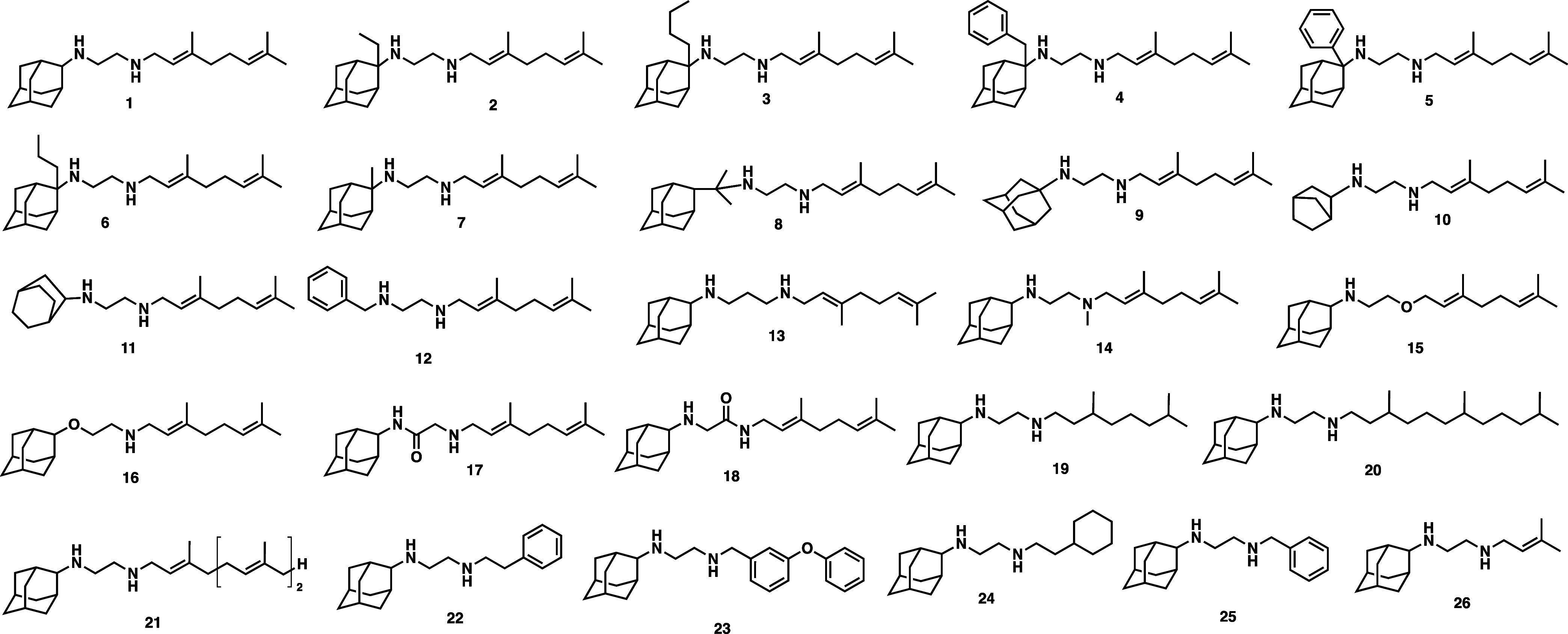
This scientific illustration displays a series of 26 chemical structures categorized for medicinal chemistry research into antimalarial agents. The structures represent analogs of SQ109/1, an antitubercular clinical candidate with activity against Plasmodium falciparum. The diagram is divided into three Structure-Activity Relationship (SAR) study groups. SAR-1 (Compounds 1-12) explores modifications at the 2-adamantyl head group and its linker, including alkyl (ethyl, propyl) and aromatic (benzyl, phenyl) substitutions, as well as bioisosteric replacements with cyclohexyl and bicyclic moieties. SAR-2 (Compounds 13-18) details modifications to the ethylenediamine linker, such as chain extension, N-methylation, oxygen substitution, and the introduction of amide linkages. SAR-3 (Compounds 19-26) focuses on the hydrophobic geranyl tail, illustrating variations like tail saturation, chain extension, and replacement with cyclohexyl or various phenyl-based aromatic groups. These molecular diagrams are essential for understanding the chemical space optimized for targeting multiple stages of the malaria parasite life cycle, particularly late-stage gametocytes.
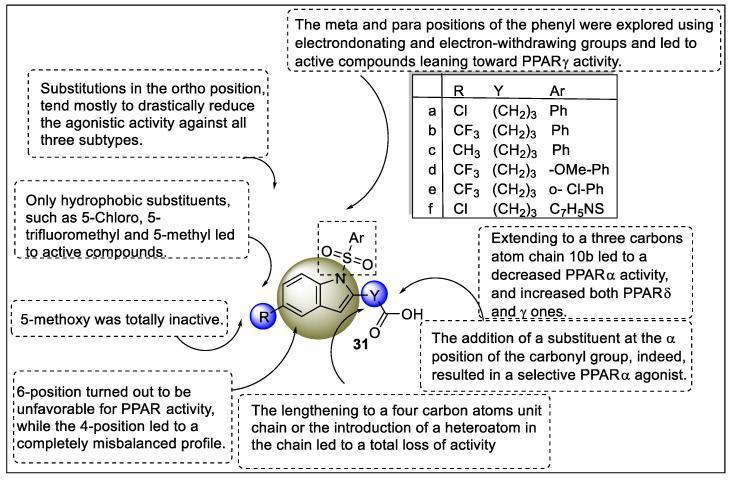
This medicinal chemistry diagram illustrates the structural-activity relationship (SAR) of indole hybrid compounds (labeled 31) acting as peroxisome proliferator-activated receptor (PPAR) ligands. The central structure is an indole scaffold fused with a sulfonamide group (Ar) and a carboxylic acid chain. Key substitution sites are identified as R, Y, and Ar. Educational annotations specify that hydrophobic substituents at the R position (5-Chloro, 5-trifluoromethyl, and 5-methyl) maintain activity, while 5-methoxy is inactive. Modifying the chain length at position Y significantly impacts subtype selectivity: a three-carbon chain decreases PPAȒ activity but increases PPAR̔ and ̓ potency, whereas a four-carbon chain or heteroatom introduction leads to complete loss of activity. Ortho-substitutions on the Ar phenyl ring reduce agonistic activity across all PPAR subtypes, while meta and para substitutions favor PPAR̓. A table lists specific analogues (a-f) with their respective R, Y, and Ar groups, such as Cl, CF3, and phenyl variants, providing a comprehensive overview of how molecular modifications influence receptor binding and therapeutic selectivity in metabolic signaling pathways.
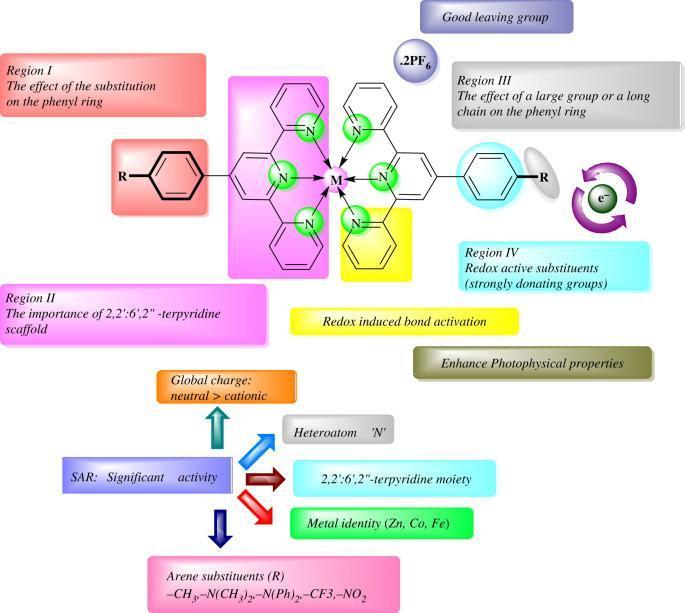
This medicinal chemistry infographic illustrates the Structure-Activity Relationship (SAR) of synthesized terpyridine-based metal complexes, focusing on their potential as antimicrobial agents. The central figure depicts a transition metal complex where a central metal atom (M), such as Zn, Co, or Fe, is coordinated by a 2,2′:6′,2″-terpyridine tridentate ligand. The diagram highlights four critical regions of chemical modification: Region I explores phenyl ring substitutions (R groups), Region II emphasizes the terpyridine scaffold, Region III assesses steric effects of bulky peripheral groups, and Region IV focuses on redox-active, strongly donating substituents. Associated hexafluorophosphate (.2PF₆) counterions are shown for cationic complexes. Below the structural model, a flowchart summarizes key factors influencing 'Significant Activity,' including global charge (neutral vs. cationic), nitrogen heteroatoms, and metal identity. Specific arene substituents like -CH₃, -N(CH₃)₂, and -NO₂ are listed as variables that tune antibacterial efficacy through lipophilicity and electronic induction, impacting the complex's ability to permeate bacterial cell membranes.
Functional Groups Similar to Amines and Amides - SAR Comparison
Part 1: Amine (-NH₂ / -NHR / -NR₂) and Its Similar Groups
| Group | Structure | Key Difference from Amine | SAR Impact |
|---|---|---|---|
| Amine | -NH₂ / -NHR | Reference group | Basic (pKa ~10), H-bond donor + acceptor, nucleophilic |
| Guanidine | -NH-C(=NH)-NH₂ | Adds extra N and C=NH | Strongly basic (pKa ~12.5), multiple H-bond donors - improves binding to acidic/anionic targets |
| Amidine | -C(=NH)-NH₂ | C=NH instead of N only | Highly basic, flat structure, good for ionic interactions with Asp/Glu residues |
| Hydroxylamine | -NH-OH | O replaces one H | Weaker base than amine, different H-bonding pattern, can chelate metals |
| Hydrazine | -NH-NH₂ | Two N atoms linked | More reactive, used in prodrugs, can form Schiff bases |
| Sulfonamide | -NH-SO₂- | SO₂ replaces C | Weaker base (pKa ~10), more acidic NH, better metabolic stability than amine |
| Urea | -NH-CO-NH- | Carbonyl between two N | Flat, H-bond donor + acceptor on both ends, less basic, improved metabolic stability |
- Increasing substitution (1° → 2° → 3°) increases lipophilicity and decreases basicity slightly
- 3° amines cannot H-bond as donors - may reduce binding but improve membrane permeability
- Replacing -NH₂ with guanidine dramatically increases basicity and binding to carboxylate residues in enzyme active sites
- Sulfonamide replacement reduces pKa significantly - better CNS penetration in some cases, reduced amine toxicity
Part 2: Amide (-CONH-) and Its Similar Groups (Bioisosteres)
| Group | Structure | Key Difference from Amide | SAR Impact |
|---|---|---|---|
| Amide | -CO-NH- | Reference group | Planar, H-bond donor (NH) + acceptor (C=O), metabolically labile |
| Reversed amide | -NH-CO- | Flipped orientation | Same H-bonding but reversed vector - can maintain or change activity |
| Thioamide | -CS-NH- | S replaces O | More lipophilic, C=S is weaker H-bond acceptor, more metabolically stable |
| Sulfonamide | -SO₂-NH- | SO₂ replaces CO | Stronger H-bond donor (NH more acidic), no H-bond acceptor from S=O in same way, more stable to hydrolysis |
| Urea | -NH-CO-NH- | Extra NH added | Two H-bond donors, symmetric, flat - used for enhanced binding in kinase inhibitors |
| Carbamate | -O-CO-NH- | O replaces NH | Still H-bond donor but now also ester-like - more metabolically labile, changes hydrophilicity |
| Ketomethylene | -CO-CH₂- | CH₂ replaces NH | Loses H-bond donor - more lipophilic, protease-resistant (used in peptidomimetics) |
| Methyleneamino | -CH₂-NH- | CH₂ replaces CO | Loses H-bond acceptor from carbonyl, adds flexibility, more basic |
| 1,2,3-Triazole | cyclic N=N-N | Heterocyclic ring | Metabolically stable (resistant to proteases, oxidation, hydrolysis), H-bond acceptor but no donor |
| E-Alkene / Olefin | -CH=CH- | Mimics trans-amide geometry | Locks trans-conformation, removes all H-bonding, more lipophilic |
| Tetrazole | cyclic 4N ring | Bioisostere of carboxylic acid-amide | Acidic, highly water-soluble, metabolically stable |
| Oxazole / Imidazole | aromatic heterocycle | Ring replaces flat amide | Locks geometry, can act as H-bond acceptor, more lipophilic |
Part 3: Critical SAR Differences - Amine vs Amide
| Property | Amine | Amide |
|---|---|---|
| Basicity | Basic (pKa 8-11) | Non-basic (pKa < 0) |
| H-bond donor | Yes (N-H) | Yes (N-H) |
| H-bond acceptor | Yes (lone pair on N) | Yes (lone pair on N AND C=O) |
| Planarity | Pyramidal (sp³ N) | Planar (sp² N, resonance) |
| Nucleophilicity | Strong nucleophile | Very weak nucleophile (resonance) |
| Metabolic stability | Susceptible to N-oxidation, dealkylation | Susceptible to hydrolysis by amidases |
| Solubility | Often water-soluble (as salt) | Neutral, lower water solubility |
| CNS penetration | Protonated at pH 7.4 - reduced permeability | Neutral - better passive permeability |
Part 4: Classic Drug Examples Showing SAR Differences
Procaine → Procainamide (Amine Bioisostere)
- Procaine has an ester linkage - rapidly hydrolyzed, short duration
- Procainamide replaces ester O with NH (amide) - more resistant to hydrolysis, longer duration of action
- This is the classic "ester vs amide" SAR example in local anesthetics
Diazepam → Alprazolam
- Alprazolam has a triazole ring replacing part of the amide system
- Alprazolam does not produce active long-lived metabolites like diazepam does (half-life 50-120 h for diazepam vs shorter for alprazolam)
- The structural change dramatically alters metabolic fate
Sulpiride → Pyridazine Analogs
- The amide bond in sulpiride (D2 antagonist) was replaced by a pyridazine ring as a bioisostere
- The ring locks the planar geometry of the amide, maintains binding, but improves oral bioavailability
Capsaicin Analogs
- Replacing the amide in capsaicin with a 1,2,3-triazole converted a TRPV1 agonist into an antagonist
- The triazole cannot donate an H-bond the way the amide NH does, reversing the pharmacological outcome - a dramatic SAR consequence
Summary: Why These Replacements Are Made
| Goal | Strategy |
|---|---|
| Improve metabolic stability | Replace amide with sulfonamide, triazole, or E-alkene |
| Improve H-bonding | Replace amine with guanidine or urea |
| Increase lipophilicity / CNS permeability | Replace amine with 3° amine or replace amide NH with CH₂ (ketomethylene) |
| Lock conformation | Replace amide with oxazole, imidazole, or triazole ring |
| Reduce basicity | Replace amine with sulfonamide or amide |
| Improve selectivity | Use reversed amide or thioamide to change H-bond vector |
No i need similar to spell but different types of
imine imide enamine lactam lactim vs amine amide structural differences SAR pharmacology
A clean educational chemistry diagram showing 8 nitrogen-containing functional groups with similar spellings: Amine (R-NH2), Amide (R-CO-NH2), Imine (R2C=NH), Imide (CO-NH-CO), Enamine (C=C-NH), Lactam (cyclic amide), Lactim (cyclic imine/OH form), and Sulfonamide (R-SO2-NH2). Each group shown with its chemical structure drawn clearly, labeled with name and formula, arranged in a grid layout with color coding by structural type. White background, clear black line structures.
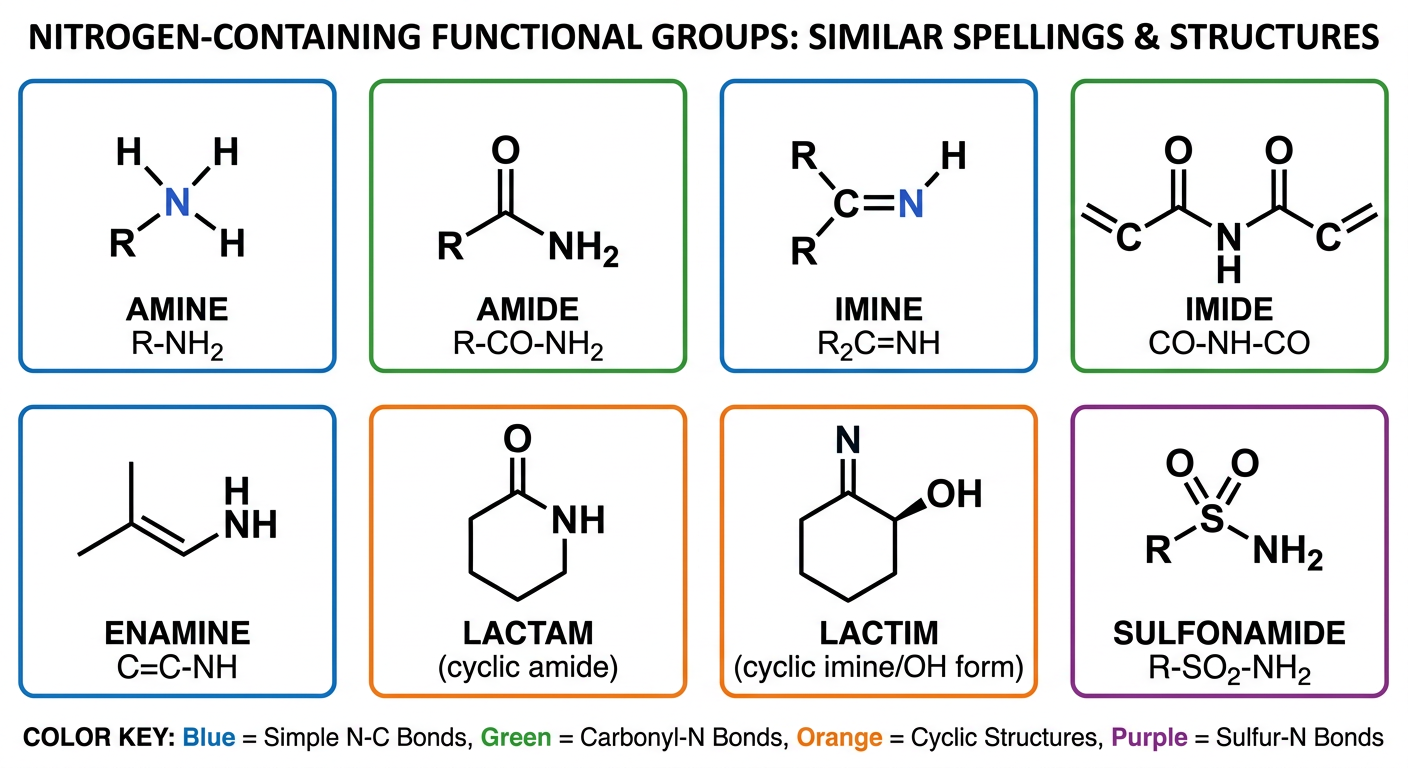
Amine, Amide and "Similar Spelling" Nitrogen Groups
The Complete Family
| # | Name | Formula | Key Feature |
|---|---|---|---|
| 1 | Amine | R-NH₂ | N bonded to C only |
| 2 | Amide | R-CO-NH₂ | N bonded to carbonyl (C=O) |
| 3 | Imine | R₂C=NH | C=N double bond |
| 4 | Imide | CO-NH-CO | N between two carbonyls |
| 5 | Enamine | C=C-NH | N bonded to a C=C alkene |
| 6 | Lactam | cyclic amide | Ring form of amide |
| 7 | Lactim | cyclic imine/=N-OH | Tautomer of lactam |
| 8 | Sulfonamide | R-SO₂-NH₂ | N bonded to SO₂ |
1. Amine vs Imine
| Property | Amine (R-NH₂) | Imine (R₂C=NH) |
|---|---|---|
| Bond type | C-N single bond (sp³ N) | C=N double bond (sp² N) |
| Hybridization | sp³ nitrogen, pyramidal | sp² nitrogen, planar |
| Basicity | Strong base, pKa ~10 | Weaker base, pKa ~5-7 |
| Reactivity | Nucleophile | Electrophile at C; hydrolyzed by water |
| H-bonding | Donor + acceptor | Donor (N-H) + acceptor (N lone pair) |
| SAR Impact | Stable in drug, persistent binding | Reactive intermediate; Schiff bases form reversibly with Lys residues in enzymes |
Key example: Pyridoxal phosphate (Vit B6) forms an imine (Schiff base) with lysine in aminotransferase enzymes - this C=N is the catalytic core of the reaction.
2. Amide vs Imide
| Property | Amide (R-CO-NH₂) | Imide (CO-NH-CO) |
|---|---|---|
| Structure | One C=O next to N | Two C=O flanking N |
| Basicity | Very weakly basic (pKa < 0) | Even more acidic than amide |
| N-H acidity | pKa ~25 | pKa ~8-10 (much more acidic!) |
| H-bond donor | Weak donor | Strong donor (acidic NH) |
| Drug example | Paracetamol (acetaminophen) | Thalidomide, Succinimide, Glutarimide |
| SAR Impact | Metabolically labile amide bond | More acidic NH, improved binding to basic residues, can ionize at physiological pH |
Key example: Thalidomide contains a glutarimide ring (imide). Its imide NH is much more acidic than a plain amide, and one enantiomer causes teratogenicity by binding cereblon via the imide NH.
3. Amine vs Enamine
| Property | Amine (R-NH₂) | Enamine (C=C-N) |
|---|---|---|
| Structure | N on sp³ carbon | N on sp² carbon adjacent to C=C |
| Resonance | None | Strong - N lone pair donates into C=C (push-pull) |
| Nucleophilicity | Nucleophilic at N | Nucleophilic at beta carbon (C=C end) |
| Basicity | pKa ~10 | pKa ~5 (lone pair delocalized, less basic) |
| Tautomer | Stable | Tautomers with iminium ion |
| SAR Impact | Binds targets via N | Reactive at C - used in covalent drug mechanisms, Michael acceptors |
Key example: Many natural alkaloids (e.g., ergot alkaloids, certain antibiotics) contain enamine moieties that contribute to reactivity and target engagement.
4. Lactam vs Lactim (Tautomers!)
| Property | Lactam (-CO-NH-, cyclic) | Lactim (=C-OH, cyclic, =N-) |
|---|---|---|
| Form | Keto/amide form | Enol/imine form |
| In solution | Predominant form in most lactams | Minor form (tautomer) |
| Example | Penicillin, beta-lactams | Uracil (lactim form in some conditions) |
| SAR Impact | Beta-lactam ring is the pharmacophore in penicillins - it acylates and irreversibly inhibits transpeptidase | Lactim form of purines/pyrimidines affects base-pairing in DNA |
Critical SAR fact: Purine and pyrimidine bases (adenine, guanine, cytosine, thymine, uracil) exist in lactam form normally, but shift to lactim form in rare tautomers - this causes mispairing mutations in DNA replication.
5. Amide vs Sulfonamide
| Property | Amide (-CO-NH-) | Sulfonamide (-SO₂-NH-) |
|---|---|---|
| Central atom | Carbon (C=O) | Sulfur (S=O)₂ |
| NH acidity | pKa ~25 | pKa ~10 (much more acidic!) |
| Metabolic stability | Cleaved by amidases | More resistant to hydrolysis |
| H-bond donor | Weak | Strong (acidic NH) |
| Drug examples | Paracetamol, Lidocaine | Sulfamethoxazole, Furosemide, Celecoxib |
| SAR Impact | Neutral at pH 7.4 | Can ionize at pH 7.4 - changes protein binding, plasma protein binding, and distribution |
Quick Memory Aid - Spelling Family
am-INE   → N single bond to C (basic, nucleophilic)
am-IDE   → N + C=O (less basic, planar, labile)
im-INE   → C=N double bond (electrophilic carbon)
im-IDE   → N between two C=O (acidic NH)
en-AMINE → N on C=C (nucleophilic at beta-C)
LACT-am  → cyclic amide
LACT-im  → cyclic imine/tautomer
SULFONAMIDE → N + SO₂ (acidic, stable)
Basicity Order (Most to Least Basic)
Generate a visual poster comparing 8 nitrogen-containing groups
A detailed educational science poster titled "8 Nitrogen-Containing Functional Groups" for medicinal chemistry students. The poster has a dark navy blue background with white and bright colored text. It is divided into 8 clearly labeled sections arranged in a 2x4 grid, each with a distinct color border. Each section contains: 1. AMINE (green) - Structure: R-NH2, sp3 nitrogen, pyramidal shape, strongly basic pKa ~10, nucleophilic at N, example: Dopamine 2. AMIDE (blue) - Structure: R-CO-NH2, sp2 nitrogen, planar resonance with C=O, weakly basic pKa less than 0, example: Paracetamol 3. IMINE (orange) - Structure: R2C=NH (Schiff base), C=N double bond, sp2 nitrogen, moderately basic pKa ~5-7, electrophilic carbon, example: Pyridoxal phosphate 4. IMIDE (red) - Structure: CO-NH-CO, nitrogen flanked by TWO carbonyls, very acidic NH pKa ~8-10, example: Thalidomide 5. ENAMINE (purple) - Structure: C=C-NH, nitrogen on alkene carbon, delocalized lone pair, nucleophilic at beta carbon, example: Ergot alkaloids 6. LACTAM (teal) - Structure: cyclic amide ring drawn as a 4-membered ring (beta-lactam), pharmacophore of penicillin, acylates transpeptidase 7. LACTIM (yellow) - Structure: cyclic imine-OH tautomer of lactam (=N-OH form), tautomer of DNA bases, causes mutations when formed 8. SULFONAMIDE (pink) - Structure: R-SO2-NH2, sulfur central atom with two oxygens, acidic NH pKa ~10, metabolically stable, example: Sulfamethoxazole At the bottom, a basicity order bar: Amine > Enamine > Imine > Amide > Imide > Sulfonamide. Clean hand-drawn style chemical structures in each box. Professional poster layout suitable for a pharmacy classroom.
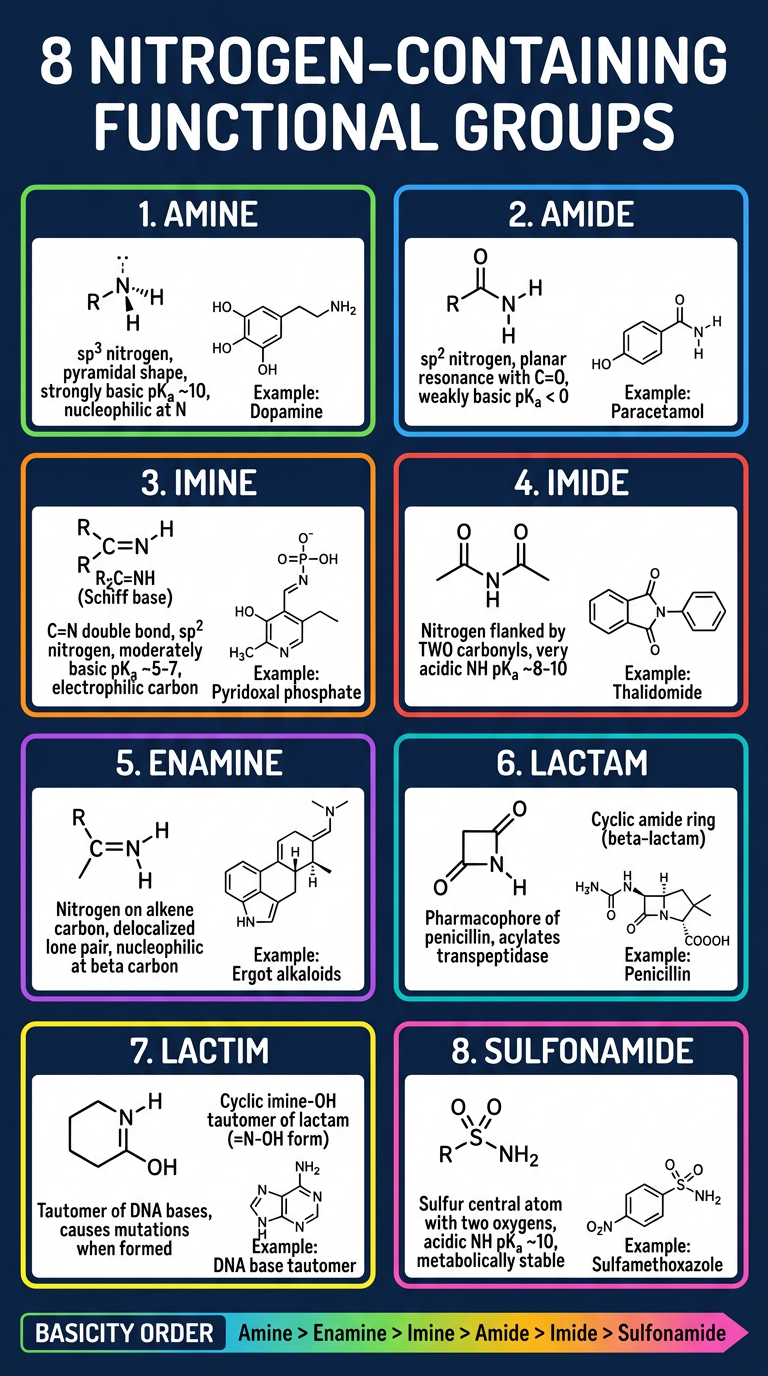
| # | Group | Color | Key ID |
|---|---|---|---|
| 1 | Amine | Green | R-NH₂, basic, pyramidal N |
| 2 | Amide | Blue | R-CO-NH₂, planar, resonance with C=O |
| 3 | Imine | Orange | R₂C=NH, C=N double bond, Schiff base |
| 4 | Imide | Red | CO-NH-CO, two carbonyls, acidic NH |
| 5 | Enamine | Purple | C=C-NH, nucleophilic at beta carbon |
| 6 | Lactam | Teal | Cyclic amide, penicillin pharmacophore |
| 7 | Lactim | Yellow | Cyclic imine tautomer, DNA base mutations |
| 8 | Sulfonamide | Pink | R-SO₂-NH₂, acidic NH, metabolically stable |
Can you make it simple
A simple clean white background poster showing 8 nitrogen functional groups as hand-drawn chemical structures in a 4x2 grid. Each box has a light colored background, the group name in bold at the top, one simple structural formula drawn clearly, and one short phrase describing it. Large clear fonts. Minimal text. Like a student flashcard sheet. Box 1 - AMINE: R-NH2 drawn, "N with single bonds, basic" Box 2 - AMIDE: R-CO-NH2 drawn, "N next to C=O" Box 3 - IMINE: R-C=NH drawn, "C=N double bond" Box 4 - IMIDE: CO-NH-CO drawn, "N between two C=O" Box 5 - ENAMINE: C=C-NH drawn, "N on a double bond carbon" Box 6 - LACTAM: small ring with NH and C=O, "cyclic amide" Box 7 - LACTIM: small ring with N and OH, "tautomer of lactam" Box 8 - SULFONAMIDE: R-SO2-NH2 drawn, "N bonded to SO2" Simple, clean, minimal, easy to read, student-friendly
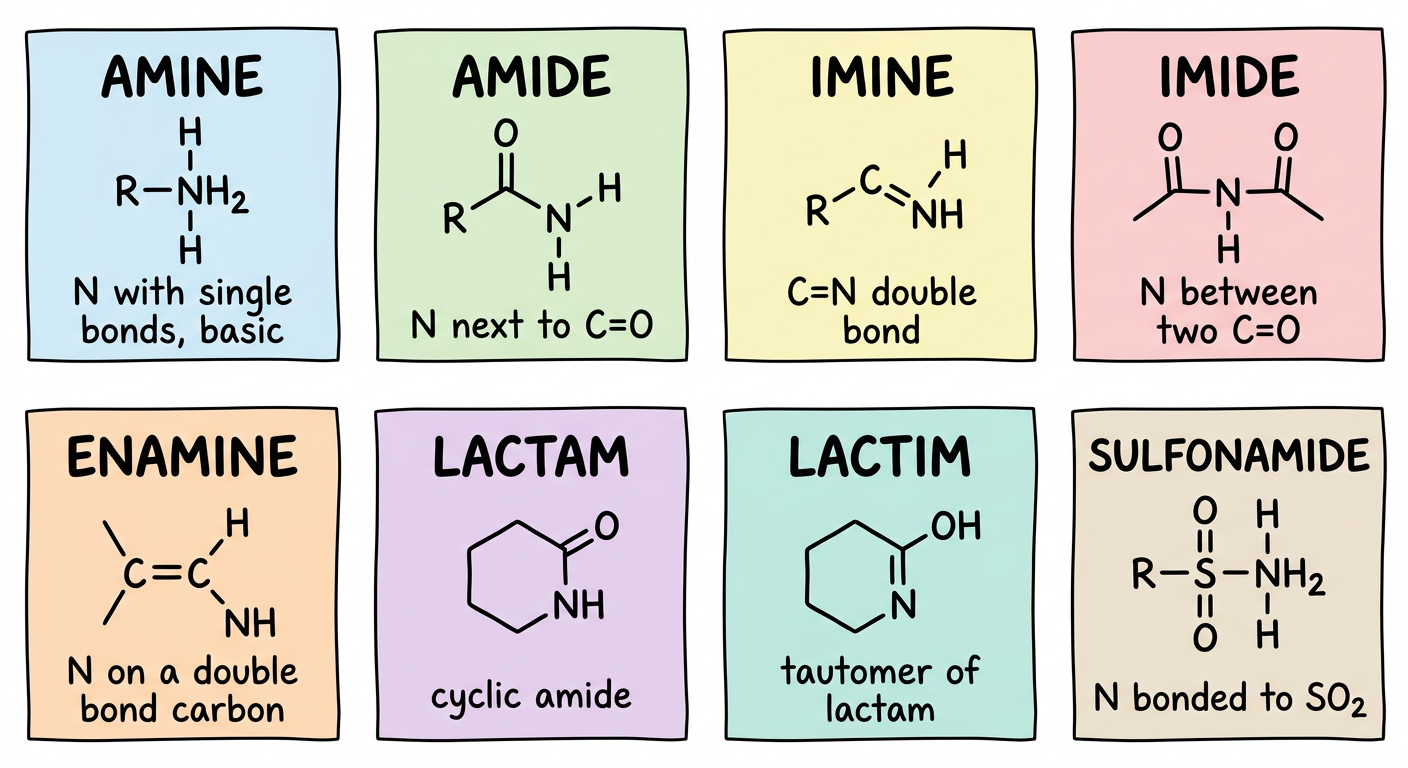
- Amine - N with single bonds, basic
- Amide - N next to C=O
- Imine - C=N double bond
- Imide - N between two C=O
- Enamine - N on a double bond carbon
- Lactam - cyclic amide (e.g. penicillin)
- Lactim - tautomer of lactam
- Sulfonamide - N bonded to SO₂
All
A large comprehensive educational chemistry reference poster on white background titled "Nitrogen-Containing Functional Groups: Structure & SAR" in bold dark blue at top. The poster has 8 clearly separated cards arranged in a 4x2 grid, each with a colored header band, chemical structure drawing, and 3 bullet points. Below the grid, a basicity order arrow graphic. Card 1 - AMINE (green header): Structure: R-NH2 drawn with single bonds, pyramidal N - Basic (pKa ~10), sp3 N - Strong H-bond donor - Example drug: Dopamine, Amphetamine Card 2 - AMIDE (blue header): Structure: R-C(=O)-NH2 with resonance arrows - Non-basic (pKa less than 0), planar sp2 N - Resonance with C=O, labile to hydrolysis - Example drug: Paracetamol, Lidocaine Card 3 - IMINE (orange header): Structure: R2C=NH with double bond to N clearly shown - Moderate base (pKa ~5-7), sp2 N - Electrophilic at C, forms Schiff bases - Example: Pyridoxal phosphate, Schiff bases Card 4 - IMIDE (red header): Structure: -CO-NH-CO- with both carbonyls shown - Acidic NH (pKa ~8-10), very electron poor N - Two C=O groups withdraw electrons from N - Example drug: Thalidomide, Succinimide Card 5 - ENAMINE (purple header): Structure: C=C-N with nitrogen on alkene - Less basic (pKa ~5), lone pair delocalized - Nucleophilic at beta carbon not at N - Example: Ergot alkaloids, biosynthetic intermediates Card 6 - LACTAM (teal header): Structure: 4-membered ring with NH and C=O (beta-lactam) - Cyclic amide, ring strain increases reactivity - Acylates bacterial transpeptidase (irreversible) - Example drug: Penicillin, Amoxicillin, Carbapenem Card 7 - LACTIM (yellow header): Structure: ring with =N and OH shown as tautomer - Tautomer of lactam (keto-enol type) - DNA bases shift to lactim causing mutations - Example: Uracil, Guanine tautomerism Card 8 - SULFONAMIDE (pink header): Structure: R-SO2-NH2 with sulfur and two oxygens - Acidic NH (pKa ~10), metabolically stable - Inhibits bacterial dihydropteroate synthase - Example drug: Sulfamethoxazole, Furosemide, Celecoxib At the bottom: a horizontal arrow labeled "BASICITY ORDER" with labels from high to low: Amine > Enamine > Imine > Amide > Imide > Sulfonamide Clean professional layout, suitable for pharmacy and medicinal chemistry students. All text clearly readable, structures accurately drawn.
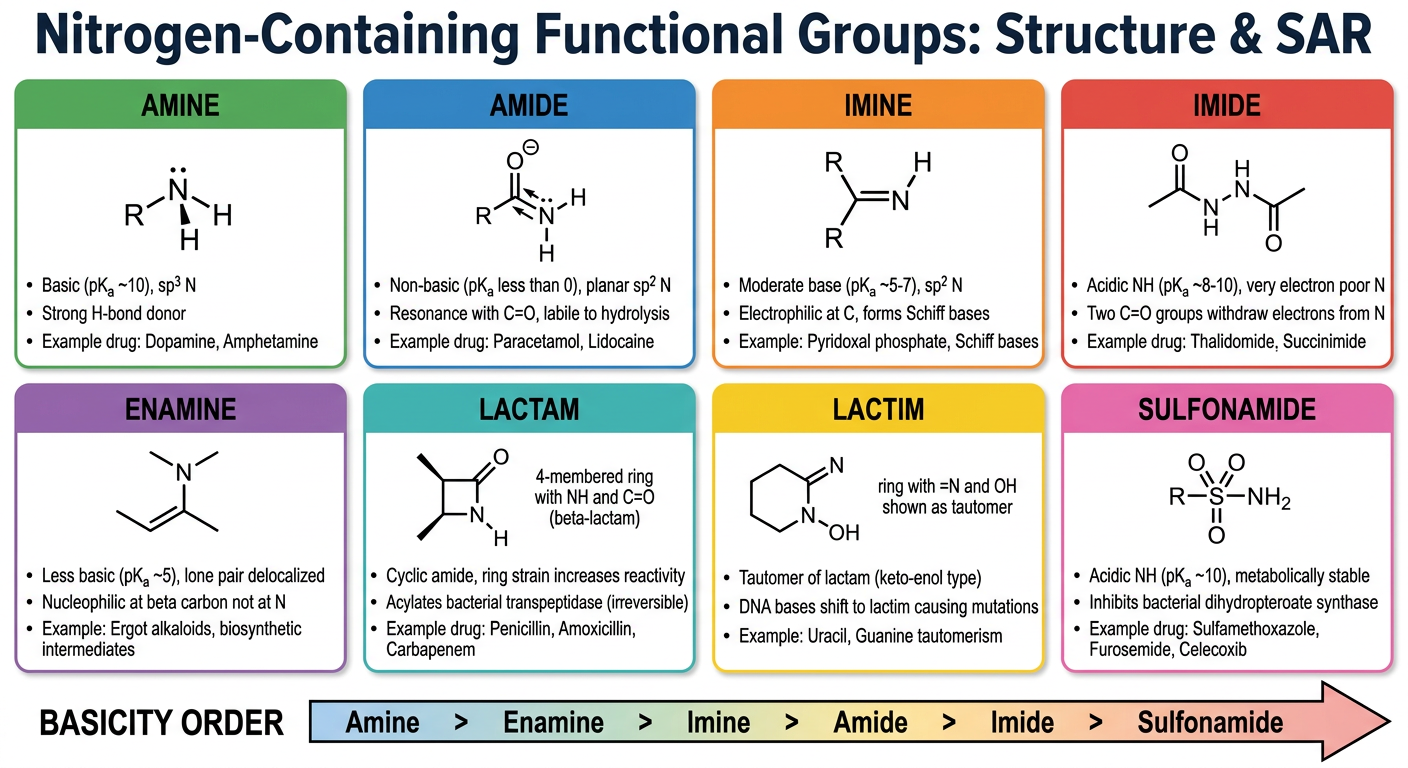
- Chemical structure drawn clearly
- SAR properties (basicity, hybridization, H-bonding)
- Drug examples from real pharmacology
Amine > Enamine > Imine > Amide > Imide > Sulfonamide
Create a PDF study guide with all 8 groups
Find recent medicinal chemistry guidelines on bioisosteres