
diffence between trnsverse cysnus and oblice sinus of heart
The transverse sinus is a space behind the great vessels (aorta and pulmonary trunk), while the oblique sinus is a blind recess behind the left atrium, bounded by pulmonary veins. Both are pericardial sinuses formed during embryonic development as the heart folds within the pericardial cavity.
Searching sources...
Reading File
Finding Sources
Finding Sources
Reading File
Reading File
Loading Image
Here is a thorough comparison of the two pericardial sinuses, sourced directly from Gray's Anatomy for Students and Fuster & Hurst's The Heart.
Transverse Pericardial Sinus vs. Oblique Pericardial Sinus
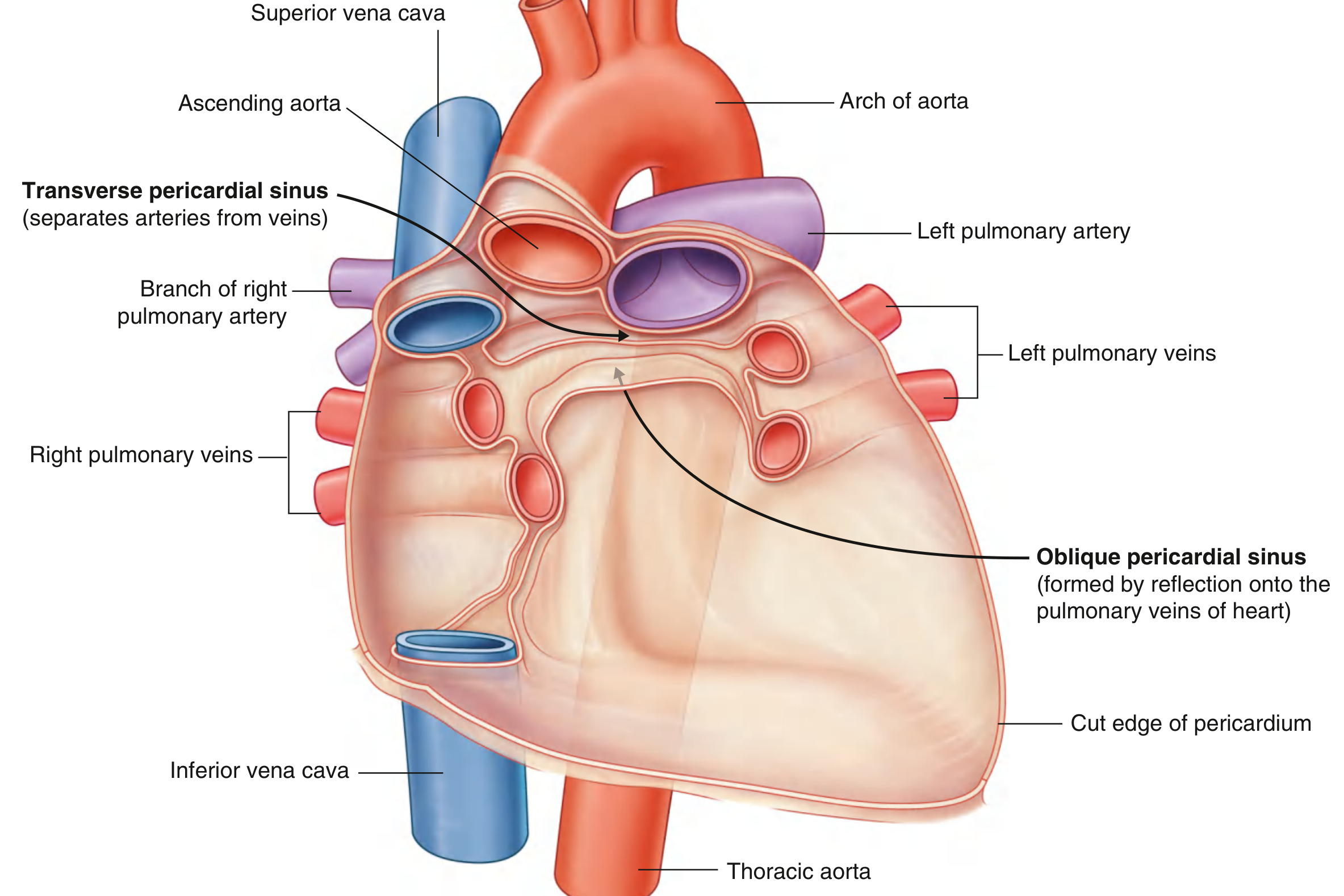
Comparison Table
| Feature | Transverse Sinus | Oblique Sinus |
|---|---|---|
| Shape | A passage (tunnel-like) | A blind cul-de-sac (dead end) |
| Location | Between the two reflections of serous pericardium - one around arteries and one around veins | Within the J-shaped venous reflection, posterior to the left atrium |
| Boundaries | - Posterior to the ascending aorta & pulmonary trunk - Anterior to the superior vena cava - Superior to the left atrium | - Bounded by the right pulmonary veins and IVC on the right - Bounded by the left pulmonary veins on the left - Posterior to the left atrium - Anterior to the esophagus |
| What it separates | Arteries (aorta, pulmonary trunk) from veins (SVC, pulmonary veins) | Left atrium from the esophagus |
| Formed by | The passage between the two pericardial reflection cuffs | The J-shaped reflection around the pulmonary veins and IVC |
| Open or closed? | Open (you can pass a finger through it) | Closed on three sides - only open inferiorly |
| Surgical use | Surgeon places a finger through it to isolate and clamp the aorta and pulmonary trunk (e.g., during cardiopulmonary bypass) | Less commonly used; a hand slipped under the cardiac apex moves superiorly into it |
| Notable contents | Nothing normally; gives surgical access between great vessels | Vein of Marshall runs within its left margin |
Key Points to Remember
Transverse sinus:
- Think of it as a window behind the great arteries and in front of the great veins
- A finger inserted through it from the right side emerges on the left, passing posterior to the aorta/pulmonary trunk - this is how surgeons apply vascular clamps during cardiac surgery
- It lies superior to the left atrium
Oblique sinus:
- Think of it as a pocket - open at the bottom, closed on three sides
- The reflection around the veins is J-shaped (or inverted U-shaped), and the space inside the J is the oblique sinus
- It separates the left atrium from the esophagus posteriorly
- Pericardial effusions can collect here and mimic left atrial or esophageal masses on imaging
Embryological Basis
Both sinuses form because the developing heart folds within the pericardial cavity. The serous pericardium reflects off the heart at two separate cuffs - one around the arterial pole (aorta + pulmonary trunk) and one around the venous pole (caval and pulmonary veins). The space between these two cuffs becomes the transverse sinus, and the enclosed recess within the venous-pole reflection becomes the oblique sinus.
Sources: Gray's Anatomy for Students (9780323934237), p. 223-224 | Fuster & Hurst's The Heart, 15th ed. (9781264257560)
This is a shared conversation. Sign in to Orris to start your own chat.