
Leopold manuver
Reading File
Finding Sources
Searching Images
Leopold maneuver obstetrics fetal position
Finding Sources
Finding Sources
Reading File
Reading File
Loading Image
Reading File
Here is a comprehensive overview of Leopold's Maneuvers, a systematic series of four abdominal palpation steps used to assess fetal lie, presentation, position, and engagement — typically performed from ≥30 weeks' gestation.
Leopold's Maneuvers
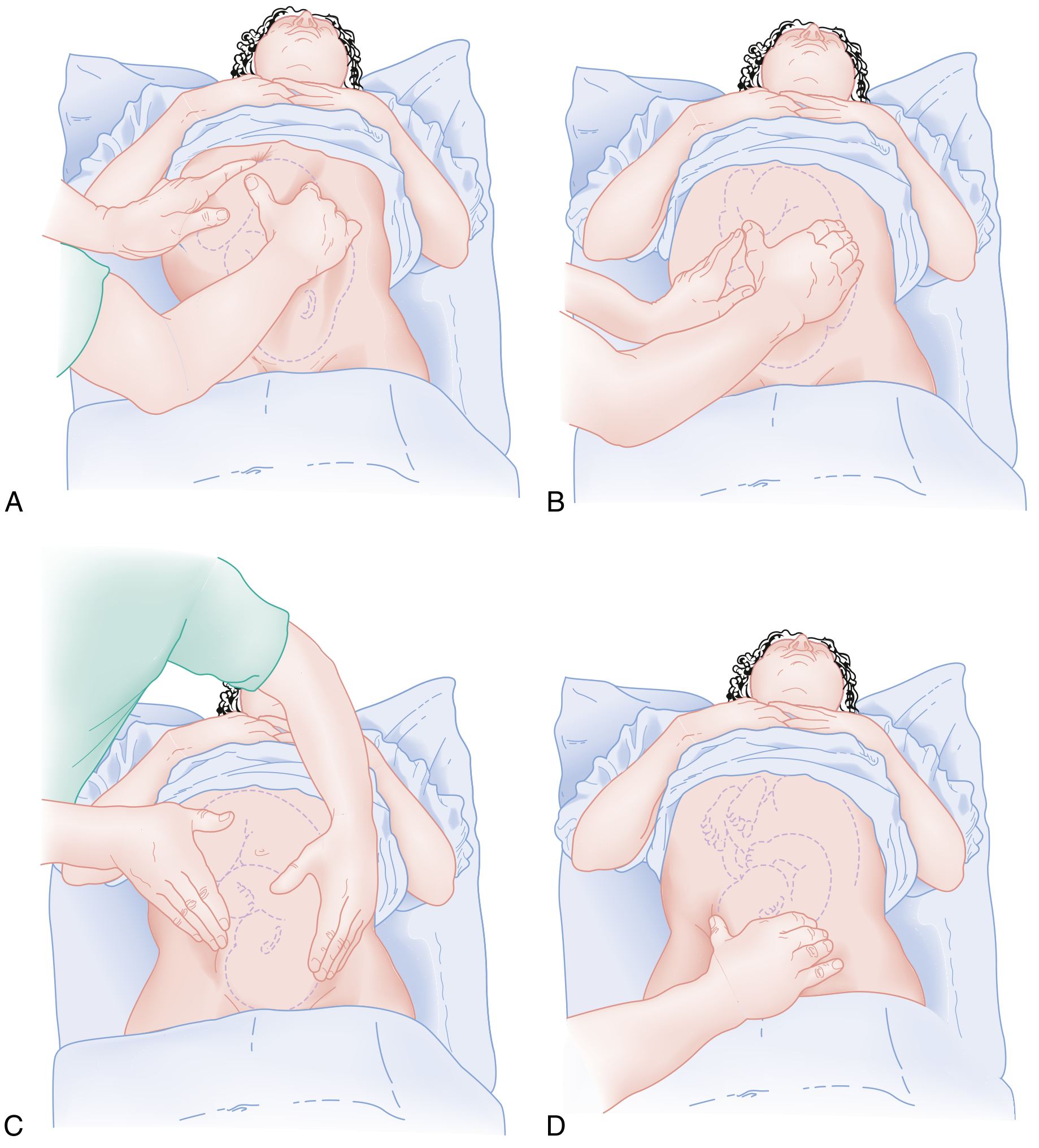
(A) Maneuver 1 — Fundal Grip | (B) Maneuver 2 — Lateral / Umbilical Grip | (C) Maneuver 3 — Pawlik's Grip | (D) Maneuver 4 — Pelvic Grip
Patient Positioning
The patient lies supine (dorsal recumbent). The examiner stands at the patient's side, facing her head for maneuvers 1–3, then turns 180° to face her feet for maneuver 4.
The Four Maneuvers
| # | Name | Examiner Position | Technique | What It Determines |
|---|---|---|---|---|
| 1 | Fundal grip | Facing patient's head | Both hands palpate the uterine fundus | Which fetal part occupies the fundus — soft/irregular = breech; round/hard/ballottable = head |
| 2 | Lateral / umbilical grip | Facing patient's head | Hands glide laterally down both sides of the uterus | Location of the fetal back (firm, smooth, convex) vs. limbs (irregular, knobby); determines fetal position (e.g., LOA, ROA) |
| 3 | Pawlik's grip | Facing patient's head | One hand cups the presenting part just above the symphysis pubis | Presenting part (head vs. breech) and its degree of descent/engagement — if movable, not yet engaged |
| 4 | Pelvic grip | Facing patient's feet | Both hands placed on lower uterus, fingers directed toward pelvis | Degree of flexion of the fetal head — the cephalic prominence is palpated; if on same side as back = deflexed/brow; if on opposite side = well-flexed vertex |
Clinical Interpretation
| Fundal finding (Maneuver 1) | Presenting part (Maneuver 3) | Presentation |
|---|---|---|
| Soft, irregular, not ballottable | Hard, round, ballottable | Cephalic (vertex) |
| Hard, round, ballottable | Soft, irregular | Breech |
| Neither clearly felt | Head felt laterally | Transverse lie |
When to Perform
- Routinely at ≥30 weeks of gestation, when the fetus is large enough for reliable palpation
- Repeated at every visit from 30 weeks onward
- Before labor to anticipate presentation and guide delivery planning
Clinical Value
- Identifies non-vertex presentations (breech, transverse) requiring counseling, external cephalic version (ECV), or cesarean planning
- Guides placement of the Doppler/fetoscope — fetal heart tones are best auscultated through the fetal back:
- Left lower quadrant → LOA/LOT/LOP positions
- Right lower quadrant → ROA/ROT/ROP positions
- Supplements but does not replace ultrasound for definitive presentation confirmation
Limitations
- Less reliable in obese patients, polyhydramnios, anterior placenta, or uterine fibroids
- Can be uncomfortable for the patient — perform gently
- Sensitivity/specificity are lower than ultrasound; use ultrasound when in doubt
Sources: Rosen's Emergency Medicine, 9e; Textbook of Family Medicine, 9e
This is a shared conversation. Sign in to Orris to start your own chat.