
maternal health problems and services ANC , PNC, IMMUNIZATION,NUTRITIONAL supplementation
maternal health services ANC PNC immunization nutritional supplementation WHO guidelines 2024
antenatal care ANC schedule maternal health diagram
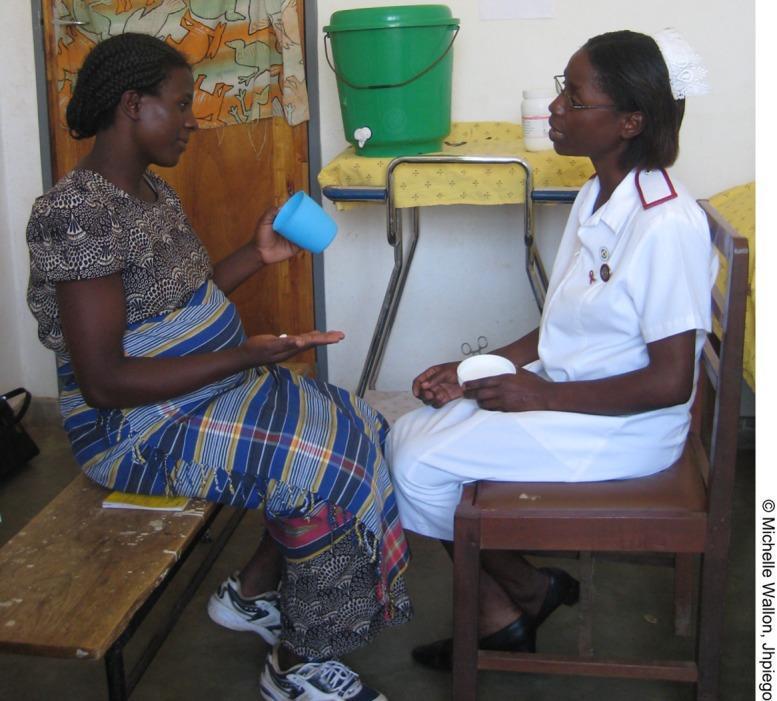
A clinical photograph depicting an antenatal care (ANC) visit in a global health setting, illustrating the administration of Intermittent Preventive Treatment of malaria in pregnancy (IPTp). The image shows a pregnant woman in the third trimester seated on a bench, holding oral medication (pills) in one hand and a blue cup of water in the other, demonstrating Directly Observed Therapy (DOT). Across from her, a healthcare provider in a professional white nurse's uniform with a red cross emblem and nursing cap provides clinical guidance. The setting includes essential clinic supplies, such as a water dispenser and medical documentation on a yellow notepad. This visual serves as an educational example of maternal health interventions, specifically the prevention of Malaria in Pregnancy (MiP) through health system scaling and standardized diagnostic/treatment protocols in resource-limited environments.
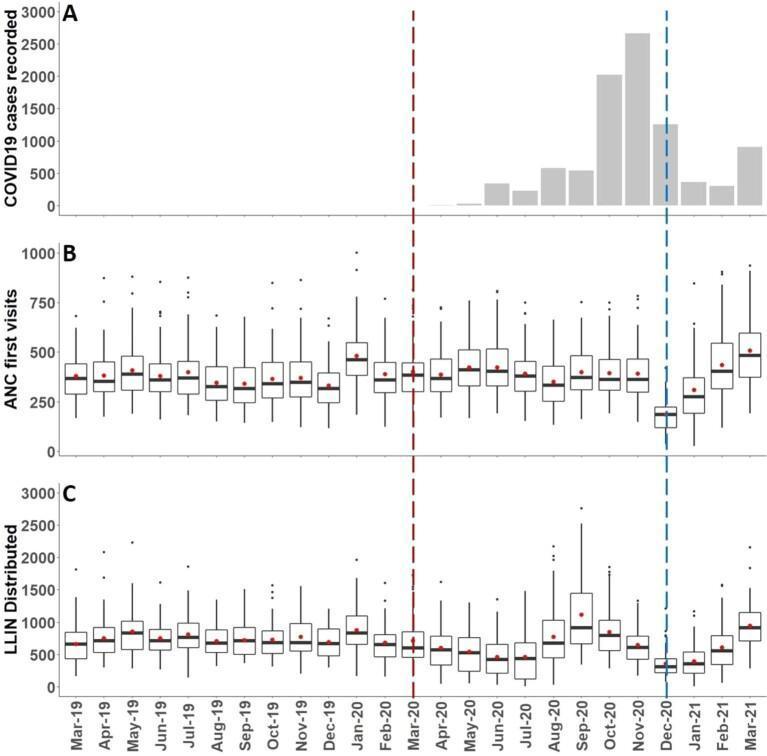
This infographic and comparison chart illustrates the impact of health system shocks on public health service delivery in Western Kenya from March 2019 to March 2021. The figure is divided into three panels. Panel A is a bar graph showing monthly COVID-19 cases, revealing a substantial increase between August and December 2020. Panel B uses box-and-whisker plots to display monthly Antenatal Care (ANC) first visits, showing relative stability until a sharp decline in December 2020. Panel C utilizes box-and-whisker plots to track monthly distributions of Long-Lasting Insecticidal Nets (LLINs) to pregnant women and children. Key visual indicators include a red vertical dashed line (March 2020) representing the initiation of COVID-19 mitigation protocols and a blue vertical dashed line (December 2020) marking a national health worker strike. The data demonstrates how external shocks, particularly the strike, caused significant disruptions in routine service provision, such as malaria prevention (LLIN distribution) and maternal health access (ANC visits), followed by recovery periods.
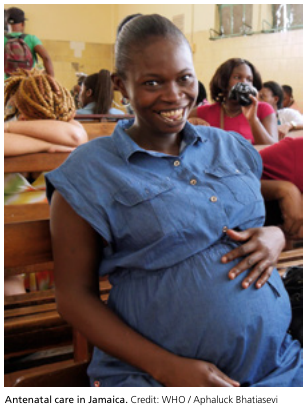
Summary : This photograph shows a pregnant woman seated in a waiting area, likely a clinic or healthcare facility, with other women in the background, illustrating the context of antenatal care in Jamaica. photo: Scene Overview : • Main subject is a visibly pregnant woman sitting on a wooden bench, wearing a blue button-up dress. • The setting appears to be a clinic or healthcare waiting room, with several other women seated on benches in the background. • The perspective is at eye level, focusing on the woman in the foreground. • Lighting is natural or fluorescent, typical of indoor public health facilities. • The colour palette includes neutral tones, with the blue dress of the main subject standing out. Technical Details : • No scale bar or magnification is present. • No visible on-image text or user interface elements. • The image is credited to WHO / Aphaluck Bhatiasevi. Spatial Relationships : • The pregnant woman occupies the foreground, positioned centrally and slightly to the right. • Other women are seated behind her, some facing forward, others turned to the side, indicating a communal waiting area. • The benches are arranged in rows, suggesting an orderly seating arrangement. Analysis : • The image visually communicates the experience of antenatal care in Jamaica, highlighting the communal aspect of healthcare access for pregnant women. • The focus on the pregnant woman in the foreground draws attention to maternal health as a central theme. • The presence of multiple women in the background suggests a shared healthcare environment, possibly indicating demand for antenatal services.
maternal immunization tetanus toxoid pregnancy vaccination
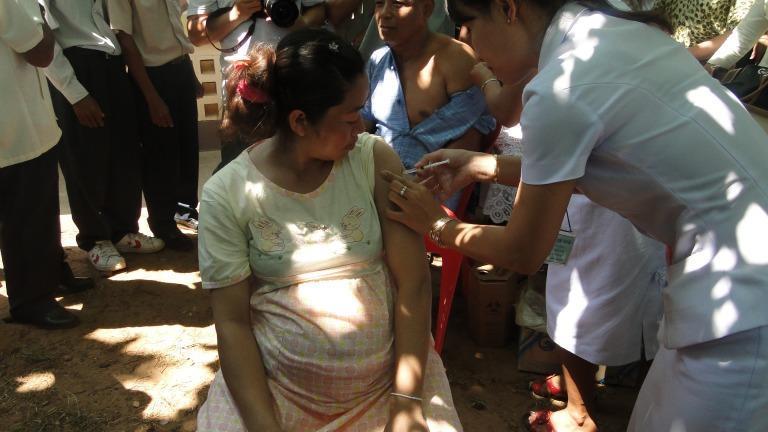
This clinical photograph depicts a public health immunization outreach scene in a rural setting in Vietnam. A seated pregnant woman is receiving an intramuscular vaccination, such as the influenza vaccine, administered by a health professional. The healthcare worker, dressed in a white clinical uniform with a visible identification tag, is performing the injection into the patient's deltoid muscle using a standard syringe and needle. The surrounding environment illustrates a community-based grassroots health system, featuring other residents waiting for care and an outdoor village backdrop. The image serves as an educational example of maternal immunization programs, primary healthcare delivery in resource-limited or mountainous regions, and the role of village health workers in promoting public health and preventive medicine during pregnancy.
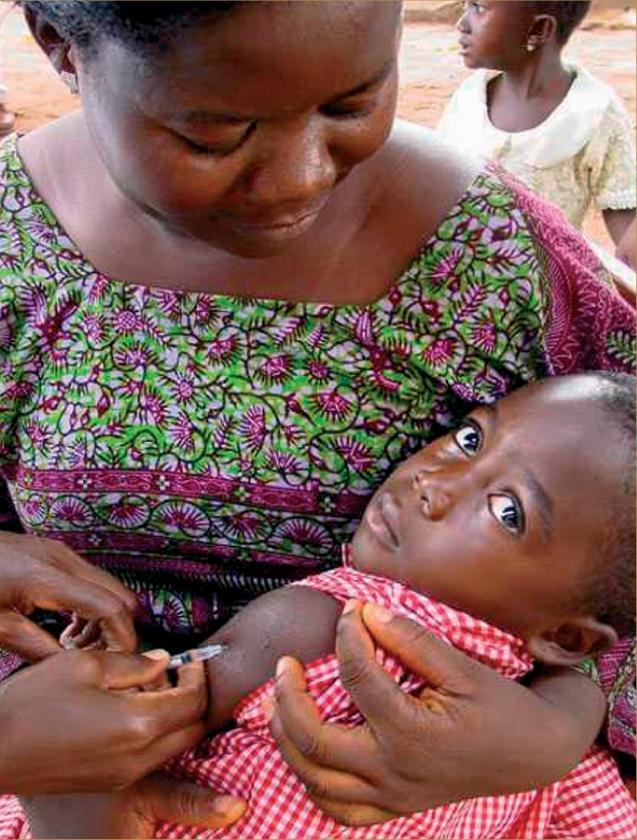
This clinical photograph captures a pediatric vaccination procedure in a global health setting. A healthcare provider is shown administering an intramuscular or subcutaneous injection into the deltoid region of an infant's upper left arm. The equipment visible is a small-gauge syringe with a fine-bore needle, consistent with standard immunization protocols. The infant is cradled securely by a caregiver, who is observing the procedure. This visual illustrates key concepts in public health, including routine childhood immunization programs, primary care delivery in developing regions, and efforts to reduce under-five mortality. The focus of the image is on the precision of the injection technique and the delivery of preventative medicine. Relevant medical themes include maternal and child health (MCH), immunology, and community-based healthcare interventions.
![<table><thead><tr><th>Vaccines and other Immunizing Agents</th><th>Contraindicated or Not Recommended¹</th><th>Precautions²</th></tr></thead><tbody><tr><td>Dengue (DEN4CYD)</td><td>• Severe allergic reaction (eg, anaphylaxis) after a previous dose or to a vaccine component³<br>• Severe immunodeficiency (eg, hematologic and solid tumors, receipt of chemotherapy, congenital immunodeficiency, long-term immunosuppressive therapy or patients with HIV infection who are severely immunocompromised)<br>• Lack of laboratory confirmation of a previous dengue infection</td><td>• Pregnancy<br>• HIV infection without evidence of severe immunosuppression<br>• Moderate or severe acute illness with or without fever</td></tr><tr><td>Diphtheria, tetanus, pertussis (DTaP)</td><td>• Severe allergic reaction (eg, anaphylaxis) after a previous dose or to a vaccine component³<br>• Encephalopathy (eg, coma, decreased level of consciousness, prolonged seizures) not attributable to another identifiable cause within 7 days of administration of previous dose of DTP or DTaP</td><td>• Guillain-Barré syndrome within 6 weeks after previous dose of tetanus toxoid-containing vaccine<br>• History of Arthus-type hypersensitivity reactions after a previous dose of diphtheria toxoid-containing or tetanus toxoid-containing vaccine; defer vaccination until at least 10 years have elapsed since the last tetanus toxoid-containing vaccine<br>• For DTaP only: Progressive neurologic disorder, including infantile spasms, uncontrolled epilepsy, progressive encephalopathy; defer DTaP until neurologic status clarified and stabilized<br>• Moderate or severe acute illness with or without fever</td></tr><tr><td>Haemophilus influenzae type b (Hib)</td><td>• Severe allergic reaction (eg, anaphylaxis) after a previous dose or to a vaccine component³<br>• Younger than age 6 weeks</td><td>• Moderate or severe acute illness with or without fever</td></tr><tr><td>Hepatitis A (HepA)</td><td>• Severe allergic reaction (eg, anaphylaxis) after a previous dose or to a vaccine component³ including neomycin</td><td>• Moderate or severe acute illness with or without fever</td></tr><tr><td>Hepatitis B (HepB)</td><td>• Severe allergic reaction (eg, anaphylaxis) after a previous dose or to a vaccine component³ including yeast</td><td>• Moderate or severe acute illness with or without fever</td></tr><tr><td>Hepatitis A-Hepatitis B vaccine (HepA-HepB) [Twinrix]</td><td>• Severe allergic reaction (eg, anaphylaxis) after a previous dose or to a vaccine component³ including neomycin and yeast</td><td>• Moderate or severe acute illness with or without fever</td></tr><tr><td>Human papillomavirus (HPV)</td><td>• Severe allergic reaction (eg, anaphylaxis) after a previous dose or to a vaccine component³<br>• Pregnancy: HPV vaccination not recommended.</td><td>• Moderate or severe acute illness with or without fever</td></tr><tr><td>Measles, mumps, and rubella (MMR)</td><td>• Severe allergic reaction (eg, anaphylaxis) after a previous dose or to a vaccine component³<br>• Severe immunodeficiency (eg, hematologic and solid tumors, receipt of chemotherapy, congenital immunodeficiency, long-term immunosuppressive therapy or patients with HIV infection who are severely immunocompromised)<br>• Pregnancy<br>• Family history of altered immunocompetence, unless verified clinically or by laboratory testing as immunocompetent<br>• For MMRV only: HIV infection of any severity</td><td>• Recent (≤11 months) receipt of antibody-containing blood product (specific interval depends on product)<br>• History of thrombocytopenia or thrombocytopenic purpura<br>• Need for tuberculin skin testing or interferon-gamma release assay (IGRA) testing<br>• Moderate or severe acute illness with or without fever<br>• For MMRV only: Personal or family (ie, sibling or parent) history of seizures of any etiology<br>• If using MMRV, see Varicella/MMRV for additional precautions</td></tr><tr><td>Meningococcal ACWY (MenACWY)<br>MenACWY-CRM [Menveo]<br>MenACWY-TT [MenQuadfi]</td><td>• Severe allergic reaction (eg, anaphylaxis) after a previous dose or to a vaccine component³<br>• For MenACWY-CRM only: severe allergic reaction to any diphtheria toxoid—or CRM197—containing vaccine<br>• For MenACWY-TT only: severe allergic reaction to a tetanus toxoid-containing vaccine</td><td>• For MenACWY-CRM only: Preterm birth if younger than age 9 months<br>• Moderate or severe acute illness with or without fever</td></tr><tr><td>Meningococcal B (MenB)<br>MenB-4C [Bexsero]<br>MenB-FHbp [Trumenba]</td><td>• Severe allergic reaction (eg, anaphylaxis) after a previous dose or to a vaccine component³</td><td>• Pregnancy<br>• For MenB-4C only: Latex sensitivity<br>• Moderate or severe acute illness with or without fever</td></tr><tr><td>Meningococcal ABCWY<br>(MenACWY-TT/MenB-FHbp) [Penbraya]<br>(MenACWY-TT/MenB-4C) [Penmenvy]</td><td>• Severe allergic reaction (eg, anaphylaxis) after a previous dose or to a vaccine component³<br>• Severe allergic reaction to a tetanus toxoid-containing vaccine</td><td>• Moderate or severe acute illness with or without fever</td></tr><tr><td>Mpox [JYNNEOS]</td><td>• Severe allergic reaction (eg, anaphylaxis) after a previous dose or to a vaccine component³</td><td>• Moderate or severe acute illness with or without fever</td></tr><tr><td>Pneumococcal conjugate (PCV)</td><td>• Severe allergic reaction (eg, anaphylaxis) after a previous dose or to a vaccine component³<br>• Severe allergic reaction (eg, anaphylaxis) to any diphtheria toxoid-containing vaccine or its component⁴</td><td>• Moderate or severe acute illness with or without fever</td></tr><tr><td>Pneumococcal polysaccharide (PPSV23)</td><td>• Severe allergic reaction (eg, anaphylaxis) after a previous dose or to a vaccine component³</td><td>• Moderate or severe acute illness with or without fever</td></tr></tbody></table>](https://cdn.orris.care/cdss_images/GLGCA_4802261_1766491618403_50c3d5ee-e5ef-4e64-96a4-ee12cd74d0ce_2800efb1-77fd-4ce5-96d8-999af1073921.png)
<table><thead><tr><th>Vaccines and other Immunizing Agents</th><th>Contraindicated or Not Recommended¹</th><th>Precautions²</th></tr></thead><tbody><tr><td>Dengue (DEN4CYD)</td><td>• Severe allergic reaction (eg, anaphylaxis) after a previous dose or to a vaccine component³<br>• Severe immunodeficiency (eg, hematologic and solid tumors, receipt of chemotherapy, congenital immunodeficiency, long-term immunosuppressive therapy or patients with HIV infection who are severely immunocompromised)<br>• Lack of laboratory confirmation of a previous dengue infection</td><td>• Pregnancy<br>• HIV infection without evidence of severe immunosuppression<br>• Moderate or severe acute illness with or without fever</td></tr><tr><td>Diphtheria, tetanus, pertussis (DTaP)</td><td>• Severe allergic reaction (eg, anaphylaxis) after a previous dose or to a vaccine component³<br>• Encephalopathy (eg, coma, decreased level of consciousness, prolonged seizures) not attributable to another identifiable cause within 7 days of administration of previous dose of DTP or DTaP</td><td>• Guillain-Barré syndrome within 6 weeks after previous dose of tetanus toxoid-containing vaccine<br>• History of Arthus-type hypersensitivity reactions after a previous dose of diphtheria toxoid-containing or tetanus toxoid-containing vaccine; defer vaccination until at least 10 years have elapsed since the last tetanus toxoid-containing vaccine<br>• For DTaP only: Progressive neurologic disorder, including infantile spasms, uncontrolled epilepsy, progressive encephalopathy; defer DTaP until neurologic status clarified and stabilized<br>• Moderate or severe acute illness with or without fever</td></tr><tr><td>Haemophilus influenzae type b (Hib)</td><td>• Severe allergic reaction (eg, anaphylaxis) after a previous dose or to a vaccine component³<br>• Younger than age 6 weeks</td><td>• Moderate or severe acute illness with or without fever</td></tr><tr><td>Hepatitis A (HepA)</td><td>• Severe allergic reaction (eg, anaphylaxis) after a previous dose or to a vaccine component³ including neomycin</td><td>• Moderate or severe acute illness with or without fever</td></tr><tr><td>Hepatitis B (HepB)</td><td>• Severe allergic reaction (eg, anaphylaxis) after a previous dose or to a vaccine component³ including yeast</td><td>• Moderate or severe acute illness with or without fever</td></tr><tr><td>Hepatitis A-Hepatitis B vaccine (HepA-HepB) [Twinrix]</td><td>• Severe allergic reaction (eg, anaphylaxis) after a previous dose or to a vaccine component³ including neomycin and yeast</td><td>• Moderate or severe acute illness with or without fever</td></tr><tr><td>Human papillomavirus (HPV)</td><td>• Severe allergic reaction (eg, anaphylaxis) after a previous dose or to a vaccine component³<br>• Pregnancy: HPV vaccination not recommended.</td><td>• Moderate or severe acute illness with or without fever</td></tr><tr><td>Measles, mumps, and rubella (MMR)</td><td>• Severe allergic reaction (eg, anaphylaxis) after a previous dose or to a vaccine component³<br>• Severe immunodeficiency (eg, hematologic and solid tumors, receipt of chemotherapy, congenital immunodeficiency, long-term immunosuppressive therapy or patients with HIV infection who are severely immunocompromised)<br>• Pregnancy<br>• Family history of altered immunocompetence, unless verified clinically or by laboratory testing as immunocompetent<br>• For MMRV only: HIV infection of any severity</td><td>• Recent (≤11 months) receipt of antibody-containing blood product (specific interval depends on product)<br>• History of thrombocytopenia or thrombocytopenic purpura<br>• Need for tuberculin skin testing or interferon-gamma release assay (IGRA) testing<br>• Moderate or severe acute illness with or without fever<br>• For MMRV only: Personal or family (ie, sibling or parent) history of seizures of any etiology<br>• If using MMRV, see Varicella/MMRV for additional precautions</td></tr><tr><td>Meningococcal ACWY (MenACWY)<br>MenACWY-CRM [Menveo]<br>MenACWY-TT [MenQuadfi]</td><td>• Severe allergic reaction (eg, anaphylaxis) after a previous dose or to a vaccine component³<br>• For MenACWY-CRM only: severe allergic reaction to any diphtheria toxoid—or CRM197—containing vaccine<br>• For MenACWY-TT only: severe allergic reaction to a tetanus toxoid-containing vaccine</td><td>• For MenACWY-CRM only: Preterm birth if younger than age 9 months<br>• Moderate or severe acute illness with or without fever</td></tr><tr><td>Meningococcal B (MenB)<br>MenB-4C [Bexsero]<br>MenB-FHbp [Trumenba]</td><td>• Severe allergic reaction (eg, anaphylaxis) after a previous dose or to a vaccine component³</td><td>• Pregnancy<br>• For MenB-4C only: Latex sensitivity<br>• Moderate or severe acute illness with or without fever</td></tr><tr><td>Meningococcal ABCWY<br>(MenACWY-TT/MenB-FHbp) [Penbraya]<br>(MenACWY-TT/MenB-4C) [Penmenvy]</td><td>• Severe allergic reaction (eg, anaphylaxis) after a previous dose or to a vaccine component³<br>• Severe allergic reaction to a tetanus toxoid-containing vaccine</td><td>• Moderate or severe acute illness with or without fever</td></tr><tr><td>Mpox [JYNNEOS]</td><td>• Severe allergic reaction (eg, anaphylaxis) after a previous dose or to a vaccine component³</td><td>• Moderate or severe acute illness with or without fever</td></tr><tr><td>Pneumococcal conjugate (PCV)</td><td>• Severe allergic reaction (eg, anaphylaxis) after a previous dose or to a vaccine component³<br>• Severe allergic reaction (eg, anaphylaxis) to any diphtheria toxoid-containing vaccine or its component⁴</td><td>• Moderate or severe acute illness with or without fever</td></tr><tr><td>Pneumococcal polysaccharide (PPSV23)</td><td>• Severe allergic reaction (eg, anaphylaxis) after a previous dose or to a vaccine component³</td><td>• Moderate or severe acute illness with or without fever</td></tr></tbody></table>
Maternal Health Problems and Services
Major Maternal Health Problems
| Problem | Significance |
|---|---|
| Anaemia | Most common nutritional deficiency in pregnancy; linked to maternal mortality and LBW |
| Hypertensive disorders | Pre-eclampsia/eclampsia - leading cause of maternal death |
| Haemorrhage (PPH) | No. 1 cause of maternal mortality globally |
| Sepsis/Infection | Puerperal sepsis; RTI/STI complications |
| Obstructed labour | Requires skilled attendance and emergency obstetric care |
| Malnutrition | Micronutrient deficiencies (iron, folate, iodine, calcium, Vitamin D) |
| Low Birth Weight (LBW) | <2500 g; linked to poor maternal nutrition and antenatal infections |
| Neonatal tetanus | Preventable by maternal immunization |
| Malaria in pregnancy | Endemic areas - causes anaemia, LBW, premature delivery |
| Mental health disorders | Perinatal depression/anxiety - often overlooked |
I. Antenatal Care (ANC)
Components of ANC
ANC Visit Schedule (Minimum 4 contacts)
| Visit | Gestational Age | Key Activities |
|---|---|---|
| 1st Visit | Within 12 weeks (as soon as pregnancy suspected) | Registration, history taking, height/weight, BP, Hb, urine (albumin + sugar), RPR for syphilis, blood group, HIV counselling & testing, folic acid supplementation |
| 2nd Visit | 14-26 weeks | Weight, BP, Hb, fundal height, foetal heart sounds, IFA (iron-folic acid) supplementation, TT2 injection |
| 3rd Visit | 28-34 weeks | Weight, BP, foetal presentation, Hb, urine test, TT booster if needed, deworming (Albendazole) |
| 4th Visit | 36 weeks to term | Weight, BP, foetal presentation/engagement, birth preparedness counselling, danger signs, referral planning |
WHO (2016 ANC model) recommends 8 contacts instead of 4, for additional monitoring and interventions. Many national programmes are adopting this.
Essential ANC Services (as per Park's Textbook)
- Early registration of ALL pregnancies - within first trimester (before 12 weeks)
- Even if a woman presents late, register her and give care according to gestational age
- Minimum 4 ANC visits including registration
- Associated services: general examination (height, weight, BP), anaemia screening, abdominal and breast examination
- Folic acid supplementation in 1st trimester; Iron and folic acid (IFA) from 12 weeks onwards
- Tetanus Toxoid (TT) injection
- Recording tobacco use by all antenatal mothers; counselling on cessation
- Minimum laboratory investigations: urine for pregnancy confirmation, Hb estimation, urine for albumin and sugar
- Name-based tracking of all pregnant women for assured service delivery
- Identification of high-risk pregnancies - anaemia, hypertension, diabetes, multiple pregnancies, previous obstetric complications
- Identification and management of danger signs (severe headache, blurred vision, convulsions, severe abdominal pain, heavy bleeding, absent foetal movements)
- Malaria prophylaxis in endemic zones as per NVBDCP guidelines
- Counselling on diet, rest, tobacco cessation, institutional delivery, birth preparedness, clean/safe delivery
- Information on Janani Suraksha Yojana (JSY) and other government schemes
- Identification and referral of suspected RTI/STI cases
- Counselling and referral for HIV/AIDS testing and PMTCT
- Name-based tracking of missed and left-out ANC cases
Danger Signs Requiring Immediate Referral
- Severe headache / blurred vision / convulsions (pre-eclampsia/eclampsia)
- Severe vaginal bleeding (placenta praevia/abruption)
- Absent or reduced foetal movements
- High fever (>38°C)
- Severe vomiting / inability to eat
- Difficulty breathing (anaemia, pulmonary oedema)
High-Risk Pregnancy Identification
II. Postnatal Care (PNC)
PNC Visit Schedule
| Visit | Timing | Purpose |
|---|---|---|
| Day 0 (immediately) | At delivery/within hours | Initiate breastfeeding within 1 hour; newborn care; oxytocin for PPH prevention; cord care |
| Day 3 | 3rd day | Assess involution, lochia, wound healing; assess feeding; check newborn for jaundice/infections |
| Day 7 | 7th day | BP, weight, breast examination; assess newborn growth and feeding |
| Day 42 | 6 weeks | Final check - involution complete; contraception counselling; assess mental health; immunization check; resume normal activity |
Essential PNC Activities
- Early initiation of breastfeeding within 1 hour of birth
- Exclusive breastfeeding for 6 months, then complementary feeding while continuing breastfeeding up to 2 years
- Examination of newborn for signs of sickness and congenital abnormalities (IMNCI guidelines)
- Monitoring maternal BP, temperature, uterine involution, lochia, episiotomy/wound healing
- Counselling on:
- Diet and rest for the mother
- Hygiene and personal care
- Infant and young child feeding (IYCF)
- Essential newborn care (warmth/KMC, cord care, eye care)
- Contraception and family planning
- STI/RTI and HIV/AIDS
- Danger signs in mother and baby
- Immunization of newborn - BCG, OPV-0, Hepatitis B (birth dose)
- Name-based tracking of missed and left-out PNC cases
- Kangaroo Mother Care (KMC) for LBW babies
- Referral of sick newborns - danger signs include hypothermia, not breastfeeding, lethargy, fast breathing, convulsions, jaundice within 24 hours
Maternal Danger Signs in PNC
- Heavy vaginal bleeding (PPH)
- High fever >38°C (puerperal sepsis)
- Foul-smelling vaginal discharge
- Convulsions (eclampsia)
- Severe headache, visual disturbance
- Breathlessness/chest pain
- Breast engorgement / mastitis
- Perineal wound infection
III. Immunization in Maternal Health
A. Immunization During Pregnancy
| Vaccine | Schedule | Purpose |
|---|---|---|
| Tetanus Toxoid (TT) | TT1: early pregnancy; TT2: 4 weeks after TT1 (minimum 6 weeks before delivery); Booster if previously immunized | Prevents maternal and neonatal tetanus (lock jaw); provides passive immunity to newborn via placental transfer of IgG |
| Influenza (Inactivated) | Any trimester, especially recommended in 2nd/3rd trimester | Reduces risk of severe influenza complications in pregnancy; protects newborn via maternal antibody transfer |
| Tdap (Tetanus-Diphtheria-Pertussis) | 27-36 weeks gestation | Protects newborn from pertussis (whooping cough) before they can be vaccinated; "cocoon strategy" |
| Hepatitis B | If non-immune | Prevents vertical transmission if mother becomes infected during pregnancy |
| COVID-19 | Recommended in pregnancy | Protection against severe COVID-19 |
Tetanus Toxoid Schedule Detail (India - National Programme)
| Dose | When | Protection |
|---|---|---|
| TT1 | First contact or as early as possible in pregnancy | Minimal |
| TT2 | At least 4 weeks after TT1, preferably at least 6 weeks before delivery | Protection for 1-3 years |
| Booster | If woman received 2 TT within last 3 years | Protection for 5 years |
B. Vaccines CONTRAINDICATED in Pregnancy
- Live attenuated vaccines are generally avoided:
- MMR (Measles-Mumps-Rubella)
- Varicella
- BCG
- Live attenuated influenza vaccine (nasal)
- Yellow fever (avoid unless high risk of exposure)
- HPV vaccine (delay until after delivery)
C. Newborn Immunization at Birth (Birth Dose)
| Vaccine | Route | Purpose |
|---|---|---|
| BCG | Intradermal, left upper arm | Prevention of severe tuberculosis (miliary TB, TB meningitis) |
| OPV-0 (Zero dose) | Oral | Priming for polio immunization |
| Hepatitis B (HepB-BD) | IM, right thigh | Prevention of perinatal hepatitis B transmission (especially in HBsAg-positive mothers) |
D. Universal Immunization Programme (UIP) for Infants - Schedule
| Age | Vaccines |
|---|---|
| Birth | BCG, OPV-0, Hep B |
| 6 weeks | OPV-1, IPV-1, Penta-1 (DPT+HepB+Hib), PCV-1, Rota-1 |
| 10 weeks | OPV-2, IPV-2, Penta-2, PCV-2, Rota-2 |
| 14 weeks | OPV-3, IPV-3, Penta-3, PCV-3, Rota-3 |
| 9-12 months | Measles/MR-1, JE-1 (in endemic areas) |
| 16-24 months | DPT booster-1, OPV booster, Measles/MR-2, JE-2, Vitamin A (2nd dose) |
AEFI (Adverse Events Following Immunization)
IV. Nutritional Supplementation in Maternal Health
A. Iron and Folic Acid (IFA) Supplementation
| Programme | Target | Dose | Duration |
|---|---|---|---|
| IFA (Adult) | All pregnant women | 1 tablet daily (100 mg elemental iron + 500 mcg folic acid) | Throughout pregnancy (minimum 180 tablets / 6 months) |
| Folic acid only | First trimester (preconceptional ideally) | 400-500 mcg daily | 1st trimester (prevents neural tube defects) |
| IFA (treatment) | Anaemic women (Hb <11 g/dL) | 2 tablets daily | Until Hb normalises |
- Prevention of iron-deficiency anaemia (most common cause of maternal morbidity)
- Folic acid prevents Neural Tube Defects (NTDs) - spina bifida, anencephaly
- Reduces risk of preterm birth and LBW
- Normal: ≥11 g/dL
- Mild anaemia: 10-10.9 g/dL
- Moderate anaemia: 7-9.9 g/dL
- Severe anaemia: <7 g/dL (requires parenteral iron or transfusion)
B. Calcium Supplementation
- Dose: 500-1000 mg elemental calcium/day (given as calcium carbonate)
- Purpose: Reduces risk of pre-eclampsia/eclampsia, ensures foetal bone and teeth mineralisation, prevents maternal bone loss
- WHO recommendation: 1.5-2 g/day in populations with low dietary calcium intake, from 20 weeks gestation to delivery
C. Vitamin D Supplementation
- Dose: 400-600 IU/day (some guidelines recommend up to 2000 IU in deficient populations)
- Purpose: Calcium absorption, foetal bone development, immune function; deficiency linked to gestational diabetes, pre-eclampsia
D. Iodine Supplementation
- Dose: 150-250 mcg/day (through iodised salt or supplements)
- Purpose: Prevents cretinism (congenital hypothyroidism) and intellectual disability in the child; prevents goitre in the mother
- Iodine deficiency is the most preventable cause of intellectual disability worldwide
E. Zinc Supplementation
- Dose: 25 mg/day
- Purpose: Reduces risk of preterm birth; supports immune function; foetal growth and development
F. Vitamin A
- NOT routinely supplemented during pregnancy in most programmes (risk of teratogenicity at high doses)
- Exception: Vitamin A-deficient populations or night-blind mothers - single dose of up to 10,000 IU/day or 25,000 IU/week is safe
- Postpartum: A single dose of 200,000 IU Vitamin A given to the mother within 6 weeks of delivery (lactating mothers); improves breast milk content and helps recovery
G. Multiple Micronutrient Supplementation (MMS)
- WHO (2020) recommends Multiple Micronutrient Supplements (MMS) - containing 15 micronutrients including iron and folic acid - as superior to IFA alone in reducing LBW and small-for-gestational-age babies
- MMS is increasingly replacing or supplementing standard IFA in many national programmes
H. Protein-Energy Supplementation
- Balanced protein-energy supplementation for undernourished pregnant women (BMI <18.5 kg/m²)
- Reduces risk of LBW and stillbirth
- High-protein supplementation is NOT recommended
- Food fortification and dietary diversity are preferred where possible
I. Deworming (Albendazole)
- 400 mg single dose of Albendazole given in 2nd trimester (after 1st trimester)
- Treats hookworm and other helminth infections that worsen anaemia
- Not given in 1st trimester due to theoretical teratogenic risk
J. Nutritional Advice and Dietary Counselling (Key Messages)
- Consume an additional 300-350 kcal/day during pregnancy
- Include green leafy vegetables, pulses, eggs, milk, fruits
- Use iodised salt
- Avoid alcohol, tobacco, raw/undercooked meat
- Adequate fluid intake (8-10 glasses/day)
- Small, frequent meals to reduce nausea/hyperemesis
- Calcium-rich foods: dairy, ragi (finger millet), sesame seeds
- Iron-rich foods: dark green leafy vegetables, legumes, meat, poultry, fish
- Consume Vitamin C-rich foods alongside iron-rich foods to enhance absorption
Summary Table: Key Interventions
| Service | Intervention | Target | Goal |
|---|---|---|---|
| ANC | Minimum 4 (ideally 8) visits; registration by 12 weeks | All pregnant women | Early detection of complications, high-risk identification |
| ANC | IFA supplementation | All pregnant women from 12 weeks | Prevent anaemia, NTDs |
| ANC | TT immunization | All pregnant women | Prevent neonatal tetanus |
| ANC | Malaria prophylaxis (IPTp) | Endemic areas | Prevent malaria-related LBW |
| ANC | Danger sign counselling | All | Early recognition and referral |
| PNC | Visits: Day 0, 3, 7, 42 | All deliveries | Detect PPH, sepsis, newborn problems |
| PNC | Breastfeeding initiation | Within 1 hour of birth | Optimal infant nutrition, bonding |
| PNC | Contraception counselling | By Day 42 visit | Birth spacing ≥2 years |
| Immunization | TT1 + TT2 during pregnancy | All pregnant women | Prevent maternal and neonatal tetanus |
| Immunization | BCG + OPV-0 + HepB at birth | All newborns | TB, polio, hepatitis B prevention |
| Nutrition | IFA (180 tablets minimum) | All pregnant women | Anaemia and NTD prevention |
| Nutrition | Calcium 500-1000 mg/day | All (especially from 20 weeks) | Pre-eclampsia prevention |
| Nutrition | Vitamin A (postpartum) | Mothers within 6 weeks post-delivery | Vitamin A content of breast milk |
| Nutrition | Albendazole 400 mg (2nd trimester) | All (endemic areas) | Treat helminth infections, improve Hb |
Role of ANM/Health Worker in Maternal Health Services
- Register and track all pregnancies by name (MCTS - Mother and Child Tracking System)
- Ensure minimum 4 ANC visits per pregnancy
- Test urine for albumin and sugar; estimate Hb
- Refer cases with abnormal findings to PHC
- Conduct deliveries when called upon
- Make postnatal home visits (Day 0, 3, 7, 42 for home deliveries; Day 3, 7, 42 for institutional)
- Provide 6 PNC visits for LBW babies (Day 0, 3, 7, 14, 21, 28)
- Initiate early breastfeeding within 1 hour; promote exclusive breastfeeding for 6 months
- Educate mothers on maternal and child health, family planning, nutrition, immunization
- Track and ensure full immunization coverage
- Report and refer AEFI cases
- Coordinate with ASHA, AWW, Village Health Sanitation and Nutrition Committee (VHSNC)
Key Programme Linkages (India)
| Programme | Relevance |
|---|---|
| Janani Suraksha Yojana (JSY) | Cash incentive for institutional delivery |
| JSSK | Free drugs, diagnostics, blood transfusion, diet, transport for pregnant women |
| PMMVY | Maternity benefit of Rs. 5000 for first live birth |
| MCTS | Name-based tracking of all pregnant women and children |
| NHM/NRHM | Framework for maternal and child health service delivery |
| IMNCI | Integrated Management of Neonatal and Childhood Illness |
| NVBDCP | Malaria prophylaxis guidelines in endemic zones |