
Why nystatin is commonly prescribed in oral candidiasis
nystatin oral candidiasis mechanism pharmacology
nystatin oral candidiasis treatment
nystatin mechanism of action ergosterol fungal cell membrane polyene
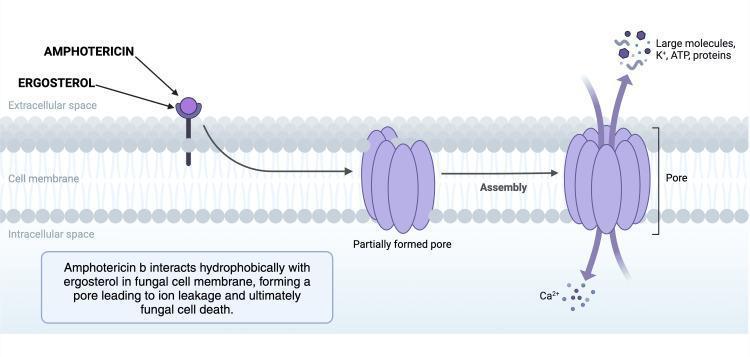
This pathophysiology diagram illustrates the mechanism of action of Amphotericin B, a polyene antifungal agent, on a fungal cell membrane. The diagram depicts the cell membrane as a phospholipid bilayer separating the extracellular space from the intracellular space. The process is shown in a three-step progression from left to right: (1) Initial interaction where Amphotericin B molecules bind hydrophobically to ergosterol, a primary sterol in the fungal membrane; (2) An intermediate state showing a 'partially formed pore' resulting from this interaction; and (3) The final 'Assembly' stage where a complete transmembrane pore is established. The diagram highlights the clinical consequence of pore formation: altered membrane permeability leading to the efflux of large molecules, potassium ions (K+), ATP, and proteins, and the influx of calcium ions (Ca2+). This disruption of cellular homeostasis results in fungal cell death. The visual is intended for medical education regarding antifungal pharmacology and is relevant to the treatment of invasive fungal infections like Cryptococcosis or Candidiasis.
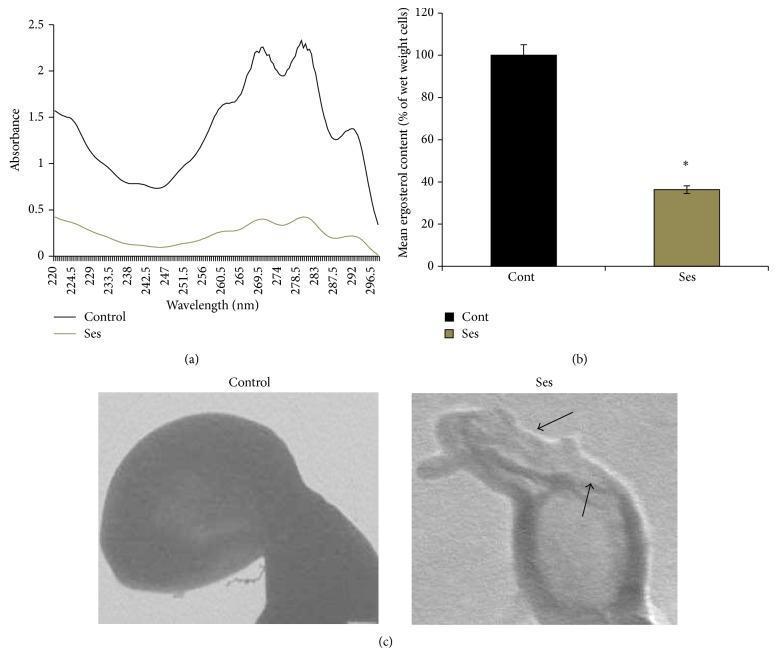
This composite image illustrates the impact of Sesquiterpene (Ses) on Candida albicans membrane integrity and ergosterol biosynthesis. Panel (a) is a UV-Vis spectrophotometric sterol profile showing absorbance across the 220–300 nm wavelength range. The control group (black line) exhibits characteristic sterol peaks, including a prominent peak around 270–285 nm, whereas the Ses-treated group (olive line) shows a marked reduction in absorbance, indicating depleted total sterol content. Panel (b) is a bar graph quantifying mean ergosterol levels as a percentage of wet cell weight. It shows a significant reduction (approximately 63%) in the Ses-treated group compared to the control (P < 0.05). Panel (c) displays Transmission Electron Micrograph (TEM) images of C. albicans cells. The control image shows a cell with a smooth, continuous, and well-defined membrane. In contrast, the Ses-treated cell shows clear evidence of membrane tampering and disruption, with arrows pointing to irregular, thinned, and compromised areas of the cell boundary. Collectively, these data demonstrate that the antifungal activity of Ses is linked to the destruction of fungal membrane veracity and the inhibition of ergosterol pathways.
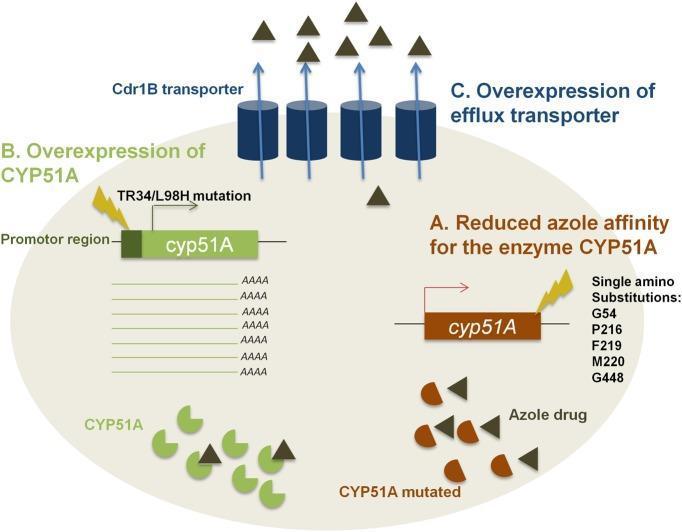
A pathophysiology diagram illustrating three primary mechanisms of azole drug resistance in Aspergillus fumigatus. Mechanism A (Reduced azole affinity) shows a brown cyp51A gene with lightning bolt symbols representing single amino acid substitutions (G54, P216, F219, M220, G448), resulting in mutated CYP51A enzymes that cannot bind azole drugs. Mechanism B (Overexpression of CYP51A) depicts a green cyp51A gene with a TR34/L98H mutation in the promoter region, leading to increased mRNA transcription and a high concentration of target enzymes. Mechanism C (Overexpression of efflux transporter) illustrates multiple blue cylindrical Cdr1B transporters embedded in the cell membrane, using blue arrows to show the active expulsion of azole drugs (represented by brown triangles) from the intracellular space. This medical illustration provides a clear visual summary of genetic mutations and protein overexpression strategies used by fungal pathogens to evade antifungal treatments targeting the ergosterol synthesis pathway.
Why Nystatin is Commonly Prescribed for Oral Candidiasis
What Is Nystatin?
1. Mechanism of Action - Why It Works Against Candida
- Loss of selective membrane permeability
- Outflow of potassium ions (K⁺), ATP, and essential intracellular components
- Influx of calcium ions (Ca²⁺) and water
- Disruption of cellular homeostasis and ultimately fungal cell death
2. Key Pharmacological Properties That Make It Ideal for Oral Thrush
| Property | Significance |
|---|---|
| Not absorbed from GI tract, skin, or mucous membranes | No systemic toxicity; safe for infants, neonates, pregnant patients |
| Acts locally on oral mucosa | Direct fungicidal contact with the infected tissue |
| Active against most Candida species | Covers C. albicans (most common cause of oral thrush) reliably |
| No significant resistance in vivo | C. albicans shows no significant resistance on repeated in vitro subculture; resistance rarely develops clinically |
| Available as oral suspension | Easy to swish around the mouth for mucosal contact coverage |
3. Clinical Use in Oral Candidiasis
- Oropharyngeal thrush (primary use)
- Neonatal oral thrush (very safe profile)
- Immunocompetent patients with oral candidiasis
- Suppression of subclinical esophageal candidiasis and GI Candida overgrowth
4. Why It's Preferred Over Systemic Antifungals for Routine Cases
- Safety profile: Because it is not absorbed, it causes virtually no systemic side effects and no hepatotoxicity. - NCBI LiverTox / Jawetz, p.264
- Cost-effective: Nystatin is the least expensive option among topical antifungals. - Red Book 2021
- No drug interactions of clinical significance
- Safe in neonates and pregnant patients - the absence of absorption makes it suitable where systemic azoles would be avoided
5. Limitations to Know
- Bitter, unpleasant taste - often the main complaint limiting adherence
- Not effective for invasive or systemic candidiasis - cannot be given parenterally (too toxic IV)
- Less effective than azoles in immunocompromised patients (e.g., HIV) - for these patients, oral fluconazole is preferred, as confirmed by a 2025 network meta-analysis (PMID 39214731) comparing antifungal drugs for oral candidiasis in HIV-positive patients
- Nail and hyperkeratinized skin infections do not respond - drug cannot penetrate adequately
- Candida species other than C. albicans can become resistant in vitro