
Mars diagram
A detailed scientific diagram of Mars showing its internal structure layers (crust, mantle, core), surface features (Olympus Mons, Valles Marineris, polar ice caps, Tharsis plateau, Hellas Basin), atmosphere layers, and key facts labeled. Clean educational style with accurate proportions and annotations.
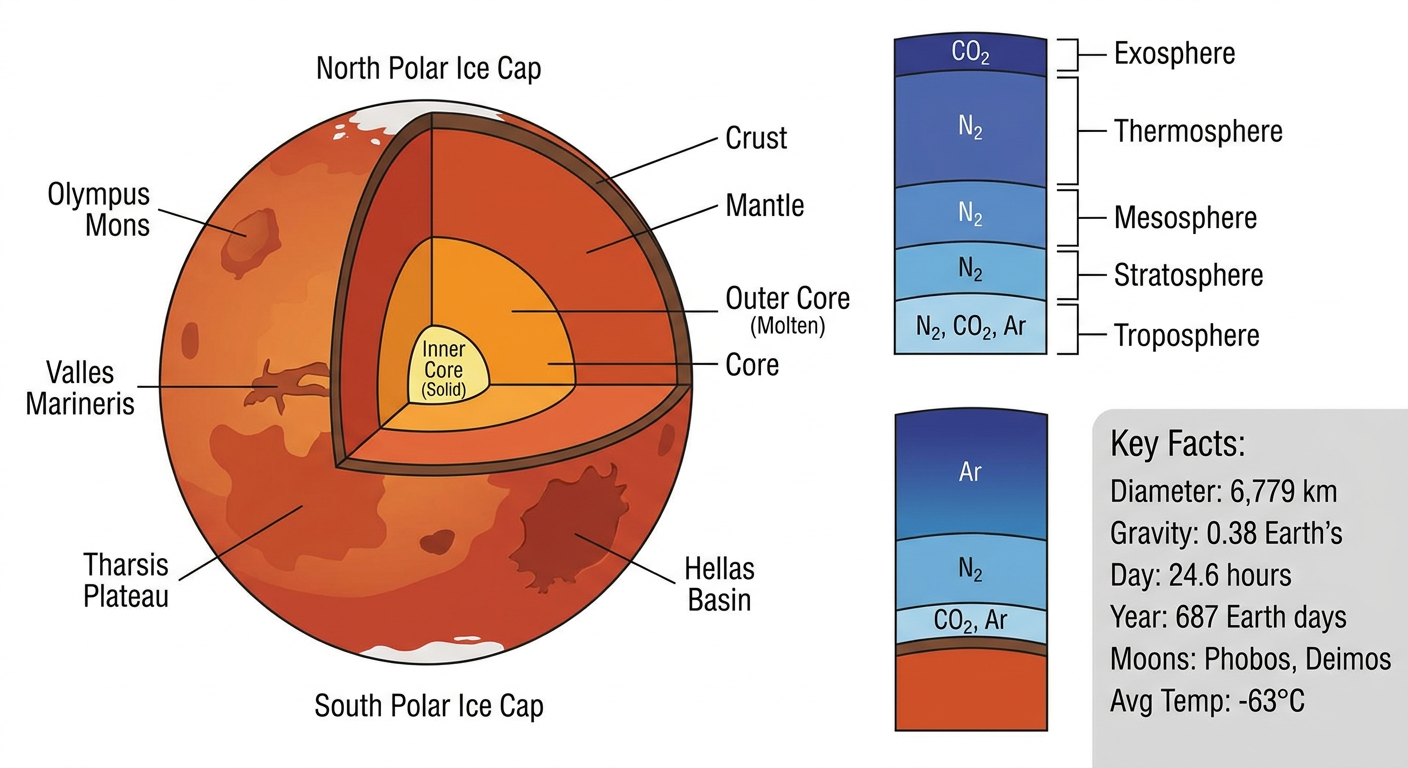
- Internal structure - crust, silicate mantle, and an iron/iron-sulfide core
- Surface landmarks - Olympus Mons (the largest volcano in the solar system), Valles Marineris (a canyon system stretching ~4,000 km), Hellas Basin (a major impact crater), and the Tharsis plateau
- Polar ice caps - composed of water ice and dry ice (CO₂)
- Atmosphere - thin, ~95% CO₂, with dust storms that can engulf the entire planet
Mars dialysis diagram
A detailed medical educational diagram of MARS (Molecular Adsorbent Recirculating System) dialysis, showing the blood circuit, albumin dialysate circuit, and the standard dialysis circuit. Label the patient blood flow, MARS membrane (hollow fiber), albumin regeneration columns (activated charcoal column and anion exchanger resin column), low-flux dialyzer, albumin pump, blood pump, and key substances removed (bilirubin, bile acids, ammonia, aromatic amino acids). Clean clinical diagram style with arrows showing flow direction.
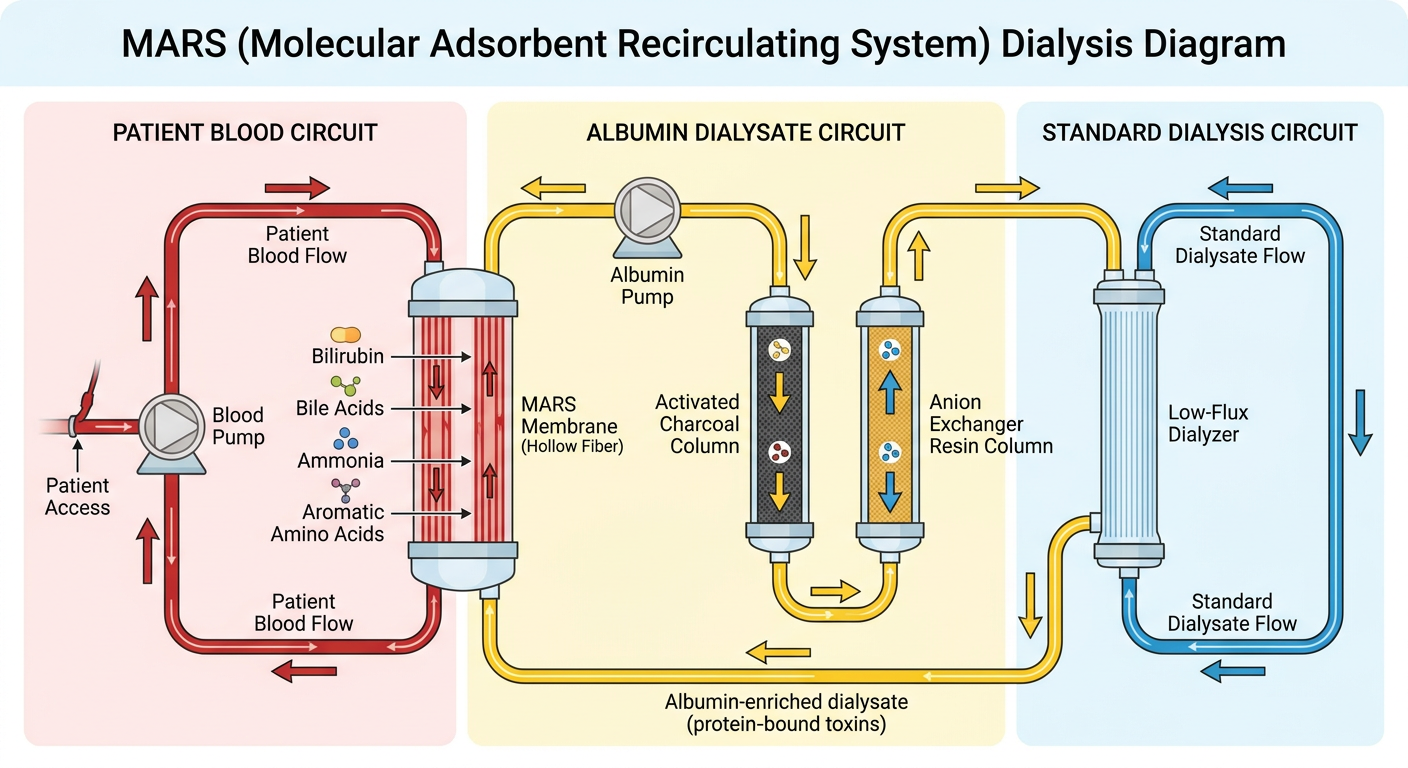
MARS (Molecular Adsorbent Recirculating System) Dialysis
- Acute liver failure (ALF)
- Acute-on-chronic liver failure (ACLF)
- Hepatorenal syndrome (HRS)
- Severe hepatic encephalopathy
How It Works - Three Circuits
- Patient blood flows across an albumin-impermeable hollow-fiber membrane
- The membrane is permeable to toxins but NOT to albumin - so the patient's own albumin stays in the blood
- A 20% human serum albumin (HSA) solution circulates on the other side of the membrane
- Protein-bound toxins (bilirubin, bile acids, aromatic amino acids, short/medium-chain fatty acids) diffuse across the membrane and bind to the albumin dialysate
- This circuit then passes through two regeneration columns:
- Activated charcoal column - adsorbs aromatic amino acids and lipophilic toxins
- Anion exchange resin column - adsorbs bilirubin and bile acids
- The cleaned albumin is then recirculated (hence "recirculating system")
- A low-flux dialyzer is incorporated into the albumin circuit
- Removes water-soluble toxins - urea, ammonia, creatinine, cytokines
- Maintains electrolyte and fluid balance
Toxins Removed
| Category | Examples |
|---|---|
| Protein-bound | Bilirubin, bile acids, fatty acids |
| Water-soluble | Ammonia, urea, creatinine |
| Amino acids | Aromatic amino acids (tryptophan, phenylalanine) |
| Inflammatory | Cytokines, endotoxins |
Clinical Evidence
- Prometheus (FPSA) - separates patient's own albumin and uses two adsorption columns + high-flux dialyzer; no survival benefit in ACLF
- SPAD (Single-Pass Albumin Dialysis) - simpler setup using albumin added to standard dialysis; also no clear survival impact
- High-Volume Plasma Exchange (HVP) - removes toxins AND replenishes coagulation factors; small studies show possible survival benefit
With patient
A detailed medical educational diagram of MARS (Molecular Adsorbent Recirculating System) dialysis showing a patient lying in a hospital bed connected to the system. Show three clearly labeled circuits: (1) Blood Circuit - arrows from patient's vascular access through a blood pump to the MARS membrane (hollow fiber dialyzer), then back to the patient; (2) Albumin Dialysate Circuit - 20% human serum albumin solution circulating from the MARS membrane through an activated charcoal adsorption column, then through an anion exchange resin column, then through a low-flux dialyzer, back to the MARS membrane; (3) Standard Dialysis Circuit - connected to the low-flux dialyzer for water-soluble toxin removal. Label the patient, vascular access (central line/catheter), blood pump, MARS membrane, albumin pump, activated charcoal column, anion exchange resin column, low-flux dialyzer, and dialysate drain. Use colored arrows: red for blood circuit, yellow for albumin circuit, blue for dialysis circuit. List toxins removed at the membrane: bilirubin, bile acids, ammonia, aromatic amino acids. Clean clinical educational style with clear annotations.
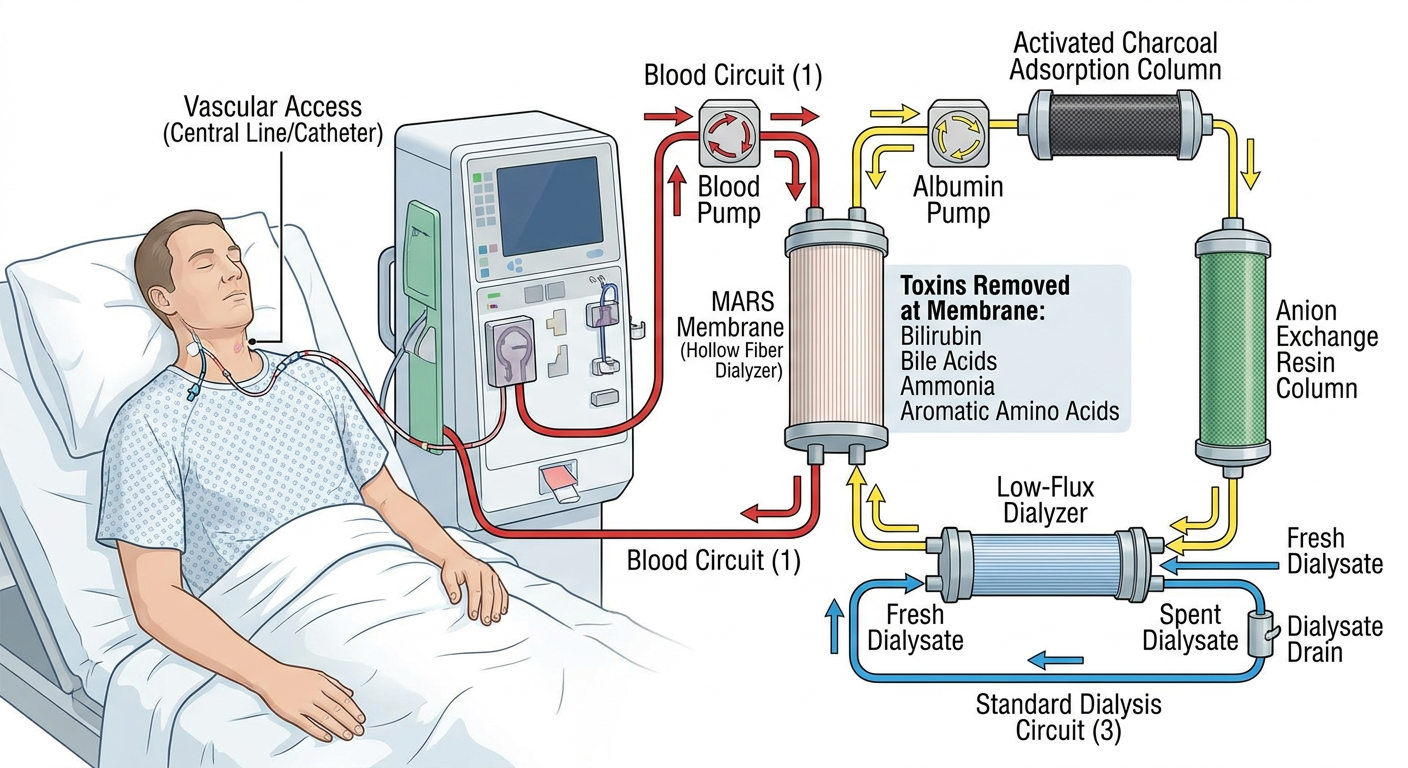
- Red (Blood Circuit) - patient blood drawn out via vascular access, pumped through the MARS hollow-fiber membrane, then returned to the patient
- Yellow (Albumin Circuit) - 20% albumin solution picks up protein-bound toxins at the membrane, gets regenerated through the activated charcoal column and anion exchange resin column, then loops back
- Blue (Dialysis Circuit) - connected to the low-flux dialyzer within the albumin loop, clearing water-soluble toxins like ammonia and urea