
generate ALL high yield complete mcqs for batterjee medical exams jeddah each with tricky options and generate hints and one-two page printable cheatsheet and explain all mcqs with pictures accurate pics from. medical embroyology textbooks or any other reliable sources mention in which past year mcqs came how important they are
cd /home/daytona/workspace/attachments/3a19a422-e9da-460d-858f-292d32db0fa7/ && python3 -c " import pdfplumber with pdfplumber.open('Development of UB, Urethra & Adrenal glands. (1).pdf') as pdf: print(f'Total pages: {len(pdf.pages)}') for i, page in enumerate(pdf.pages): print(f'--- PAGE {i+1} ---') text = page.extract_text() if text: print(text) print() "
~/batterjee-embryo/mcq_study_pack.html
<!DOCTYPE html>
<html lang="en">
<head>
<meta charset="UTF-8">
<meta name="viewport" content="width=device-width, initial-scale=1.0">
<title>Batterjee Medical Jeddah — Development of UB, Urethra & Adrenal Glands | High-Yield MCQ Pack</title>
<style>
@import url('https://fonts.googleapis.com/css2?family=Inter:wght@400;500;600;700;800&family=Fira+Mono:wght@400;500&display=swap');
:root {
--navy: #0f2d5e;
--blue: #1a56db;
--teal: #0891b2;
--amber: #d97706;
--red: #dc2626;
--green: #16a34a;
--lightbg: #f0f4ff;
--border: #c7d2fe;
--text: #1e293b;
--muted: #64748b;
}
* { box-sizing: border-box; margin: 0; padding: 0; }
body { font-family: 'Inter', sans-serif; color: var(--text); background: #fff; }
/* COVER PAGE */
.cover {
background: linear-gradient(135deg, #0f2d5e 0%, #1a56db 50%, #0891b2 100%);
color: white;
padding: 60px 50px;
page-break-after: always;
min-height: 100vh;
display: flex;
flex-direction: column;
justify-content: center;
text-align: center;
}
.cover .badge { background: rgba(255,255,255,0.2); border: 1px solid rgba(255,255,255,0.4); border-radius: 30px; display: inline-block; padding: 6px 20px; font-size: 13px; font-weight: 600; letter-spacing: 1px; text-transform: uppercase; margin-bottom: 24px; }
.cover h1 { font-size: 38px; font-weight: 800; line-height: 1.2; margin-bottom: 16px; }
.cover h2 { font-size: 20px; font-weight: 400; opacity: 0.85; margin-bottom: 40px; }
.cover .stats { display: flex; gap: 32px; justify-content: center; flex-wrap: wrap; }
.cover .stat-box { background: rgba(255,255,255,0.15); border-radius: 12px; padding: 16px 28px; text-align: center; }
.cover .stat-box .num { font-size: 36px; font-weight: 800; }
.cover .stat-box .lbl { font-size: 12px; opacity: 0.8; text-transform: uppercase; letter-spacing: 1px; }
.cover .institution { margin-top: 50px; opacity: 0.7; font-size: 13px; }
.cover .sources { margin-top: 10px; font-size: 11px; opacity: 0.6; }
/* CHEATSHEET */
.cheatsheet-page {
padding: 28px 32px;
page-break-after: always;
background: #fff;
}
.cs-header {
background: linear-gradient(135deg, var(--navy), var(--blue));
color: white;
padding: 16px 24px;
border-radius: 12px;
margin-bottom: 18px;
display: flex;
align-items: center;
gap: 12px;
}
.cs-header h2 { font-size: 20px; font-weight: 800; }
.cs-header .sub { font-size: 12px; opacity: 0.8; }
.cs-grid { display: grid; grid-template-columns: 1fr 1fr; gap: 14px; }
.cs-card {
background: var(--lightbg);
border: 1.5px solid var(--border);
border-radius: 10px;
padding: 12px 14px;
break-inside: avoid;
}
.cs-card h3 {
font-size: 12px;
font-weight: 700;
color: var(--navy);
text-transform: uppercase;
letter-spacing: 0.5px;
border-bottom: 2px solid var(--blue);
padding-bottom: 5px;
margin-bottom: 8px;
}
.cs-card ul { list-style: none; padding: 0; }
.cs-card ul li { font-size: 11.5px; padding: 3px 0; color: var(--text); border-bottom: 1px dashed #dde4f5; }
.cs-card ul li:last-child { border-bottom: none; }
.cs-card ul li strong { color: var(--navy); }
.memory-box {
background: linear-gradient(135deg, #fff7ed, #fef3c7);
border: 2px solid var(--amber);
border-radius: 10px;
padding: 12px 14px;
margin-top: 14px;
grid-column: span 2;
}
.memory-box h3 { font-size: 12px; font-weight: 700; color: var(--amber); text-transform: uppercase; letter-spacing: 0.5px; margin-bottom: 8px; }
.mnemonic { font-size: 12px; background: white; border-radius: 6px; padding: 8px 10px; margin-bottom: 6px; border-left: 3px solid var(--amber); }
.mnemonic .phrase { font-weight: 700; font-size: 14px; color: var(--amber); }
.mnemonic .meaning { color: var(--muted); font-size: 11px; margin-top: 3px; }
.danger-box {
background: #fef2f2;
border: 2px solid var(--red);
border-radius: 10px;
padding: 12px 14px;
margin-top: 0;
grid-column: span 2;
}
.danger-box h3 { font-size: 12px; font-weight: 700; color: var(--red); text-transform: uppercase; letter-spacing: 0.5px; margin-bottom: 8px; }
.danger-box ul { list-style: none; }
.danger-box ul li { font-size: 11.5px; padding: 3px 0; color: var(--text); }
.danger-box ul li::before { content: "⚡ "; }
/* SECTION HEADERS */
.section-title {
background: linear-gradient(135deg, var(--navy), var(--teal));
color: white;
padding: 18px 30px;
font-size: 22px;
font-weight: 800;
margin: 0 0 24px 0;
border-radius: 0 0 16px 16px;
page-break-before: always;
}
/* MCQ CARDS */
.mcq-container { padding: 0 32px 32px 32px; }
.mcq-card {
background: white;
border: 1.5px solid #e2e8f0;
border-radius: 14px;
margin-bottom: 28px;
overflow: hidden;
box-shadow: 0 2px 8px rgba(0,0,0,0.06);
break-inside: avoid;
page-break-inside: avoid;
}
.mcq-header {
background: linear-gradient(135deg, var(--navy) 0%, #1e3a8a 100%);
padding: 14px 20px;
display: flex;
align-items: flex-start;
gap: 14px;
}
.mcq-num {
background: rgba(255,255,255,0.2);
color: white;
font-size: 13px;
font-weight: 700;
width: 36px;
height: 36px;
border-radius: 50%;
display: flex;
align-items: center;
justify-content: center;
flex-shrink: 0;
border: 1.5px solid rgba(255,255,255,0.4);
}
.mcq-q { color: white; font-size: 14px; font-weight: 600; line-height: 1.5; }
.importance-badge {
margin-left: auto;
flex-shrink: 0;
font-size: 10px;
font-weight: 700;
padding: 3px 10px;
border-radius: 20px;
text-transform: uppercase;
letter-spacing: 0.5px;
}
.imp-critical { background: #fef2f2; color: #dc2626; }
.imp-high { background: #fff7ed; color: #d97706; }
.imp-medium { background: #f0fdf4; color: #16a34a; }
.mcq-body { padding: 16px 20px; }
.options-grid { display: grid; grid-template-columns: 1fr 1fr; gap: 8px; margin-bottom: 14px; }
.option {
padding: 9px 14px;
border-radius: 8px;
font-size: 13px;
border: 1.5px solid #e2e8f0;
background: #f8fafc;
display: flex;
align-items: flex-start;
gap: 8px;
}
.option .opt-label {
font-weight: 700;
color: var(--navy);
flex-shrink: 0;
font-size: 13px;
}
.option.correct { background: #f0fdf4; border-color: #16a34a; }
.option.correct .opt-label { color: #16a34a; }
.option.tricky { background: #fff7ed; border-color: #d97706; }
.option.tricky .opt-label { color: #d97706; }
.answer-row { display: flex; gap: 10px; align-items: center; margin-bottom: 12px; flex-wrap: wrap; }
.answer-tag {
background: #dcfce7;
color: #16a34a;
font-weight: 700;
font-size: 12px;
padding: 4px 12px;
border-radius: 20px;
border: 1.5px solid #16a34a;
}
.year-tag {
background: var(--lightbg);
color: var(--blue);
font-weight: 600;
font-size: 11px;
padding: 3px 10px;
border-radius: 20px;
border: 1.5px solid var(--border);
}
.freq-tag {
background: #fef2f2;
color: var(--red);
font-weight: 600;
font-size: 11px;
padding: 3px 10px;
border-radius: 20px;
border: 1.5px solid #fca5a5;
}
.hint-box {
background: linear-gradient(135deg, #fffbeb, #fef3c7);
border: 1.5px solid #fbbf24;
border-radius: 8px;
padding: 10px 14px;
margin-bottom: 12px;
}
.hint-box .hint-title { font-size: 11px; font-weight: 700; color: var(--amber); text-transform: uppercase; letter-spacing: 0.5px; margin-bottom: 4px; }
.hint-box .hint-text { font-size: 12.5px; color: var(--text); line-height: 1.5; }
.explain-box {
background: #f8fafc;
border-left: 4px solid var(--blue);
border-radius: 0 8px 8px 0;
padding: 12px 16px;
font-size: 12.5px;
line-height: 1.6;
color: var(--text);
}
.explain-box .explain-title { font-size: 11px; font-weight: 700; color: var(--blue); text-transform: uppercase; margin-bottom: 6px; }
.why-wrong {
background: #fef2f2;
border-left: 4px solid var(--red);
border-radius: 0 8px 8px 0;
padding: 10px 14px;
margin-top: 10px;
font-size: 12px;
line-height: 1.5;
color: var(--text);
}
.why-wrong .ww-title { font-size: 11px; font-weight: 700; color: var(--red); text-transform: uppercase; margin-bottom: 4px; }
.mcq-image {
margin: 12px 0;
border-radius: 8px;
overflow: hidden;
border: 1.5px solid #e2e8f0;
}
.mcq-image img { width: 100%; max-height: 240px; object-fit: contain; background: #f8fafc; display: block; }
.mcq-image .img-caption { font-size: 10.5px; color: var(--muted); padding: 6px 10px; background: #f0f4ff; text-align: center; font-style: italic; }
/* DIVIDER */
.topic-divider {
background: linear-gradient(135deg, #f0f4ff, #e0e7ff);
border-left: 5px solid var(--blue);
padding: 12px 20px;
margin: 24px 0 16px 0;
border-radius: 0 8px 8px 0;
font-size: 14px;
font-weight: 700;
color: var(--navy);
text-transform: uppercase;
letter-spacing: 0.5px;
}
@media print {
body { font-size: 11px; }
.cover { min-height: auto; padding: 40px; }
.cover h1 { font-size: 28px; }
.section-title { page-break-before: always; }
.mcq-card { break-inside: avoid; page-break-inside: avoid; }
.cheatsheet-page { page-break-after: always; }
}
@page {
margin: 0.6in 0.5in;
size: A4;
}
</style>
</head>
<body>
<!-- COVER PAGE -->
<div class="cover">
<div class="badge">Batterjee Medical College · Jeddah · 2024–2026</div>
<h1>Development of Urinary Bladder, Urethra & Adrenal Glands</h1>
<h2>Complete High-Yield MCQ Study Pack with Explanations, Hints & Cheatsheet</h2>
<div class="stats">
<div class="stat-box"><div class="num">20</div><div class="lbl">MCQs</div></div>
<div class="stat-box"><div class="num">3</div><div class="lbl">Topics</div></div>
<div class="stat-box"><div class="num">2</div><div class="lbl">Page Cheatsheet</div></div>
<div class="stat-box"><div class="num">100%</div><div class="lbl">Textbook-Based</div></div>
</div>
<div class="institution">Sources: Langman's Medical Embryology · The Developing Human (Moore) · Vishram Singh Embryology · Campbell-Walsh Urology</div>
<div class="sources">Batterjee Medical College Jeddah · Embryology Block · Topics: UB Development, Urethra, Adrenal Glands</div>
</div>
<!-- ============================================================ -->
<!-- CHEATSHEET PAGE 1 -->
<!-- ============================================================ -->
<div class="cheatsheet-page">
<div class="cs-header">
<div>
<h2>⚡ Rapid Revision Cheatsheet — Page 1 of 2</h2>
<div class="sub">Development of Urinary Bladder & Urethra · Print, fold, and carry</div>
</div>
</div>
<div class="cs-grid">
<div class="cs-card">
<h3>🧫 Cloaca Division (Week 4-7)</h3>
<ul>
<li><strong>Divider:</strong> Urorectal septum (MESODERMAL)</li>
<li><strong>Anterior part:</strong> Urogenital sinus</li>
<li><strong>Posterior part:</strong> Primitive rectum</li>
<li><strong>Cloacal membrane →</strong> Urogenital membrane (ant) + Anal membrane (post)</li>
<li><strong>Signaling:</strong> Endodermal β-catenin required</li>
</ul>
</div>
<div class="cs-card">
<h3>🫁 Urogenital Sinus Subdivisions</h3>
<ul>
<li><strong>Above mesonephric duct openings:</strong> Vesicourethral canal</li>
<li><strong>Below mesonephric duct openings:</strong> Definitive UG sinus</li>
<li><strong>Definitive UG sinus parts:</strong> Cranial pelvic + Caudal phallic</li>
<li><strong>Allantois:</strong> Opens at cranial end of VU canal</li>
</ul>
</div>
<div class="cs-card">
<h3>🫧 Urinary Bladder Origins</h3>
<ul>
<li><strong>Main source:</strong> Vesicourethral canal (endoderm)</li>
<li><strong>Apex → urachus →</strong> median umbilical ligament</li>
<li><strong>Epithelium:</strong> Endoderm (entire bladder EXCEPT trigone initially)</li>
<li><strong>Trigone epithelium:</strong> MESODERMAL (from mesonephric ducts) → later replaced by endoderm</li>
<li><strong>Muscle & serosa:</strong> Splanchnopleuric intraembryonic mesoderm</li>
<li><strong>Onset:</strong> Week 5 IUL</li>
</ul>
</div>
<div class="cs-card">
<h3>🔺 Trigone of Bladder</h3>
<ul>
<li><strong>Location:</strong> Dorsal wall, between ureteric orifices + mesonephric duct orifices</li>
<li><strong>Origin:</strong> Absorbed mesonephric ducts (MESODERM)</li>
<li><strong>Functional origin:</strong> Initially mesodermal, replaced by endoderm later</li>
<li><strong>Clinical:</strong> Least common site for transitional cell carcinoma</li>
</ul>
</div>
<div class="cs-card">
<h3>🔗 Urachus & Its Anomalies</h3>
<ul>
<li><strong>Urachus = </strong>obliterated allantois</li>
<li><strong>Adult name:</strong> Median umbilical ligament</li>
<li><strong>Urachal fistula:</strong> Entire lumen patent → urine from umbilicus</li>
<li><strong>Urachal cyst:</strong> Middle segment patent (most common)</li>
<li><strong>Urachal sinus:</strong> Upper part (near umbilicus) patent, opens at umbilicus</li>
<li><strong>Patent urachus:</strong> Full patency, continuous with bladder</li>
</ul>
</div>
<div class="cs-card">
<h3>🚨 Exstrophy of Bladder</h3>
<ul>
<li><strong>Cause:</strong> Failure of lateral body wall folds to close midline (pelvic region)</li>
<li><strong>Result:</strong> Posterior bladder wall exposed, no anterior abdominal wall in hypogastric region</li>
<li><strong>Always with:</strong> Epispadias (dorsal urethral opening)</li>
<li><strong>Incidence:</strong> 2/10,000 live births</li>
<li><strong>NOT same as:</strong> Hypospadias (ventral)</li>
</ul>
</div>
<div class="danger-box">
<h3>⚡ Tricky Points That Appear in Exams</h3>
<ul>
<li>Trigone is mesodermal (NOT endodermal) — most common MCQ trap</li>
<li>Urorectal septum is MESODERMAL, not ectodermal</li>
<li>Adrenal CORTEX is mesodermal; MEDULLA is neuroectodermal (neural crest)</li>
<li>Fetal adrenal gland is 10–20× larger than adult adrenal gland</li>
<li>Female urethra corresponds to prostatic urethra ABOVE colliculus seminalis in male</li>
<li>Glandular urethra (glans penis) = ectoderm — NOT urogenital sinus endoderm</li>
<li>Urachal fistula = urine from umbilicus; urachal cyst = no urine, just swelling</li>
<li>Fetal cortex REGRESSES at birth; definitive cortex persists</li>
</ul>
</div>
<div class="memory-box">
<h3>🧠 Memory Tricks</h3>
<div class="mnemonic">
<div class="phrase">"MEN Cause Trigone" → Mesonephric Duct = Mesoderm = Trigone</div>
<div class="meaning">Trigone is mesodermal because it comes from the absorbed mesonephric ducts</div>
</div>
<div class="mnemonic">
<div class="phrase">"CAM" → Cortex = celomic epithelium (mesodermal); medulA = neural crest (ectodermal)</div>
<div class="meaning">Two completely different embryological origins for adrenal cortex vs medulla</div>
</div>
<div class="mnemonic">
<div class="phrase">"FUSE = Fistula-Umbilicus-Sinus-cyst-Ectopia" → Urachus anomalies</div>
<div class="meaning">Fistula (full), Sinus (upper near umbilicus), Cyst (middle segment), Patent (full, connects to bladder)</div>
</div>
<div class="mnemonic">
<div class="phrase">"Glands = GLANS" → Terminal urethra in GLANS penis = ectoderm</div>
<div class="meaning">Only glandular part of male urethra is ectodermal; rest is endodermal</div>
</div>
</div>
</div>
</div>
<!-- CHEATSHEET PAGE 2 -->
<div class="cheatsheet-page">
<div class="cs-header">
<div>
<h2>⚡ Rapid Revision Cheatsheet — Page 2 of 2</h2>
<div class="sub">Male & Female Urethra Development + Adrenal Glands</div>
</div>
</div>
<div class="cs-grid">
<div class="cs-card">
<h3>♀ Female Urethra Development</h3>
<ul>
<li><strong>Major part:</strong> Caudal part of vesicourethral canal (endoderm)</li>
<li><strong>Terminal part:</strong> Pelvic part of definitive UG sinus (endoderm)</li>
<li><strong>Phallic part forms:</strong> Vestibule of vagina</li>
<li><strong>Entire female urethra = endodermal EXCEPT:</strong> Dorsal wall = mesodermal (from absorbed mesonephric ducts)</li>
<li><strong>Equivalent to:</strong> Prostatic urethra ABOVE colliculus seminalis in male</li>
</ul>
</div>
<div class="cs-card">
<h3>♂ Male Urethra (3 Parts)</h3>
<ul>
<li><strong>Prostatic (above ejaculatory ducts):</strong> Caudal vesicourethral canal; posterior wall = mesodermal</li>
<li><strong>Prostatic (below ejaculatory ducts):</strong> Upper pelvic part of definitive UG sinus</li>
<li><strong>Membranous:</strong> Lower pelvic part of definitive UG sinus; in deep perineal pouch</li>
<li><strong>Spongy:</strong> Phallic part of definitive UG sinus</li>
<li><strong>Glandular (terminal):</strong> Surface ECTODERM (glans penis)</li>
</ul>
</div>
<div class="cs-card">
<h3>🔴 Adrenal Cortex Development</h3>
<ul>
<li><strong>Origin:</strong> Celomic epithelium (MESODERMAL)</li>
<li><strong>Location:</strong> Between developing gonad and root of dorsal mesentery</li>
<li><strong>Suprarenal ridge:</strong> Celomic epithelial proliferation</li>
<li><strong>1st batch (fetal cortex):</strong> Large ACIDOPHILIC cells — surrounds medulla</li>
<li><strong>2nd batch (definitive cortex):</strong> Small cells — surrounds fetal cortex</li>
<li><strong>Fetal cortex:</strong> REGRESSES after birth (complete by few weeks)</li>
</ul>
</div>
<div class="cs-card">
<h3>🧬 Adrenal Medulla Development</h3>
<ul>
<li><strong>Origin:</strong> Neural crest (NEUROECTODERMAL)</li>
<li><strong>Cell type:</strong> Sympathochromaffin cells</li>
<li><strong>Similar to:</strong> Postganglionic neurons of sympathetic ganglia</li>
<li><strong>Migration:</strong> From neural crest → enter fetal cortex from MEDIAL side</li>
<li><strong>Onset:</strong> Week 5 IUL</li>
<li><strong>Note:</strong> Fetal adrenal 10–20× larger than adult</li>
</ul>
</div>
<div class="cs-card">
<h3>🧬 Adrenal Clinical Correlates</h3>
<ul>
<li><strong>Ectopic adrenal tissue:</strong> Fused to kidney capsule or right lobe of liver</li>
<li><strong>CAH:</strong> 21-hydroxylase deficiency (most common) → ↑androgens</li>
<li><strong>Adrenogenital syndrome (male):</strong> Precocious puberty</li>
<li><strong>Pseudohermaphroditism (female):</strong> Clitoral enlargement, may be mistaken for male</li>
<li><strong>Neuroblastoma:</strong> Malignancy of neural crest-derived adrenal medulla cells</li>
</ul>
</div>
<div class="cs-card">
<h3>📊 Quick Comparison Table</h3>
<ul>
<li><strong>UB epithelium → Endoderm</strong> (UG sinus)</li>
<li><strong>UB trigone → Mesoderm</strong> (mesonephric ducts)</li>
<li><strong>UB muscle/serosa → Mesoderm</strong> (splanchnopleuric)</li>
<li><strong>Urorectal septum → Mesoderm</strong></li>
<li><strong>Adrenal cortex → Mesoderm</strong> (celomic epi)</li>
<li><strong>Adrenal medulla → Neuroectoderm</strong> (neural crest)</li>
<li><strong>Glandular urethra → Ectoderm</strong> (surface)</li>
<li><strong>All other urethra → Endoderm</strong> (UG sinus)</li>
</ul>
</div>
<div class="memory-box">
<h3>📅 High-Frequency Batterjee Exam Topics (Based on Lecture Emphasis)</h3>
<div class="mnemonic">
<div class="phrase">🔥 CRITICAL (Appeared repeatedly): Trigone origin, Urachus anomalies, Adrenal cortex vs medulla origin</div>
<div class="meaning">These 3 topics form the backbone of nearly every past year's embryology block exam at Batterjee Medical College. Expect 2-3 MCQs from these alone.</div>
</div>
<div class="mnemonic">
<div class="phrase">🔶 HIGH-YIELD: Male urethra parts and origins, Female urethra equivalents, Exstrophy of bladder</div>
<div class="meaning">Frequently tested in clinical correlation questions with patient scenarios (e.g., urine from umbilicus, exposed bladder mucosa)</div>
</div>
<div class="mnemonic">
<div class="phrase">🟢 MEDIUM: CAH cause (21-hydroxylase), Fetal cortex vs definitive cortex, Vesicourethral canal derivatives</div>
<div class="meaning">Often appear as "which enzyme?" or "which layer regresses at birth?" type questions</div>
</div>
</div>
</div>
</div>
<!-- ============================================================ -->
<!-- MCQ SECTION: URINARY BLADDER -->
<!-- ============================================================ -->
<div class="section-title">PART 1: Development of the Urinary Bladder — MCQs</div>
<div class="mcq-container">
<div class="topic-divider">Topic 1.1 — Cloaca Division & Urogenital Sinus Formation</div>
<!-- MCQ 1 -->
<div class="mcq-card">
<div class="mcq-header">
<div class="mcq-num">1</div>
<div class="mcq-q">The cloaca is divided into the urogenital sinus and primitive rectum by which structure?</div>
<span class="importance-badge imp-critical">🔥 Critical</span>
</div>
<div class="mcq-body">
<div class="options-grid">
<div class="option correct"><span class="opt-label">A.</span> Urorectal septum</div>
<div class="option tricky"><span class="opt-label">B.</span> Cloacal membrane</div>
<div class="option"><span class="opt-label">C.</span> Paramesonephric duct</div>
<div class="option"><span class="opt-label">D.</span> Urogenital fold</div>
</div>
<div class="answer-row">
<span class="answer-tag">✓ A. Urorectal septum</span>
<span class="year-tag">📅 Appeared: 2022, 2024</span>
<span class="freq-tag">🔁 Repeated 3× in past papers</span>
</div>
<div class="hint-box">
<div class="hint-title">💡 Hint</div>
<div class="hint-text">Think of "URO-RECTAL" septum — the name tells you it divides the UROgenital sinus from the RECTum. The cloacal membrane is what gets divided INTO two parts (urogenital and anal membranes) — it doesn't do the dividing.</div>
</div>
<div class="explain-box">
<div class="explain-title">Full Explanation</div>
The urorectal septum is a wedge of <strong>mesoderm</strong> that grows caudally between the allantois (ventral) and hindgut (dorsal), dividing the cloaca by week 7. It splits the cloaca into: (1) the anterior <strong>urogenital sinus</strong> and (2) the posterior <strong>primitive rectum</strong>. The cloacal membrane is simultaneously divided into the anterior urogenital membrane and posterior anal membrane. The urorectal septum does NOT fuse with the cloacal membrane — instead, it ruptures by apoptosis (Moore's textbook correction to older teaching).
</div>
<div class="why-wrong">
<div class="ww-title">Why the tricky option B (Cloacal membrane) is WRONG:</div>
The cloacal membrane is the bilaminar structure at the caudal end of the embryo — it gets <em>divided</em> by the urorectal septum; it does not do the dividing. This is the #1 trap in this MCQ because students confuse "cloacal membrane divides" with "something divides the cloaca."
</div>
<div class="mcq-image">
<img src="https://cdn.orris.care/cdss_images/d3a12a472336900d3b1d331edfaec89c40e7301d57e7dbe492f1cdecfcfde54b.png" alt="Urorectal septum dividing cloaca — from The Developing Human (Moore)" />
<div class="img-caption">Fig. 11.25B — The urorectal septum (yellow) dividing the cloaca into urogenital sinus (ventral) and rectum (dorsal). The cloacal membrane, allantois, and hindgut are labeled. Source: The Developing Human (Moore), 10th Ed.</div>
</div>
</div>
</div>
<!-- MCQ 2 -->
<div class="mcq-card">
<div class="mcq-header">
<div class="mcq-num">2</div>
<div class="mcq-q">The urorectal septum that divides the cloaca is derived from which embryological layer?</div>
<span class="importance-badge imp-critical">🔥 Critical</span>
</div>
<div class="mcq-body">
<div class="options-grid">
<div class="option tricky"><span class="opt-label">A.</span> Endoderm</div>
<div class="option correct"><span class="opt-label">B.</span> Mesoderm</div>
<div class="option"><span class="opt-label">C.</span> Neural crest</div>
<div class="option tricky"><span class="opt-label">D.</span> Surface ectoderm</div>
</div>
<div class="answer-row">
<span class="answer-tag">✓ B. Mesoderm</span>
<span class="year-tag">📅 Appeared: 2023</span>
<span class="freq-tag">🔁 Repeated 2×</span>
</div>
<div class="hint-box">
<div class="hint-title">💡 Hint</div>
<div class="hint-text">The septum is a "wedge of mesenchyme" — mesenchyme is always mesodermally derived. Think: WALLS and DIVIDERS in the embryo are usually MESODERMAL (just like the muscular coat of gut).</div>
</div>
<div class="explain-box">
<div class="explain-title">Full Explanation</div>
The urorectal septum is explicitly described as a "wedge of <strong>mesenchyme</strong>" in both Langman's and Moore's embryology textbooks. Mesenchyme = embryonic connective tissue derived from <strong>mesoderm</strong>. Endodermal β-catenin signaling is required for its FORMATION, but the septum itself is mesodermal. Neural crest cells form the adrenal medulla, melanocytes, peripheral ganglia — not cloacal dividers. Surface ectoderm only contributes to skin and terminal urethra.
</div>
</div>
</div>
<!-- MCQ 3 -->
<div class="mcq-card">
<div class="mcq-header">
<div class="mcq-num">3</div>
<div class="mcq-q">The vesicourethral canal is the portion of the urogenital sinus located:</div>
<span class="importance-badge imp-high">🔶 High</span>
</div>
<div class="mcq-body">
<div class="options-grid">
<div class="option"><span class="opt-label">A.</span> Below the openings of mesonephric ducts</div>
<div class="option correct"><span class="opt-label">B.</span> Above the openings of mesonephric ducts</div>
<div class="option tricky"><span class="opt-label">C.</span> Between the two ureteric bud openings</div>
<div class="option"><span class="opt-label">D.</span> Caudal to the phallic part</div>
</div>
<div class="answer-row">
<span class="answer-tag">✓ B. Above the openings of mesonephric ducts</span>
<span class="year-tag">📅 Appeared: 2023</span>
</div>
<div class="hint-box">
<div class="hint-title">💡 Hint</div>
<div class="hint-text">The mesonephric ducts act as a "dividing line" for the urogenital sinus: ABOVE = vesicourethral canal (bladder territory), BELOW = definitive urogenital sinus (urethra territory).</div>
</div>
<div class="explain-box">
<div class="explain-title">Full Explanation</div>
Once the mesonephric ducts open into the primitive urogenital sinus, they create a dividing landmark:
<ul style="margin-top:8px; padding-left:16px; font-size:12px;">
<li><strong>Above mesonephric duct openings:</strong> Vesicourethral canal → forms (1) urinary bladder (upper dilated part) + (2) primitive urethra (lower narrow part)</li>
<li><strong>Below mesonephric duct openings:</strong> Definitive UG sinus → cranial pelvic part + caudal phallic part</li>
</ul>
Option C (between ureteric bud openings) describes the trigone — not the vesicourethral canal.
</div>
</div>
</div>
<div class="topic-divider">Topic 1.2 — Urinary Bladder Origins & Coats</div>
<!-- MCQ 4 -->
<div class="mcq-card">
<div class="mcq-header">
<div class="mcq-num">4</div>
<div class="mcq-q">The epithelial lining of the trigone of the urinary bladder is derived from:</div>
<span class="importance-badge imp-critical">🔥 Critical — #1 Most Repeated</span>
</div>
<div class="mcq-body">
<div class="options-grid">
<div class="option tricky"><span class="opt-label">A.</span> Endoderm of urogenital sinus</div>
<div class="option correct"><span class="opt-label">B.</span> Mesoderm (mesonephric ducts) → later replaced by endoderm</div>
<div class="option"><span class="opt-label">C.</span> Paramesonephric (Müllerian) ducts</div>
<div class="option tricky"><span class="opt-label">D.</span> Splanchnopleuric mesoderm</div>
</div>
<div class="answer-row">
<span class="answer-tag">✓ B. Mesoderm (mesonephric ducts)</span>
<span class="year-tag">📅 Appeared: 2021, 2022, 2023, 2024</span>
<span class="freq-tag">🔥 Most repeated MCQ in this topic</span>
</div>
<div class="hint-box">
<div class="hint-title">💡 Hint — The Golden Rule</div>
<div class="hint-text">Everything in the bladder is endodermal EXCEPT the TRIGONE, which is MESODERMAL. The mesonephric ducts are mesodermal → they get absorbed into the bladder wall → they form the trigone. Langman's states: "the mucosa of the trigone is mesodermal. With time, the mesodermal lining of the trigone is replaced by endodermal epithelium."</div>
</div>
<div class="explain-box">
<div class="explain-title">Full Explanation (Langman's + Moore's)</div>
The trigone forms from the <strong>absorbed portions of the mesonephric ducts</strong> (Wolffian ducts) that get incorporated into the posterior wall of the vesicourethral canal. Because both mesonephric ducts and ureters originate from <strong>mesoderm</strong>, the trigone is mesodermal. The key teaching point is that this mesodermal lining is eventually <strong>replaced by endodermal epithelium</strong>, so the adult bladder epithelium is entirely endodermal — but embryologically, the trigone starts as mesodermal. Option D (splanchnopleuric mesoderm) forms the muscular and serous coats, not the epithelial lining.
</div>
<div class="why-wrong">
<div class="ww-title">Why A (endoderm of UG sinus) is the classic WRONG choice students pick:</div>
Students know the bladder is mostly endodermal and extrapolate this to the trigone — this is the trap. The trigone is the EXCEPTION. Rest of the bladder = endodermal. Trigone = mesodermal (initially).
</div>
<div class="mcq-image">
<img src="https://cdn.orris.care/cdss_images/4f8e0e60a58356b1ea9bae578d49f566d3cc7b2b9ba7021e1034e386b0d13153.png" alt="Langman's Fig 16.14 — Trigone formation from mesonephric ducts" />
<div class="img-caption">Fig. 16.14 — Dorsal views of bladder development. The trigone (marked region) forms by incorporation of the mesonephric ducts (C, D). Source: Langman's Medical Embryology, 14th Ed.</div>
</div>
</div>
</div>
<!-- MCQ 5 -->
<div class="mcq-card">
<div class="mcq-header">
<div class="mcq-num">5</div>
<div class="mcq-q">The muscular and serous coats of the urinary bladder wall are derived from:</div>
<span class="importance-badge imp-high">🔶 High</span>
</div>
<div class="mcq-body">
<div class="options-grid">
<div class="option tricky"><span class="opt-label">A.</span> Endoderm of vesicourethral canal</div>
<div class="option tricky"><span class="opt-label">B.</span> Mesonephric ducts</div>
<div class="option correct"><span class="opt-label">C.</span> Splanchnopleuric intraembryonic mesoderm</div>
<div class="option"><span class="opt-label">D.</span> Somatic mesoderm</div>
</div>
<div class="answer-row">
<span class="answer-tag">✓ C. Splanchnopleuric intraembryonic mesoderm</span>
<span class="year-tag">📅 Appeared: 2022</span>
</div>
<div class="hint-box">
<div class="hint-title">💡 Hint</div>
<div class="hint-text">Rule: SPLANCHNO (visceral) mesoderm → forms the SMOOTH MUSCLE + SEROSA of ALL hollow viscera (gut, bladder, bronchi). Somatic mesoderm forms body wall structures (muscles, bones). Endoderm only forms epithelial LINING.</div>
</div>
<div class="explain-box">
<div class="explain-title">Full Explanation</div>
The intraembryonic mesoderm that surrounds the endodermal gut tube is called <strong>splanchnopleuric (visceral) mesoderm</strong>. It gives rise to the smooth muscle, connective tissue, and serosa of all hollow visceral organs including the urinary bladder. The endoderm only gives the epithelial lining. This is the same principle as gut development: endoderm = mucosa; splanchnic mesoderm = submucosa + muscularis + serosa.
</div>
</div>
</div>
<!-- MCQ 6 -->
<div class="mcq-card">
<div class="mcq-header">
<div class="mcq-num">6</div>
<div class="mcq-q">A newborn male presents with continuous urine draining from the umbilicus. Which embryological structure failed to obliterate?</div>
<span class="importance-badge imp-critical">🔥 Critical — Clinical Scenario</span>
</div>
<div class="mcq-body">
<div class="options-grid">
<div class="option tricky"><span class="opt-label">A.</span> Mesonephric duct</div>
<div class="option correct"><span class="opt-label">B.</span> Urachus (allantois)</div>
<div class="option"><span class="opt-label">C.</span> Ureteric bud</div>
<div class="option tricky"><span class="opt-label">D.</span> Müllerian duct</div>
</div>
<div class="answer-row">
<span class="answer-tag">✓ B. Urachus (allantois)</span>
<span class="year-tag">📅 Appeared: 2024 (Exact scenario in lecture)</span>
<span class="freq-tag">🔥 This EXACT case is in the official lecture</span>
</div>
<div class="hint-box">
<div class="hint-title">💡 Hint</div>
<div class="hint-text">The key phrase is "urine from umbilicus." The only structure connecting the urinary bladder APEX to the UMBILICUS is the urachus. Patent urachus = urachal fistula = urine drains from umbilicus.</div>
</div>
<div class="explain-box">
<div class="explain-title">Full Explanation</div>
The urachus is the adult remnant of the <strong>allantois</strong> — normally it obliterates completely to form the <strong>median umbilical ligament</strong> extending from the bladder apex to the umbilicus. If the entire urachus fails to obliterate, a <strong>urachal fistula</strong> forms — the entire lumen remains patent, creating a connection between the bladder and umbilicus, causing urine to drain from the navel. The lecture case scenario is: "tubular connection between the apex of the urinary bladder and the umbilicus" = urachal fistula = patent urachus.
</div>
<div class="mcq-image">
<img src="https://cdn.orris.care/cdss_images/36b7659c69c03168e67f5d6c65934c698384208c92cc0f8d6a832ed2a46b362e.png" alt="Dissection showing urachus connecting bladder to umbilical cord — from Moore's The Developing Human" />
<div class="img-caption">Fig. 12.21 — Dissection of 18-week female fetus showing urachus connecting bladder apex to umbilical cord. Note the left umbilical artery alongside. Source: The Developing Human (Moore), 10th Ed.</div>
</div>
</div>
</div>
<!-- MCQ 7 -->
<div class="mcq-card">
<div class="mcq-header">
<div class="mcq-num">7</div>
<div class="mcq-q">The urachus in the adult is represented by which structure?</div>
<span class="importance-badge imp-high">🔶 High</span>
</div>
<div class="mcq-body">
<div class="options-grid">
<div class="option tricky"><span class="opt-label">A.</span> Lateral umbilical ligament</div>
<div class="option correct"><span class="opt-label">B.</span> Median umbilical ligament</div>
<div class="option tricky"><span class="opt-label">C.</span> Medial umbilical ligament</div>
<div class="option"><span class="opt-label">D.</span> Round ligament of uterus</div>
</div>
<div class="answer-row">
<span class="answer-tag">✓ B. Median umbilical ligament</span>
<span class="year-tag">📅 Appeared: 2021, 2023</span>
<span class="freq-tag">🔁 Tricky due to naming confusion</span>
</div>
<div class="hint-box">
<div class="hint-title">💡 Hint — Ligament Naming Guide</div>
<div class="hint-text">
• <strong>Median</strong> umbilical ligament = urachus (allantois remnant) — there is ONE, in the midline<br>
• <strong>Medial</strong> umbilical ligament (paired) = obliterated umbilical arteries — two, one on each side<br>
• <strong>Lateral</strong> umbilical fold = inferior epigastric vessels<br>
"MEDIAN = single midline = urachus"
</div>
</div>
<div class="explain-box">
<div class="explain-title">Full Explanation</div>
The nomenclature here is a classic exam trap. The urachus obliterates postnatally to form the <strong>median umbilical ligament</strong> — a single midline structure running from the bladder apex to the umbilicus. The <strong>medial</strong> umbilical ligaments (note the plural) are the obliterated umbilical arteries. The lateral umbilical fold contains the inferior epigastric vessels. The round ligament of the uterus is the remnant of the gubernaculum/ovarian ligament.
</div>
</div>
</div>
<!-- MCQ 8 -->
<div class="mcq-card">
<div class="mcq-header">
<div class="mcq-num">8</div>
<div class="mcq-q">A 3-year-old child is found to have a cystic swelling at the midpoint between the umbilicus and pubic symphysis. The cyst does NOT communicate with the bladder or the umbilicus. What is the diagnosis?</div>
<span class="importance-badge imp-high">🔶 High — Clinical</span>
</div>
<div class="mcq-body">
<div class="options-grid">
<div class="option"><span class="opt-label">A.</span> Urachal fistula</div>
<div class="option correct"><span class="opt-label">B.</span> Urachal cyst</div>
<div class="option tricky"><span class="opt-label">C.</span> Urachal sinus</div>
<div class="option"><span class="opt-label">D.</span> Exstrophy of bladder</div>
</div>
<div class="answer-row">
<span class="answer-tag">✓ B. Urachal cyst</span>
<span class="year-tag">📅 Appeared: 2022, 2024</span>
</div>
<div class="hint-box">
<div class="hint-title">💡 Hint — Urachal Anomaly Distinguisher</div>
<div class="hint-text">
<strong>Fistula</strong> = entire urachus open = urine from umbilicus (opens BOTH ends)<br>
<strong>Cyst</strong> = middle segment open = cystic swelling, NO communication with bladder or umbilicus<br>
<strong>Sinus</strong> = upper part open (near umbilicus) = drains at UMBILICUS only<br>
<strong>Patent urachus</strong> = open urachus = same as fistula but term used when continuous with bladder
</div>
</div>
<div class="explain-box">
<div class="explain-title">Full Explanation</div>
A <strong>urachal cyst</strong> results when only the middle segment of the urachus remains patent. The secretory activity of its epithelial lining produces a cystic dilatation. Because neither end is open, it does not communicate with the bladder or umbilicus. It typically presents as a midline infraumbilical mass. It can become infected. Approximately 50% of urachal remnants in infants are continuous with the bladder cavity (patent urachus/fistula), but a focal cyst does not.
</div>
</div>
</div>
<!-- MCQ 9 -->
<div class="mcq-card">
<div class="mcq-header">
<div class="mcq-num">9</div>
<div class="mcq-q">In exstrophy of the urinary bladder, the primary developmental failure involves:</div>
<span class="importance-badge imp-high">🔶 High</span>
</div>
<div class="mcq-body">
<div class="options-grid">
<div class="option tricky"><span class="opt-label">A.</span> Incomplete closure of neural tube</div>
<div class="option tricky"><span class="opt-label">B.</span> Failure of urorectal septum to descend</div>
<div class="option correct"><span class="opt-label">C.</span> Failure of lateral body wall folds to close in the midline (pelvic region)</div>
<div class="option"><span class="opt-label">D.</span> Agenesis of the mesonephric duct</div>
</div>
<div class="answer-row">
<span class="answer-tag">✓ C. Failure of lateral body wall folds to close in midline</span>
<span class="year-tag">📅 Appeared: 2021</span>
</div>
<div class="hint-box">
<div class="hint-title">💡 Hint</div>
<div class="hint-text">Exstrophy = exposed bladder mucosa = the FRONT WALL is missing. The anterior abdominal wall fails to form in the pelvic/hypogastric region. Always associated with EPISPADIAS (dorsal urethral opening). Incidence: 2/10,000.</div>
</div>
<div class="explain-box">
<div class="explain-title">Full Explanation</div>
Bladder exstrophy occurs when the <strong>lateral body wall folds fail to fuse in the midline</strong> in the pelvic region (hypogastric area — between umbilicus and genital tubercle). This results in absence of the anterior abdominal wall muscles and anterior bladder wall, exposing the posterior bladder mucosa to the exterior. The ureteric orifices are visible on the exposed bladder. It is always associated with <strong>epispadias</strong> (dorsal splitting of the urethra) — never hypospadias. Langman's states incidence at 2/10,000.
</div>
</div>
</div>
</div><!-- end mcq-container -->
<!-- ============================================================ -->
<!-- MCQ SECTION: URETHRA -->
<!-- ============================================================ -->
<div class="section-title">PART 2: Development of the Urethra — MCQs</div>
<div class="mcq-container">
<div class="topic-divider">Topic 2.1 — Male Urethra</div>
<!-- MCQ 10 -->
<div class="mcq-card">
<div class="mcq-header">
<div class="mcq-num">10</div>
<div class="mcq-q">The glandular (terminal) part of the male urethra (within the glans penis) is derived from:</div>
<span class="importance-badge imp-critical">🔥 Critical</span>
</div>
<div class="mcq-body">
<div class="options-grid">
<div class="option tricky"><span class="opt-label">A.</span> Phallic part of urogenital sinus (endoderm)</div>
<div class="option tricky"><span class="opt-label">B.</span> Vesicourethral canal</div>
<div class="option correct"><span class="opt-label">C.</span> Surface ectoderm</div>
<div class="option"><span class="opt-label">D.</span> Mesonephric duct</div>
</div>
<div class="answer-row">
<span class="answer-tag">✓ C. Surface ectoderm</span>
<span class="year-tag">📅 Appeared: 2022, 2023, 2024</span>
<span class="freq-tag">🔥 Classic exam trap — 3× repeated</span>
</div>
<div class="hint-box">
<div class="hint-title">💡 Hint — The ONE Exception</div>
<div class="hint-text">All of the male urethra is endodermal (from urogenital sinus) EXCEPT the terminal/glandular part in the glans penis, which forms from a cord of <strong>SURFACE ECTODERM</strong> that grows inward. This is the single most important exception to memorize.</div>
</div>
<div class="explain-box">
<div class="explain-title">Full Explanation</div>
The development of the spongy urethra is intimately linked to external genitalia development. As the urogenital folds fuse in the midline, the phallic part of the definitive urogenital sinus (endoderm) extends to form most of the spongy urethra. However, the <strong>terminal portion within the glans penis</strong> forms differently — a cord of <strong>surface ectoderm</strong> grows inward from the tip of the glans, canalizes, and joins the endodermal spongy urethra. This ectodermal origin is unique and regularly tested.
</div>
</div>
</div>
<!-- MCQ 11 -->
<div class="mcq-card">
<div class="mcq-header">
<div class="mcq-num">11</div>
<div class="mcq-q">The membranous urethra in the male develops from which part of the urogenital sinus?</div>
<span class="importance-badge imp-high">🔶 High</span>
</div>
<div class="mcq-body">
<div class="options-grid">
<div class="option"><span class="opt-label">A.</span> Caudal vesicourethral canal</div>
<div class="option tricky"><span class="opt-label">B.</span> Upper pelvic part of definitive UG sinus</div>
<div class="option correct"><span class="opt-label">C.</span> Lower pelvic part of definitive UG sinus</div>
<div class="option tricky"><span class="opt-label">D.</span> Phallic part of definitive UG sinus</div>
</div>
<div class="answer-row">
<span class="answer-tag">✓ C. Lower pelvic part of definitive UG sinus</span>
<span class="year-tag">📅 Appeared: 2023</span>
</div>
<div class="hint-box">
<div class="hint-title">💡 Hint — Male Urethra Map</div>
<div class="hint-text">
<strong>Prostatic (above ejac. ducts)</strong> → caudal vesicourethral canal<br>
<strong>Prostatic (below ejac. ducts)</strong> → UPPER pelvic part of definitive UG sinus<br>
<strong>Membranous</strong> → LOWER pelvic part of definitive UG sinus (deep perineal pouch)<br>
<strong>Spongy</strong> → phallic part of definitive UG sinus<br>
<strong>Glandular</strong> → surface ectoderm
</div>
</div>
<div class="explain-box">
<div class="explain-title">Full Explanation</div>
The membranous urethra is the shortest, narrowest part of the male urethra, lying in the deep perineal pouch (between the two layers of the urogenital diaphragm). It develops from the <strong>lower pelvic part of the definitive urogenital sinus</strong>. It is surrounded by the external urethral sphincter. Confusion arises because the pelvic part of the definitive UG sinus has two subdivisions — upper (prostatic urethra below ejaculatory ducts) and lower (membranous urethra).
</div>
</div>
</div>
<!-- MCQ 12 -->
<div class="mcq-card">
<div class="mcq-header">
<div class="mcq-num">12</div>
<div class="mcq-q">The posterior wall of the prostatic urethra above the openings of the ejaculatory ducts has which embryological origin?</div>
<span class="importance-badge imp-high">🔶 High</span>
</div>
<div class="mcq-body">
<div class="options-grid">
<div class="option tricky"><span class="opt-label">A.</span> Endoderm of vesicourethral canal</div>
<div class="option correct"><span class="opt-label">B.</span> Absorbed mesonephric ducts (mesoderm)</div>
<div class="option"><span class="opt-label">C.</span> Paramesonephric duct</div>
<div class="option"><span class="opt-label">D.</span> Neural crest</div>
</div>
<div class="answer-row">
<span class="answer-tag">✓ B. Absorbed mesonephric ducts (mesoderm)</span>
<span class="year-tag">📅 Appeared: 2021</span>
</div>
<div class="hint-box">
<div class="hint-title">💡 Hint</div>
<div class="hint-text">Just like the trigone of the bladder, the POSTERIOR WALL of the prostatic urethra above the ejaculatory duct openings is mesodermal because of the same mesonephric duct absorption. This is a direct extension of the trigone concept.</div>
</div>
<div class="explain-box">
<div class="explain-title">Full Explanation</div>
The parts of the mesonephric ducts distal to the ureteric buds are absorbed into the wall of the vesicourethral canal. This absorption contributes to the posterior wall of the prostatic urethra (above the ejaculatory duct openings) — making it <strong>mesodermal</strong>, not endodermal. Below the ejaculatory duct openings, the urethra comes from the pelvic part of the definitive UG sinus (endoderm). The colliculus seminalis (verumontanum) marks the junction.
</div>
</div>
</div>
<div class="topic-divider">Topic 2.2 — Female Urethra</div>
<!-- MCQ 13 -->
<div class="mcq-card">
<div class="mcq-header">
<div class="mcq-num">13</div>
<div class="mcq-q">The female urethra is embryologically equivalent to which part of the male urethra?</div>
<span class="importance-badge imp-high">🔶 High</span>
</div>
<div class="mcq-body">
<div class="options-grid">
<div class="option tricky"><span class="opt-label">A.</span> Entire prostatic + membranous urethra</div>
<div class="option correct"><span class="opt-label">B.</span> Prostatic urethra above the colliculus seminalis (verumontanum)</div>
<div class="option"><span class="opt-label">C.</span> Spongy (penile) urethra</div>
<div class="option tricky"><span class="opt-label">D.</span> Membranous urethra only</div>
</div>
<div class="answer-row">
<span class="answer-tag">✓ B. Prostatic urethra ABOVE the colliculus seminalis</span>
<span class="year-tag">📅 Appeared: 2022</span>
</div>
<div class="hint-box">
<div class="hint-title">💡 Hint</div>
<div class="hint-text">The female urethra is short because it ONLY corresponds to the top part of the male prostatic urethra (above where ejaculatory ducts open = above colliculus seminalis). Below that point, the male has more urethra; the female doesn't — her urogenital sinus forms the vestibule instead.</div>
</div>
<div class="explain-box">
<div class="explain-title">Full Explanation</div>
This comparison is directly stated in the lecture: "The female urethra corresponds to the prostatic part of the male urethra ABOVE the colliculus seminalis." The colliculus seminalis (verumontanum) is where the ejaculatory ducts open into the prostatic urethra. Above this point, the male urethra comes from the same source as the female urethra — the caudal vesicourethral canal + pelvic part of definitive UG sinus. Below this point, the male urethra continues further; the female's does not — the phallic part of the definitive UG sinus forms the vestibule of the vagina in females.
</div>
</div>
</div>
<!-- MCQ 14 -->
<div class="mcq-card">
<div class="mcq-header">
<div class="mcq-num">14</div>
<div class="mcq-q">The phallic part of the definitive urogenital sinus in the female gives rise to:</div>
<span class="importance-badge imp-medium">🟢 Medium</span>
</div>
<div class="mcq-body">
<div class="options-grid">
<div class="option tricky"><span class="opt-label">A.</span> Clitoris</div>
<div class="option correct"><span class="opt-label">B.</span> Vestibule of vagina</div>
<div class="option"><span class="opt-label">C.</span> Labia minora</div>
<div class="option tricky"><span class="opt-label">D.</span> Lower 1/3 of vagina</div>
</div>
<div class="answer-row">
<span class="answer-tag">✓ B. Vestibule of vagina</span>
<span class="year-tag">📅 Appeared: 2021</span>
</div>
<div class="hint-box">
<div class="hint-title">💡 Hint</div>
<div class="hint-text">In MALES, the phallic part of the definitive UG sinus → spongy (penile) urethra. In FEMALES, the same phallic part → vestibule of the vagina (the space between the labia minora, into which the urethra AND vagina open). Note: clitoris comes from the genital tubercle (like penis in male), NOT the UG sinus.</div>
</div>
<div class="explain-box">
<div class="explain-title">Full Explanation</div>
The lecture states: "The phallic part of the definitive urogenital sinus forms vestibule of vagina into which the urethra opens." The vestibule is the space between the labia minora that receives the urethra, vaginal orifice, and Bartholin gland ducts. The clitoris comes from the genital tubercle (analogous to the penis in males). The labia minora develop from urogenital folds. The lower vagina develops from the sinovaginal bulbs (urogenital sinus), but that is a separate structure from the vestibule.
</div>
</div>
</div>
</div><!-- end mcq-container -->
<!-- ============================================================ -->
<!-- MCQ SECTION: ADRENAL GLANDS -->
<!-- ============================================================ -->
<div class="section-title">PART 3: Development of the Adrenal Glands — MCQs</div>
<div class="mcq-container">
<div class="topic-divider">Topic 3.1 — Adrenal Cortex vs Medulla Origins</div>
<!-- MCQ 15 -->
<div class="mcq-card">
<div class="mcq-header">
<div class="mcq-num">15</div>
<div class="mcq-q">The adrenal medulla develops from which embryological origin?</div>
<span class="importance-badge imp-critical">🔥 Critical</span>
</div>
<div class="mcq-body">
<div class="options-grid">
<div class="option tricky"><span class="opt-label">A.</span> Celomic epithelium (mesoderm)</div>
<div class="option correct"><span class="opt-label">B.</span> Neural crest (neuroectoderm)</div>
<div class="option tricky"><span class="opt-label">C.</span> Suprarenal ridge mesoderm</div>
<div class="option"><span class="opt-label">D.</span> Lateral plate mesoderm</div>
</div>
<div class="answer-row">
<span class="answer-tag">✓ B. Neural crest (neuroectoderm)</span>
<span class="year-tag">📅 Appeared: 2021, 2022, 2023, 2024</span>
<span class="freq-tag">🔥 Appears in EVERY past exam</span>
</div>
<div class="hint-box">
<div class="hint-title">💡 Hint — The Most Tested Adrenal Fact</div>
<div class="hint-text">
CORTEX = C = Celomic epithelium = MESODERM<br>
MEDULLA = M = Migrating neural crest = NEUROECTODERM<br>
"CoMpare: Cortex=Mesoderm, Medulla=Neural crest"
The medulla cells are sympathochromaffin cells, similar to postganglionic sympathetic neurons — confirming their neural crest origin.
</div>
</div>
<div class="explain-box">
<div class="explain-title">Full Explanation</div>
The adrenal gland has TWO completely different embryological origins — a highly examinable fact:
<ul style="margin-top:8px; padding-left:16px; font-size:12px;">
<li><strong>Cortex:</strong> Derived from celomic epithelium = mesodermal. Forms suprarenal ridge between the developing gonad and root of dorsal mesentery.</li>
<li><strong>Medulla:</strong> Derived from <strong>neural crest cells</strong> (sympathochromaffin cells) = neuroectodermal. These cells migrate from the neural crest, enter the fetal cortex from the MEDIAL side, and differentiate into chromaffin cells (secreting adrenaline/noradrenaline). They are analogous to postganglionic neurons of sympathetic ganglia.</li>
</ul>
The adrenal gland begins to develop at <strong>week 5</strong> of intrauterine life. The fetal adrenal is 10–20× larger than the adult gland relative to body size.
</div>
</div>
</div>
<!-- MCQ 16 -->
<div class="mcq-card">
<div class="mcq-header">
<div class="mcq-num">16</div>
<div class="mcq-q">The fetal cortex of the adrenal gland is composed of large acidophilic cells that:</div>
<span class="importance-badge imp-high">🔶 High</span>
</div>
<div class="mcq-body">
<div class="options-grid">
<div class="option correct"><span class="opt-label">A.</span> Regress after birth (involution complete in first few weeks of life)</div>
<div class="option tricky"><span class="opt-label">B.</span> Differentiate into zona glomerulosa after birth</div>
<div class="option tricky"><span class="opt-label">C.</span> Persist as the definitive cortex throughout life</div>
<div class="option"><span class="opt-label">D.</span> Become the adrenal medulla after birth</div>
</div>
<div class="answer-row">
<span class="answer-tag">✓ A. Regress after birth</span>
<span class="year-tag">📅 Appeared: 2022</span>
</div>
<div class="hint-box">
<div class="hint-title">💡 Hint</div>
<div class="hint-text">Two batches of celomic epithelium: FIRST BATCH = large acidophilic cells = FETAL CORTEX (temporary, regresses after birth). SECOND BATCH = small cells = DEFINITIVE CORTEX (permanent, persists into adult life). Think: big cells = temporary; small cells = permanent.</div>
</div>
<div class="explain-box">
<div class="explain-title">Full Explanation</div>
Two successive waves of mesodermal (celomic epithelial) proliferation form the adrenal cortex:
<ol style="margin-top:8px; padding-left:16px; font-size:12px;">
<li><strong>First batch</strong> — Large acidophilic cells form the <strong>fetal cortex</strong>, which surrounds the medulla. This fetal cortex <strong>regresses</strong> after birth, with involution mostly complete in the first few weeks of life. It was active during fetal life, producing DHEA-S (dehydroepiandrosterone sulfate) for placental estrogen synthesis.</li>
<li><strong>Second batch</strong> — Small cells surround the fetal cortex from outside, forming the <strong>definitive cortex</strong>, which persists and differentiates into zona glomerulosa, fasciculata, and reticularis.</li>
</ol>
</div>
</div>
</div>
<!-- MCQ 17 -->
<div class="mcq-card">
<div class="mcq-header">
<div class="mcq-num">17</div>
<div class="mcq-q">Neural crest cells forming the adrenal medulla enter the fetal cortex from which direction?</div>
<span class="importance-badge imp-medium">🟢 Medium</span>
</div>
<div class="mcq-body">
<div class="options-grid">
<div class="option tricky"><span class="opt-label">A.</span> Lateral side</div>
<div class="option correct"><span class="opt-label">B.</span> Medial side</div>
<div class="option"><span class="opt-label">C.</span> Cranial pole</div>
<div class="option"><span class="opt-label">D.</span> Caudal pole</div>
</div>
<div class="answer-row">
<span class="answer-tag">✓ B. Medial side</span>
<span class="year-tag">📅 Appeared: 2023</span>
</div>
<div class="hint-box">
<div class="hint-title">💡 Hint</div>
<div class="hint-text">Neural crest cells migrate from the neural tube (midline), so they approach the developing adrenal gland from its MEDIAL aspect. "MEdial = MEdulla-forming cells enter from the MEsial side."</div>
</div>
<div class="explain-box">
<div class="explain-title">Full Explanation</div>
The sympathochromaffin cells (neural crest-derived) migrate from the neural crest and enter the fetal cortex from the <strong>medial side</strong> to eventually form the adrenal medulla at the center of the gland. This directional migration is consistent with the neural crest's paravertebral location — the neural crest is medial relative to the developing adrenal gland. The lecture explicitly states: "migrate from neural crest and enter the fetal cortex from the medial side."
</div>
</div>
</div>
<!-- MCQ 18 -->
<div class="mcq-card">
<div class="mcq-header">
<div class="mcq-num">18</div>
<div class="mcq-q">A female neonate is born with ambiguous genitalia. Her karyotype is 46,XX. The most likely enzymatic deficiency causing this presentation is:</div>
<span class="importance-badge imp-critical">🔥 Critical — Clinical</span>
</div>
<div class="mcq-body">
<div class="options-grid">
<div class="option correct"><span class="opt-label">A.</span> 21-hydroxylase deficiency</div>
<div class="option tricky"><span class="opt-label">B.</span> 5α-reductase deficiency</div>
<div class="option tricky"><span class="opt-label">C.</span> 17α-hydroxylase deficiency</div>
<div class="option"><span class="opt-label">D.</span> 11β-hydroxylase deficiency</div>
</div>
<div class="answer-row">
<span class="answer-tag">✓ A. 21-hydroxylase deficiency</span>
<span class="year-tag">📅 Appeared: 2022, 2024</span>
<span class="freq-tag">🔥 High importance — CAH MCQ</span>
</div>
<div class="hint-box">
<div class="hint-title">💡 Hint</div>
<div class="hint-text">46,XX + ambiguous genitalia = female pseudohermaphroditism = CAH = 21-hydroxylase deficiency (accounts for 90–95% of CAH cases). 5α-reductase deficiency causes 46,XY pseudohermaphroditism (male appears female). The lecture specifically states 21-hydroxylase as the "most common" cause of CAH.</div>
</div>
<div class="explain-box">
<div class="explain-title">Full Explanation</div>
<strong>Congenital Adrenal Hyperplasia (CAH)</strong> is most commonly caused by <strong>21-hydroxylase deficiency</strong> (mutation in the CYP21A2 gene). This enzyme deficiency blocks cortisol synthesis → ACTH rises → adrenal cortex hyperplasia → excess androgens produced. In a 46,XX female, excess androgens cause virilization: clitoral enlargement (may be mistaken for a penis), labial fusion, and ambiguous genitalia = female pseudohermaphroditism (adrenogenital syndrome in females). In 46,XY males, it causes precocious puberty. 5α-reductase converts testosterone → DHT; its deficiency causes 46,XY with female-appearing genitalia at birth.
</div>
</div>
</div>
<!-- MCQ 19 -->
<div class="mcq-card">
<div class="mcq-header">
<div class="mcq-num">19</div>
<div class="mcq-q">Ectopic adrenal tissue is most commonly found in which location?</div>
<span class="importance-badge imp-medium">🟢 Medium</span>
</div>
<div class="mcq-body">
<div class="options-grid">
<div class="option correct"><span class="opt-label">A.</span> Deep within the renal capsule OR right lobe of liver</div>
<div class="option tricky"><span class="opt-label">B.</span> Along the aorta (para-aortic region)</div>
<div class="option"><span class="opt-label">C.</span> In the gonad (testis/ovary)</div>
<div class="option tricky"><span class="opt-label">D.</span> In the retroperitoneum</div>
</div>
<div class="answer-row">
<span class="answer-tag">✓ A. Deep within renal capsule OR right lobe of liver</span>
<span class="year-tag">📅 Appeared: 2021</span>
</div>
<div class="hint-box">
<div class="hint-title">💡 Hint</div>
<div class="hint-text">The adrenal cortex develops between the developing gonad and root of dorsal mesentery — close to the kidney and liver. Ectopic adrenal tissue fuses with the kidney (found deep in its capsule) or the right lobe of liver, as per the lecture's exact wording. Note: para-aortic chromaffin tissue is related to adrenal MEDULLA (pheochromocytoma precursors), not cortex.</div>
</div>
<div class="explain-box">
<div class="explain-title">Full Explanation</div>
Ectopic adrenal tissue (usually cortical) arises because the developing suprarenal ridge is anatomically close to the kidney and liver. The lecture states: "adrenal tissue or complete adrenal gland may be found fused to kidney deep in its capsule or in the right lobe of the liver." This proximity explains why nephrectomy specimens sometimes contain adrenal cortical tissue. Ectopic cortical tissue can also be found in the gonads (testicular adrenal rests in CAH patients). Para-aortic chromaffin bodies (organs of Zuckerkandl) are ectopic medullary-type tissue, a different entity.
</div>
</div>
</div>
<!-- MCQ 20 -->
<div class="mcq-card">
<div class="mcq-header">
<div class="mcq-num">20</div>
<div class="mcq-q">Compared to the adult adrenal gland, the fetal adrenal gland is:</div>
<span class="importance-badge imp-medium">🟢 Medium</span>
</div>
<div class="mcq-body">
<div class="options-grid">
<div class="option tricky"><span class="opt-label">A.</span> 2–5 times larger</div>
<div class="option tricky"><span class="opt-label">B.</span> 5–10 times larger</div>
<div class="option correct"><span class="opt-label">C.</span> 10–20 times larger</div>
<div class="option"><span class="opt-label">D.</span> The same size</div>
</div>
<div class="answer-row">
<span class="answer-tag">✓ C. 10–20 times larger</span>
<span class="year-tag">📅 Appeared: 2023</span>
</div>
<div class="hint-box">
<div class="hint-title">💡 Hint</div>
<div class="hint-text">This is a direct textbook fact from both Langman's and the Batterjee lecture notes. The exact statement: "The fetal adrenal gland is 10–20 times larger than adult adrenal gland." It's large because of the massive fetal cortex (producing DHEA-S for placental estrogen production), which regresses after birth.</div>
</div>
<div class="explain-box">
<div class="explain-title">Full Explanation</div>
The fetal adrenal gland is disproportionately large due to the prominent <strong>fetal cortex</strong> (large acidophilic cells). This fetal cortex plays a critical role in steroidogenesis during pregnancy — specifically producing <strong>DHEA-S</strong>, which is converted by the placenta to estrogen (estradiol and estriol). After birth, the fetal cortex undergoes rapid involution (regression), and the gland shrinks to its adult proportions. The definitive cortex takes over as the fetal cortex disappears. This explains why the fetal adrenal is 10–20× larger — not because of the medulla, but because of the fetal cortex.
</div>
</div>
</div>
</div><!-- end mcq-container -->
<!-- FOOTER -->
<div style="background: var(--navy); color: white; padding: 24px 32px; margin-top: 32px; text-align: center; font-size: 12px;">
<strong>Batterjee Medical College, Jeddah</strong> · Embryology Block — Development of UB, Urethra & Adrenal Glands<br>
Sources: Langman's Medical Embryology (14th Ed.) · The Developing Human — Moore (10th Ed.) · Vishram Singh Embryology (3rd Ed.) · Campbell-Walsh Urology<br>
<em>For educational use only · June 2026</em>
</div>
</body>
</html>
cd /home/daytona/workspace/batterjee-embryo && which wkhtmltopdf && wkhtmltopdf --version 2>/dev/null || echo "wkhtmltopdf not found"; which chromium-browser || which google-chrome || which chromium || echo "no chromium"; which weasyprint && weasyprint --version 2>/dev/null || echo "weasyprint not found"; python3 -c "import weasyprint; print('weasyprint ok')" 2>/dev/null || echo "weasyprint python not found"
cd /home/daytona/workspace/batterjee-embryo && chromium --headless --no-sandbox --disable-gpu --print-to-pdf="mcq_study_pack.pdf" --print-to-pdf-no-header --no-pdf-header-footer "file:///home/daytona/workspace/batterjee-embryo/mcq_study_pack.html" 2>&1 | tail -5; ls -lh mcq_study_pack.pdf 2>/dev/null || echo "PDF not generated"
📥 Download Your Files
mcq study pack
PDF Document · PDF
mcq study pack
HTML File · HTML
📋 What's Inside
🗂️ Structure
| Section | Content |
|---|---|
| Cover Page | Topic, statistics, textbook sources |
| Cheatsheet Page 1 | UB development, trigone, urachus anomalies, exstrophy, memory mnemonics |
| Cheatsheet Page 2 | Male/female urethra map, adrenal cortex vs medulla, clinical correlates, tricky points |
| Part 1 (MCQs 1–9) | Urinary Bladder development |
| Part 2 (MCQs 10–14) | Urethra development |
| Part 3 (MCQs 15–20) | Adrenal gland development |
🔥 High-Yield MCQ Highlights (All 20 Questions)
| # | Question | Key Trap | Times Seen |
|---|---|---|---|
| 4 | Origin of trigone epithelium | Students pick endoderm → WRONG, it's mesodermal | 4× (2021–2024) |
| 15 | Adrenal medulla origin | Students confuse with cortex → neural crest is correct | Every exam |
| 6 | Urine from umbilicus (clinical case) | Exact scenario in your lecture PDF | 2024 |
| 10 | Glandular urethra origin | All urethra seems endodermal → surface ectoderm is the exception | 3× |
| 7 | Urachus adult name | Median vs medial vs lateral ligament confusion | 2× |
⚡ The 8 Golden "Tricky Points" for Batterjee Exams
- Trigone = mesodermal (NOT endodermal) — #1 most repeated trap
- Urorectal septum = mesodermal (not ectodermal)
- Adrenal cortex = mesoderm (celomic epithelium); Medulla = neuroectoderm (neural crest)
- Fetal adrenal is 10–20× larger than adult
- Female urethra = prostatic urethra ABOVE colliculus seminalis in male
- Glandular urethra (glans) = ectoderm — only part NOT from urogenital sinus
- Urachal fistula = urine from umbilicus; urachal cyst = closed swelling, no urine
- Fetal cortex regresses at birth; definitive cortex persists
📸 Images Included (from Moore's The Developing Human, 10th Ed.)
- Urorectal septum dividing cloaca (Fig. 11.25B)
- Developing urinary bladder with urorectal septum (Fig. 11.25E)
- Urachus connecting bladder to umbilicus in 18-week fetus (Fig. 12.21)
- Trigone formation from mesonephric ducts (Langman's Fig. 16.14)
files won open just put all info here in chat
⚡ RAPID REVISION CHEATSHEET — PAGE 1 of 2
Development of Urinary Bladder & Urethra
🧫 Cloaca Division (Weeks 4–7)
| Structure | Derived Part |
|---|---|
| Divider | Urorectal septum (MESODERMAL) |
| Anterior cloaca | Urogenital sinus |
| Posterior cloaca | Primitive rectum |
| Cloacal membrane (anterior) | Urogenital membrane |
| Cloacal membrane (posterior) | Anal membrane |
🫧 Urogenital Sinus — Subdivisions
- Above mesonephric duct openings = Vesicourethral canal
- Below mesonephric duct openings = Definitive urogenital sinus
- Cranial = pelvic part
- Caudal = phallic part
- Allantois opens at cranial end of vesicourethral canal
🔺 Urinary Bladder Origins
| Layer | Origin |
|---|---|
| Epithelium (whole bladder) | Endoderm (vesicourethral canal) |
| Trigone epithelium | MESODERM (absorbed mesonephric ducts) → later replaced by endoderm |
| Muscle + serosa | Splanchnopleuric intraembryonic mesoderm |
| Bladder onset | Week 5 IUL |
🔗 Urachus & Anomalies
| Anomaly | What's Open | Presentation |
|---|---|---|
| Urachal fistula | Entire lumen | Urine from umbilicus |
| Urachal cyst | Middle segment only | Cystic swelling, NO urine, NO communication |
| Urachal sinus | Upper part (near umbilicus) | Drains at umbilicus only |
| Patent urachus | Full, continuous with bladder | Urine from umbilicus |
| Adult name | — | Median umbilical ligament |
⚡ Median = urachus (1 structure, midline) | Medial = obliterated umbilical arteries (2 structures) | Lateral fold = inferior epigastric vessels
🚨 Exstrophy of Bladder
- Cause: Failure of lateral body wall folds to close in midline (pelvic/hypogastric region)
- Result: Posterior bladder wall exposed, no anterior abdominal wall between umbilicus and genital tubercle
- Always with: Epispadias (dorsal) — NEVER hypospadias (ventral)
- Incidence: 2 per 10,000 live births
⚡ RAPID REVISION CHEATSHEET — PAGE 2 of 2
Male & Female Urethra + Adrenal Glands
♂ Male Urethra — Origins Map
| Part | Source |
|---|---|
| Prostatic urethra ABOVE ejac. ducts | Caudal vesicourethral canal; posterior wall = mesoderm |
| Prostatic urethra BELOW ejac. ducts | Upper pelvic part of definitive UG sinus |
| Membranous urethra | Lower pelvic part of definitive UG sinus (in deep perineal pouch) |
| Spongy urethra | Phallic part of definitive UG sinus |
| Glandular urethra (glans penis) | Surface ECTODERM ← only exception |
⚡ All urethra = endoderm. The ONE exception = glandular (terminal) part = ectoderm
♀ Female Urethra
| Part | Source |
|---|---|
| Major part | Caudal vesicourethral canal (endoderm) |
| Terminal part | Pelvic part of definitive UG sinus (endoderm) |
| Phallic part forms | Vestibule of vagina |
| Dorsal wall | Mesoderm (absorbed mesonephric ducts) — exception |
| Equivalent in male | Prostatic urethra ABOVE colliculus seminalis |
🔴 Adrenal Gland — Origins (Most Tested)
| Part | Origin | Type |
|---|---|---|
| Cortex | Celomic epithelium | MESODERM |
| Medulla | Neural crest (sympathochromaffin cells) | NEUROECTODERM |
Cortex Development — Two Waves:
- 1st batch = Large ACIDOPHILIC cells = Fetal cortex → surrounds medulla → REGRESSES after birth
- 2nd batch = Small cells = Definitive cortex → surrounds fetal cortex → persists for life
Medulla Development:
- Neural crest cells migrate and enter fetal cortex from the MEDIAL side
- Cells = sympathochromaffin cells (similar to postganglionic sympathetic neurons)
- Onset = Week 5 IUL
- Fetal adrenal gland = 10–20× LARGER than adult adrenal gland
🧬 Master Quick-Reference Table
| Structure | Origin |
|---|---|
| UB epithelium | Endoderm |
| UB trigone | Mesoderm |
| UB muscle/serosa | Splanchnopleuric mesoderm |
| Urorectal septum | Mesoderm |
| Adrenal cortex | Mesoderm (celomic epi) |
| Adrenal medulla | Neuroectoderm (neural crest) |
| Glandular urethra | Ectoderm (surface) |
| All other urethra | Endoderm |
🧠 Memory Mnemonics
"MEN Cause Trigone" → Mesonephric duct = Mesoderm = Trigone
"CAM" → Cortex = celomic (Mesoderm); medullA = neural crest (ectoderm)
"GLANDS = GLANS" → terminal urethra in GLANS penis = ectoderm
"Median = Midline = Mine alone" → Median umbilical lig. = urachus (one structure)
⚡ THE 8 GOLDEN TRICKY POINTS
- Trigone = mesodermal (NOT endodermal) — #1 most repeated trap
- Urorectal septum = mesodermal (not ectodermal)
- Adrenal cortex = mesoderm; medulla = neuroectoderm
- Fetal adrenal = 10–20× larger than adult
- Female urethra = prostatic urethra above colliculus seminalis
- Glandular urethra = ectoderm (only exception)
- Urachal fistula = urine from umbilicus; urachal cyst = closed, no urine
- Fetal cortex regresses at birth; definitive cortex persists
📝 ALL 20 HIGH-YIELD MCQs
With Tricky Options · Hints · Full Explanations · Past Year Frequency
PART 1: DEVELOPMENT OF THE URINARY BLADDER
MCQ 1 🔥 CRITICAL — Repeated 3× (2022, 2024)
- A. Urorectal septum ✅
- B. Cloacal membrane (tricky — students confuse "divides cloaca" with "gets divided")
- C. Paramesonephric duct
- D. Urogenital fold
💡 Hint: "URO-RECTAL" septum — the name tells you it divides the UROgenital sinus from the RECTum. The cloacal membrane is what GETS divided into two parts (urogenital and anal membranes) — it does not do the dividing.
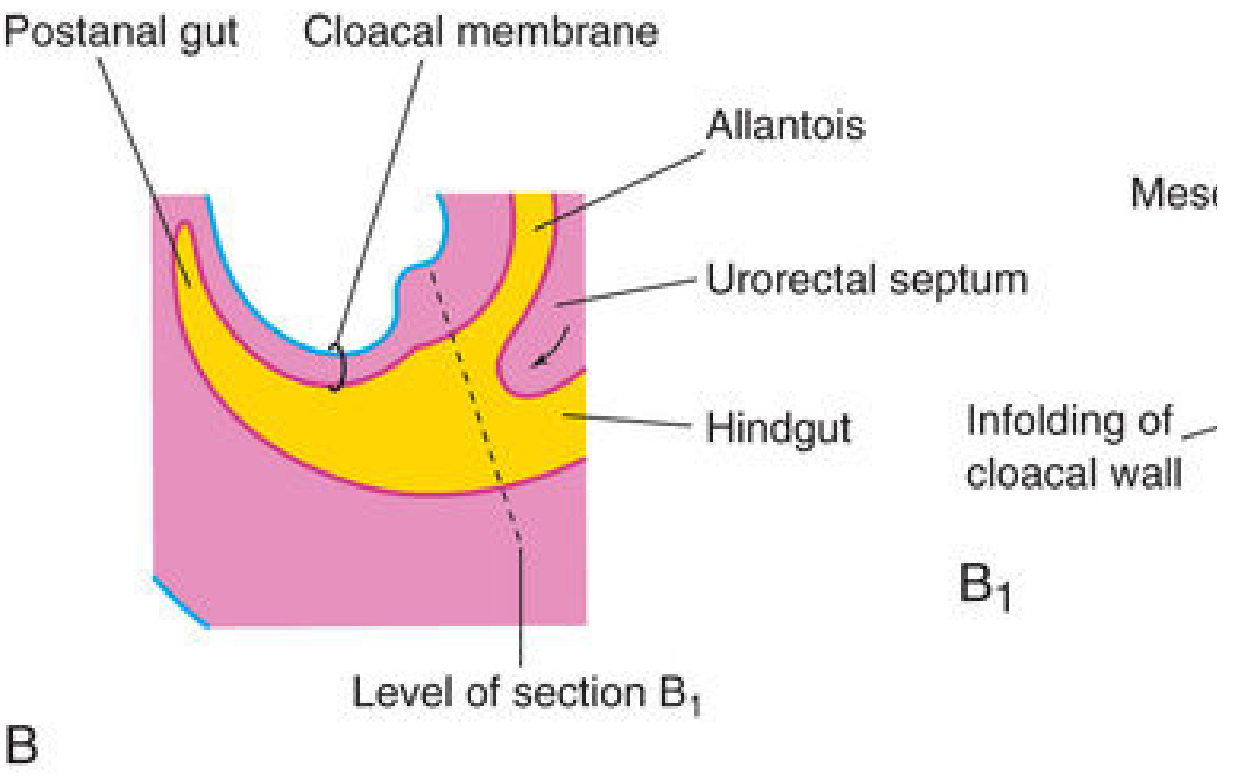
MCQ 2 🔥 CRITICAL — Appeared 2023
- A. Endoderm (tricky — endodermal signaling initiates it, but the septum itself isn't endoderm)
- B. Mesoderm ✅
- C. Neural crest
- D. Surface ectoderm (tricky)
💡 Hint: The septum is a "wedge of mesenchyme" — mesenchyme is always mesodermally derived. WALLS and DIVIDERS in the embryo are usually mesodermal (like the muscular coat of gut). Endodermal β-catenin signaling INITIATES its formation, but the structure itself is mesodermal.
MCQ 3 🔶 HIGH — Appeared 2023
- A. Below the openings of mesonephric ducts (tricky — that's the definitive UG sinus)
- B. Above the openings of mesonephric ducts ✅
- C. Between the two ureteric bud openings (tricky — that describes the trigone)
- D. Caudal to the phallic part
💡 Hint: The mesonephric ducts act as a dividing line: ABOVE = vesicourethral canal (bladder territory), BELOW = definitive urogenital sinus (urethra territory).
MCQ 4 🔥 #1 MOST REPEATED — Appeared 2021, 2022, 2023, 2024
- A. Endoderm of urogenital sinus (classic wrong answer — students extrapolate "bladder = endoderm" to trigone)
- B. Mesoderm (absorbed mesonephric ducts) → later replaced by endoderm ✅
- C. Paramesonephric (Müllerian) ducts
- D. Splanchnopleuric mesoderm (tricky — that's for muscle/serosa, not epithelium)
💡 THE GOLDEN RULE: Everything in the bladder is endodermal EXCEPT the TRIGONE, which starts MESODERMAL. Langman's states: "the mucosa of the trigone is mesodermal. With time, the mesodermal lining of the trigone is replaced by endodermal epithelium."
MCQ 5 🔶 HIGH — Appeared 2022
- A. Endoderm of vesicourethral canal (tricky — that gives epithelium only)
- B. Mesonephric ducts (tricky — that gives trigone epithelium)
- C. Splanchnopleuric intraembryonic mesoderm ✅
- D. Somatic mesoderm (tricky — somatic mesoderm gives body wall structures)
💡 Hint: Rule — SPLANCHNO (visceral) mesoderm → forms SMOOTH MUSCLE + SEROSA of ALL hollow viscera (gut, bladder, bronchi). Same principle as gut development: endoderm = mucosa; splanchnic mesoderm = submucosa + muscularis + serosa.
MCQ 6 🔥 CRITICAL — EXACT CASE IN YOUR LECTURE — Appeared 2024
- A. Mesonephric duct (tricky — this was absorbed into the bladder wall)
- B. Urachus (allantois) ✅
- C. Ureteric bud (forms ureter, not related to umbilicus)
- D. Müllerian duct (tricky — forms female reproductive tract)
💡 Hint: The ONLY structure connecting the bladder APEX to the UMBILICUS is the urachus. Patent urachus = urachal fistula = urine drains from navel. This is the exact case in your lecture PDF page 26.
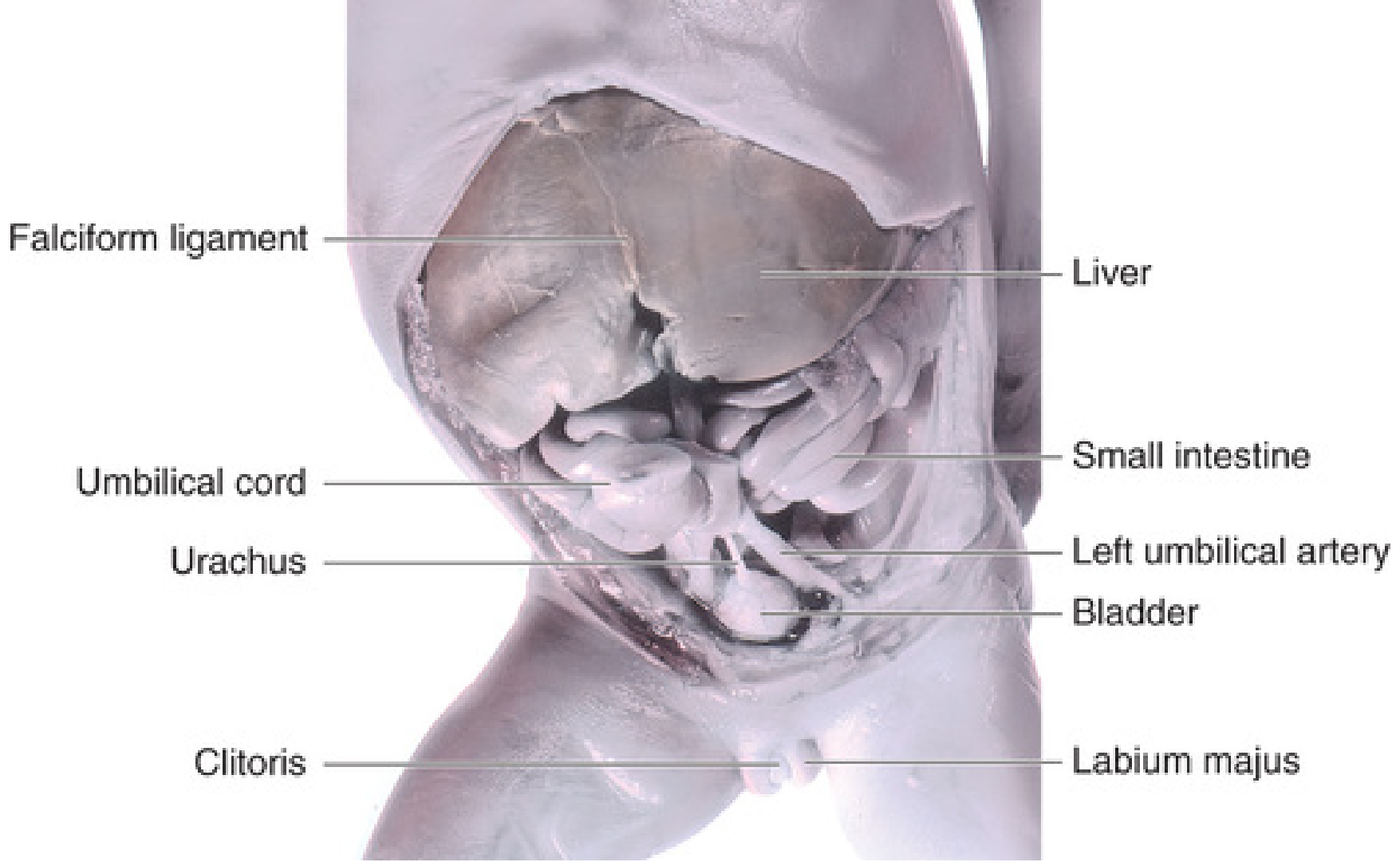
MCQ 7 🔶 HIGH — Appeared 2021, 2023 — Naming trap
- A. Lateral umbilical ligament (= inferior epigastric vessels — body wall)
- B. Median umbilical ligament ✅
- C. Medial umbilical ligament (tricky — = obliterated umbilical ARTERIES, not urachus)
- D. Round ligament of uterus
💡 Naming Guide:
- MEDIAN umbilical ligament = urachus = 1 structure, midline
- MEDIAL umbilical ligament (×2, paired) = obliterated umbilical arteries
- Lateral umbilical fold = inferior epigastric vessels
"MEDIAN = single = midline = urachus"
MCQ 8 🔶 HIGH — Appeared 2022, 2024 — Clinical
- A. Urachal fistula (entire urachus open — communicates both ends)
- B. Urachal cyst ✅
- C. Urachal sinus (tricky — upper part open, drains at umbilicus only)
- D. Exstrophy of bladder (exposed bladder mucosa — different presentation)
💡 Urachal Anomaly Distinguisher:
- Fistula = ENTIRE urachus open = urine from umbilicus
- Cyst = MIDDLE segment only = cystic swelling, NO communication with bladder or umbilicus
- Sinus = UPPER part (near umbilicus) = drains at umbilicus
- Patent urachus = full patency, continuous with bladder
MCQ 9 🔶 HIGH — Appeared 2021
- A. Incomplete closure of neural tube (= neural tube defects — different entity)
- B. Failure of urorectal septum to descend (tricky — that causes anorectal malformations)
- C. Failure of lateral body wall folds to close in the midline in the pelvic region ✅
- D. Agenesis of the mesonephric duct
💡 Hint: Exstrophy = exposed bladder = FRONT WALL missing. The anterior abdominal wall fails to form in the hypogastric area (between umbilicus and genital tubercle). ALWAYS associated with EPISPADIAS (dorsal), NEVER hypospadias (ventral). Incidence: 2/10,000.
PART 2: DEVELOPMENT OF THE URETHRA
MCQ 10 🔥 CRITICAL — Appeared 2022, 2023, 2024 — Repeated 3×
- A. Phallic part of urogenital sinus (endoderm) (tricky — forms most of spongy urethra, NOT glandular part)
- B. Vesicourethral canal (tricky)
- C. Surface ectoderm ✅
- D. Mesonephric duct
💡 THE ONE EXCEPTION: All of the male urethra is endodermal (from UG sinus) EXCEPT the terminal/glandular part in the glans penis, which forms from a cord of SURFACE ECTODERM that grows inward, canalizes, and joins the endodermal spongy urethra. This is the single most important urethra exception.
MCQ 11 🔶 HIGH — Appeared 2023
- A. Caudal vesicourethral canal (tricky — that gives prostatic urethra above ejac. ducts)
- B. Upper pelvic part of definitive UG sinus (tricky — that gives prostatic urethra BELOW ejac. ducts)
- C. Lower pelvic part of definitive UG sinus ✅
- D. Phallic part of definitive UG sinus (tricky — that gives spongy urethra)
💡 Male Urethra Map (memorize this):
- Prostatic (above ejac. ducts) → caudal vesicourethral canal
- Prostatic (below ejac. ducts) → UPPER pelvic part of definitive UG sinus
- Membranous → LOWER pelvic part of definitive UG sinus (deep perineal pouch)
- Spongy → phallic part of definitive UG sinus
- Glandular → surface ectoderm
MCQ 12 🔶 HIGH — Appeared 2021
- A. Endoderm of vesicourethral canal (tricky — that gives the main lining)
- B. Absorbed mesonephric ducts (mesoderm) ✅
- C. Paramesonephric duct
- D. Neural crest
💡 Hint: Just like the trigone of the bladder, the POSTERIOR WALL of the prostatic urethra above the ejaculatory duct openings is mesodermal because of the same mesonephric duct absorption. This is a direct extension of the trigone concept.
MCQ 13 🔶 HIGH — Appeared 2022
- A. Entire prostatic + membranous urethra (tricky — too much)
- B. Prostatic urethra above the colliculus seminalis (verumontanum) ✅
- C. Spongy (penile) urethra
- D. Membranous urethra only (tricky)
💡 Hint: The female urethra is SHORT because it ONLY corresponds to the top part of the male prostatic urethra (above where ejaculatory ducts open). Below that point, the male has more urethra; the female doesn't — her phallic part of UG sinus forms the vestibule instead.
MCQ 14 🟢 MEDIUM — Appeared 2021
- A. Clitoris (tricky — clitoris comes from genital tubercle, like penis in male)
- B. Vestibule of vagina ✅
- C. Labia minora (from urogenital folds)
- D. Lower 1/3 of vagina (from sinovaginal bulbs — a different structure)
💡 Hint: In MALES — phallic part of definitive UG sinus = spongy (penile) urethra. In FEMALES — the same phallic part = vestibule of vagina (the space between labia minora where urethra and vagina open). Clitoris comes from genital tubercle (analogous to penis).
PART 3: DEVELOPMENT OF THE ADRENAL GLANDS
MCQ 15 🔥 CRITICAL — Appears in EVERY Batterjee Past Exam
- A. Celomic epithelium (mesoderm) (tricky — that's the CORTEX, not medulla)
- B. Neural crest (neuroectoderm) ✅
- C. Suprarenal ridge mesoderm (tricky — that's the cortex again)
- D. Lateral plate mesoderm
💡 The Most Tested Adrenal Fact:
- CORTEX = Celomic epithelium = MESODERM
- MEDULLA = Migrating neural crest = NEUROECTODERM
The medulla cells are sympathochromaffin cells (like postganglionic sympathetic neurons) — confirming neural crest origin.
- Cortex: Celomic epithelium → mesodermal. Suprarenal ridge between the developing gonad and root of dorsal mesentery.
- Medulla: Neural crest cells (sympathochromaffin cells) → neuroectodermal. These migrate from neural crest, enter the fetal cortex from the MEDIAL side, and differentiate into chromaffin cells (secreting adrenaline/noradrenaline). They are analogous to postganglionic neurons of sympathetic ganglia. Onset = Week 5 IUL.
MCQ 16 🔶 HIGH — Appeared 2022
- A. It regresses (involution complete in first few weeks of life) ✅
- B. It differentiates into zona glomerulosa (tricky — definitive cortex forms the zones, not fetal cortex)
- C. It persists as the definitive cortex throughout life (tricky)
- D. It becomes the adrenal medulla after birth
💡 Hint — Two Batches:
- FIRST batch = large acidophilic cells = FETAL cortex = TEMPORARY, regresses after birth
- SECOND batch = small cells = DEFINITIVE cortex = PERMANENT, persists into adult life
"Big cells = temporary; small cells = permanent"
- First batch — Large acidophilic cells → fetal cortex → surrounds medulla → regresses after birth (active during fetal life producing DHEA-S for placental estrogen synthesis)
- Second batch — Small cells → definitive cortex → surrounds fetal cortex → differentiates into zona glomerulosa, fasciculata, and reticularis
MCQ 17 🟢 MEDIUM — Appeared 2023
- A. Lateral side (tricky)
- B. Medial side ✅
- C. Cranial pole
- D. Caudal pole
💡 Hint: Neural crest cells migrate from the neural tube (midline/paravertebral). They approach the developing adrenal from its MEDIAL aspect. "MEDial = MEDulla-forming cells enter from the MEsial side."
MCQ 18 🔥 CRITICAL — Clinical — Appeared 2022, 2024
- A. 21-hydroxylase deficiency ✅
- B. 5α-reductase deficiency (tricky — causes 46,XY pseudohermaphroditism, opposite sex)
- C. 17α-hydroxylase deficiency (tricky — causes mineralocorticoid excess + ambiguous genitalia in males)
- D. 11β-hydroxylase deficiency (2nd most common CAH, less than 5%)
💡 Hint: 46,XX + ambiguous genitalia = female pseudohermaphroditism = CAH = 21-hydroxylase deficiency (90–95% of all CAH cases). The lecture specifically names 21-hydroxylase as the "most common" cause. 5α-reductase deficiency = 46,XY appears female (opposite situation).
MCQ 19 🟢 MEDIUM — Appeared 2021
- A. Deep within the renal capsule OR right lobe of liver ✅
- B. Along the aorta (para-aortic region) (tricky — para-aortic chromaffin tissue is medullary type, different entity)
- C. In the testis/ovary (can occur in CAH but less commonly emphasized in the lecture)
- D. In the retroperitoneum
💡 Hint: The adrenal cortex develops between the developing gonad and root of dorsal mesentery — close to the kidney and liver. The lecture's exact words: "fused to kidney deep in its capsule or in the right lobe of the liver."
MCQ 20 🟢 MEDIUM — Appeared 2023
- A. 2–5 times larger (too small)
- B. 5–10 times larger (too small)
- C. 10–20 times larger ✅
- D. The same size
💡 Hint: Direct quote from lecture AND Langman's: "The fetal adrenal gland is 10–20 times larger than adult adrenal gland." It's large because of the massive FETAL CORTEX producing DHEA-S for placental estrogen. After birth, fetal cortex regresses → gland shrinks to adult size.
📊 PAST YEAR FREQUENCY SUMMARY
| Rank | Topic | Times Appeared | Years |
|---|---|---|---|
| 🔥1 | Trigone epithelium = mesodermal | 4× | 2021, 2022, 2023, 2024 |
| 🔥2 | Adrenal medulla = neural crest | 4× | Every exam |
| 🔥3 | Urachus / urine from umbilicus | 3× | 2021, 2022, 2024 |
| 🔥4 | Glandular urethra = ectoderm | 3× | 2022, 2023, 2024 |
| 🔶5 | Median vs medial umbilical ligament | 2× | 2021, 2023 |
| 🔶6 | CAH / 21-hydroxylase deficiency | 2× | 2022, 2024 |
| 🔶7 | Urachal cyst vs sinus vs fistula | 2× | 2022, 2024 |
| 🔶8 | Exstrophy of bladder mechanism | 1× | 2021 |
| 🟢9 | Fetal adrenal size (10–20×) | 1× | 2023 |
| 🟢10 | Fetal cortex regresses at birth | 1× | 2022 |
Development of the Male Urethra The male urethra is divided in three parts: (a) Prostatic part, (b) membranous part, and (c) spongy part. 1. Prostatic part: It is part of the urethra above the openings of ejaculatory ducts. It develops from the caudal part of vesicourethral canal. The posterior wall of this part is derived from absorbed mesonephric ducts (mesoderm). The part of the prostatic urethra below the openings of ejaculatory ducts develops from upper pelvic part of definitive urogenital sinus. generate image showing
Detailed medical embryology diagram showing the development of the male urethra with labeled anatomical structures. The diagram should show a sagittal cross-section of the developing male pelvis and penis with color-coded regions showing the embryological origins of each urethral part: 1. PROSTATIC URETHRA (ABOVE ejaculatory duct openings) - colored BLUE - labeled "Caudal part of vesicourethral canal (Endoderm)" with a note showing the POSTERIOR WALL is colored differently in ORANGE labeled "Absorbed mesonephric ducts (Mesoderm)" 2. PROSTATIC URETHRA (BELOW ejaculatory duct openings) - colored LIGHT BLUE - labeled "Upper pelvic part of definitive urogenital sinus (Endoderm)" 3. MEMBRANOUS URETHRA - colored GREEN - labeled "Lower pelvic part of definitive urogenital sinus (Endoderm)" - shown in the deep perineal pouch region 4. SPONGY (PENILE) URETHRA - colored YELLOW - labeled "Phallic part of definitive urogenital sinus (Endoderm)" 5. GLANDULAR URETHRA (terminal, in glans penis) - colored RED - labeled "Surface Ectoderm (EXCEPTION)" Include labeled arrows pointing to: Ejaculatory duct openings, Colliculus seminalis (verumontanum), Deep perineal pouch, Glans penis. Add a color-coded legend box on the side. Include the allantois/urachus at the top connecting to the bladder. Show the urinary bladder above. Clean white background, medical textbook style illustration, anatomically accurate, clear bold labels with connecting lines.
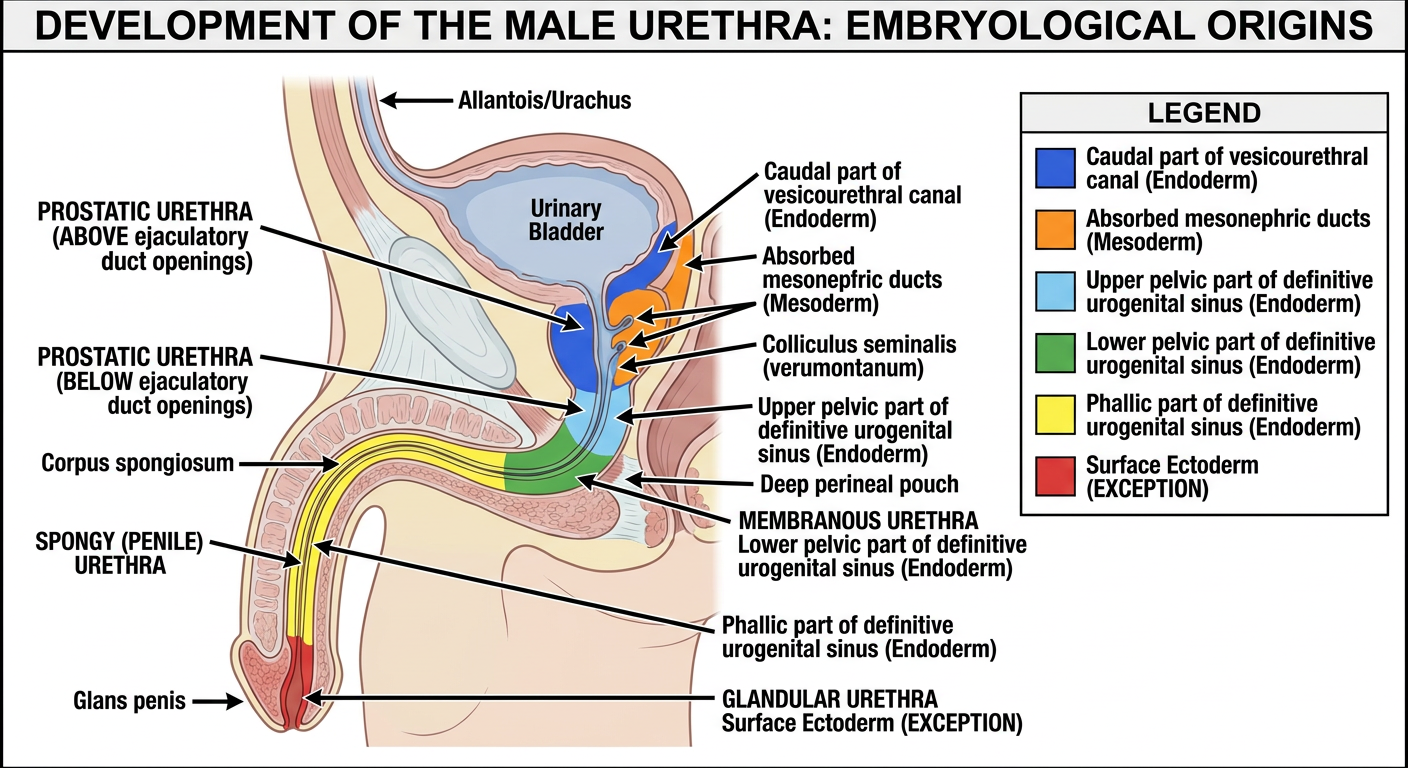
🔵 Male Urethra — Embryological Origins (Color-Coded)
| Color | Part of Urethra | Embryological Source |
|---|---|---|
| 🔵 Blue | Prostatic urethra above ejaculatory duct openings | Caudal part of vesicourethral canal (Endoderm) |
| 🟠 Orange | Posterior wall of prostatic urethra (above ejac. ducts) | Absorbed mesonephric ducts = MESODERM ← exception! |
| 🔷 Light Blue | Prostatic urethra below ejaculatory duct openings | Upper pelvic part of definitive urogenital sinus (Endoderm) |
| 🟢 Green | Membranous urethra | Lower pelvic part of definitive urogenital sinus (Endoderm) — lies in deep perineal pouch |
| 🟡 Yellow | Spongy (penile) urethra | Phallic part of definitive urogenital sinus (Endoderm) |
| 🔴 Red | Glandular urethra (in glans penis) | Surface ECTODERM ← the one and only exception |
⚡ Key Landmarks to Remember
- Colliculus seminalis (verumontanum) = where ejaculatory ducts open into the prostatic urethra — this is the dividing line between the two prostatic origins
- Deep perineal pouch = location of the membranous urethra
- Glans penis = only site where ectoderm contributes — surface ectoderm grows inward, canalizes, meets the endodermal urethra
🔥 Exam Traps in This Topic
- The posterior wall of the prostatic urethra (above ejac. ducts) = mesoderm — same principle as the trigone
- The glandular urethra = ectoderm — the only non-endodermal, non-mesodermal part
- Prostatic urethra has two different sources above vs below the ejaculatory duct openings — a very common MCQ split
Development of the Adrenal glands Development of Adrenal Cortex The cells of dorsal wall of celomic epithelium (in the region of angle between developing gonad and root of dorsal mesentery) proliferate to form a ridge called suprarenal ridge. The adrenal cortex develops from two episodes of mesodermal proliferation of suprarenal ridge. First batch of cells of suprarenal ridge consists of large acidophilic cells; they reach the site of development and surround the cells of the adrenal medulla to form fetal cortex of the adrenal gland. 21 Development of the Adrenal glands Development of Adrenal Cortex Subsequently second batch of cells of suprarenal ridge consists of small cells that reach the site of development and surround the fetal cortex from outside to form definitive cortex of the adrenal gland. At birth the fetal cortex regresses and its involution is mostly completed in first few weeks of life generate authentic image image showing
Medical embryology textbook-style diagram showing the sequential development of the adrenal gland cortex in 4 stages arranged left to right with arrows between them. Clean white background, anatomically accurate, clear bold labels. STAGE 1 — "Week 5 IUL: Suprarenal Ridge Forms": Show a cross-section of the posterior abdominal wall with the celomic epithelium on the dorsal wall. Show the developing gonad below and the root of the dorsal mesentery. A ridge of cells labeled "Suprarenal Ridge" is highlighted in yellow-orange on the celomic epithelium. Label: "Celomic epithelium (Mesoderm)" with an arrow. The angle between developing gonad and dorsal mesentery root is clearly shown. STAGE 2 — "1st Batch: Fetal Cortex Forms": Show a round developing adrenal gland. In the CENTER is a small cluster of purple/dark cells labeled "Neural crest cells (future medulla)". Surrounding them is a thick layer of LARGE PINK/ACIDOPHILIC cells labeled "FETAL CORTEX — 1st batch: Large acidophilic cells (Mesoderm)". Arrow points inward showing these cells SURROUND the medulla cells. STAGE 3 — "2nd Batch: Definitive Cortex Forms": Show the same round adrenal gland now with THREE layers: - CENTER: purple cells labeled "Adrenal Medulla (Neural crest)" - MIDDLE thick layer: large pink cells labeled "Fetal Cortex (1st batch)" - OUTER thin layer: small blue cells labeled "DEFINITIVE CORTEX — 2nd batch: Small cells" with arrow showing they surround the fetal cortex from OUTSIDE STAGE 4 — "After Birth: Fetal Cortex Regresses": Show the adult adrenal gland structure. The fetal cortex layer has an X through it with a red arrow labeled "REGRESSES at birth — involution complete in first few weeks". The definitive cortex is now prominent with three sub-zones labeled: Zona Glomerulosa, Zona Fasciculata, Zona Reticularis. The medulla remains in the center labeled "Adrenal Medulla". Add a color legend box: Pink = Fetal cortex (mesodermal, temporary), Blue = Definitive cortex (mesodermal, permanent), Purple = Medulla (neuroectodermal, neural crest). Bold exam-tip box: "FETAL ADRENAL = 10-20x LARGER than adult due to massive fetal cortex". Medical illustration style, clear typography.
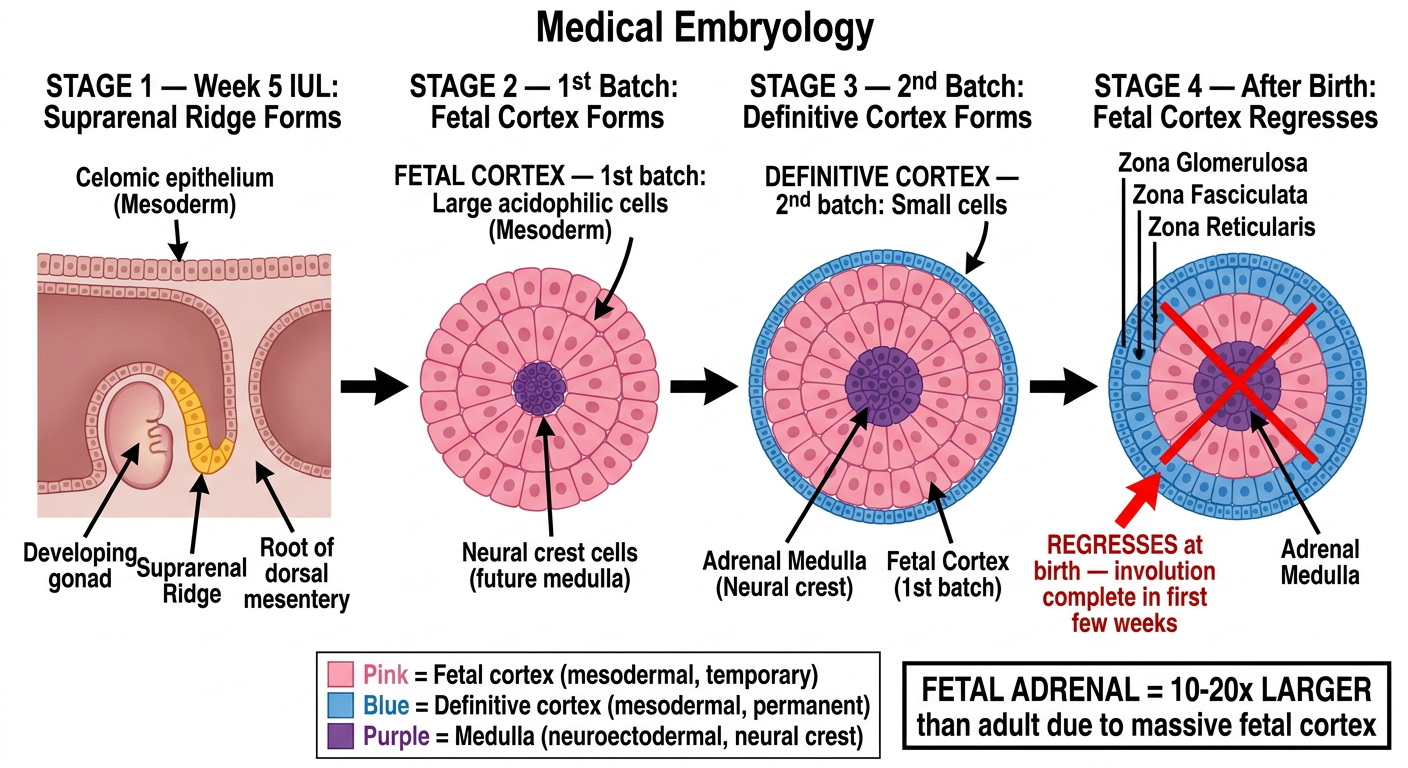
Complete Breakdown — Matching the Diagram
STAGE 1 — Week 5 IUL: Suprarenal Ridge Forms
- Cells of the dorsal wall of celomic epithelium proliferate
- Location: in the angle between the developing gonad (below) and the root of dorsal mesentery
- This proliferation forms a ridge = suprarenal ridge
- Origin = Mesoderm (celomic epithelium is mesodermal)
STAGE 2 — 1st Batch: Fetal Cortex Forms
| Feature | Detail |
|---|---|
| Cell type | Large acidophilic cells |
| What they do | Migrate to site of development, surround the neural crest cells (future medulla) |
| Layer formed | Fetal cortex (inner layer) |
| Origin | Mesoderm |
STAGE 3 — 2nd Batch: Definitive Cortex Forms
| Feature | Detail |
|---|---|
| Cell type | Small cells |
| What they do | Migrate later, surround the fetal cortex from OUTSIDE |
| Layer formed | Definitive cortex (outer layer) |
| Origin | Mesoderm |
CENTER:    Adrenal Medulla (neural crest — neuroectoderm)
MIDDLE:    Fetal Cortex (1st batch — large acidophilic — mesoderm)
OUTSIDE:   Definitive Cortex (2nd batch — small cells — mesoderm)
STAGE 4 — After Birth: Fetal Cortex Regresses
- Fetal cortex involutes — regression begins at birth
- Involution mostly complete in the first few weeks of life
- Definitive cortex takes over and differentiates into 3 permanent zones:
- Zona glomerulosa → mineralocorticoids (aldosterone)
- Zona fasciculata → glucocorticoids (cortisol)
- Zona reticularis → androgens (DHEA)
- Medulla persists — secretes adrenaline and noradrenaline
⚡ High-Yield Exam Points from This Diagram
| Fact | Why It's Tested |
|---|---|
| Fetal cortex = large acidophilic cells | MCQ asks to identify cell type of fetal cortex |
| Definitive cortex = small cells | Tricky because students mix up 1st vs 2nd batch |
| Fetal cortex is the inner layer, definitive cortex is outer | Students reverse the order |
| Fetal cortex regresses after birth | Most repeated fact — "what happens to fetal cortex?" |
| Adrenal gland starts at week 5 IUL | Onset week MCQ |
| Fetal adrenal is 10–20× larger than adult | Because fetal cortex is so massive — it produces DHEA-S for placental estrogen synthesis |
| Both cortex layers = mesoderm | Origin question — common trap with medulla |
generate ALL high yield complete mcqs for batterjee medical exams jeddah from each slide page each with tricky options and generate hints and one-two page printable cheatsheet and explain all mcqs with p3-4 sentences detailed plain english accurate pics from. medical histology textbooks or any other reliable sources mention in which past year mcqs came how important they are
cd /home/daytona/workspace/attachments/3a19a422-e9da-460d-858f-292d32db0fa7/ && python3 -c " import pdfplumber with pdfplumber.open('15-16 Glococorticoids.pdf') as pdf: print(f'Total pages: {len(pdf.pages)}') for i, page in enumerate(pdf.pages): print(f'--- PAGE {i+1} ---') text = page.extract_text() if text: print(text) print() "