
Effect of smoking in medicine
Reading File
Now I'll search the medical library and PubMed in parallel for comprehensive coverage.
Finding Sources
Searching PubMed
smoking health effects medicine
Searching the Web
effects of smoking on human health medical overview 2024 2025
Now let me read the most relevant textbook sections in parallel, covering multiple organ systems:
Reading File
Finding Sources
Finding Sources
Finding Sources
Finding Sources
Finding Sources
Reading File
Reading File
I found an excellent diagram. Let me fetch that image and also gather more content on specific effects:
Loading Image
Reading File
I now have comprehensive information from multiple authoritative medical textbooks. Let me compile the full response.
Effects of Smoking in Medicine
Smoking is the single most preventable cause of human death. Tobacco smoke contains more than 2,000 compounds - including nicotine (responsible for addiction), polycyclic aromatic hydrocarbons, nitrosamines, aromatic amines, carbon monoxide, benzopyrene, formaldehyde, and oxides of nitrogen. Together, these substances damage nearly every organ system in the body.
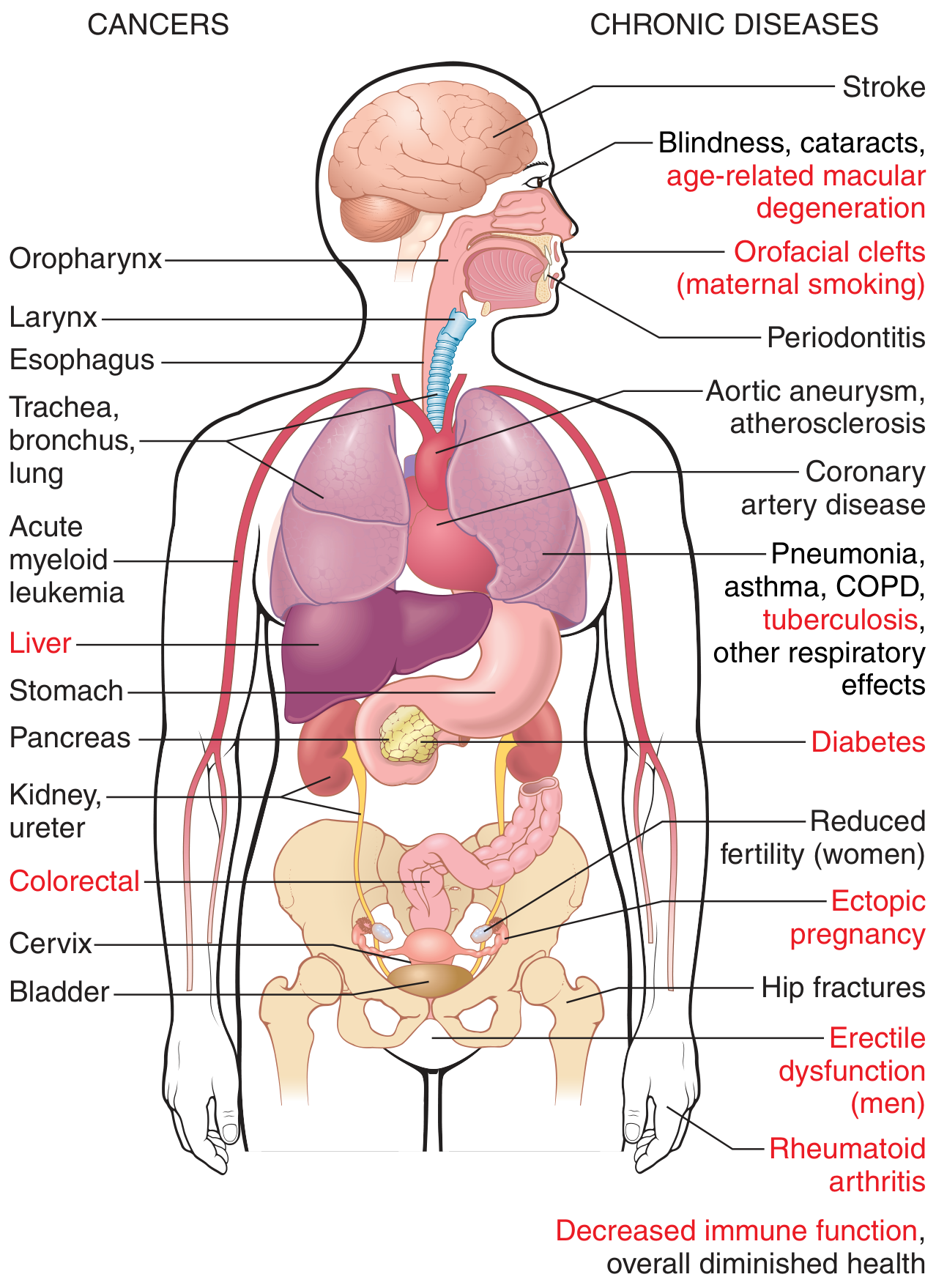
1. Toxic Constituents of Tobacco Smoke
| Substance | Effect |
|---|---|
| Tar | Carcinogenesis |
| Polycyclic aromatic hydrocarbons | Carcinogenesis |
| Nicotine | Ganglionic stimulation/depression; tumor promotion |
| Benzopyrene | Carcinogenesis |
| Carbon monoxide | Impaired oxygen transport and utilization |
| Formaldehyde | Toxic to cilia; mucosal irritation |
| Oxides of nitrogen | Toxic to cilia; mucosal irritation |
| Nitrosamines | Carcinogenesis |
- Robbins & Kumar Basic Pathology, Table 7.3
2. Cancer
Smoking causes approximately 20-30% of all cancer deaths in the United States. About 90% of lung cancers occur in smokers. The risk is proportional to pack-years of exposure.
Cancers causally linked to tobacco smoking include:
- Respiratory tract: Lung (trachea, bronchus), larynx, oropharynx, hypopharynx, nasopharynx, nasal cavity/paranasal sinuses
- Upper GI: Oral cavity, esophagus, stomach
- Pancreas and liver (hepatocellular carcinoma)
- Urinary tract: Kidney, ureter, urinary bladder
- Reproductive: Cervix uteri
- Hematologic: Acute myeloid leukemia
- Colorectal (more recently established)
- Goldman-Cecil Medicine, Robbins & Kumar Basic Pathology, Harrison's Principles of Internal Medicine 22E
Organ-specific carcinogens include polycyclic aromatic hydrocarbons and NNK (nicotine-derived nitrosamine ketone) for lung/larynx; 4-aminobiphenyl and 2-naphthylamine for the bladder; and NNN (N'-nitrosonornicotine) for the esophagus. - Robbins & Kumar Basic Pathology, Table 7.4
Synergistic effects: Smoking multiplies carcinogenic risk from other exposures. Well-recognized examples include a 10-fold increased lung cancer incidence in smokers exposed to asbestos, and a greatly amplified risk for oral/laryngeal/esophageal cancer when combined with alcohol. - Robbins & Kumar Basic Pathology
3. Cardiovascular Disease
Tobacco consumption is a major independent risk factor for:
- Atherosclerosis and myocardial infarction
- Coronary artery disease (CAD)
- Peripheral arterial disease (PAD): Smokers develop intermittent claudication approximately a decade earlier than nonsmokers. The incidence of IC among smokers is 2-3x higher than in non-smokers, and smokers with IC have an 11-fold greater amputation rate. The association between smoking and PAD may actually be stronger than the association between smoking and CAD.
- Cerebrovascular disease (stroke)
- Aortic aneurysm
Smoking cessation slows PAD progression, improves claudication symptoms, decreases the likelihood of amputation, and improves overall longevity. All-cause mortality is reduced by cessation but not by mere reduction in consumption. - Textbook of Family Medicine 9e
A 2023 large meta-analysis in the NEJM confirmed smoking among the top modifiable cardiovascular risk factors globally (Global Cardiovascular Risk Consortium, NEJM 2023).
4. Respiratory Disease
- COPD (emphysema + chronic bronchitis): Cigarette smoking is the main cause of COPD, the leading cause of disability in the United States. Risk is directly proportional to cigarettes smoked; lung function improves even after cessation. Smoking cessation is the only intervention demonstrated to alter the natural history of COPD. - Murray & Nadel's Textbook of Respiratory Medicine
- Lung cancer: 90% of cases occur in smokers (covered above)
- Pneumonia and asthma: Increased susceptibility and severity
- Tuberculosis: Smoking increases susceptibility
- Impaired mucociliary clearance: Due to toxic effects of formaldehyde and nitrogen oxides on cilia
5. Gastrointestinal System
- Increased risk of peptic ulcer disease
- Esophageal and stomach cancers (direct carcinogenic effect)
- Pancreatic cancer (NNK implicated)
- Liver cancer (hepatocellular carcinoma)
- Smokeless (chewing) tobacco markedly increases risk of oral and pharyngeal cancers - Goldman-Cecil Medicine
6. Urinary Tract
- Bladder cancer: Caused by 4-aminobiphenyl and 2-naphthylamine (excreted in urine)
- Kidney and ureter cancer: Strong causal link
7. Neurological and Sensory Effects
- Stroke: Major independent risk factor
- Dementia / mild cognitive impairment: Smoking is a potentially modifiable risk factor (meta-analysis: Jones et al., Dement Geriatr Cogn Disord 2024)
- Blindness and cataracts: Established link
- Age-related macular degeneration: More recently established causal link
8. Metabolic and Endocrine Effects
- Type 2 diabetes: Smoking increases insulin resistance
- Reduced bone density: Contributes to hip fractures
- Rheumatoid arthritis: Established association
9. Reproductive and Pregnancy Effects
Maternal smoking causes:
- Increased risk of spontaneous abortion
- Premature birth
- Intrauterine growth retardation
- Orofacial clefts (cleft lip/palate) in offspring
In men: erectile dysfunction
In women: reduced fertility and ectopic pregnancy
10. Dermatological Effects
- Premature skin aging
- Poor wound healing
- Increased skin cancer risk in combination with UV exposure
11. Oral/ENT Effects
- Oral cavity cancers (both smoking and smokeless tobacco)
- Periodontitis (gum disease)
- Laryngeal cancer
12. Passive (Secondhand) Smoke
Passive smoking is a major contributor to worldwide morbidity and mortality. Non-smoking spouses of smokers have a 20-30% increase in lung cancer risk. - Grainger & Allison's Diagnostic Radiology
13. Benefits of Cessation
Smoking cessation at any age reduces risk:
- Lung cancer mortality reduction with cessation matches that achieved by CT screening
- 7 years of abstinence achieves a ~20% lung cancer mortality reduction
- Cardiovascular risk begins falling within 1 year of cessation
- All-cause mortality is significantly reduced by cessation but NOT by reduction alone - Murray & Nadel's Textbook of Respiratory Medicine; Textbook of Family Medicine 9e
Globally, an estimated 22% of the adult population smokes, and tobacco is responsible for more than 8 million deaths annually, with 1 in 5 cardiovascular deaths attributable to smoking (Global Heart Journal 2024).
This is a shared conversation. Sign in to Orris to start your own chat.