
Explain lightning and the cause of injury in lighting.
Reading File
Finding Sources
Searching the Web
lightning injury mechanisms pathophysiology types
Reading File
Reading File
Reading File
Reading File
Reading File
Reading File
Reading File
Reading File
Loading Image
Now I have comprehensive information from authoritative emergency medicine textbooks. Here is a detailed, well-organized answer:
Lightning and Lightning Injury
What is Lightning?
Lightning is a massive electrostatic discharge - ranging from 10 million to 2 billion volts, carrying 3,000 to 200,000 amperes of current - that occurs cloud-to-cloud, cloud-to-ground, or (less commonly) ground-to-cloud. It is a unidirectional (DC) impulse with an extremely brief duration of only 10 microseconds to 3 milliseconds. It takes several forms: streaked, forked, ribbon, sheet, beaded, or the unusual "ball lightning" that can roll along structures and even pass through openings.
How Lightning Differs from Ordinary Electrical Injury
Although lightning is a form of electrical energy, it behaves very differently from human-generated high-voltage electricity:
| Factor | Lightning | High-Voltage AC |
|---|---|---|
| Voltage/Current | 10M-2B V; 3,000-200,000 A | 600-200,000 V; <1000 A |
| Duration | 10 µs to 3 ms | Brief to prolonged |
| Current type | DC (unidirectional) | AC (alternating) |
| Tissue damage | Mostly superficial (flashover) | Deep tissue destruction |
| Cardiac arrest rhythm | Asystole | Asystole > V-fib |
| Renal failure | Rare | Relatively common |
| Fasciotomy/amputation | Rarely necessary | Relatively common |
| Immediate cause of death | Prolonged apnea, blunt injury | V-fib, prolonged apnea, deep burns |
- Tintinalli's Emergency Medicine, Table 219-5
The paradox of lightning is that its enormous energy causes less internal tissue destruction than lower-voltage electrical injuries, precisely because contact time is so brief.
The Flashover Effect - Central to Understanding Lightning Injury
The single most important concept in lightning injury is the flashover effect: because the strike duration is so brief, the majority of energy travels over the body's surface rather than through it, following the path of least resistance (wet skin, clothing surfaces). Wet skin from rain or sweat actually reduces internal injury by facilitating this surface-current pathway. This explains why victims can survive direct strikes with relatively minor injury, and why deep muscle necrosis and rhabdomyolysis - common in industrial electrical injuries - are much rarer in lightning victims.
Types of Lightning Strikes (Mechanisms of Injury)
Five mechanisms exist by which lightning reaches and injures a person:
-
Direct strike - The lightning bolt makes direct contact with the victim. Accounts for about 5% of injuries but is most severe.
-
Side flash (splash injury) - Lightning strikes a nearby object (tree, pole, structure) and "jumps" through the air to the victim. Can injure multiple victims at once (e.g., a group sheltering under a tree). Side flashes may travel up to 30 meters.
-
Contact strike - The victim is touching an object (a telephone wire, metal fence, golf club) that is struck. Current transfers from the object through the person to the ground. Indoor phone use during a storm is a classic example.
-
Ground current (stride voltage / step potential) - Lightning hits the ground and spreads outward. If the victim's two feet are at different distances from the strike point, a voltage difference (potential difference) exists between them. Current enters one foot, travels up through the torso, and exits the other foot. This isolates neurovascular injury to the legs and is likely responsible for mass cattle deaths in open pastures during storms. Minimized by standing with feet together.
-
Upward streamer - A weak upward electrical streamer from the ground toward a storm cloud does not complete a full connection to the lightning channel, but still carries enough current to cause fatal injury. This is a recently recognized fifth mechanism.
Pathophysiology: How Lightning Causes Injury
1. Electrical Energy
The massive current depolarizes excitable tissues throughout the body simultaneously. Cardiac pacemaker cells are depolarized, causing immediate asystole. The medullary respiratory center is paralyzed, causing central apnea. Because the heart often recovers its intrinsic automaticity (pacemaker cells are usually not permanently damaged), it can resume beating - but the respiratory arrest typically persists longer, leading to secondary hypoxic cardiac arrest if breathing is not restored. This is why victims in apparent cardiac arrest may still be successfully resuscitated after prolonged CPR, and it explains the unique "treat the apparently dead first" triage principle at multi-victim lightning scenes.
2. Thermal Injury
- Lightning emits brief but intense thermal radiation, superheating surrounding air.
- Metal objects (belt buckles, jewelry, coins, zippers) are superheated and cause contact burns where they touch skin.
- Sweat and moisture on the skin can vaporize instantly, tearing clothing and causing superficial steam burns - sometimes mimicking signs of assault.
- Clothing can catch fire, causing secondary thermal burns.
3. Barotrauma
The explosive expansion of superheated air around the lightning channel produces a powerful pressure wave (shock wave). This causes:
- Tympanic membrane perforation (very common; suspect in any lightning victim)
- Internal organ contusion
- The victim may be thrown violently, causing blunt trauma, fractures, and spinal injury.
4. Blunt Trauma
Victims are frequently knocked off their feet or thrown considerable distances by the blast. This results in:
- Traumatic brain injury
- Fractures
- Spinal injuries
5. Optic/Acoustic Injury
- Intense photic (light) stimulation from the strike can damage the retina or later cause cataracts (especially in younger patients).
- Acoustic blast causes tympanic membrane rupture.
Skin: Lichtenberg Figures
About 90% of lightning strike victims have skin burns, but fewer than 5% are deep burns. The most characteristic finding is the Lichtenberg figure (also called "feathering" or "ferning"): branching, arborescent (fern-like) erythematous streaks across the skin, representing first-degree burns from the surface flashover current.
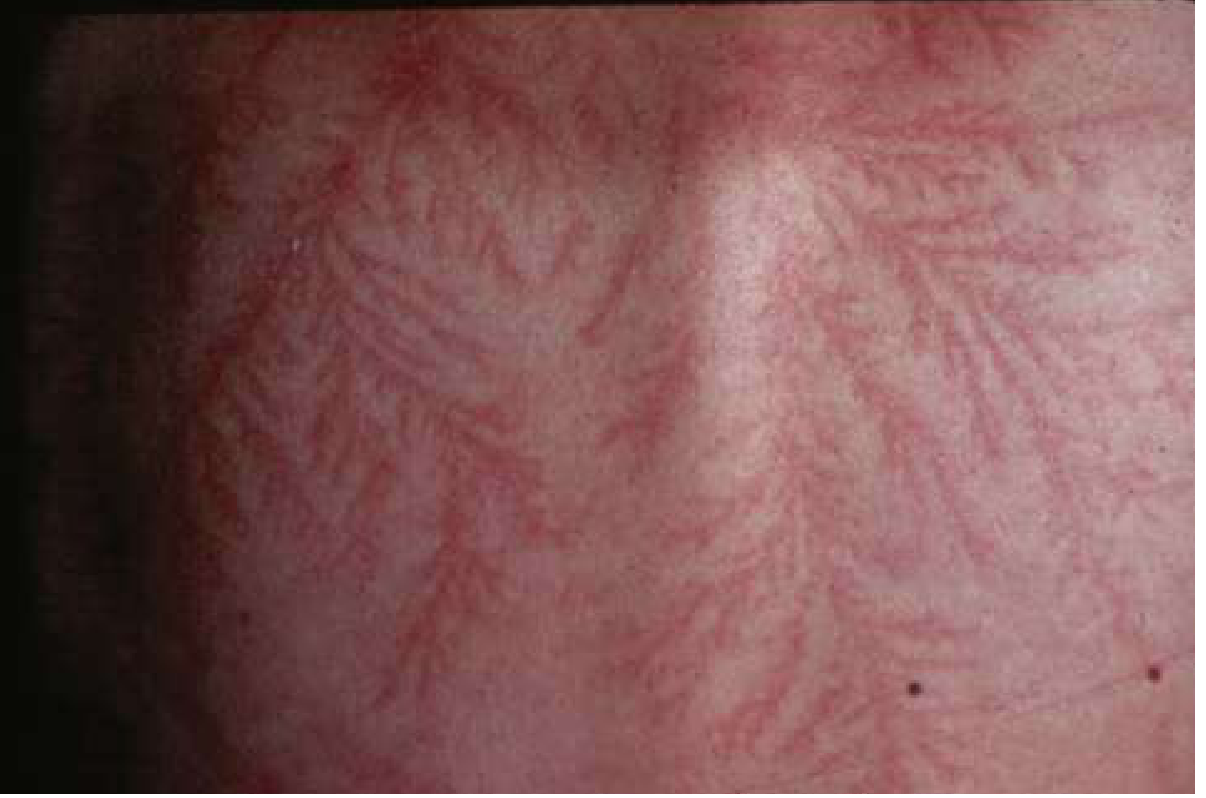
Lichtenberg figures on the skin after a lightning strike (Rosen's Emergency Medicine)
Organ-System Effects
Cardiovascular
- Asystole is the initial rhythm most often.
- If the heart resumes, hypertension and tachycardia are common from sympathetic activation.
- ECG may show ST elevation, QT prolongation (which can persist for weeks), T-wave inversions.
- True myocardial infarction is rare; troponin and CK elevations usually reflect skeletal muscle damage.
- Atrial fibrillation and other dysrhythmias usually resolve spontaneously.
- Global myocardial contractility depression, coronary artery spasm, and pericardial effusion are reported.
Neurological - Keraunoparalysis
A distinctive phenomenon called keraunoparalysis (from "keraunos," Greek for thunderbolt) is unique to lightning. It is a transient neurological and muscular "stunning" with:
- Lower limb weakness greater than upper limb weakness
- Sensory abnormalities, pallor, coolness, absent pulses in the extremities
- Mimics acute arterial occlusion or spinal injury
- Usually resolves within an hour, though it can persist longer with amnesia and "neurotic" behavior clearing over days.
- Thought to result from excessive autonomic nervous system stimulation.
- Long-term sequelae include muscular weakness, photophobia, and neurological control disturbances.
Respiratory
- Central apnea from medullary stunning is the major immediate threat.
- May outlast cardiac standstill, making respiratory support the priority.
Renal
- Myoglobinuria and acute renal failure are uncommon (unlike high-voltage electrical injuries, where deep muscle destruction makes renal failure frequent).
Ocular
- Cataracts (sometimes delayed, appearing weeks later)
- Retinal damage
- Corneal injury
Auditory
- Tympanic membrane perforation
- Hearing loss
Key Clinical Points
- Survivors: 70-90% of lightning strike victims survive, but up to 75% of survivors have permanent sequelae.
- Reverse triage: At multi-victim scenes, treat the "apparently dead" first - they have the best chance of recovery with resuscitation.
- Prolonged CPR is justified: Full neurological recovery has been reported after victims were pulseless and apneic for up to 15 minutes. CPR lasting up to 8 hours has been successful. This may be explained by a lightning-induced state of "suspended animation" affecting all cells including the brain.
- Lightning kills approximately 20-50 people per year in the United States, with about 500 injuries annually.
Sources: Rosen's Emergency Medicine, pp. 2798-2800; Tintinalli's Emergency Medicine, Chapter 219.
Make me understand superheated air, expanded and repelled air and sledge hammer effect
Finding Sources
Searching the Web
lightning superheated air expansion shock wave sledgehammer effect physics thunder
Your credits are exhausted. Your daily credits reset tomorrow, or you can purchase a top-up for more.
This is a shared conversation. Sign in to Orris to start your own chat.