
Basal ganglia anatomy .
Reading File
Now let me search the library for basal ganglia anatomy content and images in parallel.
Finding Sources
Finding Sources
Excellent sources found. Let me now read the key sections in parallel - the dedicated anatomy sections from the best sources.
Reading File
Reading File
Reading File
Good content retrieved. Now let me get the detailed anatomy section from Neuroanatomy through Clinical Cases and fetch the key images in parallel.
Reading File
Loading Image
Loading Image
Now let me fetch the key spatial anatomy figure and read more of the detailed content.
Loading Image
Reading File
Excellent - I have rich content. Let me read the remaining key sections on circuits and get more images.
Reading File
Finding Sources
Reading File
Reading File
Loading Image
I now have comprehensive content from multiple authoritative sources and excellent diagrams. Let me compile the full answer.
Basal Ganglia Anatomy
The basal ganglia are a collection of gray matter nuclei located deep within the white matter of the cerebral hemispheres. They do not project directly to the periphery, but participate in complex networks that modulate the descending motor systems, as well as cognitive and affective functions.
1. Components and Terminology
The main components are:
| Grouping | Structures |
|---|---|
| Striatum (neostriatum) | Caudate nucleus + Putamen |
| Lenticular (lentiform) nucleus | Putamen + Globus pallidus |
| Pallidum | Globus pallidus - external segment (GPe) + internal segment (GPi) |
| Associated nuclei | Subthalamic nucleus (STN), Substantia nigra (SNc + SNr) |
| Ventral striatum | Nucleus accumbens + ventral putamen/caudate |
The striatum receives virtually all inputs to the basal ganglia. Outputs leave via the GPi and substantia nigra pars reticulata (SNr).
- Neuroanatomy through Clinical Cases, 3rd Ed., p. 768
- Costanzo Physiology 7th Ed., p. 3467
2. Three-Dimensional Spatial Relationships
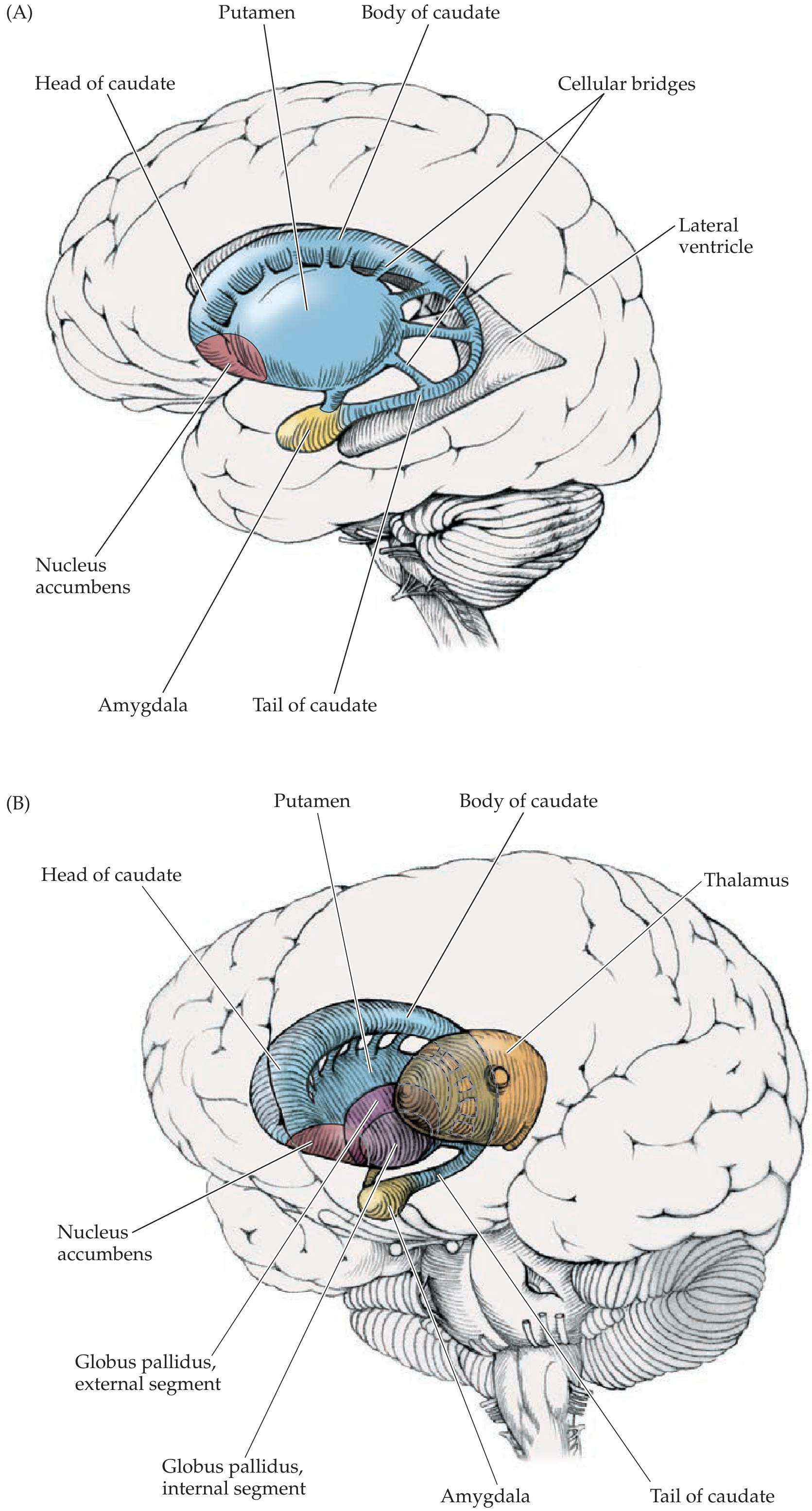
Fig. 16.1 - Spatial relationships of the basal ganglia, thalamus, and amygdala. (A) Lateral view; (B) Anterolateral view. From Neuroanatomy through Clinical Cases, 3rd Ed.
Caudate Nucleus
- A C-shaped structure that runs along the lateral wall of the lateral ventricle
- Divided into head, body, and tail (no sharp boundaries between them)
- The head bulges into the lateral wall of the anterior horn of the lateral ventricle
- The tail curves inferiorly and anteriorly through the temporal lobe, ending just anterior to the amygdala
- Connected to the putamen by cellular bridges that cross the internal capsule - these give rise to the "striped" appearance and the name "striatum"
Putamen
- The largest and most lateral nucleus of the basal ganglia
- Anteriorly and ventrally it fuses with the head of the caudate - this region is the ventral striatum
- The nucleus accumbens forms the bulk of the ventral striatum and is important in limbic circuitry
Globus Pallidus
- Lies just medial to the putamen
- Named "pale globe" due to the many myelinated axons traversing it
- Divided into external segment (GPe) and internal segment (GPi) by the internal medullary lamina
- GPi is structurally and functionally homologous with the SNr
Lenticular (Lentiform) Nucleus
- The putamen + globus pallidus together form a lens- or lentil-shaped structure
- Lateral to the internal capsule in all planes of section
Internal Capsule Relationships
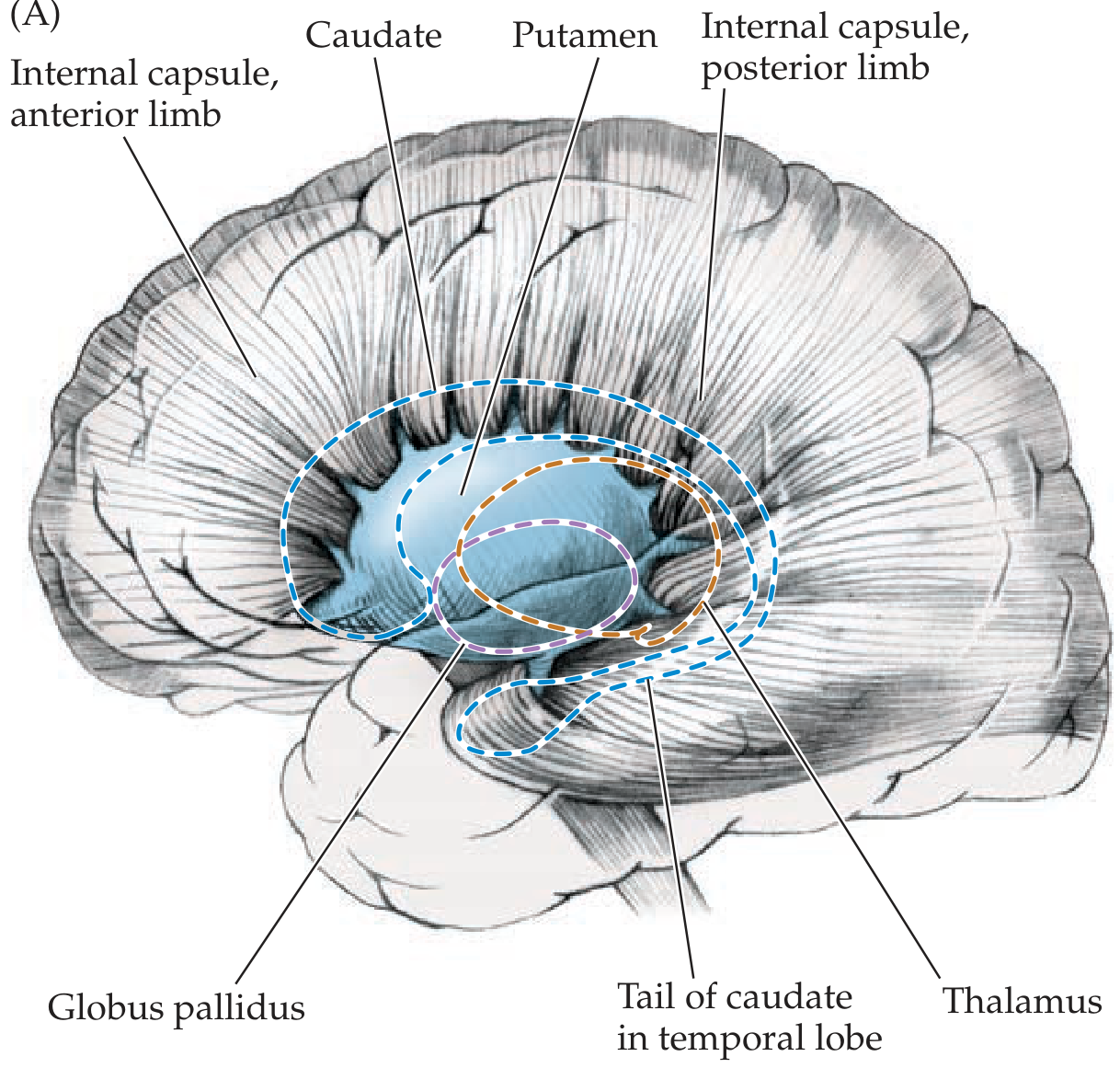
Fig. 16.3 - Basal ganglia and thalamus in relation to the internal capsule. From Neuroanatomy through Clinical Cases, 3rd Ed.
Moving from lateral to medial (on axial section):
- Insula → extreme capsule → claustrum → external capsule → Putamen → external medullary lamina → GPe → internal medullary lamina → GPi → internal capsule
Key landmarks:
- Anterior limb of the internal capsule: between the head of caudate (medially) and the lentiform nucleus (laterally)
- Posterior limb of the internal capsule: between the thalamus (medially) and the lentiform nucleus (laterally)
- The caudate and thalamus are always medial to the internal capsule; the lentiform nucleus is always lateral
Subthalamic Nucleus (STN)
- A small lens-shaped structure at the border between the cerebrum and brainstem
- Located ventral to the thalamus, dorsal to the substantia nigra
Substantia Nigra
- Extends the length of the midbrain, ventral to the red nucleus and dorsal to the cerebral peduncles
- Contains about 500,000 dopaminergic neurons normally
- Divided into pars compacta (SNc) - dopamine-producing - and pars reticulata (SNr) - output nucleus
- A melanin-containing (pigmented) nucleus; the dark coloration is from neuromelanin
3. Afferent (Input) Connections
All inputs arrive via the striatum. Sources include:
- Nearly all areas of the cerebral cortex (topographically organized)
- Intralaminar nuclei of the thalamus
- Substantia nigra pars compacta (SNc) - dopaminergic input
- Locus coeruleus (noradrenergic) and raphe nuclei (serotonergic)
- There is also a direct cortical projection to the STN (hyperdirect pathway)
4. Efferent (Output) Connections
The GPi and SNr are the output nuclei:
- GPi → ventral anterior (VA) and ventrolateral (VL) thalamus → motor and premotor cortex (including SMA)
- GPi → centromedian thalamic nucleus
- SNr → mediodorsal thalamus and superior colliculus (eye movements)
- Outputs are also sent to the pedunculopontine nucleus (PPN) in the brainstem
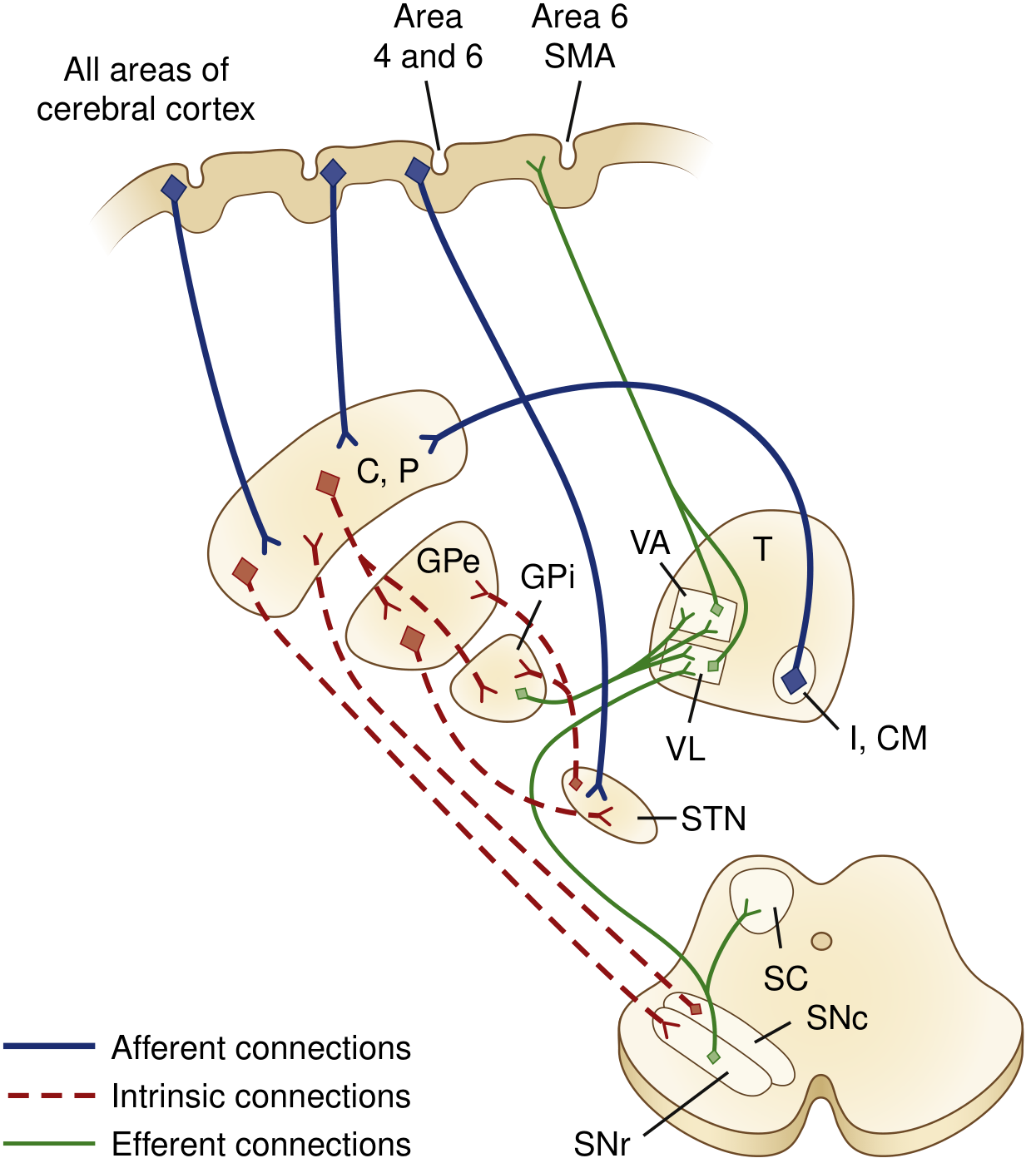
Fig. 96.1 - Afferent (blue), intrinsic (dashed red), and efferent (green) connections of the basal ganglia. C,P = caudate/putamen; GPe = external globus pallidus; GPi = internal globus pallidus; STN = subthalamic nucleus; SNc = substantia nigra pars compacta; SNr = pars reticulata; VA/VL = thalamic nuclei; SC = superior colliculus; CM = centromedian nucleus. From Bradley and Daroff's Neurology in Clinical Practice.
5. Direct and Indirect Pathways
These two opposing pathways are fundamental to basal ganglia function and are carefully balanced:
Direct Pathway (net excitatory effect on motor cortex)
Cortex → Striatum (D1 receptors) → GPi/SNr → Thalamus → Motor Cortex
- Striatum sends inhibitory (GABA) projections to GPi/SNr
- This reduces tonic inhibition of the thalamus, thereby disinhibiting it
- Result: increased thalamic output → increased cortical excitation → facilitation of movement
Indirect Pathway (net inhibitory effect on motor cortex)
Cortex → Striatum (D2 receptors) → GPe → STN → GPi/SNr → Thalamus → Motor Cortex
- Striatum inhibits GPe (GABA)
- GPe then releases its inhibitory tone on STN
- STN increases excitatory (glutamate) drive to GPi/SNr
- GPi/SNr increases inhibition of thalamus
- Result: reduced thalamic output → suppression of movement
Dopamine's Role (nigrostriatal projection)
- D1 receptors (direct pathway): dopamine is excitatory - facilitates movement
- D2 receptors (indirect pathway): dopamine is inhibitory - reduces indirect pathway activity, further facilitating movement
- Net effect: dopamine from SNc promotes movement through both pathways
6. Parallel Functional Circuits
There are several parallel cortico-basal ganglia-thalamo-cortical loops:
| Circuit | Input cortex | Output target | Function |
|---|---|---|---|
| Motor | Sensorimotor cortex | SMA / premotor cortex | General movement |
| Oculomotor | Frontal eye fields | Superior colliculus / frontal eye fields | Saccadic eye movements |
| Prefrontal | Prefrontal cortex | Prefrontal cortex | Cognitive/executive functions |
| Limbic | Anterior cingulate, orbitofrontal | Limbic areas | Emotion, motivation |
7. Clinical Relevance
| Disorder | Pathology | Mechanism | Features |
|---|---|---|---|
| Parkinson disease | Degeneration of SNc dopaminergic neurons | Decreased D1 activation (less facilitation) + decreased D2 inhibition (more indirect pathway activity) → net increased GPi inhibition of thalamus | Resting tremor, rigidity, bradykinesia, shuffling gait |
| Huntington disease | Destruction of striatal (GABAergic/cholinergic) neurons | Loss of indirect pathway striatal neurons → decreased GPe inhibition → decreased STN drive → less GPi inhibition → excessive movement | Chorea (involuntary writhing movements), dementia |
| Hemiballismus | STN lesion (usually infarct) | Loss of STN excitatory drive to GPi → reduced thalamic inhibition → involuntary movement | Wild flinging movements of contralateral limbs |
Sources:
- Neuroanatomy through Clinical Cases, 3rd Ed. (Blumenfeld), pp. 767-775
- Bradley and Daroff's Neurology in Clinical Practice, Ch. 96
- Costanzo Physiology, 7th Ed., pp. 3467-3482
- Neuroscience: Exploring the Brain, 5th Ed. (Bear, Connors, Paradiso), Ch. 14
This is a shared conversation. Sign in to Orris to start your own chat.