
Hypercholestrolemia : management
"hypercholesterolemia"[MeSH Terms] AND "management"[MeSH Terms]
hypercholesterolemia LDL management algorithm statin therapy flowchart
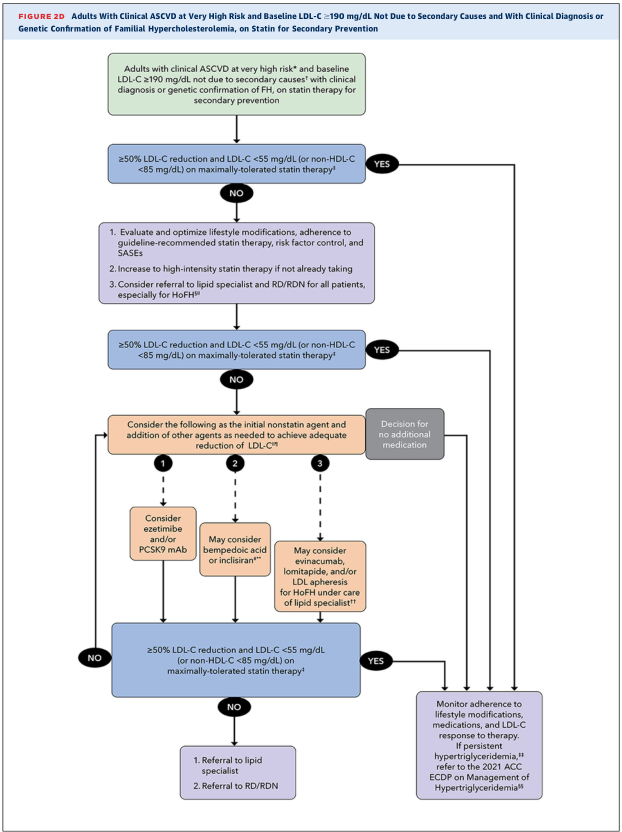
Summary : This flowchart provides a stepwise clinical decision algorithm for adults with clinical ASCVD at very high risk and baseline LDL-C ≥190 mg/dL (not due to secondary causes), with clinical diagnosis or genetic confirmation of familial hypercholesterolemia (FH), who are on statin therapy for secondary prevention. The chart guides clinicians through statin optimization, nonstatin agent selection, and referral pathways to achieve LDL-C targets. flowchart: # Nodes : • Start (rounded rectangle): "Adults with clinical ASCVD at very high risk* and baseline LDL-C ≥190 mg/dL not due to secondary causes† with clinical diagnosis or genetic confirmation of FH, on statin therapy for secondary prevention" • Decision (diamond): "≥50% LDL-C reduction and LDL-C <55 mg/dL (or non-HDL-C <85 mg/dL) on maximally-tolerated statin therapy‡" • If YES: "Monitor adherence to lifestyle modifications, medications, and LDL-C response to therapy. If persistent hypertriglyceridemia,‖ refer to the 2021 ACC ECDP on Management of Hypertriglyceridemia45" • If NO: (rectangle with steps) 1. "Evaluate and optimize lifestyle modifications, adherence to guideline-recommended statin therapy, risk factor control, and SASES" 2. "Increase to high-intensity statin therapy if not already taking" 3. "Consider referral to lipid specialist and RD/RDN for all patients, especially for HoFH‖" • Decision (diamond): "≥50% LDL-C reduction and LDL-C <55 mg/dL (or non-HDL-C <85 mg/dL) on maximally-tolerated statin therapy‡" • If YES: "Monitor adherence to lifestyle modifications, medications, and LDL-C response to therapy. If persistent hypertriglyceridemia,‖ refer to the 2021 ACC ECDP on Management of Hypertriglyceridemia45" • If NO: (rectangle) "Consider the following as the initial nonstatin agent and addition of other agents as needed to achieve adequate reduction of LDL-C‖" 1. "Consider ezetimibe and/or PCSK9 mAb" 2. "May consider bempedoic acid or inclisiran**" 3. "May consider evinacumab, lomitapide, and/or LDL apheresis for HoFH under care of lipid specialist‖" • Decision (diamond): "≥50% LDL-C reduction and LDL-C <55 mg/dL (or non-HDL-C <85 mg/dL) on maximally-tolerated statin therapy‡" • If YES: "Monitor adherence to lifestyle modifications, medications, and LDL-C response to therapy. If persistent hypertriglyceridemia,‖ refer to the 2021 ACC ECDP on Management of Hypertriglyceridemia45" • If NO: (rectangle) "1. Referral to lipid specialist 2. Referral to RD/RDN" • Decision (gray rectangle): "Decision for no additional medication" # Connectors : • Downward arrows connect each node in sequence. • Decision diamonds split into YES and NO branches. • YES branches loop to monitoring node. • NO branches proceed to next intervention or referral. • Nonstatin agent selection node splits into three parallel options (numbered 1, 2, 3). • All branches ultimately converge on either monitoring or referral. # Layout : • Vertical flow, top-to-bottom. • Decision diamonds create branch points. • Parallel options for nonstatin agents are horizontally arranged. • Monitoring node is a common endpoint for successful LDL-C reduction. • Referral node is the endpoint for unsuccessful LDL-C reduction after all interventions. # Analysis : • The flowchart emphasizes a stepwise escalation: starting with statin therapy, optimizing lifestyle and statin intensity, then adding nonstatin agents if LDL-C targets are not met. • Multiple nonstatin options are provided, with more advanced therapies reserved for patients with homozygous familial hypercholesterolemia (HoFH) under specialist care. • The algorithm ensures regular monitoring and referral to specialists if targets remain unmet, supporting a comprehensive approach to secondary prevention in very high-risk ASCVD patients with FH.
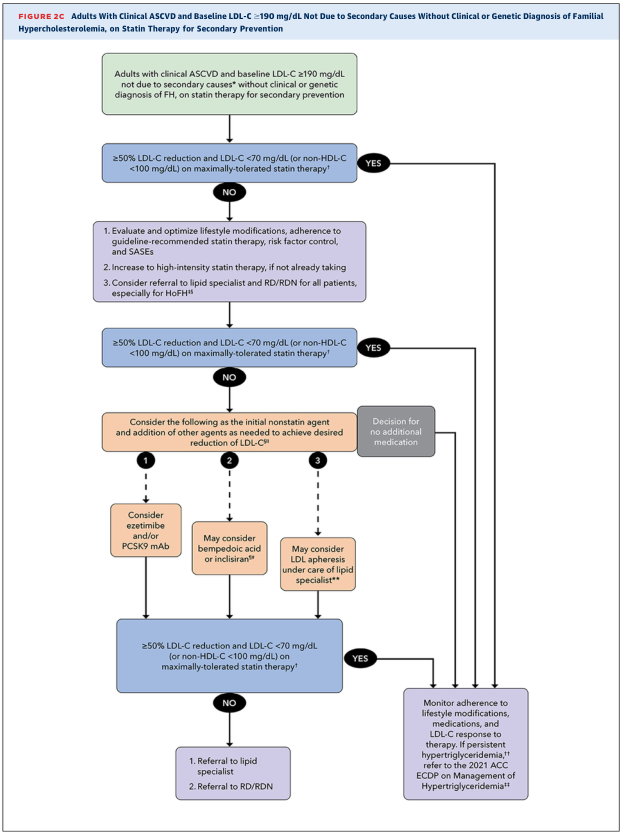
Summary : This flowchart outlines the recommended management for adults with clinical ASCVD and baseline LDL-C ≥190 mg/dL not due to secondary causes, without clinical or genetic diagnosis of familial hypercholesterolemia, focusing on statin therapy for secondary prevention. flowchart: # Nodes : • Start (rounded rectangle): "Adults with clinical ASCVD and baseline LDL-C ≥190 mg/dL not due to secondary causes* without clinical or genetic diagnosis of FH, on statin therapy for secondary prevention" • Decision (diamond): "≥50% LDL-C reduction and LDL-C <70 mg/dL (or non-HDL-C <100 mg/dL) on maximally-tolerated statin therapy†" • If YES: (rounded rectangle) "Monitor adherence to lifestyle modifications, medications, and LDL-C response to therapy. If persistent hypertriglyceridemia,†† refer to the 2021 ACC ECDP on Management of Hypertriglyceridemia††" • If NO: (rectangle) "1. Evaluate and optimize lifestyle modifications, adherence to guideline-recommended statin therapy, risk factor control, and SAEs 2. Increase to high-intensity statin therapy, if not already taking 3. Consider referral to lipid specialist and RD/RDN for all patients, especially for HoFH‡‡" • Decision (diamond): "≥50% LDL-C reduction and LDL-C <70 mg/dL (or non-HDL-C <100 mg/dL) on maximally-tolerated statin therapy†" • If YES: (rounded rectangle) "Monitor adherence to lifestyle modifications, medications, and LDL-C response to therapy. If persistent hypertriglyceridemia,†† refer to the 2021 ACC ECDP on Management of Hypertriglyceridemia††" • If NO: (rectangle) "Consider the following as the initial nonstatin agent and addition of other agents as needed to achieve desired reduction of LDL-C§§" - Sub-nodes (rectangles): 1. "Consider ezetimibe and/or PCSK9 mAb" 2. "May consider bempedoic acid or inclisiran§§" 3. "May consider LDL apheresis under care of lipid specialist**" 4. "Decision for no additional medication" • Decision (diamond): "≥50% LDL-C reduction and LDL-C <70 mg/dL (or non-HDL-C <100 mg/dL) on maximally-tolerated statin therapy†" • If YES: (rounded rectangle) "Monitor adherence to lifestyle modifications, medications, and LDL-C response to therapy. If persistent hypertriglyceridemia,†† refer to the 2021 ACC ECDP on Management of Hypertriglyceridemia††" • If NO: (rectangle) "1. Referral to lipid specialist 2. Referral to RD/RDN" # Connectors : • Arrows connect each decision diamond to YES/NO branches. • YES branches loop to monitoring node. • NO branches proceed to next intervention or referral. • Sub-nodes for nonstatin agents are parallel options. • Final NO branch leads to referral options. # Layout : • Vertical flow, starting from top. • Decision diamonds split into YES (right) and NO (downward) branches. • Parallel options for nonstatin agents are horizontally arranged. • Monitoring node is a common endpoint for all YES branches. • Referral is the endpoint for persistent failure to reach targets. # Analysis : • The flowchart provides a stepwise escalation for LDL-C management in high-risk patients, starting with statin therapy and progressing to nonstatin agents and specialist referral if targets are not met. • The process emphasizes repeated assessment of LDL-C reduction and adherence, with multiple opportunities for intervention. • The chart highlights the importance of lifestyle modification, medication optimization, and specialist involvement for refractory cases. • Monitoring and referral are key endpoints, ensuring ongoing management and escalation as needed.
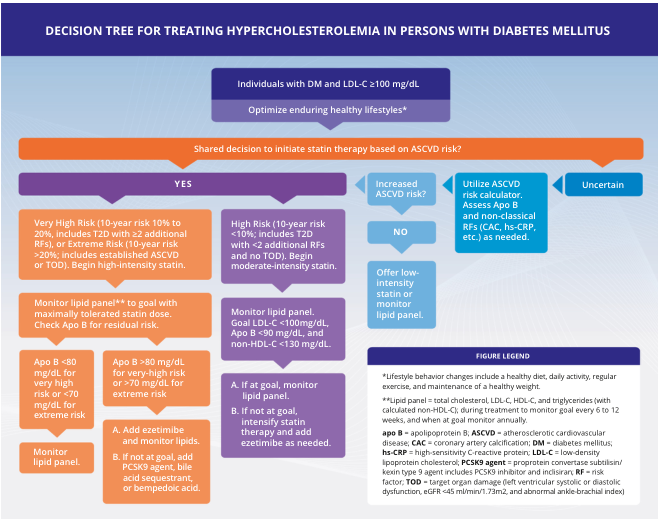
Summary : This flowchart provides a decision tree for treating hypercholesterolemia in persons with diabetes mellitus, focusing on statin therapy initiation and management based on ASCVD risk and lipid panel results. flowchart: # Nodes : • Individuals with DM and LDL-C ≥100 mg/dL (rectangle) • Optimize enduring healthy lifestyles* (rectangle) • Shared decision to initiate statin therapy based on ASCVD risk? (rectangle) • YES (decision branch) – Very High Risk (10-year risk 10% to 20%, includes T2D with ≥2 additional RFs), or Extreme Risk (>20%, includes established ASCVD or TOD). Begin high-intensity statin. (rectangle) – High Risk (10-year risk <10%, includes T2D with <2 additional RFs and no TOD). Begin moderate-intensity statin. (rectangle) – Monitor lipid panel** to goal with maximally tolerated statin dose. Check Apo B for residual risk. (rectangle) – Monitor lipid panel. Goal LDL-C <100 mg/dL, Apo B <90 mg/dL, and non-HDL-C <130 mg/dL. (rectangle) – Apo B <80 mg/dL for very high risk or <70 mg/dL for extreme risk (rectangle) – Apo B >80 mg/dL for very-high risk or >70 mg/dL for extreme risk (rectangle) – Monitor lipid panel. (rectangle) – A. Add ezetimibe and monitor lipids. (rectangle) – B. If not at goal, add PCSK9 agent, bile acid sequestrant, or bempedoic acid. (rectangle) – A. If at goal, monitor lipid panel. (rectangle) – B. If not at goal, intensify statin therapy and add ezetimibe as needed. (rectangle) • NO (decision branch) – Offer low-intensity statin or monitor lipid panel. (rectangle) • Increased ASCVD risk? (decision diamond) • Utilize ASCVD risk calculator. Assess Apo B and non-classical RFs (CAC, hs-CRP, etc.) as needed. (rectangle) • Uncertain (decision branch) # Connectors : • Arrows connect each node in a top-down, left-to-right branching structure. • Decision points split into YES, NO, and Uncertain branches. • YES branch further splits into risk categories and subsequent management steps. • NO branch leads to low-intensity statin or monitoring. • Uncertain branch leads to risk calculator and further assessment. # Layout : • The flowchart is organized in a vertical hierarchy, starting from the top with initial patient criteria, then branching based on ASCVD risk assessment. • The YES branch is subdivided into risk levels and corresponding treatment steps, with feedback loops for monitoring and intensifying therapy. • The NO and Uncertain branches provide alternative pathways for lower or unclear risk. # Figure Legend : • Lifestyle changes include healthy diet, activity, regular exercise, and weight maintenance. • Lipid panel includes total cholesterol, LDL-C, HDL-C, triglycerides, and calculated non-HDL-C; monitor every 6 to 12 weeks. • Apo B = apolipoprotein B; ASCVD = atherosclerotic cardiovascular disease; CAC = coronary artery calcification; DM = diabetes mellitus; hs-CRP = high-sensitivity C-reactive protein; LDL-C = low-density lipoprotein cholesterol; PCSK9 agent = PCSK9 inhibitor; RF = risk factor; TOD = target organ damage. # Analysis : • The flowchart provides a structured approach to statin therapy initiation and management in diabetic patients with elevated LDL-C, emphasizing risk stratification and stepwise intensification based on lipid panel results and residual risk markers. • The decision tree ensures individualized therapy, with clear escalation steps for patients not meeting lipid goals, and incorporates non-classical risk factors for uncertain cases. • The process is cyclical, with repeated monitoring and adjustment to achieve optimal lipid control.
Hypercholesterolemia: Management
1. Overview and Goals
| Risk Category | LDL-C Target |
|---|---|
| Very high risk (ASCVD + multiple events/conditions) | < 55 mg/dL (< 1.4 mmol/L) |
| High risk (clinical ASCVD or FH) | < 70 mg/dL (< 1.8 mmol/L) |
| Moderate risk | < 100 mg/dL (< 2.6 mmol/L) |
2. Lifestyle Modifications (First-Line for All Patients)
- Diet: Reduce saturated fat (<7% of calories), eliminate trans fats, increase dietary fiber, plant sterols/stanols; Mediterranean or DASH diet patterns
- Physical activity: At least 150 min/week of moderate aerobic exercise
- Weight reduction: 5-10% weight loss improves lipid profile significantly
- Smoking cessation: Raises HDL-C and reduces overall CV risk
- Limit alcohol: Excessive intake raises triglycerides
3. Pharmacologic Therapy - Step-by-Step
Step 1: Who Needs Drug Treatment?
- Secondary prevention (established ASCVD): Drug therapy to reduce LDL-C is well supported as long as LDL-C remains >70 mg/dL
- Primary prevention with FH: Treatment should start as early as possible, ideally childhood
- Primary prevention (no ASCVD, no FH): Use a risk calculator (e.g., pooled cohort risk estimator). A 10-year ASCVD risk >7.5% merits statin therapy regardless of LDL-C level
- Borderline cases: Measure ApoB, Lp(a), hs-CRP, or coronary artery calcium (CAC) score for additional risk stratification
Step 2: First-Line - Statins (HMG-CoA Reductase Inhibitors)
Statin Intensity Classification (ACC/AHA):
| Intensity | Expected LDL-C Reduction | Agents & Doses |
|---|---|---|
| High | ≥ 50% | Atorvastatin 40-80 mg; Rosuvastatin 20-40 mg |
| Moderate | 30-50% | Atorvastatin 10-20 mg; Rosuvastatin 5-10 mg; Simvastatin 20-40 mg; Pravastatin 40-80 mg; Lovastatin 40 mg; Pitavastatin 2-4 mg |
| Low | < 30% | Simvastatin 10 mg; Pravastatin 10-20 mg; Lovastatin 20 mg; Pitavastatin 1 mg |
Key Safety Considerations:
- Myalgia: Most common side effect; occurs in 3-5% of patients. Obtain CK if symptoms arise (routine CK monitoring not needed)
- Myopathy/Rhabdomyolysis: Rare. Risk increases with older age, frailty, renal insufficiency, and co-administration of CYP3A4 inhibitors (erythromycin, antifungals, cyclosporine), especially gemfibrozil
- Hepatotoxicity: Mild transaminase elevations are common and usually transient; rarely requires discontinuation
- Incident diabetes: Slight increased risk; cardiovascular benefits far outweigh this risk
- Contraindicated in pregnancy and lactation
Note: Simvastatin 80 mg is not recommended due to increased myopathy risk.
Step 3: Add-On Therapy if LDL-C Targets Not Met
A. Ezetimibe (Second-Line Add-On)
- Mechanism: Inhibits NPC1L1 protein in the small intestine → blocks cholesterol absorption → compensatory increase in hepatic LDL receptor expression
- Dose: 10 mg once daily
- Effect: ~18% additional LDL-C reduction; additive with statins
- Evidence: The IMPROVE-IT trial showed ezetimibe + statin significantly reduced major cardiovascular events vs. statin alone
- Safety: Very well tolerated; monitor transaminases when used with a statin
B. PCSK9 Inhibitors (Third-Line / Refractory Cases)
- Mechanism: Monoclonal antibodies against PCSK9 prevent LDL receptor degradation → more receptors available on hepatocyte surface → markedly increased LDL clearance
- Effect: ~60% LDL-C reduction; also modestly reduce Lp(a)
- Agents: Evolocumab, Alirocumab (sc injection every 2 weeks); Inclisiran (siRNA, every 6 months)
- Evidence: Both evolocumab and alirocumab significantly reduce cardiovascular events when added to statin in patients with established CAD
- Indications: Patients with FH or ASCVD not reaching LDL-C targets on maximally tolerated statin ± ezetimibe
- Safety: Generally well tolerated; injection site reactions. Monoclonal antibodies contraindicated in pregnancy
C. Bempedoic Acid
- Mechanism: ATP citrate lyase (ACL) inhibitor → reduces hepatic cholesterol synthesis upstream of HMG-CoA reductase
- Use: Add-on in statin-intolerant patients or those not at goal. Can be combined with ezetimibe
- Note: Active only in liver (not in muscle) - may have lower myopathy risk than statins
D. Bile Acid Sequestrants (Resins)
- Cholestyramine, Colestipol, Colesevelam
- Reduce LDL-C by 15-30%; can be used in combination
- Poor tolerability (GI side effects, constipation) limits their use
- Can increase triglycerides - avoid if TG > 400 mg/dL
- One of the few options safe in pregnancy
4. Specific Patient Populations
Familial Hypercholesterolemia (FH)
- Lifestyle alone is insufficient; almost all FH patients need pharmacotherapy
- Children/Adolescents: Moderate-intensity statin if LDL-C > 160 mg/dL after lifestyle trial
- Adults (>20 years): High-intensity statin if LDL-C > 190 mg/dL
- Target LDL-C ~100 mg/dL for primary prevention; <70 mg/dL (or <55 mg/dL) for those with ASCVD
- Add ezetimibe + PCSK9 inhibitor for severe cases or when targets are not met
- LDL apheresis: Option for homozygous FH (HoFH) or patients intolerant/unresponsive to all medications
- Evinacumab, lomitapide: For HoFH under specialist care
Familial Combined Hypercholesterolemia
- Polygenic disorder; expressed with age and obesity
- Same treatment approach as FH: lifestyle + statin ± ezetimibe ± PCSK9 inhibitor ± bempedoic acid
- Manage triglycerides if TG > 1000 mg/dL separately
Diabetes Mellitus
- Patients with DM + LDL-C ≥ 100 mg/dL: optimize lifestyle, then initiate statin based on ASCVD risk
- Very high/extreme risk: high-intensity statin; high risk: moderate-intensity statin
- Monitor ApoB for residual risk; add ezetimibe if at-goal ApoB not achieved
- Escalate to PCSK9 inhibitors/bile acid sequestrants/bempedoic acid if needed
Pregnancy
- Statins and PCSK9 monoclonal antibodies are contraindicated
- Bile acid sequestrants are the preferred option when treatment is necessary
Children and Adolescents
- For FH: moderate-intensity statin is recommended when LDL-C > 160 mg/dL after lifestyle changes
5. Treatment Decision Flowchart
6. Monitoring
| Parameter | Frequency |
|---|---|
| Lipid panel (LDL-C, HDL-C, TG, non-HDL-C) | Baseline, 4-12 weeks after initiation/dose change, then annually |
| Liver transaminases (ALT/AST) | Baseline; repeat if symptomatic |
| CK | Only if muscle symptoms develop (not routine) |
| ApoB, Lp(a), hs-CRP | For borderline-risk patients needing additional risk stratification |
| Coronary artery calcium (CAC) score | In men >40 yrs, women >50 yrs with borderline risk |
7. Summary Algorithm
ALL PATIENTS → Lifestyle modification (diet, exercise, weight, smoking cessation)
                      ↓
        Assess ASCVD risk + LDL-C level
                      ↓
       High/very high risk OR established ASCVD?
              YES ↓                    NO ↓
    High-intensity statin        Calculate 10-yr risk
         ↓                          >7.5%? Start statin
    LDL-C target met?
         YES → Monitor
         NO  ↓
    Add Ezetimibe (10 mg/day)
         ↓
    LDL-C target met?
         YES → Monitor
         NO  ↓
    Add PCSK9 inhibitor (evolocumab/alirocumab) or inclisiran
         ↓
    Still not at goal? → Bempedoic acid / bile acid sequestrant
    FH/HoFH? → LDL apheresis / evinacumab / lomitapide (specialist)
What is the latest evidence on PCSK9 inhibitors vs. GLP-1 agonists for cardiovascular outcomes?
"PCSK9 inhibitors"[MeSH Terms] AND "cardiovascular outcomes"
"GLP-1 receptor agonists"[MeSH Terms] AND "cardiovascular outcomes"
PCSK9 inhibitors vs GLP-1 agonists cardiovascular outcomes 2025 2026 comparison evidence
"glucagon-like peptide-1" AND "cardiovascular" AND "major adverse"
PMID: 40511660
PMID: 41468554
semaglutide OR liraglutide AND "MACE" AND cardiovascular
PMID: 40255182
https://link.springer.com/article/10.1186/s12933-026-03164-6
PMID: 40892610
PMID: 40156846
PMID: 39181597
PCSK9 Inhibitors vs. GLP-1 Receptor Agonists: Cardiovascular Outcomes - Latest Evidence (2024-2026)
Mechanisms of CV Benefit: A Key Distinction
| Feature | PCSK9 Inhibitors | GLP-1 Receptor Agonists |
|---|---|---|
| Primary mechanism | LDL-C lowering via LDL receptor upregulation | Multi-modal: glycemic control, weight loss, BP reduction, direct CV/renal effects |
| LDL-C reduction | ~60% (injectable mAbs) | Modest (~5%) |
| Weight effect | Neutral | Significant (-5% to -16% or more with newer agents) |
| Diabetes required? | No | No (SELECT, FLOW trials in non-diabetics) |
| Heart failure benefit | Primarily ischemic | Both ischemic and HFpEF/HFrEF |
| Kidney benefit | Modest | Significant (FLOW trial) |
PCSK9 Inhibitors: Landmark Recent Evidence
VESALIUS-CV Trial (2025) - Primary Prevention Breakthrough
- 25% reduction in the composite of CHD death, MI, or ischemic stroke
- 19% reduction in the broader primary endpoint (including ischemia-driven revascularization)
- 27% reduction in CV death, MI, or ischemic stroke
- 36% reduction in MI specifically
- Nominally lower all-cause mortality (7.9% vs 9.7%)
Alirocumab vs. Evolocumab - Head-to-Head Meta-Analysis (2026)
- Alirocumab: significant reductions in MI (RR 0.85), stroke (RR 0.75), and hospitalization for unstable angina (RR 0.58 - a 42% reduction)
- Evolocumab: significant reductions in MI (RR 0.75) and coronary revascularization (RR 0.81)
- Conclusion: Alirocumab appears superior for stroke and unstable angina prevention; evolocumab may have an edge on preventing revascularization. Both are effective and safe.
Oral PCSK9 Inhibitors - Emerging Class (2026)
Specialized Populations (FOURIER Sub-analyses, 2025)
- Evolocumab in Type 1 Diabetes: Reduces CV events with the same magnitude as in T2D (PMID: 40544474)
- Evolocumab in autoimmune/inflammatory disease: FOURIER sub-analysis shows benefit preserved in patients with autoimmune conditions (Circulation 2025)
- Evolocumab in obesity: FOURIER pre-specified analysis (JACC 2026) confirms CV benefit regardless of baseline BMI [PMID: 41369622]
GLP-1 Receptor Agonists: Landmark Recent Evidence
Largest Meta-Analysis to Date: JACC 2025 (n=99,599)
- All-cause death: IRR 0.88 (95% CI 0.84-0.92) - NNT = 121
- CV death: IRR 0.87 (95% CI 0.81-0.92) - NNT = 170
- MACE: IRR 0.87 (95% CI 0.83-0.91) - NNT = 66
- MI: -15%; Heart failure: -15%; Acute kidney failure: -9%
- Gastrointestinal adverse events: +63%; Gallbladder disorders: +26%
- No increased stroke, pancreatitis, or malignancy risk
- Evidence rated high-certainty by GRADE
Cardiovascular & Kidney Outcomes in T2D: Diabetes Care Meta-Analysis (2025)
- MACE: HR 0.86 (14% reduction), consistent across injectable and oral semaglutide
- Hospitalization for heart failure: HR 0.86 (14% reduction)
- Composite kidney outcome: HR 0.83 (17% reduction)
- All-cause mortality: HR 0.88 (12% reduction)
- No increased hypoglycemia, retinopathy, or pancreatitis
SELECT Trial - Heart Failure Sub-analysis (Lancet, 2024)
- In patients WITH heart failure: MACE HR 0.72, CV death HR 0.76, HF composite HR 0.79
- Benefit preserved in both HFpEF and HFrEF subgroups
- Notably: benefit was independent of diabetes status and weight loss magnitude
SURPASS-CVOT (2025) - Tirzepatide (GIP/GLP-1 Dual Agonist)
- Non-inferior for 3-point MACE (HR 0.91, p<0.001 for non-inferiority)
- 16% reduction in all-cause mortality (HR 0.84, 95% CI 0.73-0.97) vs. dulaglutide
- -11.6% weight loss vs. -4.5% with dulaglutide
- Positions dual agonists as superior metabolic-CV agents versus single GLP-1 agonists
Direct Comparison: Key Contrasts
| Outcome Domain | PCSK9 Inhibitors | GLP-1 Receptor Agonists |
|---|---|---|
| MI reduction | ~15-25% (vs placebo on statin) | ~15% |
| Stroke reduction | ~15-25% (alirocumab: RR 0.75) | ~14% (inconsistent across agents) |
| CV death | Trend to reduction | Significant ~12-13% reduction |
| All-cause mortality | Trend (VESALIUS-CV nominally significant) | Significant ~12% reduction |
| Heart failure | Not a primary benefit | 14-15% HHF reduction |
| Kidney protection | Modest | 17% composite kidney outcome reduction |
| Weight loss | None | Significant (-5% to -16%+) |
| Primary prevention | Now established (VESALIUS-CV 2025) | Yes (SELECT: non-diabetic obesity) |
| LDL-C | -60% (injectable mAb) | Minimal |
Combination Therapy: The Emerging Paradigm
- GLP-1 RAs work primarily through weight loss, glycemic control, inflammation reduction, and direct cardiorenal mechanisms - leaving residual LDL-driven risk
- PCSK9 inhibitors address that residual LDL risk
- Medscape (2026) notes that even in SELECT patients already on statins, PCSK9 inhibitors, and antiplatelets, adding a GLP-1 RA still reduced MACE by a further 10-20%
- Guidelines are evolving toward using both classes in very-high-risk patients
Bottom Line for Clinical Practice
- For patients with established ASCVD not at LDL-C target on statin ± ezetimibe: Add a PCSK9 inhibitor - well-established, ~60% LDL-C reduction, consistent CV event reduction
- For patients with T2D, obesity, or HF: GLP-1 RA (especially semaglutide or tirzepatide) adds multi-system protection beyond any lipid-lowering agent
- In very-high-risk patients: Consider both - they address different pathophysiologic targets
- For primary prevention (no prior MI/stroke): VESALIUS-CV (2025) now supports PCSK9 inhibitor use in high-risk patients on intensive statin therapy
- Galli et al. (2025). GLP-1 RA meta-analysis, 99,599 patients. PMID: 40892610
- Lee et al. (2025). GLP-1 RA T2D outcomes, 71,351 patients. PMID: 40156846
- Cleto et al. (2026). Alirocumab vs. evolocumab meta-analysis. PMID: 40511660
- VESALIUS-CV (2025). AHA Scientific Sessions 2025 - evolocumab in primary prevention. AHA report
- Deanfield et al. (2024). Semaglutide and heart failure (SELECT sub-analysis). PMID: 39181597