
Risk factors of Down’s syndrome
Reading File
Down's syndrome risk factors are well-established, with advanced maternal age being the primary one. Let me consult the medical library for a thorough answer.
Searching sources...
Finding Sources
Searching PubMed
"Down syndrome" AND "risk factors"
Reading File
Finding Sources
Reading File
Finding Sources
Reading File
Reading File
Reading File
Finding Sources
Now let me fetch the maternal age graph for a visual aid:
Loading Image
I now have comprehensive information from authoritative textbooks. Here is a detailed answer:
Risk Factors of Down's Syndrome (Trisomy 21)
Down syndrome (trisomy 21) has a population incidence of approximately 1 in 700 live births. The risk factors differ depending on the chromosomal mechanism underlying the condition.
1. Cytogenetic Types and Their Specific Risk Factors
Down syndrome is not a single genetic event - its three cytogenetic subtypes each carry distinct risk profiles.
A. Standard Trisomy 21 (~95% of cases)
Caused by meiotic nondisjunction of chromosome 21 pair, resulting in 47 chromosomes. The error occurs in maternal meiosis in ~90% of cases (predominantly meiosis I), and in paternal meiosis in ~10%.
Primary risk factor: Advanced maternal age
This is by far the most important risk factor. Risk rises sharply after age 30:
| Maternal Age | Risk at Term |
|---|---|
| ≤29 years | Less than 1 in 1,000 |
| 35 years | 1 in 385 |
| Oldest age group | Approaches 1 in 10 |
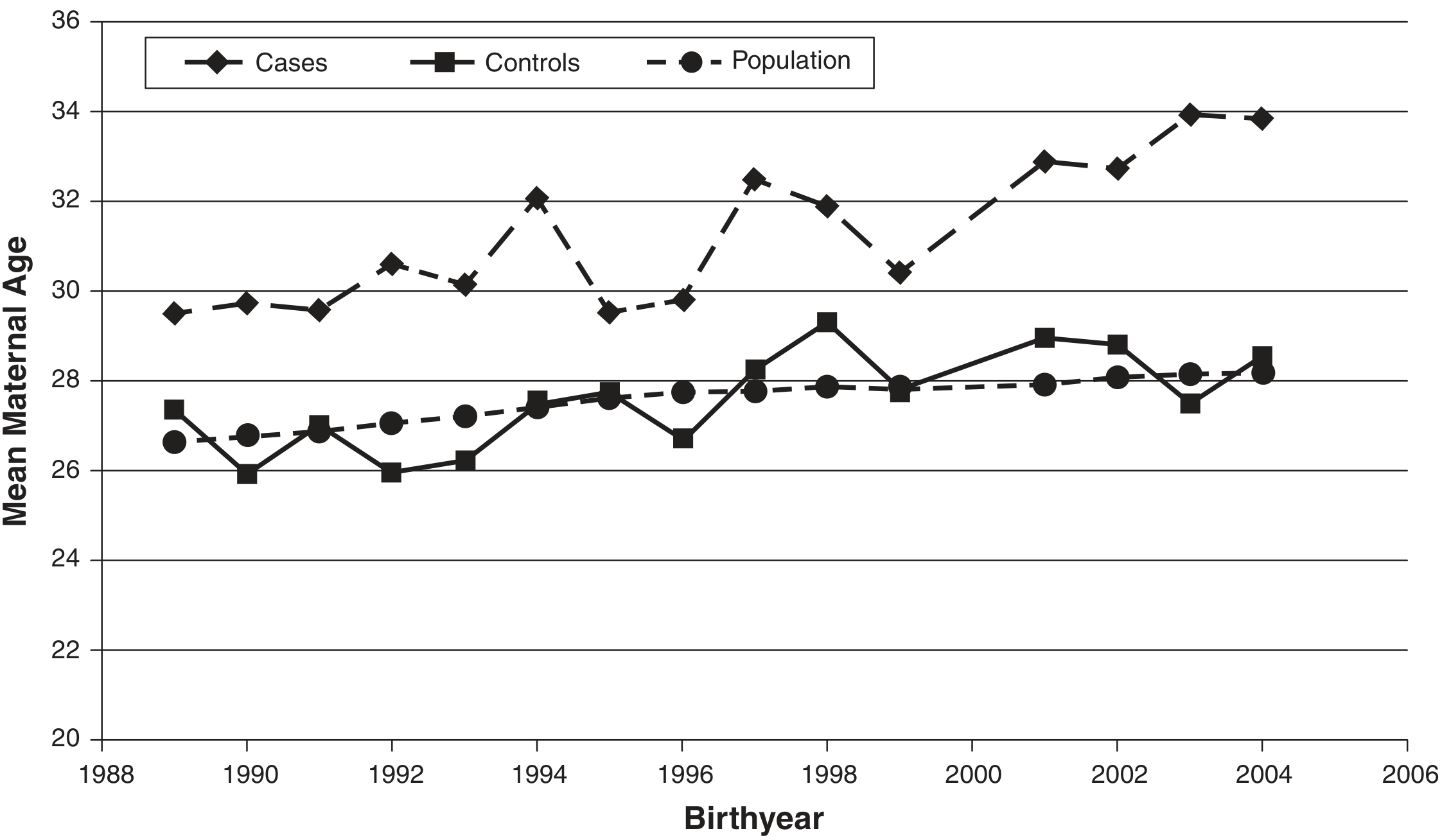
Figure: Maternal age at birth of infants with trisomy 21 (Cases) is consistently higher than controls and the general population. - Thompson & Thompson Genetics and Genomics in Medicine, 9th ed.
Important nuance: Even though older mothers have much higher individual risk, younger mothers have a far higher birth rate - so more than half of all newborns with Down syndrome are born to mothers younger than 35 years. This is why maternal age alone as a screening criterion only identifies ~51% of affected pregnancies.
B. Robertsonian Translocation Down Syndrome (~4% of cases)
- The patient has 46 chromosomes but carries a Robertsonian translocation (most commonly between chromosomes 14 and 21).
- No relationship to maternal age.
- Risk factor: Parental carrier status - a parent (especially the mother) carrying a balanced Robertsonian translocation is at significant recurrence risk.
- Carrier mother: ~10-15% risk per pregnancy
- Carrier father: a few percent risk per pregnancy
- Special case - 21q21q translocation: If a parent carries this isochromosome, recurrence risk is 100% (all viable offspring will have Down syndrome or lethal monosomy 21).
- De novo translocation (no carrier parent): recurrence risk is low, similar to trisomy 21.
C. Mosaic Down Syndrome (~2% of cases)
- Two cell populations coexist: one normal, one with trisomy 21.
- Results from nondisjunction in an early post-zygotic mitotic division (not meiotic).
- Phenotype may be milder, with wide variability.
- Specific additional risk factors are not well-defined beyond the general meiotic/mitotic error processes.
2. Summary of Risk Factors
| Risk Factor | Subtype Affected | Mechanism |
|---|---|---|
| Advanced maternal age | Trisomy 21 (95%) | Increased meiotic nondisjunction with oocyte aging |
| Parental (especially maternal) Robertsonian translocation carrier | Translocation type (4%) | Unbalanced segregation of translocation chromosome |
| Previous child with Down syndrome | All types | ~1% empirical recurrence risk for trisomy 21; higher if translocation involved |
| Paternal age | Trisomy 21 | Minor contributor (~10% of nondisjunction cases are paternal in origin) |
3. Recurrence Risk After an Affected Child
- If the child has trisomy 21 (standard nondisjunction): empirical recurrence risk is ~1% above the age-related background risk.
- If the child has translocation Down syndrome and a parent is a carrier: recurrence risk is 10-20%; karyotyping of both parents and possibly other relatives is essential for counseling.
- If the translocation is de novo (neither parent is a carrier): risk is not substantially above baseline.
4. A Note on Paternal Factors
While maternal age dominates the literature, ~10% of nondisjunction events originate in paternal meiosis (typically meiosis II). The contribution of paternal age as an independent risk factor is considered marginal and likely subject to selection bias, based on data from Adams and Victor's Principles of Neurology.
Sources:
- Thompson & Thompson Genetics and Genomics in Medicine, 9th ed., pp. 102-104
- Tietz Textbook of Laboratory Medicine, 7th ed., p. 2897
- Creasy & Resnik's Maternal-Fetal Medicine - Maternal Age as Screening Test
- Emery's Elements of Medical Genetics and Genomics - Advanced Maternal Age section
- Robbins & Kumar Basic Pathology - Chromosomal Disorders
This is a shared conversation. Sign in to Orris to start your own chat.