
Larynx anatomy
Reading File
Searching for larynx anatomy — text and images in parallel.
search_medical_text
larynx anatomy cartilages muscles ligaments
Bailey and Love's Short Practice of Surgery 28th Edition
Page 797
GradeResponse
GradeResponse
Larynx Anatomy
The larynx is a complex musculocartilaginous structure in the anterior neck, serving three primary functions: airway protection during swallowing, phonation, and respiration.
Location & Overview
The larynx lies at the level of C3–C6 vertebrae in adults, suspended from the hyoid bone superiorly and continuous with the trachea inferiorly. It is positioned anterior to the hypopharynx and laryngopharynx.
Cartilaginous Framework
The skeleton of the larynx consists of 9 cartilages (3 paired, 3 unpaired). As Bailey & Love's (p. 797) notes, this framework may ossify with advancing age.
| Cartilage | Type | Key Features |
|---|---|---|
| Thyroid | Unpaired, hyaline | Largest; two laminae fuse anteriorly at the laryngeal prominence ("Adam's apple"); ~90° angle in males, ~120° in females |
| Cricoid | Unpaired, hyaline | Only complete cartilaginous ring; signet-ring shaped — narrow arch anteriorly, broad lamina posteriorly |
| Epiglottis | Unpaired, elastic | Leaf-shaped; attached to inner thyroid angle via thyroepiglottic ligament; deflects over laryngeal inlet during swallowing |
| Arytenoids (×2) | Paired, hyaline | Pyramid-shaped; sit on cricoid lamina; have vocal process (anteriorly, for vocal fold attachment) and muscular process (posteriorly, for muscle attachment) |
| Corniculate (×2) | Paired, elastic | Small; apex of each arytenoid; within aryepiglottic folds |
| Cuneiform (×2) | Paired, elastic | Embedded in aryepiglottic folds anterolateral to corniculates |
Internal Compartments
The larynx is divided into three regions by the vocal folds:
| Region | Boundaries | Contents |
|---|---|---|
| Supraglottis | Laryngeal inlet → superior surface of vestibular folds | Epiglottis, aryepiglottic folds, false vocal cords (vestibular folds), laryngeal ventricles |
| Glottis | True vocal folds + anterior/posterior commissures | Vocal ligament, vocalis muscle; rima glottidis (glottic opening) |
| Subglottis | Inferior to vocal folds → lower border of cricoid | Transitional mucosa to tracheal epithelium |
True vs. False Vocal Folds
- True vocal folds (vocal cords): Composed of the vocalis muscle (medial part of thyroarytenoid) + vocal ligament (thickened upper edge of conus elasticus) + overlying stratified squamous epithelium. Span from the anterior commissure (thyroid cartilage) to the vocal processes of arytenoids.
- False vocal folds (vestibular folds): Superior, non-vibrating folds; important for protection but not phonation.
Axial Cross-section at the Glottis
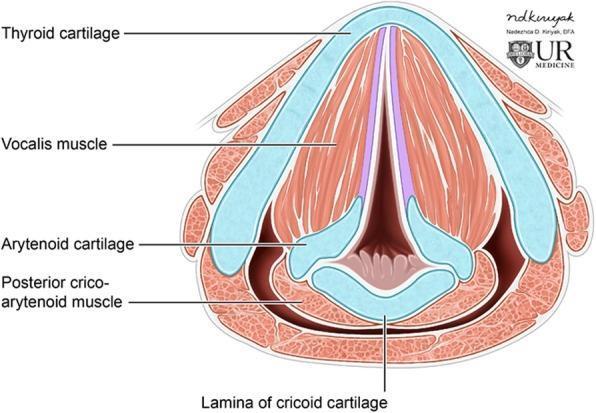
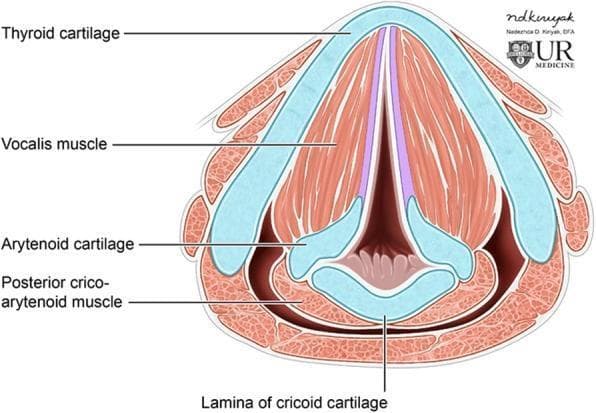
Axial section at the level of the glottis: The V-shaped thyroid cartilage forms the anterior boundary. The cricoid lamina sits posteriorly, supporting the arytenoid cartilages. The true vocal folds extend from the anterior thyroid to the vocal processes. The vocalis muscle runs within each fold, and the posterior cricoarytenoid (PCA) muscles are visible at the posterior cricoid lamina.
Intrinsic Muscles
All intrinsic laryngeal muscles are innervated by the recurrent laryngeal nerve (RLN), except the cricothyroid (external branch of the superior laryngeal nerve).
| Muscle | Action |
|---|---|
| Posterior cricoarytenoid (PCA) | Only abductor of vocal cords — opens rima glottidis |
| Lateral cricoarytenoid (LCA) | Adducts vocal cords |
| Transverse + oblique arytenoids | Adduct arytenoids (close glottis) |
| Thyroarytenoid / vocalis | Shortens and relaxes vocal folds; adducts |
| Cricothyroid | Lengthens and tenses vocal folds (raises pitch) |
The PCA is the only abductor. Bilateral RLN palsy causes both PCA muscles to fail, leaving cords adducted — the classic presentation of stridor and airway compromise.
Extrinsic Muscles
- Suprahyoid group (elevate larynx during swallowing): mylohyoid, geniohyoid, stylohyoid, digastric
- Infrahyoid "strap" muscles (depress larynx): sternohyoid, sternothyroid, omohyoid, thyrohyoid
Ligaments & Membranes
| Structure | Connects | Function |
|---|---|---|
| Thyrohyoid membrane | Thyroid cartilage → hyoid | Suspends larynx from hyoid |
| Cricothyroid membrane (conus elasticus) | Cricoid → thyroid (vocal ligament at top) | Site of cricothyrotomy; transmits sound |
| Quadrangular membrane | Epiglottis → arytenoids | Forms vestibular ligament inferiorly |
| Cricotracheal ligament | Cricoid → first tracheal ring | Connects larynx to trachea |
Nerve Supply
| Nerve | Origin | Supplies |
|---|---|---|
| Superior laryngeal nerve (SLN) | CN X | Internal branch: sensory above cords; External branch: cricothyroid motor |
| Recurrent laryngeal nerve (RLN) | CN X | All other intrinsic muscles (motor) + sensory below cords |
The right RLN loops around the subclavian artery; the left RLN loops under the aortic arch — making it more vulnerable in mediastinal pathology.
Blood Supply & Lymphatics
- Superior laryngeal artery (from superior thyroid artery, branch of ECA) — supplies upper larynx
- Inferior laryngeal artery (from inferior thyroid artery, branch of thyrocervical trunk) — supplies lower larynx
- Lymphatics: supraglottis drains to upper deep cervical nodes; subglottis drains to pretracheal/paratracheal nodes. The glottis is relatively avascular and has sparse lymphatics, which is why glottic carcinomas tend to present early and metastasize late.
This is a shared conversation. Sign in to Orris to start your own chat.