
Actually tomorrow is my psm exam and i dont know about snakebite . Please provide me answer is easy language and easy way i will write in exam without forgeting
snakebite PSM community medicine exam notes management classification India
https://nhm.gov.in/images/pdf/guidelines/nrhm-guidelines/stg…
https://cdn.who.int/media/docs/default-source/searo/india/he…
🐍 SNAKEBITE - Complete PSM Exam Notes
1. INTRODUCTION (1-2 lines for intro paragraph)
- Snakebite is an acute, life-threatening, time-limiting medical emergency
- WHO estimates: 5.4 million bites/year worldwide, 1.8-2.7 million envenomations, 81,000-1,38,000 deaths/year
- India is the world's snakebite capital - highest burden globally
- Around 70% of all snakebites are from NON-venomous snakes (dry bites)
2. THE "BIG FOUR" SNAKES OF INDIA
| Snake | Type | Venom Type |
|---|---|---|
| Spectacled Cobra (Naja naja) | Elapid | Neurotoxic |
| Common Krait (Bungarus caeruleus) | Elapid | Neurotoxic |
| Russell's Viper (Daboia russelli) | Viper | Vasculotoxic (haemotoxic) |
| Saw-scaled Viper (Echis carinatus) | Viper | Vasculotoxic (haemotoxic) |
Memory trick: "Come Kill Russell's Saw" = Cobra, Krait, Russell's, Saw-scaled
3. TWO MAIN TYPES OF SNAKE FAMILIES
| Feature | Elapidae (Cobra, Krait) | Viperidae (Russell's, Saw-scaled) |
|---|---|---|
| Fangs | Short, fixed, front | Long, hinged, front |
| Venom effect | Neurotoxic | Haemotoxic/Vasculotoxic |
| Main danger | Respiratory paralysis | Bleeding, clotting failure |
4. TYPES OF SNAKEBITE PRESENTATION
A) Dry Bite
- Bite from venomous snake but NO venom injected
- ~70% of all bites are non-venomous/dry bites
- Patient may show anxiety symptoms only (palpitations, sweating, tachycardia - these are NOT envenomation)
B) Venomous Bite - 4 Main Clinical Syndromes
| Syndrome | Snake | Key Features |
|---|---|---|
| 1. Neuroparalytic | Cobra, Krait | "5D + 2P" (see below) |
| 2. Vasculotoxic/Haemotoxic | Russell's, Saw-scaled | Bleeding, clotting failure |
| 3. Myotoxic | Sea snakes | Muscle pain, myoglobinuria, renal failure |
| 4. Local tissue swelling | Vipers | Painful progressive swelling, necrosis |
5. NEUROPARALYTIC SYMPTOMS - "5D + 2P" (MOST IMPORTANT!)
5 D's:
- Dyspnea (difficulty breathing)
- Dysphonia (voice becomes soft/less pitch)
- Dysarthria (speech difficulty)
- Diplopia (double vision)
- Dysphagia (difficulty swallowing)
2 P's:
- Ptosis (drooping of eyelids - appears FIRST)
- Paralysis
- Cobra bite: symptoms in 30 min - 6 hours
- Krait bite: symptoms in 6 - 24 hours (ptosis even up to 36 hours!)
6. VASCULOTOXIC/HAEMOTOXIC SYMPTOMS
- Bleeding from gums, nose, bite site, eyes
- Hematuria (blood in urine)
- Incoagulable blood (most important sign)
- Hypotension, shock
- Renal failure
7. KEY DIAGNOSTIC TEST - 20 WBCT (20-Minute Whole Blood Clotting Test)
- Take 2 ml of blood in a clean, dry glass tube (not plastic)
- Leave it undisturbed for 20 minutes
- Tilt the tube at 20 minutes
- Blood does NOT clot in 20 min = Viper bite (vasculotoxic) - give ASV
- Blood clots normally = No vasculotoxic envenomation
This test is a BEDSIDE test - cheap, simple, no lab required. Perfect for rural/PHC settings!
8. FIRST AID - DO's and DON'Ts
DO's:
- Reassure the patient (most bites are non-venomous)
- Immobilize the bitten limb (keep below heart level)
- Remove rings, bangles, tight clothing near bite site
- Transport immediately to hospital
- Mark the swelling edge with pen and note time
DON'Ts (FORBIDDEN - Very important in exam!):
- Do NOT cut and suck the wound
- Do NOT apply tourniquet (causes more necrosis and ischemia)
- Do NOT apply ice
- Do NOT give electric shock
- Do NOT give aspirin (worsens bleeding)
- Do NOT try to kill or catch the snake (risk of second bite)
Pressure immobilization bandage - used ONLY for neurotoxic (elapid) bites in Australia/specialized settings; NOT recommended routinely in India
9. TREATMENT - ANTI-SNAKE VENOM (ASV)
What is ASV?
- Made from horse/sheep plasma hyperimmunized with snake venom
- Indian polyvalent ASV covers the Big Four snakes
- It is an immunoglobulin (F(ab')2 fragments of IgG)
- It is the ONLY specific antidote for snake venom
Indications for ASV (give if ANY ONE present):
- Abnormal 20WBCT (blood not clotting)
- Spontaneous bleeding
- Signs of neuroparalysis (ptosis, paralysis, etc.)
- Hypotension/shock
- Renal failure
- Myoglobinuria (cola-colored urine)
- Rapidly spreading local swelling
ASV Dose (Indian Polyvalent):
| Snake | Initial dose (vials) |
|---|---|
| Cobra (Naja naja) | 10-20 vials |
| Krait (Bungarus caeruleus) | 10-20 vials |
| Russell's Viper (Daboia russelli) | 10 vials |
| Saw-scaled Viper (Echis carinatus) | 5-10 vials |
How to give ASV:
- Always IV route (slow infusion over 1 hour) - NEVER IM injection
- Dilute in normal saline (250-500 ml)
- Keep adrenaline ready before infusion (for anaphylaxis)
Repeat ASV if:
- Blood still incoagulable (20WBCT positive) after 6 hours
- Bleeding continues after 1-2 hours
- Neurological signs worsen after 1 hour
10. SUPPORTIVE TREATMENT
| Problem | Treatment |
|---|---|
| Respiratory paralysis | Intubation + Mechanical ventilation |
| Renal failure | Dialysis |
| Wound necrosis | Surgical debridement |
| Hypotension | IV fluids, vasopressors |
| Pain | Paracetamol (NOT aspirin/NSAIDs) |
| Tetanus | Tetanus toxoid |
- Give neostigmine 0.5-2.5mg IV + atropine 0.6mg IV
- If ptosis improves = neurotoxin is post-synaptic (Cobra) - neostigmine helps
- Krait has pre-synaptic toxin - neostigmine usually does NOT help
11. PSM-SPECIFIC POINTS
| Point | Detail |
|---|---|
| Notification | Snakebite is a notifiable disease in some states (public health importance) |
| Prevention | Protective footwear, avoiding walking barefoot at night in fields |
| High-risk group | Farmers, agricultural workers, people walking at night |
| Common time | Monsoon season, nighttime |
| Habitat | Rural areas, forests, agricultural fields |
| PHC management | Give 10 vials ASV, stabilize, then refer if needed |
| Cold chain | ASV does NOT require cold chain (stable at room temperature) |
| Shelf life | ASV vials have long shelf life |
12. QUICK SUMMARY TABLE FOR REVISION
| Feature | Elapid (Cobra/Krait) | Viper (Russell's/Saw-scaled) |
|---|---|---|
| Venom | Neurotoxic | Haemotoxic |
| 20WBCT | Normal (clots) | Abnormal (does NOT clot) |
| Main symptom | Ptosis, paralysis, respiratory failure | Bleeding, swelling, renal failure |
| First sign | Ptosis (eyelid drooping) | Local pain, swelling |
| ASV dose | 10-20 vials | 5-10 vials |
| Special treatment | Neostigmine + ventilation | Fresh Frozen Plasma (FFP) if needed |
13. MNEMONICS SUMMARY
| To remember | Mnemonic |
|---|---|
| Big Four | Come Kill Russell's Saw (Cobra, Krait, Russell's, Saw-scaled) |
| Neuroparalytic symptoms | 5D + 2P |
| Order of symptoms | Ptosis → Diplopia → Dysarthria → Dysphonia → Dysphagia → Paralysis |
| Don'ts in first aid | No Cut-Suck, No Tourniquet, No Ice, No Electric shock, No Aspirin |
14. ONE-LINE FACTS FOR MCQ/SHORT ANSWER
- Snakebite = notifiable emergency, time-sensitive condition
- 70% bites = non-venomous
- First sign of neuroparalytic bite = Ptosis
- Best bedside test = 20 WBCT
- Specific antidote = ASV (Anti-Snake Venom)
- ASV route = IV only (NOT IM)
- ASV is made from horse/sheep
- Krait bite symptoms can appear up to 36 hours later
- ASV is raised against Big Four in India
- Dry bite = bite with no venom injected
how to difference wheater the snake bite if from krait or cobra??
krait vs cobra bite difference clinical features symptoms India exam
https://journals.lww.com/mjdy/fulltext/2025/12002/clinical_p…
🐍 KRAIT vs COBRA - How to Differentiate?
THE BIG COMPARISON TABLE
| Feature | COBRA (Naja naja) | KRAIT (Bungarus caeruleus) |
|---|---|---|
| Time of bite | Day or night | Night only (nocturnal snake) |
| Bite marks | Usually visible fang marks | Often NO visible fang marks (tiny teeth) |
| Local signs | PRESENT - pain, swelling, redness, necrosis at bite site | ABSENT or minimal - no pain, no swelling |
| Symptom onset | Fast: 30 min - 6 hours | Slow: 6 - 24 hours (ptosis up to 36 hrs!) |
| Type of paralysis | Ascending paralysis | Descending paralysis |
| First sign | Ptosis (drooping eyelids) | Abdominal pain/cramps, then ptosis |
| Abdominal pain | Rare | Very common (classic early symptom) |
| Necrosis at bite site | Yes - tissue death can occur | No |
| Mechanism of toxin | Post-synaptic blockade (blocks acetylcholine receptor) | Pre-synaptic blockade (stops release of ACh) |
| Neostigmine test | Responds (improvement in ptosis) | Does NOT respond (pre-synaptic, so ACh cannot be released even if enzyme is blocked) |
| Paralysis severity | Moderate to severe | Often severe, can cause deep coma |
| History given by patient | Usually tells about bite | Often NO history of bite (bitten in sleep!) |
CLASSIC EXAM SCENARIO - REMEMBER THIS!
"Patient wakes up in the morning, no history of snakebite, no bite marks, has abdominal pain and slowly gets weakness/ptosis"
"Patient comes with painful swelling on hand, bite marks visible, ptosis developing within 2 hours"
WHY THE DIFFERENCE? (The Mechanism - Very Important!)
COBRA = POST-SYNAPTIC toxin (alpha-bungarotoxin-like / cobrotoxin)
- Toxin sits on the acetylcholine receptor and blocks it
- ACh is released normally but cannot bind to the receptor
- Neostigmine (anticholinesterase) → increases ACh in synapse → can overcome the block → patient improves ✅
KRAIT = PRE-SYNAPTIC toxin (beta-bungarotoxin)
- Toxin destroys the nerve terminal that releases ACh
- ACh simply cannot be released at all
- Neostigmine has nothing to work with → patient does NOT improve ❌
Memory trick: "Krait Kills the Kitchen (pre-synaptic = the factory is destroyed). Cobra Chokes the Customer (post-synaptic = the receiver is blocked)"
NEOSTIGMINE TEST (Exam Favourite!)
- Give Neostigmine 1.5mg IM + Atropine 0.6mg IV (atropine prevents muscarinic side effects)
- Wait 20-30 minutes
- Ptosis improves = Cobra bite (post-synaptic, responds)
- No improvement = Krait bite (pre-synaptic, no response)
QUICK 3-POINT SUMMARY TO WRITE IN EXAM
- Local signs: Cobra has them (pain, swelling, necrosis). Krait has NONE.
- Time: Cobra = 30 min to 6 hours. Krait = 6 to 36 hours (patient often wakes up paralyzed with NO bite history).
- Neostigmine: Cobra responds (post-synaptic). Krait does NOT respond (pre-synaptic).
APPEARANCE OF THE SNAKES (bonus - if examiner asks)
| Feature | Cobra | Krait |
|---|---|---|
| Hood | Spreads hood when threatened | No hood |
| Color | Brown/olive, with spectacle mark on back of hood | Black and white banded |
| Size | 1.5 - 2.5 m | Smaller, 0.9 - 1.5 m |
| Activity | Day + night | Strictly nocturnal |
Actually tomorrow is my psm exam and i dont know about difference between karsiworker and marasmus. Please provide me answer is easy language and easy way i will write in exam without forgeting
🍽️ KWASHIORKOR vs MARASMUS - Complete PSM Exam Notes
FIRST - UNDERSTAND THE SIMPLE CONCEPT
Marasmus = Child gets nothing at all (no food, no protein, no calories - total starvation) Kwashiorkor = Child gets some food but almost no protein (eats rice/carbs but no protein)
THE CLINICAL PHOTO (from Robbins Pathology)
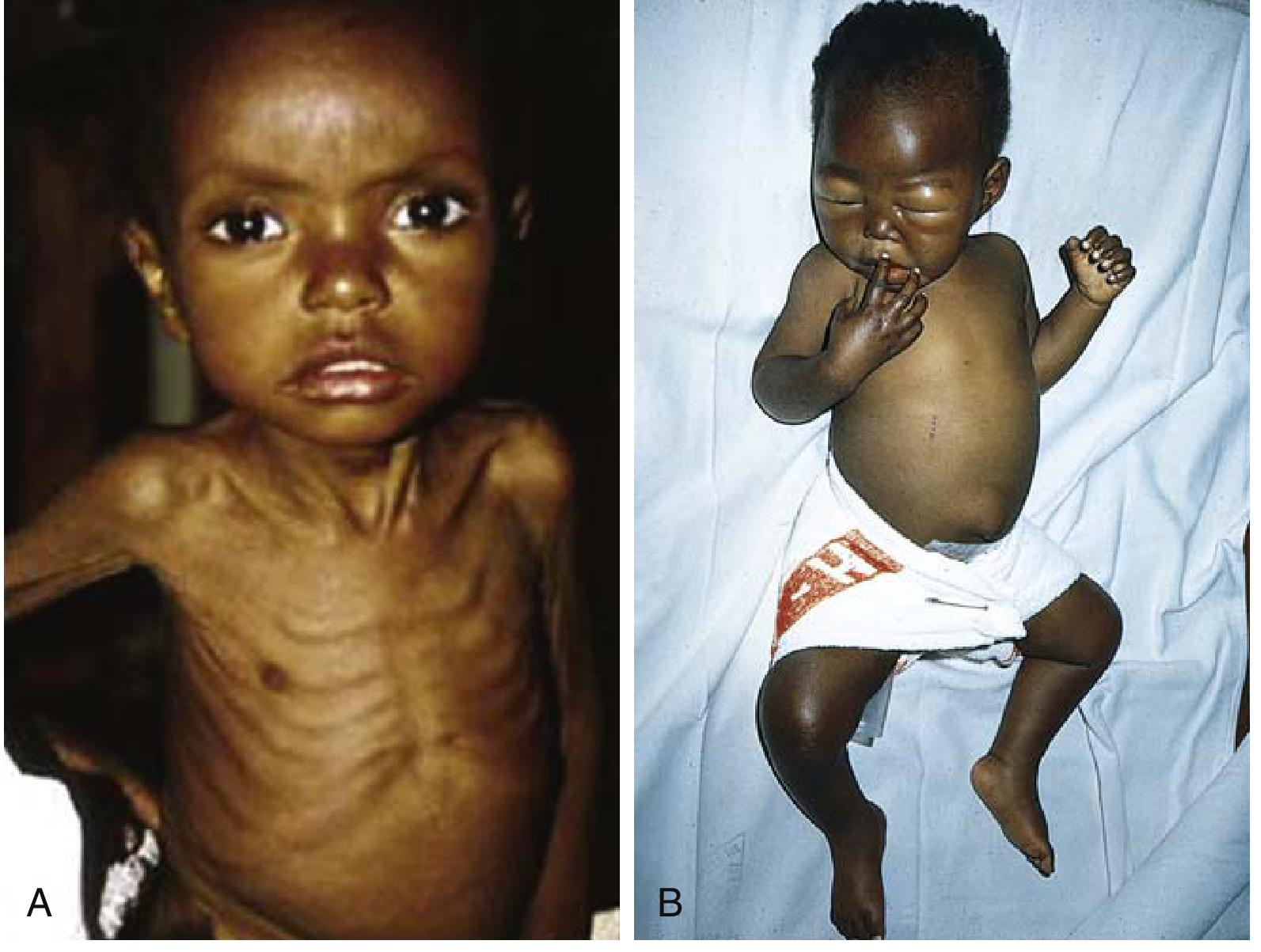
THE BIG COMPARISON TABLE
| Feature | KWASHIORKOR | MARASMUS |
|---|---|---|
| Full name meaning | "Disease of the displaced child" (Ga language, Ghana) - child displaced by new sibling | From Greek "marasmos" = wasting |
| Deficiency | Mainly PROTEIN deficiency (calories may be adequate) | Both PROTEIN + CALORIES deficient (total starvation) |
| Age | Older child: 1 - 5 years (after weaning) | Infant: under 1 year (first year of life) |
| Cause/Story | Child weaned early, given only rice/carbohydrate diet when new baby born | Early cessation of breastfeeding, total food deprivation |
| Body weight | 60-80% of normal (edema masks real weight loss) | Less than 60% of normal (severe wasting) |
| EDEMA | PRESENT (hallmark sign!) - puffy face, hands, legs, ascites | ABSENT |
| Wasting of muscle | Mild (muscle is relatively spared) | Severe - "skin and bones" |
| Subcutaneous fat | Relatively preserved (masked by edema) | Completely gone |
| Face appearance | "Moon face" - puffy, round, swollen | "Old man face" - wrinkled, sunken |
| Skin changes | "Flaky paint" dermatosis - patches of hyperpigmentation + desquamation + hypopigmentation (peeling skin) | Dry, loose, wrinkled skin hanging off bones |
| Hair changes | Flag sign - alternating light and dark bands. Hair becomes thin, soft, easily pluckable, straight, loses color ("hypopigmented") | Sparse, dry, brittle hair |
| Liver | Enlarged + Fatty liver (hepatomegaly due to fatty infiltration - reduced lipoprotein carrier proteins) | Normal size liver |
| Serum albumin | Very LOW (hypoalbuminemia - this causes edema!) | Low/normal (less severe drop) |
| Serum proteins | Severely reduced (visceral protein compartment depleted) | Relatively preserved initially |
| Behaviour/Mood | Apathetic, irritable, miserable, anorexic - child does NOT want to eat | Alert but weak - child looks hungry, wants food |
| Appetite | Poor/lost | Preserved - child wants to eat |
| Immunity | Impaired (secondary infections common) | Impaired (secondary infections common) |
| Prognosis | Worse (more complications) | Slightly better if treated |
THE ONE-LINE TRICK TO REMEMBER EDEMA
"Kwashiorkor has Komedo (edema = swelling)" - both start with similar sounds OR simply: "Kwashiorkor = Kudos (puffy, bloated look)"
- No protein → No albumin made by liver
- No albumin → No oncotic pressure in blood vessels
- Water leaks out of blood into tissues → EDEMA
- Yes, protein is also low, but the body adapts slowly (chronic starvation)
- The body breaks down its own muscle to maintain just enough albumin to prevent edema
KEY FEATURES SIDE BY SIDE (Visual Memory)
MARASMUS                    KWASHIORKOR
-----------                 ------------
Total starvation            Only protein deficient
< 1 year                    1-5 years
Bones visible               Puffy/swollen
"Old man face"              "Moon face"
NO edema                    EDEMA (hallmark!)
NO liver enlargement        Fatty liver +++
Alert, wants food           Apathetic, no appetite
"Bag of bones"              "Bloated child"
Hair: sparse, dry           Hair: flag sign, depigmented
Skin: dry/wrinkled          Skin: "flaky paint" rash
WHY FATTY LIVER IN KWASHIORKOR? (Examiner loves this!)
- No protein available → Cannot make lipoprotein carrier
- Fat gets made but cannot be exported
- Fat accumulates inside liver cells = Fatty liver (hepatic steatosis)
Memory: "Kwashiorkor = K for Kept fat in liver (can't export it)"
MARASMIC-KWASHIORKOR (Mixed Type)
- When features of BOTH are present
- Child has wasting (from marasmus) + edema (from kwashiorkor)
- This is most common type seen in practice
- Also called "Mixed PEM"
- Park says: "Marasmus and kwashiorkor represent two ends of a spectrum, and considerable overlap exists"
PSM-SPECIFIC POINTS (Park's Book)
| Point | Detail |
|---|---|
| Classification used | Wellcome classification (based on weight for age + edema) |
| Diagnosis tool in field | Weight-for-age chart (Road to Health card / growth chart) |
| MUAC (Mid-Upper Arm Circumference) | <12.5 cm = severe malnutrition; 12.5-13.5 = moderate; >13.5 = normal |
| SAM definition | Weight-for-height Z-score < -3SD OR MUAC < 115 mm OR nutritional edema |
| Prevention | Breastfeeding, proper weaning foods, nutrition education, growth monitoring |
| Treatment | F-75 (stabilization phase) → F-100 (rehabilitation phase) therapeutic food |
| Severely wasted child | 9 times more likely to die than well-nourished child |
WELLCOME CLASSIFICATION (Important for MCQ!)
| Weight for age | With Edema | Without Edema |
|---|---|---|
| 60-80% of normal | KWASHIORKOR | Undernutrition |
| < 60% of normal | Marasmic-Kwashiorkor | MARASMUS |
3-LINE EXAM SUMMARY
- Kwashiorkor = Protein deficiency only, age 1-5 yrs, edema + moon face + fatty liver + flaky paint skin + flag sign hair + apathy - child looks puffy but is actually wasted underneath
- Marasmus = Total starvation, under 1 year, NO edema, severe wasting, old man face, bones visible, alert child - child looks like a skeleton
- Key difference = EDEMA - present in Kwashiorkor, ABSENT in Marasmus. And Kwashiorkor has fatty liver, flag sign hair, and flaky paint skin which Marasmus does NOT have.
Create a quick reference PDF summary of Kwashiorkor vs Marasmus for last-minute revision
ls /home/daytona/workspace/ 2>/dev/null || echo "workspace empty or not found"
mkdir -p /home/daytona/workspace/nutrition-pdf
~/nutrition-pdf/generate_pdf.py
from reportlab.lib.pagesizes import A4
from reportlab.lib import colors
from reportlab.lib.styles import getSampleStyleSheet, ParagraphStyle
from reportlab.lib.units import mm, cm
from reportlab.platypus import (
SimpleDocTemplate, Paragraph, Spacer, Table, TableStyle,
HRFlowable, KeepTogether
)
from reportlab.lib.enums import TA_CENTER, TA_LEFT, TA_JUSTIFY
from reportlab.pdfbase import pdfmetrics
from reportlab.pdfbase.ttfonts import TTFont
import os
OUTPUT = "/home/daytona/workspace/nutrition-pdf/Kwashiorkor_vs_Marasmus_QuickRef.pdf"
doc = SimpleDocTemplate(
OUTPUT,
pagesize=A4,
leftMargin=15*mm,
rightMargin=15*mm,
topMargin=12*mm,
bottomMargin=12*mm,
)
W, H = A4
# ── Colour palette ──────────────────────────────────────────────────
C_GREEN = colors.HexColor("#1B7A3E") # Kwashiorkor header
C_ORANGE = colors.HexColor("#C0550A") # Marasmus header
C_BLUE = colors.HexColor("#1A4D8F") # Section titles
C_GOLD = colors.HexColor("#F0A500") # Mnemonic highlight
C_PINK = colors.HexColor("#FFE4EC") # Kwashiorkor row bg
C_PEACH = colors.HexColor("#FFF3E0") # Marasmus row bg
C_LTBLUE = colors.HexColor("#E8F0FB") # Alternating row
C_DKGRAY = colors.HexColor("#2C2C2C")
C_WHITE = colors.white
C_LTGREEN = colors.HexColor("#E6F5EC")
C_LTORANGE= colors.HexColor("#FFF0E6")
# ── Styles ──────────────────────────────────────────────────────────
styles = getSampleStyleSheet()
def S(name, **kw):
return ParagraphStyle(name, **kw)
title_style = S("Title",
fontSize=20, leading=24, alignment=TA_CENTER,
textColor=C_WHITE, fontName="Helvetica-Bold",
spaceAfter=2)
subtitle_style = S("Subtitle",
fontSize=11, leading=14, alignment=TA_CENTER,
textColor=colors.HexColor("#FFE680"), fontName="Helvetica-Oblique",
spaceAfter=4)
section_style = S("Section",
fontSize=12, leading=15, alignment=TA_LEFT,
textColor=C_WHITE, fontName="Helvetica-Bold",
spaceBefore=6, spaceAfter=3,
leftIndent=4, borderPad=4)
body_style = S("Body",
fontSize=8.5, leading=11.5, alignment=TA_LEFT,
textColor=C_DKGRAY, fontName="Helvetica",
spaceBefore=1, spaceAfter=1)
bold_body = S("BoldBody",
fontSize=8.5, leading=11.5, alignment=TA_LEFT,
textColor=C_DKGRAY, fontName="Helvetica-Bold")
mnemonic_style = S("Mnemonic",
fontSize=9, leading=13, alignment=TA_CENTER,
textColor=colors.HexColor("#7A3800"), fontName="Helvetica-BoldOblique",
spaceBefore=2, spaceAfter=2,
backColor=colors.HexColor("#FFF8DC"),
borderColor=C_GOLD, borderWidth=1, borderPad=5)
footer_style = S("Footer",
fontSize=7, leading=9, alignment=TA_CENTER,
textColor=colors.HexColor("#888888"), fontName="Helvetica-Oblique")
cell_hdr = S("CellHdr",
fontSize=9, leading=11, alignment=TA_CENTER,
textColor=C_WHITE, fontName="Helvetica-Bold")
cell_body = S("CellBody",
fontSize=8, leading=10.5, alignment=TA_LEFT,
textColor=C_DKGRAY, fontName="Helvetica")
cell_body_c = S("CellBodyC",
fontSize=8, leading=10.5, alignment=TA_CENTER,
textColor=C_DKGRAY, fontName="Helvetica")
cell_bold_c = S("CellBoldC",
fontSize=8.2, leading=11, alignment=TA_CENTER,
textColor=C_DKGRAY, fontName="Helvetica-Bold")
cell_green = S("CellGreen",
fontSize=8, leading=10.5, alignment=TA_CENTER,
textColor=C_GREEN, fontName="Helvetica-Bold")
cell_orange = S("CellOrange",
fontSize=8, leading=10.5, alignment=TA_CENTER,
textColor=C_ORANGE, fontName="Helvetica-Bold")
# ── Helper to make coloured section header ──────────────────────────
def section_header(text, bg=C_BLUE):
tbl = Table([[Paragraph(text, section_style)]], colWidths=[W - 30*mm])
tbl.setStyle(TableStyle([
("BACKGROUND", (0,0), (-1,-1), bg),
("ROUNDEDCORNERS", [4]),
("TOPPADDING", (0,0), (-1,-1), 5),
("BOTTOMPADDING", (0,0), (-1,-1), 5),
("LEFTPADDING", (0,0), (-1,-1), 8),
]))
return tbl
# ══════════════════════════════════════════════════════════════════
# BUILD CONTENT
# ══════════════════════════════════════════════════════════════════
story = []
# ── TITLE BANNER ────────────────────────────────────────────────────
banner_data = [[
Paragraph("🍽️ KWASHIORKOR vs MARASMUS", title_style),
]]
banner_data.append([
Paragraph("Quick Reference Card — PSM / Community Medicine | Source: Park's PSM + Robbins Pathology", subtitle_style)
])
banner = Table(banner_data, colWidths=[W - 30*mm])
banner.setStyle(TableStyle([
("BACKGROUND", (0,0), (-1,-1), C_BLUE),
("ROUNDEDCORNERS", [6]),
("TOPPADDING", (0,0), (-1,-1), 8),
("BOTTOMPADDING", (0,0), (-1,-1), 8),
("LEFTPADDING", (0,0), (-1,-1), 10),
("RIGHTPADDING", (0,0), (-1,-1), 10),
]))
story.append(banner)
story.append(Spacer(1, 6))
# ── CONCEPT BOX ─────────────────────────────────────────────────────
concept_rows = [
[
Paragraph("KWASHIORKOR", S("kh", fontSize=11, fontName="Helvetica-Bold",
textColor=C_WHITE, alignment=TA_CENTER)),
Paragraph("CONCEPT", S("cc", fontSize=10, fontName="Helvetica-Bold",
textColor=C_DKGRAY, alignment=TA_CENTER)),
Paragraph("MARASMUS", S("mh", fontSize=11, fontName="Helvetica-Bold",
textColor=C_WHITE, alignment=TA_CENTER)),
],
[
Paragraph("Mainly <b>PROTEIN</b> deficient<br/>(some calories present)", cell_body_c),
Paragraph("Deficiency", cell_bold_c),
Paragraph("<b>PROTEIN + CALORIES</b><br/>both deficient (starvation)", cell_body_c),
],
[
Paragraph("Child given only rice/carbs<br/>after weaning from breast", cell_body_c),
Paragraph("Story", cell_bold_c),
Paragraph("Total starvation,<br/>early cessation of breastfeeding", cell_body_c),
],
[
Paragraph("<b>1 – 5 years</b><br/>(after weaning)", cell_green),
Paragraph("Age", cell_bold_c),
Paragraph("<b>< 1 year</b><br/>(infancy)", cell_orange),
],
]
concept_tbl = Table(concept_rows, colWidths=[72*mm, 36*mm, 72*mm])
concept_tbl.setStyle(TableStyle([
("BACKGROUND", (0,0), (0,0), C_GREEN),
("BACKGROUND", (2,0), (2,0), C_ORANGE),
("BACKGROUND", (1,0), (1,0), colors.HexColor("#DDDDDD")),
("BACKGROUND", (0,1), (0,-1), C_LTGREEN),
("BACKGROUND", (2,1), (2,-1), C_LTORANGE),
("BACKGROUND", (1,1), (1,-1), colors.HexColor("#F5F5F5")),
("GRID", (0,0), (-1,-1), 0.5, colors.HexColor("#CCCCCC")),
("TOPPADDING", (0,0), (-1,-1), 5),
("BOTTOMPADDING", (0,0), (-1,-1), 5),
("LEFTPADDING", (0,0), (-1,-1), 6),
("RIGHTPADDING", (0,0), (-1,-1), 6),
("ALIGN", (0,0), (-1,-1), "CENTER"),
("VALIGN", (0,0), (-1,-1), "MIDDLE"),
]))
story.append(concept_tbl)
story.append(Spacer(1, 6))
# ── MAIN COMPARISON TABLE ───────────────────────────────────────────
story.append(section_header("📊 MASTER COMPARISON TABLE"))
story.append(Spacer(1, 3))
headers = [
Paragraph("Feature", cell_hdr),
Paragraph("KWASHIORKOR", S("kh2", fontSize=9, fontName="Helvetica-Bold",
textColor=C_WHITE, alignment=TA_CENTER)),
Paragraph("MARASMUS", S("mh2", fontSize=9, fontName="Helvetica-Bold",
textColor=C_WHITE, alignment=TA_CENTER)),
]
rows = [
["Body Weight", "60–80% of normal (edema masks true loss)", "< 60% of normal (severe wasting)"],
["EDEMA", "✅ PRESENT — hallmark sign!\n(face, legs, ascites)", "❌ ABSENT"],
["Muscle Wasting", "Mild — relatively SPARED", "SEVERE — skin and bones"],
["Subcutaneous Fat", "Relatively preserved (hidden by edema)", "Completely ABSENT"],
["Face", "\"Moon face\" — puffy, round, swollen", "\"Old man face\" — sunken, wrinkled"],
["Skin", "\"Flaky paint\" dermatosis\n(hyper + desquamation + hypopigmentation)", "Dry, loose, wrinkled"],
["Hair", "FLAG SIGN — alternating light & dark bands,\nthin, easily pluckable", "Sparse, dry, brittle"],
["Liver", "✅ ENLARGED — fatty liver (hepatomegaly)", "Normal size"],
["Serum Albumin", "Very LOW (hypoalbuminaemia → edema)", "Low/normal"],
["Behaviour", "Apathetic, irritable, anorexic, miserable", "Alert, looks hungry, wants food"],
["Appetite", "POOR / lost", "PRESERVED"],
["Immunity", "Impaired, secondary infections common", "Impaired, secondary infections common"],
["Prognosis", "Worse — more complications", "Slightly better if treated early"],
]
tbl_data = [headers]
for r in rows:
tbl_data.append([
Paragraph(r[0], bold_body),
Paragraph(r[1], cell_body_c),
Paragraph(r[2], cell_body_c),
])
col_w = [36*mm, 80*mm, 64*mm]
main_tbl = Table(tbl_data, colWidths=col_w)
ts = TableStyle([
# Header row
("BACKGROUND", (0,0), (0,0), C_BLUE),
("BACKGROUND", (1,0), (1,0), C_GREEN),
("BACKGROUND", (2,0), (2,0), C_ORANGE),
("TEXTCOLOR", (0,0), (-1,0), C_WHITE),
("FONTNAME", (0,0), (-1,0), "Helvetica-Bold"),
("FONTSIZE", (0,0), (-1,0), 9),
# Alternating rows
("GRID", (0,0), (-1,-1), 0.4, colors.HexColor("#CCCCCC")),
("TOPPADDING", (0,0), (-1,-1), 4),
("BOTTOMPADDING", (0,0), (-1,-1), 4),
("LEFTPADDING", (0,0), (-1,-1), 5),
("RIGHTPADDING", (0,0), (-1,-1), 5),
("VALIGN", (0,0), (-1,-1), "MIDDLE"),
# EDEMA row highlight
("BACKGROUND", (1,2), (1,2), colors.HexColor("#C8F5D8")),
("BACKGROUND", (2,2), (2,2), colors.HexColor("#FFE0E0")),
("FONTNAME", (0,2), (-1,2), "Helvetica-Bold"),
])
for i in range(1, len(tbl_data)):
if i % 2 == 0:
ts.add("BACKGROUND", (0,i), (0,i), colors.HexColor("#F0F0F0"))
else:
ts.add("BACKGROUND", (0,i), (0,i), colors.HexColor("#FAFAFA"))
main_tbl.setStyle(ts)
story.append(main_tbl)
story.append(Spacer(1, 6))
# ── TWO COLUMN: WHY EDEMA + WHY FATTY LIVER ─────────────────────────
story.append(section_header("🧠 PATHOPHYSIOLOGY (WHY?)"))
story.append(Spacer(1, 3))
edema_text = [
Paragraph("<b>WHY EDEMA in Kwashiorkor?</b>", S("eh", fontSize=9,
fontName="Helvetica-Bold", textColor=C_GREEN, alignment=TA_CENTER)),
Spacer(1, 3),
Paragraph("No protein intake", cell_body_c),
Paragraph("⬇", cell_body_c),
Paragraph("Liver can't make <b>Albumin</b>", cell_body_c),
Paragraph("⬇", cell_body_c),
Paragraph("Low oncotic pressure in blood", cell_body_c),
Paragraph("⬇", cell_body_c),
Paragraph("<b>Water leaks into tissues</b>", cell_body_c),
Paragraph("⬇", cell_body_c),
Paragraph("<b>EDEMA ✅</b>", S("ee", fontSize=9, fontName="Helvetica-Bold",
textColor=C_GREEN, alignment=TA_CENTER)),
]
liver_text = [
Paragraph("<b>WHY FATTY LIVER in Kwashiorkor?</b>", S("lh", fontSize=9,
fontName="Helvetica-Bold", textColor=C_ORANGE, alignment=TA_CENTER)),
Spacer(1, 3),
Paragraph("No protein intake", cell_body_c),
Paragraph("⬇", cell_body_c),
Paragraph("Can't make <b>Lipoprotein carrier</b>", cell_body_c),
Paragraph("⬇", cell_body_c),
Paragraph("Fat made but <b>can't be exported</b>", cell_body_c),
Paragraph("⬇", cell_body_c),
Paragraph("<b>Fat accumulates in liver cells</b>", cell_body_c),
Paragraph("⬇", cell_body_c),
Paragraph("<b>FATTY LIVER ✅</b>", S("fl", fontSize=9, fontName="Helvetica-Bold",
textColor=C_ORANGE, alignment=TA_CENTER)),
]
path_tbl = Table(
[[edema_text, liver_text]],
colWidths=[87*mm, 87*mm]
)
path_tbl.setStyle(TableStyle([
("VALIGN", (0,0), (-1,-1), "TOP"),
("LEFTPADDING", (0,0), (-1,-1), 8),
("RIGHTPADDING", (0,0), (-1,-1), 8),
("TOPPADDING", (0,0), (-1,-1), 6),
("BOTTOMPADDING", (0,0), (-1,-1), 6),
("BACKGROUND", (0,0), (0,0), C_LTGREEN),
("BACKGROUND", (1,0), (1,0), C_LTORANGE),
("GRID", (0,0), (-1,-1), 0.5, colors.HexColor("#CCCCCC")),
]))
story.append(path_tbl)
story.append(Spacer(1, 6))
# ── WELLCOME CLASSIFICATION ──────────────────────────────────────────
story.append(section_header("📋 WELLCOME CLASSIFICATION (Must Know for MCQ!)"))
story.append(Spacer(1, 3))
wc_data = [
[
Paragraph("Weight for Age", cell_hdr),
Paragraph("WITH Edema", cell_hdr),
Paragraph("WITHOUT Edema", cell_hdr),
],
[
Paragraph("60 – 80% of normal", cell_body_c),
Paragraph("KWASHIORKOR", S("wk", fontSize=9, fontName="Helvetica-Bold",
textColor=C_GREEN, alignment=TA_CENTER)),
Paragraph("Undernutrition", cell_body_c),
],
[
Paragraph("< 60% of normal", cell_body_c),
Paragraph("MARASMIC-KWASHIORKOR\n(Mixed)", S("wmk", fontSize=8.5,
fontName="Helvetica-Bold", textColor=C_BLUE, alignment=TA_CENTER)),
Paragraph("MARASMUS", S("wm", fontSize=9, fontName="Helvetica-Bold",
textColor=C_ORANGE, alignment=TA_CENTER)),
],
]
wc_tbl = Table(wc_data, colWidths=[50*mm, 72*mm, 58*mm])
wc_tbl.setStyle(TableStyle([
("BACKGROUND", (0,0), (-1,0), C_BLUE),
("TEXTCOLOR", (0,0), (-1,0), C_WHITE),
("BACKGROUND", (0,1), (-1,1), C_LTGREEN),
("BACKGROUND", (0,2), (-1,2), C_LTORANGE),
("GRID", (0,0), (-1,-1), 0.5, colors.HexColor("#CCCCCC")),
("ALIGN", (0,0), (-1,-1), "CENTER"),
("VALIGN", (0,0), (-1,-1), "MIDDLE"),
("TOPPADDING", (0,0), (-1,-1), 6),
("BOTTOMPADDING", (0,0), (-1,-1), 6),
]))
story.append(wc_tbl)
story.append(Spacer(1, 6))
# ── MUAC + SAM BOX ──────────────────────────────────────────────────
muac_data = [
[
Paragraph("MUAC (Mid-Upper Arm Circumference)", S("mh3",
fontSize=9, fontName="Helvetica-Bold", textColor=C_WHITE,
alignment=TA_CENTER)),
Paragraph("SAM Definition (WHO)", S("sh",
fontSize=9, fontName="Helvetica-Bold", textColor=C_WHITE,
alignment=TA_CENTER)),
],
[
Paragraph(
"• <b>> 13.5 cm</b> → Normal ✅<br/>"
"• <b>12.5 – 13.5 cm</b> → Mild-Moderate malnutrition ⚠️<br/>"
"• <b>< 12.5 cm</b> → Severe malnutrition ❌<br/>"
"• <b>< 11.5 cm</b> → SAM (critical) 🚨",
cell_body),
Paragraph(
"Any ONE of the following:<br/>"
"• Weight-for-height Z-score <b>< −3SD</b><br/>"
"• MUAC <b>< 115 mm</b><br/>"
"• <b>Nutritional oedema</b> present<br/>"
"Severely wasted = <b>9× more likely to die</b>",
cell_body),
]
]
muac_tbl = Table(muac_data, colWidths=[87*mm, 87*mm])
muac_tbl.setStyle(TableStyle([
("BACKGROUND", (0,0), (0,0), C_GREEN),
("BACKGROUND", (1,0), (1,0), C_ORANGE),
("BACKGROUND", (0,1), (0,1), C_LTGREEN),
("BACKGROUND", (1,1), (1,1), C_LTORANGE),
("GRID", (0,0), (-1,-1), 0.5, colors.HexColor("#CCCCCC")),
("VALIGN", (0,0), (-1,-1), "TOP"),
("TOPPADDING", (0,0), (-1,-1), 5),
("BOTTOMPADDING", (0,0), (-1,-1), 5),
("LEFTPADDING", (0,0), (-1,-1), 7),
("RIGHTPADDING", (0,0), (-1,-1), 7),
]))
story.append(muac_tbl)
story.append(Spacer(1, 6))
# ── MNEMONICS ───────────────────────────────────────────────────────
story.append(section_header("💡 MNEMONICS & MEMORY TRICKS", bg=colors.HexColor("#8B4513")))
story.append(Spacer(1, 3))
mn_rows = [
["Kwashiorkor = PUFFY",
"P-Protein def | U-Underweight (60–80%) | F-Fatty liver | F-Flag sign hair | Y-Young 1–5yr"],
["Marasmus = WASTE",
"W-Wasting severe | A-Alert child | S-Subcutaneous fat gone | T-Total starvation | E-Emaciated"],
["K for Kwashiorkor",
"K = Keeps water (edema) | K = keeps fat in liver | K = Kids 1-5yr"],
["Moon face vs Old man",
"Kwashiorkor = MOON face (round, puffy). Marasmus = OLD MAN face (sunken, wrinkled)"],
["Flaky paint skin",
"ONLY Kwashiorkor. Imagine peeling paint on a wall — that's the skin rash pattern"],
["Flag sign",
"ONLY Kwashiorkor. Hair bands = flag stripes. Each band = one episode of protein deficiency"],
]
mn_tbl_data = [[
Paragraph("<b>Mnemonic</b>", cell_hdr),
Paragraph("<b>Meaning</b>", cell_hdr),
]]
for r in mn_rows:
mn_tbl_data.append([
Paragraph(r[0], S("mnk", fontSize=8.2, fontName="Helvetica-Bold",
textColor=colors.HexColor("#5C3A00"))),
Paragraph(r[1], cell_body),
])
mn_tbl = Table(mn_tbl_data, colWidths=[55*mm, 120*mm])
mn_tbl.setStyle(TableStyle([
("BACKGROUND", (0,0), (-1,0), colors.HexColor("#8B4513")),
("TEXTCOLOR", (0,0), (-1,0), C_WHITE),
("BACKGROUND", (0,1), (-1,-1), colors.HexColor("#FFF8DC")),
("GRID", (0,0), (-1,-1), 0.4, colors.HexColor("#DEB887")),
("TOPPADDING", (0,0), (-1,-1), 4),
("BOTTOMPADDING", (0,0), (-1,-1), 4),
("LEFTPADDING", (0,0), (-1,-1), 6),
("RIGHTPADDING", (0,0), (-1,-1), 6),
("VALIGN", (0,0), (-1,-1), "MIDDLE"),
("ROWBACKGROUNDS", (0,1), (-1,-1),
[colors.HexColor("#FFF8DC"), colors.HexColor("#FFF0C0")]),
]))
story.append(mn_tbl)
story.append(Spacer(1, 6))
# ── 3-LINE EXAM SUMMARY ─────────────────────────────────────────────
story.append(section_header("✍️ 3-LINE EXAM SUMMARY (Write this first in your answer!)", bg=C_BLUE))
story.append(Spacer(1, 3))
summary_items = [
("1.", "Kwashiorkor",
"= Mainly PROTEIN deficient, age 1–5 yrs. Key features: EDEMA + Moon face + Fatty liver "
"+ Flaky paint skin + Flag sign hair + Apathy. Child looks puffy but is wasted underneath."),
("2.", "Marasmus",
"= Total starvation (protein + calories), under 1 year. Key features: NO edema, severe wasting, "
"Old man face, bones visible, alert child who wants to eat. Weight < 60% of normal."),
("3.", "Key difference",
"EDEMA — present in Kwashiorkor, absent in Marasmus. "
"Kwashiorkor also has fatty liver, flag sign hair, flaky paint skin which Marasmus does NOT have."),
]
for num, bold, rest in summary_items:
row_data = [[
Paragraph(num, S("sn", fontSize=11, fontName="Helvetica-Bold",
textColor=C_BLUE, alignment=TA_CENTER)),
Paragraph(f"<b>{bold}</b>", S("sk", fontSize=9, fontName="Helvetica-Bold",
textColor=C_BLUE, alignment=TA_CENTER)),
Paragraph(rest, cell_body),
]]
row_tbl = Table(row_data, colWidths=[8*mm, 35*mm, 134*mm])
row_tbl.setStyle(TableStyle([
("VALIGN", (0,0), (-1,-1), "MIDDLE"),
("TOPPADDING", (0,0), (-1,-1), 5),
("BOTTOMPADDING", (0,0), (-1,-1), 5),
("LEFTPADDING", (0,0), (-1,-1), 5),
("BACKGROUND", (0,0), (-1,-1), colors.HexColor("#F0F4FF")),
("LINEBELOW", (0,0), (-1,-1), 0.5, colors.HexColor("#CCCCCC")),
]))
story.append(row_tbl)
story.append(Spacer(1, 5))
# ── FOOTER ──────────────────────────────────────────────────────────
story.append(HRFlowable(width="100%", thickness=0.5, color=colors.HexColor("#AAAAAA")))
story.append(Spacer(1, 2))
story.append(Paragraph(
"Sources: Park's Textbook of Preventive & Social Medicine | Robbins & Kumar Basic Pathology | "
"Harper's Illustrated Biochemistry • Generated by Orris AI for last-minute PSM revision",
footer_style))
# ── BUILD ────────────────────────────────────────────────────────────
doc.build(story)
print(f"PDF created: {OUTPUT}")
Actually tomorrow is my psm exam and i dont know about gamow bag . Please provide me answer is easy language and easy way i will write in exam without forgeting
tomorrow is my icmhe practical exam in the last exam they asked about hopi of vomiting and shortness of breath , what might they ask tommorow apartv from this