
Structure of sphingophispho lipid
Reading File
Finding Sources
Searching Images
sphingomyelin structure diagram sphingosine fatty acid phosphocholine
Reading File
Structure of Sphingophospholipid (Sphingomyelin)
Sphingomyelin is the only physiologically significant sphingophospholipid in humans. Unlike glycerophospholipids, its backbone is not glycerol but the amino alcohol sphingosine.
Building blocks (from core outward):
- Sphingosine - a long-chain (18-carbon) amino alcohol with a trans double bond, forms the structural backbone in place of glycerol.
- Fatty acid (long-chain) - attached via an amide bond to the amino group (C2) of sphingosine. Sphingosine + fatty acid together = ceramide, the core building block of all sphingolipids (and a precursor of glycolipids too).
- Phosphorylcholine - esterified to the terminal hydroxyl group (C1) of sphingosine. This head group (phosphate + choline) is what makes it a phospholipid, distinguishing sphingomyelin from glycolipids (which have a sugar instead of phosphorylcholine at this position).
So structurally: Sphingomyelin = Ceramide (sphingosine + fatty acid via amide bond) + phosphorylcholine (via ester bond at C1)
This gives it an overall amphipathic character similar to glycerophospholipids - a nonpolar tail region (sphingosine's hydrocarbon chain + the attached fatty acid) and a polar head group (phosphate-choline).
Clinical relevance: Sphingomyelin is a major component of the myelin sheath of nerve fibers, essential for its structural integrity and for fast axonal conduction in the CNS.
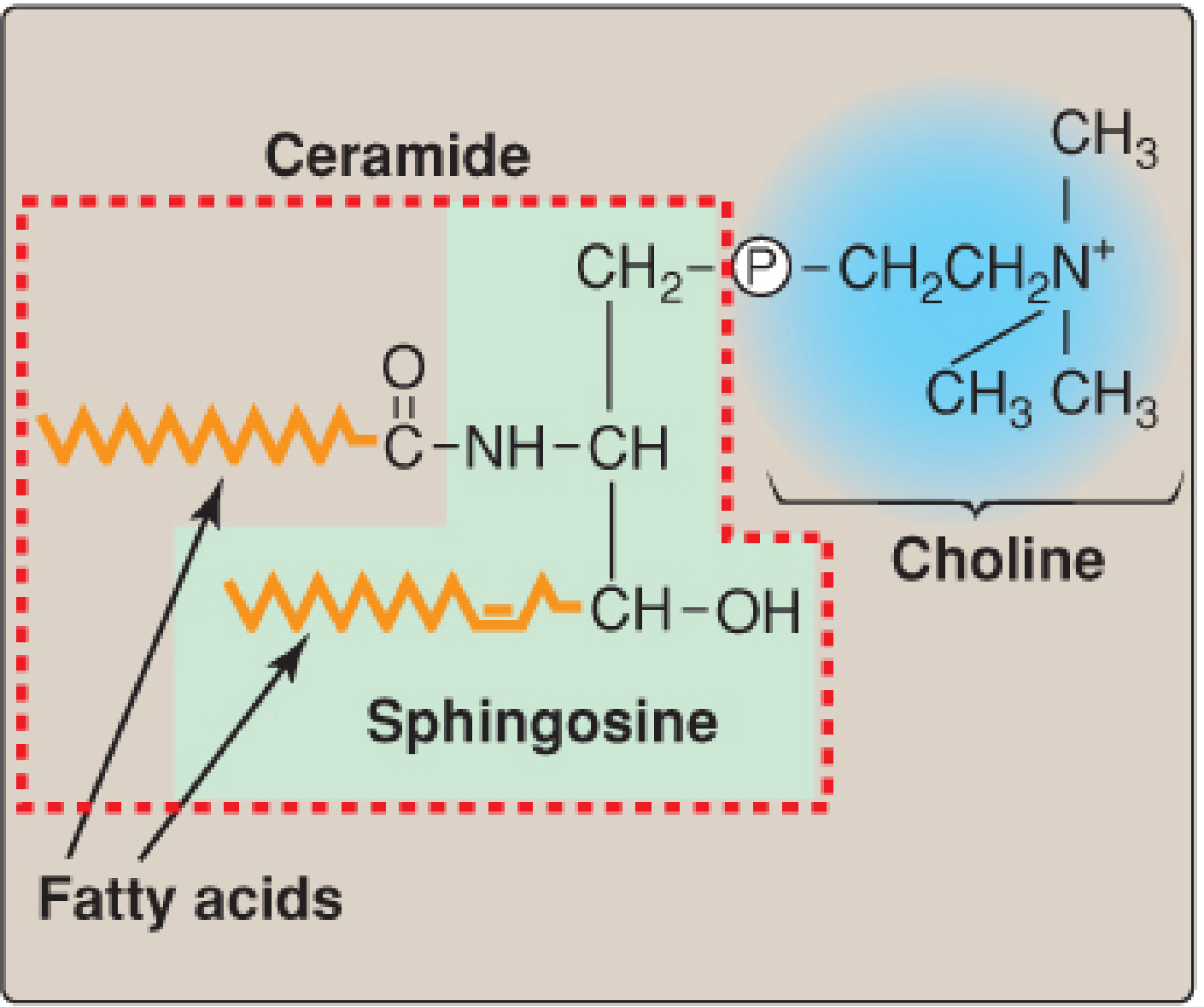
Figure: Structure of sphingomyelin - sphingosine backbone (amine group forms amide with fatty acid to create ceramide), with phosphorylcholine esterified at C1.
- Biochemistry, 8th ed., Lippincott Illustrated Reviews, p. 570-571
This is a shared conversation. Sign in to Orris to start your own chat.