
Vagovagal and myentric reflex
Reading File
The vagovagal reflex involves long reflexes through the vagus nerve (afferent and efferent), while the myenteric (Auerbach's) reflex is a local short reflex within the gut wall. Both coordinate GI motility. Let me pull the textbook content now.
Searching sources...
Finding Sources
Finding Sources
Good hits. Now let me read the key passages from Costanzo (vagovagal) and Guyton (myenteric reflex) for full detail.
Reading File
Reading File
Reading File
I now have rich, authoritative content. Let me also grab the Guyton passage on the myenteric plexus and vagovagal for the ENS section.
Finding Sources
Reading File
I also want the Ganong passage on the myenteric reflex mechanism and the Guyton ENS section.
Reading File
Finding Sources
I now have comprehensive textbook content. Let me fetch the peristalsis diagram from Ganong for visual illustration.
Loading Image
I now have everything needed for a thorough, well-illustrated answer.
Vagovagal Reflex and Myenteric (Peristaltic) Reflex
These are two fundamentally different classes of GI reflex - one is a long reflex routed through the brainstem, the other a short, intrinsic reflex entirely within the gut wall.
1. Vagovagal Reflex
Definition
A vagovagal reflex is one in which both the afferent (sensory) and efferent (motor) limbs are carried entirely in the vagus nerve (CN X). The signal travels up to the brainstem (nucleus tractus solitarius / dorsal motor nucleus of the vagus) and back down, without involving higher cortical processing.
Mechanism
- Stimulus - Mechanical stimulation (distension, pressure) or chemical stimulation of the GI wall activates mechanoreceptors or chemoreceptors in the mucosa/wall.
- Afferent limb - Sensory signals travel via vagal afferent fibers to the nucleus tractus solitarius (NTS) in the medulla.
- CNS integration - The NTS relays to the dorsal motor nucleus of the vagus (DMV), where modulation occurs. The forebrain also modulates vagovagal activity at the brainstem level.
- Efferent limb - Postganglionic parasympathetic signals travel back via vagal efferent fibers to the smooth muscle or glands.
- Neurotransmitter - The postganglionic peptidergic fibers often release VIP (vasoactive intestinal polypeptide), which causes smooth muscle relaxation.
Key Examples
| Example | Stimulus | Response |
|---|---|---|
| Receptive relaxation | Distension of lower esophagus/orad stomach by food bolus | Relaxation of orad stomach wall (accommodates up to 1.5 L); eliminated by vagotomy |
| LES guarding reflex | Increased intragastric pressure | Reflex constriction of the lower esophageal sphincter via vagovagal pathway |
| Gastric acid secretion (gastric phase) | Gastric wall distension by food | Stimulates acid secretion via vagovagal + local ENS reflexes |
| Enteropancreatic reflex | CCK release + intestinal stimuli | Vagovagal enteropancreatic reflex stimulates pancreatic acinar cells |
| PP (pancreatic polypeptide) release | Meal ingestion | Long vagovagal reflex mediates postprandial PP release |
| SGLT1 induction | Luminal sugars in small intestine | Vagovagal reflex induces upregulation of SGLT1 (capsaicin-sensitive) |
Clinical Note
- Vagotomy abolishes vagovagal reflexes, which is why it was historically used to reduce gastric acid secretion (but also impairs receptive relaxation and gastric emptying).
2. Myenteric (Peristaltic) Reflex
Definition
The myenteric reflex (also called the peristaltic reflex or law of the gut) is a short, intrinsic reflex mediated entirely by the Auerbach's (myenteric) plexus within the gut wall. It does NOT require extrinsic innervation (intact even after vagotomy or spinal transection).
Mechanism (Step by Step)
- Stimulus - Distension or stretch of the gut wall (e.g., by a bolus of food).
- Sensory detection - Stretch causes local release of serotonin (5-HT) from enterochromaffin cells, which activates intrinsic primary afferent neurons (IPANs) in the myenteric plexus.
- Interneuron activation - IPANs activate the myenteric plexus circuitry:
- Oral (behind the bolus) - Cholinergic neurons traveling retrograde activate neurons that release substance P and acetylcholine (ACh) → smooth muscle contraction (ascending excitation).
- Aboral (ahead of the bolus) - Cholinergic neurons traveling anterograde activate neurons that release NO and VIP → smooth muscle relaxation (descending inhibition / receptive relaxation).
- Result - The contractile ring behind + relaxation ahead = propulsion of contents in the anal direction at 2-25 cm/s.
This directional bias exists because the myenteric plexus is "polarized" in the anal direction.
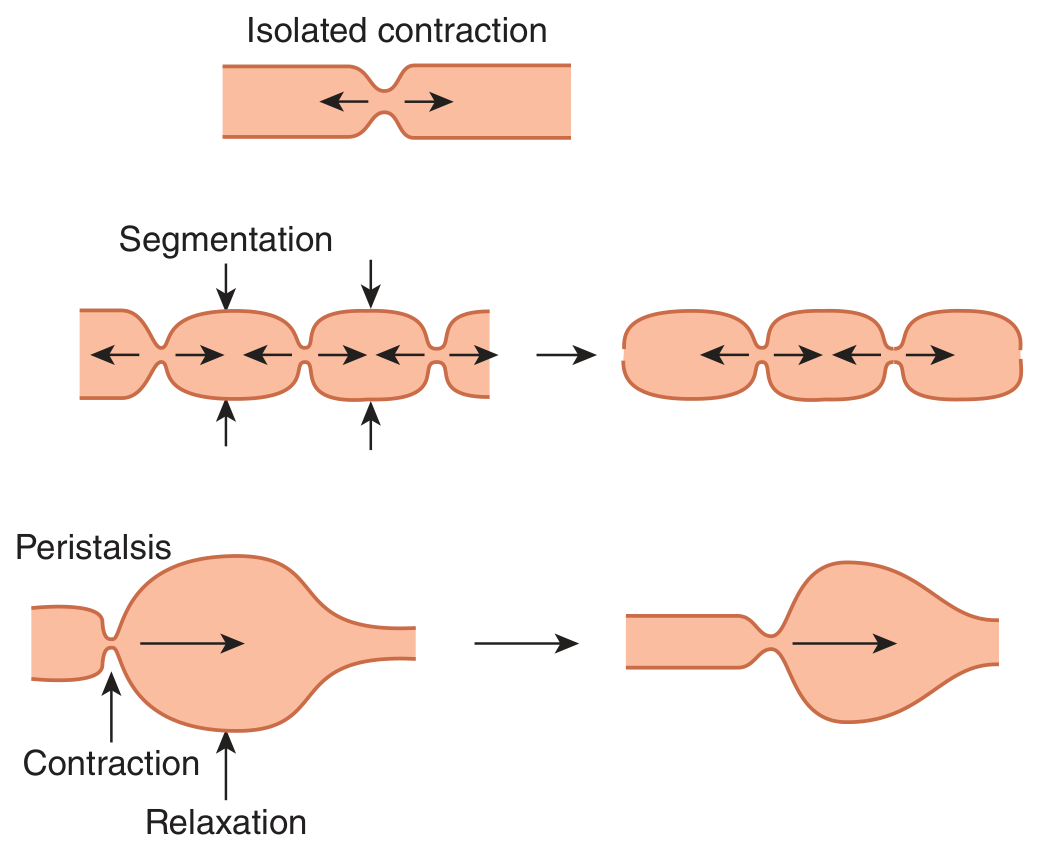
Ganong's Review of Medical Physiology - Segmentation vs. peristalsis. In peristalsis, contraction occurs behind the bolus and relaxation occurs ahead of it.
"Law of the Gut"
The term coined by Guyton: the myenteric reflex + anal direction of movement = "law of the gut." It ensures unidirectional flow of contents from mouth to anus.
Proof of Intrinsic Nature
- Peristalsis is not blocked by removing and re-suturing a segment in its original orientation.
- It IS blocked if the segment is reversed before being sewn back.
- Cutting the myenteric plexus abolishes the complex contraction-relaxation pattern.
- This complex pattern does not occur in the absence of the myenteric plexus.
Myenteric Defecation Reflex (Special Case)
When feces distend the rectum:
- Afferent signals spread through the myenteric plexus → peristaltic waves in descending colon, sigmoid, and rectum.
- Inhibitory signals from the myenteric plexus relax the internal anal sphincter.
- Alone, this reflex is relatively weak.
- It must be fortified by the parasympathetic defecation reflex (via sacral spinal cord, S2-S4, pelvic nerves) to be fully effective.
Comparison: Vagovagal vs. Myenteric Reflex
| Feature | Vagovagal Reflex | Myenteric Reflex |
|---|---|---|
| Type | Long reflex (extrinsic) | Short reflex (intrinsic) |
| Arc | Gut → vagus → brainstem → vagus → gut | Entirely within gut wall (ENS) |
| Center | Medulla (NTS + DMV) | Myenteric (Auerbach's) plexus |
| Afferent | Vagal sensory fibers (CN X) | IPANs in myenteric plexus |
| Efferent | Vagal parasympathetic fibers | Motor neurons of myenteric plexus |
| Key neurotransmitter | VIP (efferent, for relaxation); ACh | ACh, substance P (excitation); NO, VIP (inhibition) |
| Abolished by vagotomy? | Yes | No |
| Example | Receptive relaxation, LES guarding | Peristalsis, defecation (myenteric component) |
| Modifiable by CNS? | Yes (forebrain modulates at brainstem) | Yes (autonomics modulate rate/force, but not the reflex itself) |
Sources:
- Costanzo Physiology, 7th ed., p. 357 - vagovagal reflex and receptive relaxation
- Guyton and Hall Textbook of Medical Physiology - myenteric/peristaltic reflex, law of the gut, defecation reflexes
- Ganong's Review of Medical Physiology, 26th ed. - peristalsis mechanism, serotonin, ACh, NO, VIP, substance P
This is a shared conversation. Sign in to Orris to start your own chat.