
Principle of Snellen chart
Reading File
The Snellen chart is the standard tool for measuring visual acuity, based on the principle that a normal eye can resolve detail subtending 1 minute of arc at the nodal point of the eye. Let me search the textbooks for detailed content.
Searching sources...
Finding Sources
Finding Sources
Kanski's Clinical Ophthalmology has a dedicated section. Let me read it along with Adams & Victor and Rosen's for comprehensive coverage.
Reading File
Reading File
Reading File
Excellent content gathered. Let me also fetch the Snellen chart image to include in the answer.
Loading Image
Here is a full explanation of the principle of the Snellen chart, drawn from the textbooks:
Principle of the Snellen Chart
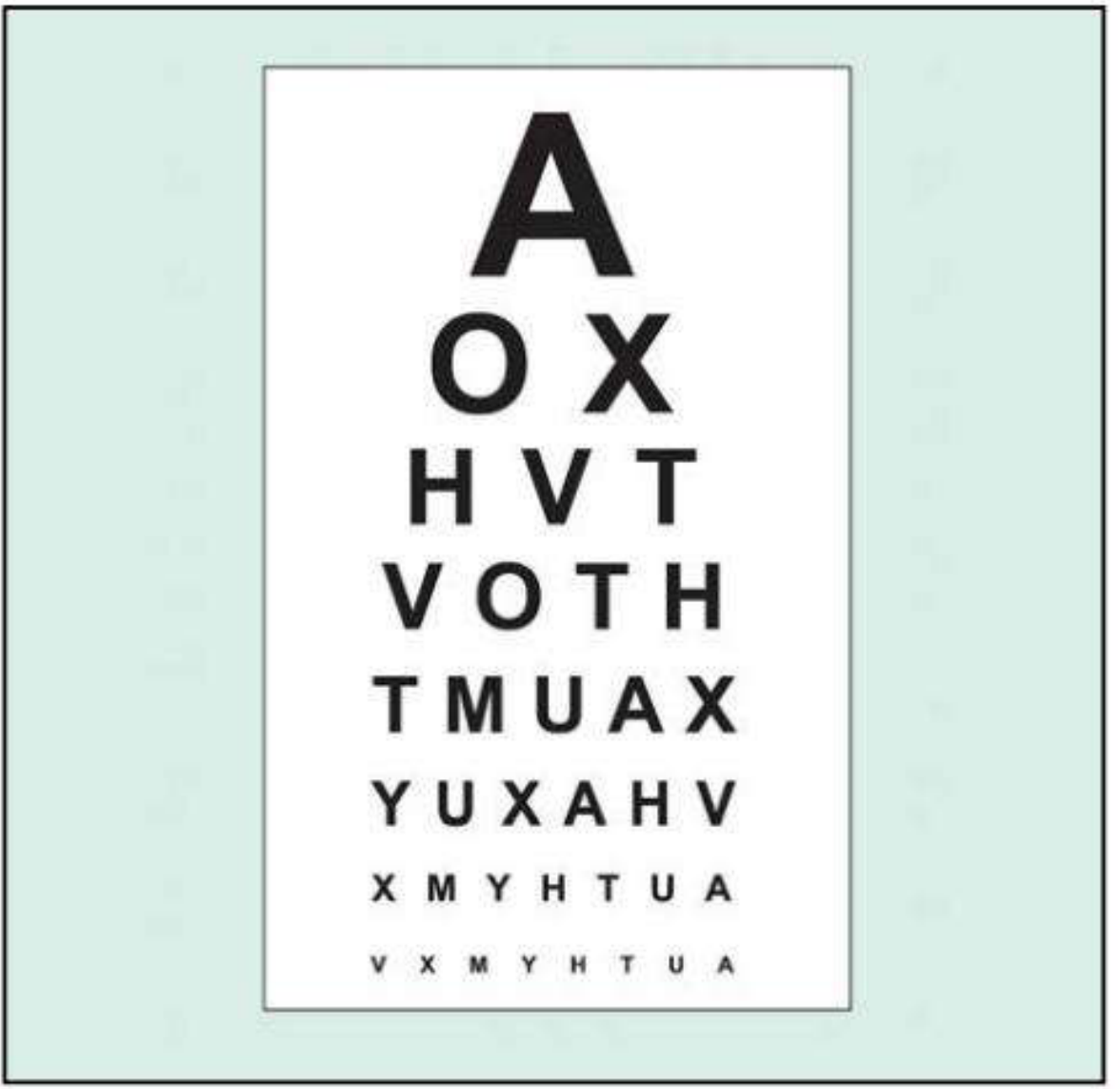
Core Optical Principle: Minimum Angle of Resolution (MAR)
Distance visual acuity (VA) is directly related to the minimum angle of separation (subtended at the nodal point of the eye) between two objects that allow them to be perceived as distinct. A normal eye can resolve two points that subtend 1 minute of arc at the nodal point of the eye. This is the fundamental basis of the Snellen chart.
- Kanski's Clinical Ophthalmology, 10th ed.
Design of the Chart
-
The chart uses black letters or symbols (optotypes) of progressively decreasing sizes set against a white background.
-
The top letter on the chart is designed to subtend 5 minutes of arc at a distance of 200 feet (approximately 60 m).
-
Each subsequent row contains letters that subtend 5 minutes of arc at progressively shorter distances (200 ft, 100 ft, 70 ft, 50 ft, 40 ft, 30 ft, 20 ft, 15 ft, etc.).
-
Each individual stroke or gap within a letter subtends 1 minute of arc at the designed distance. The letter as a whole fits within a 5 x 5 minute-of-arc grid.
-
Adams and Victor's Principles of Neurology, 12th ed.
How VA is Expressed (Snellen Fraction)
VA is recorded as a non-mathematical fraction:
VA = Test distance / Distance at which the letter subtends 5' of arc
| Notation | Meaning |
|---|---|
| 20/20 (or 6/6) | Normal vision - at 20 ft, patient reads what a normal eye reads at 20 ft |
| 20/200 (or 6/60) | At 20 ft, patient reads only what a normal eye reads at 200 ft |
| 20/15 | Better than normal - reads at 20 ft what most read at 15 ft |
- The standard testing distance is 20 feet (6 metres).
- Normal corrected VA in young adults is often better than 6/6.
- 20/200 (6/60) is the legal threshold for blindness.
Testing Protocol
- Each eye is tested separately, with the fellow eye carefully occluded.
- The eye with worse vision is tested first.
- The patient wears their distance correction (glasses/contacts) for the primary test. An unaided (uncorrected) VA is also recorded for completeness.
- The patient should be pushed to read every letter possible.
- Best-corrected VA (BCVA) = acuity achieved with optimal refractive correction.
Pinhole Test
If VA is less than 6/6, the test is repeated using a pinhole aperture (an opaque occluder with one or more holes of ~1 mm diameter):
-
The pinhole allows only a narrow shaft of light to fall on the fovea, eliminating the blur caused by defocused peripheral rays.
-
If VA improves with pinhole: the reduced vision is due to a refractive error or optical media defect (cornea, lens, aqueous, vitreous) - not a neurological cause.
-
If VA does not improve (or worsens): suggests macular disease, posterior lens opacities, or a neural/retinal problem.
-
Kanski's Clinical Ophthalmology, 10th ed.; Adams and Victor's Principles of Neurology, 12th ed.
When Chart Reading is Not Possible
For patients who cannot read chart letters, qualitative testing is used (in descending order of function):
| Level | Abbreviation | Definition |
|---|---|---|
| Counting Fingers | CF | Can count fingers held at a specified distance (usually 1 m) |
| Hand Movements | HM | Can detect whether the examiner's hand is moving |
| Perception of Light | PL | Can only detect the presence/direction of a light source |
| No Perception of Light | NPL | Completely blind |
Variants of the Snellen Chart
| Chart | Use |
|---|---|
| Standard Snellen | Literate adults and children (age 4-6+) |
| Tumbling E chart | Pre-literate children or non-English speakers (patient indicates direction of letter E) |
| Allen picture chart | Young children who cannot read |
| Rosenbaum card | Near vision testing at 14 inches (bedside) |
| Jaeger card | Near VA bedside test; J1 = 20/20, J7 = 20/50, J13 = 20/100, J16 = 20/200 |
| Teller acuity cards | Infants - uses preferential looking at striped patterns |
Summary of Key Numbers
| Parameter | Value |
|---|---|
| Testing distance | 20 ft (6 m) |
| Normal VA | 20/20 (6/6) |
| Each letter subtends | 5 minutes of arc |
| Each stroke/gap subtends | 1 minute of arc (at the designated distance) |
| Top letter readable by normal eye at | 200 ft (60 m) |
| Legal blindness threshold | 20/200 (6/60) |
| Nodal point of the eye | ~7 mm posterior to the cornea |
- Kanski's Clinical Ophthalmology, 10th ed.; Adams and Victor's Principles of Neurology, 12th ed.; Rosen's Emergency Medicine
This is a shared conversation. Sign in to Orris to start your own chat.