
Rombergs sign
Reading File
Finding Sources
Searching Images
Romberg sign neurological test
Reading File
Reading File
Romberg Sign
Definition
The Romberg sign is a clinical test of proprioception and posterior column integrity. It is positive when a patient who can stand steadily with feet together and eyes open becomes markedly unsteady or falls when the eyes are closed.
The key criterion for a true positive is a marked discrepancy between balance with eyes open versus closed. The most certain indication of abnormality is the need to step sideways or backward to avoid falling. Normal individuals may sway slightly with eyes closed — this does not constitute a positive sign.
— Adams and Victor's Principles of Neurology, 12th Ed.
Mechanism
Balance depends on three inputs:
- Proprioception (posterior columns / large sensory fibers)
- Vision
- Vestibular input
When the eyes are open, vision compensates for defective proprioception. Closing the eyes removes this compensation, unmasking the deficit.
A positive Romberg sign indicates that at least two of the three balance systems are impaired — typically proprioception plus vestibular input — and that vision was the compensatory mechanism keeping the patient upright.
How to Perform
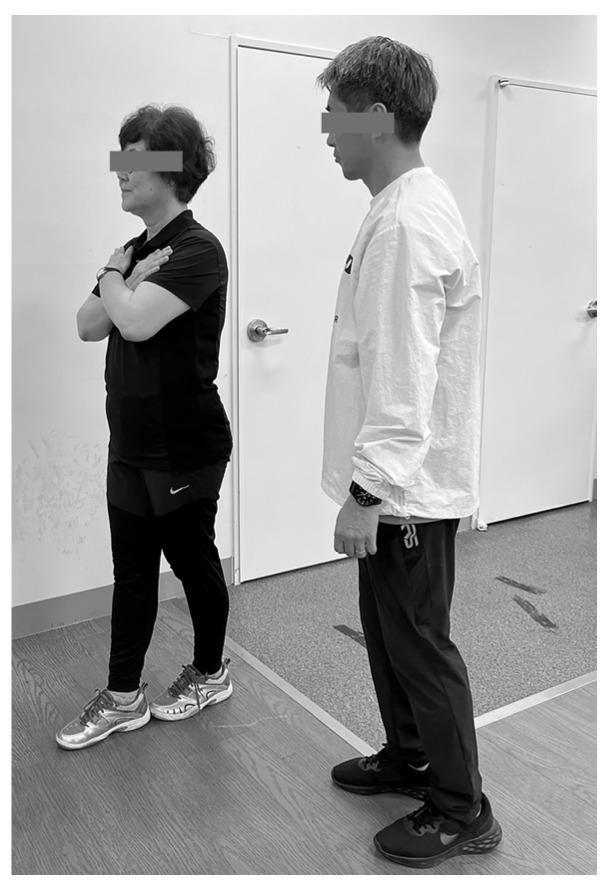
- Ask the patient to stand with feet together (narrowly spaced) and arms at the side or outstretched.
- Observe steadiness with eyes open — the posture should be easily maintained.
- Ask the patient to close their eyes.
- Observe for marked increase in sway, stepping out, or falling.
A useful maneuver to check for factitious unsteadiness: ask the patient to alternately touch their nose while standing with eyes closed. Patients with true proprioceptive deficits worsen when gaze is diverted from the ground; those with factitious unsteadiness typically remain stable.
— Adams and Victor's Principles of Neurology, 12th Ed.
Interpretation
| Result | Meaning |
|---|---|
| Positive (worsens on eye closure) | Sensory ataxia — posterior column disease, peripheral neuropathy, or vestibular dysfunction |
| Negative (little or no change on eye closure) | Motor/cerebellar ataxia — problem localizes to the cerebellum |
— Tintinalli's Emergency Medicine
Causes of a Positive Romberg Sign
| Category | Examples |
|---|---|
| Posterior column disease | Subacute combined degeneration (B12 deficiency), tabes dorsalis (neurosyphilis), multiple sclerosis |
| Peripheral neuropathy | Diabetic neuropathy, Charcot–Marie–Tooth, GBS |
| Vestibular dysfunction | Bilateral vestibular hypofunction |
| Posterior spinal root disease | Tabes dorsalis (the original indication — loss of proprioception from lumbosacral posterior roots) |
The sign was originally described by Moritz Romberg specifically to diagnose tabes dorsalis, though any defect in proprioception (peripheral neuropathy, myelopathy, or vestibulopathy) can produce it.
Romberg vs. Cerebellar Ataxia
A critical distinction:
- Cerebellar ataxia — patient is already unsteady with eyes open; closing the eyes does not significantly worsen the ataxia → Romberg negative
- Sensory/proprioceptive ataxia — patient compensates with vision; closing eyes dramatically worsens balance → Romberg positive
The classic tabetic gait: wide-based, high-stepping, patient stares at the ground to use visual compensation, and is unable to walk in darkness.
Lorazepam gait abnormalities
Finding Sources
Reading File
Finding Sources
Reading File
Reading File
Lorazepam & Gait Abnormalities
Mechanism
Lorazepam is a benzodiazepine that potentiates GABA-A receptor activity, producing CNS depression. Its effects on gait are primarily mediated through:
- Cerebellar and brainstem depression → disrupts motor coordination and balance
- Sedation and slowed psychomotor reaction time → impairs the rapid postural corrections needed for steady gait
- Muscle relaxation (hypotonia) → reduces postural tone
- Impaired visual processing and spatial orientation → compounds balance deficits
Specific Gait/Motor Effects
| Effect | Notes |
|---|---|
| Ataxia | Most characteristic — wide-based, unsteady gait; occurs in <2% at therapeutic doses but increases with dose and age |
| Impaired balance | Difficulty maintaining upright posture; particularly pronounced on tandem or narrow-base walking |
| Dizziness | Contributes to unsteadiness (<1% at therapeutic doses) |
| Slowed reaction time | Impairs compensatory stepping and postural reflexes |
| Dysarthria | Slurred speech accompanies severe ataxia |
| Hyporeflexia | Part of generalized CNS/neuromuscular depression |
Benzodiazepine intoxication classically presents with: confusion, slurred speech, ataxia, drowsiness, and hyporeflexia.
— Kaplan & Sadock's Synopsis of Psychiatry
Elevated Risk in the Elderly
This is a major clinical concern. In older patients, lorazepam (and benzodiazepines generally) cause disproportionate gait impairment due to several pharmacokinetic and pharmacodynamic changes:
- Increased volume of distribution (higher adipose-to-lean ratio) → prolonged half-life and drug accumulation
- Decreased plasma proteins → higher free (active) drug fraction
- Reduced hepatic and renal clearance → slower elimination
- Greater CNS receptor sensitivity (pharmacodynamic aging)
Note: Lorazepam and oxazepam are less affected by age-related pharmacokinetic changes than longer-acting benzodiazepines (e.g. diazepam), because they undergo direct glucuronidation without active metabolites. However, pharmacodynamic sensitivity still increases.
Falls and fractures (particularly hip fractures — at least 50% increased risk) are a direct consequence of gait impairment. Falls are more frequent with chronic benzodiazepine use.
The American Geriatrics Society Beers Criteria strongly recommends avoiding benzodiazepines in older adults, especially those with cognitive impairment.
— Kaplan & Sadock's Comprehensive Textbook of Psychiatry; Katzung's Basic & Clinical Pharmacology, 16th Ed.
Potentiation
Gait abnormalities are markedly worsened when lorazepam is combined with:
- Alcohol
- Other sedatives/CNS depressants
- Opioids
These combinations can cause marked drowsiness, disinhibition, and respiratory depression in addition to severe ataxia.
Clinical Pearl
A positive Romberg sign can be seen with lorazepam/benzodiazepine intoxication due to vestibular suppression, but the more prominent finding is a cerebellar-pattern ataxia — wide-based gait that does not significantly worsen on eye closure (Romberg-negative pattern), reflecting motor rather than pure sensory ataxia. At higher doses, however, both patterns may overlap.
This is a shared conversation. Sign in to Orris to start your own chat.