
Chemical carcinogenesis for essay in pathology
Reading File
Now let me search the medical library for chemical carcinogenesis content in parallel.
Finding Sources
Finding Sources
Robbins Pathologic Basis of Disease has the most dedicated coverage. Let me read the relevant sections in parallel.
Reading File
Reading File
Reading File
Excellent content from Robbins. Let me read the detailed mechanism sections more completely.
Reading File
Finding Sources
Finding Sources
Let me read more of the Robbins detailed mechanism section and also get the diagram image.
Reading File
Reading File
Loading Image
I now have comprehensive content. Let me also get the Robbins Basic Pathology section on mechanisms more fully, and search for specific carcinogen examples.
Reading File
Finding Sources
I now have all the key content needed for a comprehensive essay. Let me compile the full essay on chemical carcinogenesis.
Chemical Carcinogenesis
Introduction
Chemical carcinogenesis refers to the process by which exposure to chemical agents induces malignant transformation of cells through genetic damage. More than 200 years ago, the London surgeon Sir Percival Pott first recognized this relationship when he attributed scrotal skin cancer in chimney sweeps to chronic exposure to soot - a landmark observation in the history of oncology. Subsequently, hundreds of chemicals have been demonstrated to be carcinogenic in animal models, and many are now confirmed human carcinogens.
Chemical carcinogenesis is fundamentally a multistep process, encompassing initiation, promotion, and progression. The stages were first formally characterized in classic experiments on mouse skin.
Classification of Chemical Carcinogens
Chemical carcinogens are broadly divided into two categories based on whether they require metabolic activation.
1. Direct-Acting Carcinogens
Direct-acting agents do not require metabolic conversion to become carcinogenic. They react directly with cellular macromolecules. Most are relatively weak carcinogens, but several are clinically important because they are used as cancer chemotherapy drugs.
Examples:
- Alkylating agents: β-propiolactone, dimethyl sulfate, diepoxybutane, anticancer alkylating drugs (cyclophosphamide, chlorambucil, nitrosoureas)
- Acylating agents: 1-acetyl-imidazole, dimethylcarbamoyl chloride
A critical clinical caveat: alkylating agents used to treat certain cancers (e.g., Hodgkin lymphoma, leukemia, breast carcinoma) can themselves induce a second malignancy - most commonly acute myeloid leukemia. The risk is low but real, and demands judicious use.
2. Indirect-Acting Carcinogens (Procarcinogens)
The majority of chemical carcinogens are indirect-acting - they are biologically inert until metabolized to reactive intermediate forms called ultimate carcinogens. This metabolic activation is primarily mediated by cytochrome P-450-dependent monooxygenases (particularly CYP enzymes). Because these enzymes are highly polymorphic, individual susceptibility to chemical carcinogenesis varies significantly based on the specific enzyme variants inherited. This is the basis of pharmacogenomic risk assessment for cancer.
Major classes of indirect-acting carcinogens:
| Class | Examples | Associated Cancers |
|---|---|---|
| Polycyclic aromatic hydrocarbons (PAHs) | Benzo[a]pyrene, dibenz[a,h]anthracene, 3-methylcholanthrene | Lung, skin |
| Aromatic amines and azo dyes | β-naphthylamine (2-naphthylamine), benzidine, 2-acetylaminofluorene, butter yellow | Bladder, liver |
| Natural products | Aflatoxin B1 (Aspergillus), griseofulvin, cycasin | Hepatocellular carcinoma |
| Nitrosamines | Nitrosamines (from nitrites + dietary amines) | Gastric, esophageal |
| Others | Vinyl chloride, nickel, chromium, arsenic, polychlorinated biphenyls | Liver angiosarcoma, lung, skin |
Key example - Polycyclic Aromatic Hydrocarbons: Benzo[a]pyrene, the active component of soot (the same agent Pott implicated), is formed during high-temperature combustion of tobacco and is a major carcinogen in cigarette smoke. It is also produced when animal fats are broiled or grilled, and is present in smoked meats and fish. In the body, benzo[a]pyrene undergoes CYP-mediated metabolism to epoxides, which form covalent adducts with DNA, RNA, and proteins.
Key example - Aromatic amines: β-Naphthylamine, used extensively in the aniline dye and rubber industries, caused a 50-fold increased incidence of bladder cancer in exposed workers before its carcinogenicity was recognized.
Key example - Aflatoxin B1: Produced by certain strains of Aspergillus flavus growing on improperly stored grains and nuts (peanuts, corn). There is a strong geographic correlation between dietary aflatoxin levels and incidence of hepatocellular carcinoma in sub-Saharan Africa and Southeast Asia. Aflatoxin characteristically produces a G:C→T:A transversion at codon 249 of TP53, causing an arginine-to-serine substitution that impairs p53 tumor suppressor function. Detection of this specific mutation serves as a molecular fingerprint of aflatoxin exposure.
Mechanism of Action: Initiation, Promotion, and Progression
Step 1 - Initiation
Initiation results from the permanent, irreversible alteration of DNA following exposure of cells to a sufficient dose of a carcinogenic agent. All initiating carcinogens share a common biochemical property: they contain or are converted to highly reactive electrophilic groups (electron-deficient atoms) that attack nucleophilic sites (electron-rich atoms) in DNA, particularly guanine residues.
This interaction produces DNA adducts - covalent bonds between the carcinogen and DNA bases. If not repaired (or if repaired incorrectly via error-prone repair mechanisms), these adducts result in permanent mutations. The cell then passes these DNA lesions to daughter cells through normal replication.
Key points about initiation:
- Causes permanent DNA damage (mutations)
- Is irreversible - even long dormant periods do not reverse initiation
- Requires only a single, sufficient exposure
- Does not by itself produce cancer
- There is no apparent predisposition for initiators to mutate specific genes; mutations occur throughout the genome, but cells that happen to sustain damage to oncogenes (RAS) or tumor suppressors (TP53) gain a selective advantage
Step 2 - Promotion
Promoters are agents that stimulate the proliferation of initiated (mutated) cells, but are not themselves tumorigenic or mutagenic. Classic experimental promoters include phorbol esters (e.g., TPA - 12-O-tetradecanoylphorbol-13-acetate), phenols, hormones, and certain drugs.
Key points about promotion:
- Promoters are not mutagenic by themselves
- Promotion is reversible - if the promoter is withdrawn early, proliferation ceases and tumor development may not occur
- Repeated or sustained exposure to the promoter must follow initiation to be effective
- The primary mechanism is induction of cell proliferation and clonal expansion of initiated cells
- As the initiated clone proliferates under the influence of the promoter, cells accumulate additional mutations that eventually lead to a fully malignant phenotype
The dominant effect of promoters is stimulation of cell proliferation - this is the sine qua non of tumor promotion. While the initiating mutation may activate an oncogene like RAS, the promoter drives clonal expansion of that cell, allowing the accumulation of further mutations required for full malignant transformation.
Step 3 - Progression
The expanded preneoplastic clone acquires further genetic alterations (through continued mitotic errors and possible additional carcinogen exposures), leading to emergence of a malignant clone with all the hallmarks of cancer: autonomous growth, invasiveness, metastatic potential, and resistance to apoptosis.
The classic sequence is:
Carcinogen → Electrophilic intermediate → DNA adducts → Permanent DNA lesion (Initiated cell) → Promoter exposure → Preneoplastic clone → Further mutations → Malignant clone
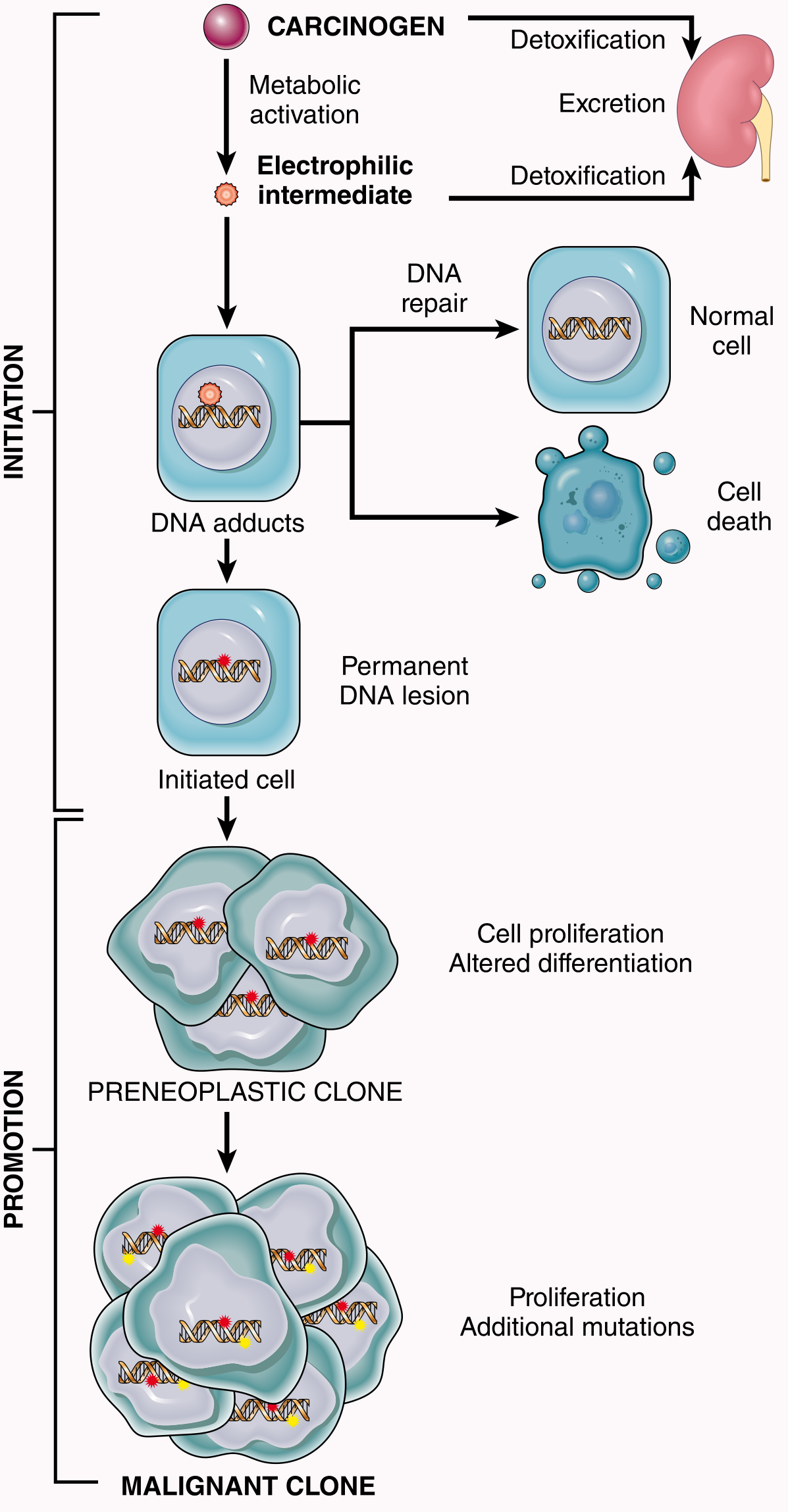
Fig. 7.43 - Robbins Pathologic Basis of Disease: Initiation and promotion of cancer by chemical carcinogens
Molecular Targets of Chemical Carcinogens
Because malignant transformation results from mutations, it is unsurprising that most chemical initiating agents are mutagenic and target DNA. However, there is no single universal alteration - the mutational landscape is broad. Cells that sustain damage to key oncogenes and tumor suppressors by chance gain a selective growth advantage.
Importantly, some carcinogens produce mutational signatures - characteristic patterns of base substitutions that serve as molecular fingerprints of specific exposures:
- Aflatoxin B1: G:C→T:A transversion at TP53 codon 249 → hepatocellular carcinoma
- Cigarette smoke carcinogens: Lung cancers in smokers carry a 10-fold higher mutational burden than those in non-smokers, with characteristic base substitution patterns
- UV light: Pyrimidine dimer-associated C→T transitions at dipyrimidine sites
- Cancer genome sequencing has revealed dozens of distinct mutational signatures, several reflecting chemotherapy exposure; many others remain unexplained, suggesting undiscovered environmental carcinogens
Role of Metabolic Activation and Cytochrome P-450
Most indirect carcinogens are metabolized by cytochrome P-450 monooxygenases (particularly CYP1A1, CYP1A2, CYP2E1) to form reactive electrophilic intermediates. The degree to which a procarcinogen is converted to its ultimate carcinogenic form depends on the balance between:
- Activation pathways - CYP-mediated oxidation to electrophilic intermediates
- Detoxification pathways - Conjugation reactions (glucuronidation, glutathione conjugation, sulfation) that render the metabolite water-soluble and promote excretion
Because the genes encoding these enzymes are highly polymorphic, individuals vary substantially in their capacity to activate or detoxify carcinogens. This explains why not all smokers develop lung cancer, and has led to interest in genetic risk profiling based on CYP polymorphism analysis.
Tumor Promoters in Human Disease
Several clinical situations can be understood through the lens of tumor promotion:
- Unopposed estrogen stimulates endometrial and breast epithelial proliferation, promoting carcinogenesis in cells that may have sustained initiating mutations
- Chronic inflammation (inflammatory bowel disease, chronic hepatitis, Barrett esophagus, inflammatory lung disorders) involves sustained tissue injury, repair, and regenerative cell proliferation that acts as a promoter
- Phorbol esters activate protein kinase C (PKC), triggering a cascade of proliferative signals
- Phenobarbital acts as a liver tumor promoter in experimental models
Important Occupational and Environmental Carcinogens
Beyond the classic examples, the following are recognized human chemical carcinogens from occupational and environmental sources:
- Vinyl chloride (PVC manufacturing) - hepatic angiosarcoma
- Arsenic - skin, lung, bladder cancer
- Nickel and chromium compounds - lung and nasal sinus cancer
- Benzene - acute myeloid leukemia
- Polychlorinated biphenyls (PCBs) - likely carcinogenic
- Asbestos - mesothelioma, lung cancer (also a promoter/progressor)
- Nitrosamines (from dietary nitrites reacting with food amines) - suspected gastric and esophageal carcinogens
- Insecticides and fungicides - various cancers under investigation
Historical and Epidemiological Perspectives
- Sir Percival Pott (1775): First demonstration of chemical carcinogenesis - scrotal cancer in chimney sweeps from soot (polycyclic hydrocarbons). The Danish Chimney Sweeps Guild's mandatory daily bathing rule eliminated this cancer, establishing that carcinogen avoidance is preventive.
- Yamagiwa and Ichikawa (1915): Induced skin cancer in rabbits by repeated application of coal tar, the first experimental proof.
- Aniline dye industry: β-naphthylamine workers had a 50-fold excess of bladder cancer, establishing aromatic amines as carcinogens.
- Aflatoxin and hepatocellular carcinoma: Epidemiological studies in sub-Saharan Africa and Asia established the aflatoxin-HCC link.
- Tobacco smoke: The strongest single preventable cause of cancer - lung, bladder, oral cavity, oropharynx, larynx, esophagus, pancreas, kidney, and cervix.
Key Concepts Summary
| Concept | Defining Feature |
|---|---|
| Initiation | Permanent, irreversible DNA mutation; requires sufficient carcinogen dose |
| Promotion | Reversible clonal expansion of initiated cells; promoters are not mutagenic |
| Progression | Accumulation of further mutations; emergence of malignant clone |
| Direct-acting carcinogens | React with DNA without metabolic conversion (e.g., alkylating agents) |
| Indirect-acting carcinogens | Require CYP-mediated activation to ultimate carcinogen (e.g., benzo[a]pyrene) |
| Ultimate carcinogen | The reactive electrophilic metabolite that actually damages DNA |
| DNA adducts | Covalent carcinogen-DNA complexes that cause mutations if unrepaired |
| Mutational signature | Characteristic mutation pattern linked to a specific carcinogen (e.g., aflatoxin → TP53 codon 249) |
| CYP polymorphisms | Basis of individual variation in susceptibility to indirect carcinogens |
Sources:
- Robbins, Cotran & Kumar Pathologic Basis of Disease, 10th ed., Chapter 7 (Neoplasia), pp. 303-305
- Robbins & Kumar Basic Pathology (Robbins Pathology), Chapter 6, pp. 250-251
- Thompson & Thompson Genetics and Genomics in Medicine, 9th ed., Chapter on Cancer Genetics
This is a shared conversation. Sign in to Orris to start your own chat.