
According to Harrison seizure management protocol
Reading File
Finding Sources
Finding Sources
Searching PubMed
"status epilepticus" AND "guideline"
Reading File
Reading File
Finding Sources
Reading File
Reading File
Loading Image
Status Epilepticus Management — Harrison's Principles of Internal Medicine (22nd Ed.)
Definition
Status epilepticus (SE) is continuous seizure activity or repetitive discrete seizures with impaired consciousness between them. Traditionally defined by 15-30 minutes of activity, but the more practical clinical definition is: any seizure duration long enough to prompt acute anticonvulsant therapy — for generalized convulsive status epilepticus (GCSE), this means seizures lasting beyond 5 minutes.
Two major subtypes:
- GCSE — persistent generalized electrographic seizures with coma and tonic-clonic movements
- NCSE (nonconvulsive) — persistent absence or focal seizures with confusion/impaired consciousness and minimal motor signs
Why it's an emergency
GCSE must be treated immediately because prolonged seizures cause cardiorespiratory dysfunction, hyperthermia, and metabolic derangement, leading to irreversible CNS injury — this injury can occur even if the patient is paralyzed with neuromuscular blockade but still having electrographic seizures. Common causes: anticonvulsant withdrawal/noncompliance, metabolic disturbance, drug toxicity, CNS infection, CNS tumors, refractory epilepsy, head trauma.
After 30-45 minutes of uninterrupted seizures, signs can become subtle (finger clonus, rapid eye movements, paroxysmal tachycardia/hypertension/pupillary dilation) — EEG is needed to confirm ongoing SE if a patient remains comatose without overt convulsions. NCSE is treated with the same urgency as GCSE since it too causes cellular injury at the seizure focus.
Initial steps (first minutes)
- Attend to acute cardiorespiratory problems and hyperthermia
- Brief medical/neurologic exam
- Establish IV access, draw labs for metabolic workup
- Begin anticonvulsant therapy without delay
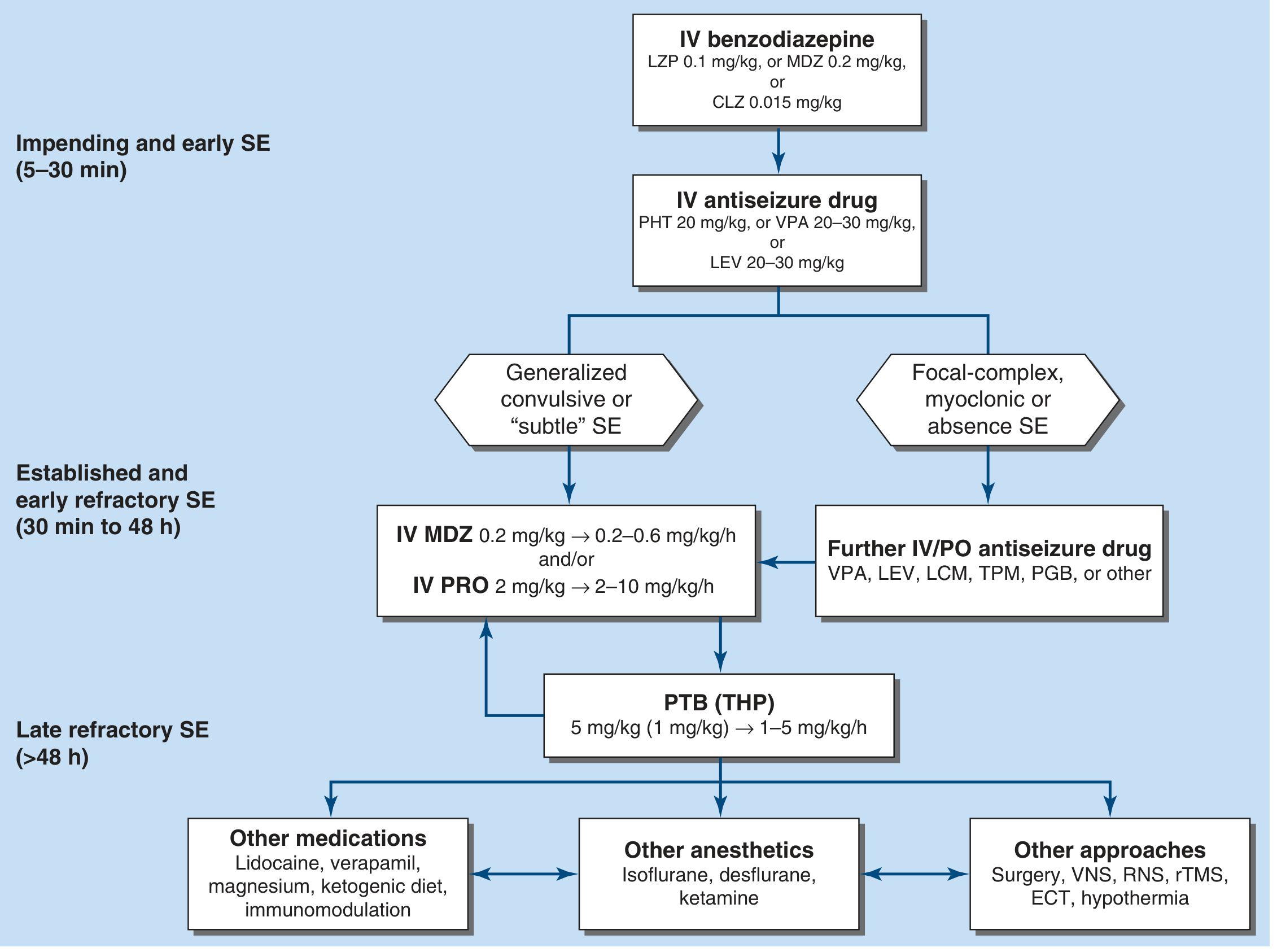
Pharmacologic protocol (Figure 436-5, Harrison's)
Impending/early SE (5-30 min):
- IV benzodiazepine: lorazepam (LZP) 0.1 mg/kg, or midazolam (MDZ) 0.2 mg/kg, or clonazepam (CLZ) 0.015 mg/kg
- Lorazepam is considered the most effective benzodiazepine and the treatment of choice for acute control
Then an IV loading antiseizure drug:
- Fosphenytoin/phenytoin (PHT) 20 mg/kg, or valproate (VPA) 20-30 mg/kg, or levetiracetam (LEV) 20-30 mg/kg — these three have similar efficacy/side-effect profiles
Established/early refractory SE (30 min - 48 h):
- For generalized convulsive or "subtle" SE: IV midazolam infusion (0.2 mg/kg load -> 0.2-0.6 mg/kg/h) and/or IV propofol (2 mg/kg load -> 2-10 mg/kg/h)
- For focal-complex, myoclonic, or absence SE: further IV/PO antiseizure drugs (VPA, LEV, lacosamide, topiramate, pregabalin, etc.)
Late refractory SE (>48 h):
- Pentobarbital/thiopental: 5 mg/kg (or 1 mg/kg) load -> 1-5 mg/kg/h
- If still refractory: other medications (lidocaine, verapamil, magnesium, ketogenic diet, immunomodulation), other anesthetics (isoflurane, desflurane, ketamine), or other approaches (surgery, vagus nerve stimulation, responsive neurostimulation, rTMS, ECT, therapeutic hypothermia)
Sources:
- Harrison's Principles of Internal Medicine 22E - Status Epilepticus, p. 3469-3470
- Harrison's Principles of Internal Medicine 22E - Critical Care Medicine chapter, p. 2342 ("Lorazepam is the most effective benzodiazepine... maintenance with fosphenytoin, valproate, or levetiracetam")
Recent evidence check
A 2024 systematic review of clinical practice guidelines for adult status epilepticus (Vignatelli et al., Epilepsia, PMID: 38606469) found substantial heterogeneity across international guidelines, particularly around second-line agent choice and timing thresholds for escalation to anesthetic infusions - worth checking if you need a specific national guideline rather than the general Harrison's approach. A 2025 systematic review (PMID: 40168634) also addressed SE management specifically in resource-limited settings, which may differ from the ICU-based protocol above if that's your context. These don't contradict the core lorazepam-first, then loading antiseizure drug approach described in Harrison's, but reflect ongoing debate on refractory-phase specifics.
Injection zevicefta
Finding Sources
Searching the Web
Zevicefta injection ceftazidime avibactam uses dose
Injection Zevicefta (Ceftazidime + Avibactam)
Zevicefta is a brand name for the fixed-dose combination injection of ceftazidime (a third-generation cephalosporin) + avibactam (a novel non-beta-lactam beta-lactamase inhibitor), marketed in India/other regions. It is the same combination sold as Avycaz (US) or Zavicefta (EU) — ceftazidime 2 g / avibactam 0.5 g per vial, IV only.
Mechanism
- Ceftazidime inhibits bacterial cell wall synthesis by binding penicillin-binding proteins, with strong activity against gram-negatives including Pseudomonas aeruginosa.
- Avibactam has no significant antibacterial activity alone but inhibits Ambler class A, C, and some class D beta-lactamases (including ESBLs and KPC carbapenemases), protecting ceftazidime from hydrolysis. It does not inhibit metallo-beta-lactamases (e.g., NDM), so it is not active against metallo-beta-lactamase-producing organisms.
- Ceftazidime-avibactam, available only as an IV formulation, has broad gram-negative activity including Enterobacterales and P. aeruginosa (Lippincott Illustrated Reviews Pharmacology, p. 3864-3868).
Indications
- Complicated urinary tract infections (cUTI), including pyelonephritis
- Complicated intra-abdominal infections (cIAI) — used in combination with metronidazole
- Hospital-acquired and ventilator-associated bacterial pneumonia (HABP/VABP)
- Empirical/targeted therapy for carbapenem-resistant Enterobacteriaceae (CRE), KPC-producing organisms, and multidrug-resistant P. aeruginosa, per Harrison's guidance on novel antimicrobials for resistant gram-negatives (Harrison's Principles of Internal Medicine 22E, p. Empirical Therapy section). Not reliably active against metallo-beta-lactamase producers or Acinetobacter spp. — cefiderocol is preferred there.
Dosing (adult, normal renal function)
- 2 g ceftazidime / 0.5 g avibactam IV every 8 hours, infused over 2 hours (Washington Manual of Medical Therapeutics, p. 168-176)
- Given with metronidazole for intra-abdominal infections
- Duration: typically 5-14 days depending on infection site
Renal dose adjustment
Both components are renally cleared and hemodialyzable — dose must be reduced as CrCl falls, and on hemodialysis days the dose should be given after dialysis completion. Approximate adjustments (based on label data):
- CrCl 31-50 mL/min: reduced dose every 8h
- CrCl 16-30 mL/min: reduced dose every 12h
- CrCl 6-15 mL/min: reduced dose every 24h
- ESRD/hemodialysis: reduced dose every 48h, post-dialysis
Adverse effects
Class effects of cephalosporins: hypersensitivity/allergic reactions, GI upset, elevated transaminases, Clostridioides difficile-associated diarrhea. Avibactam itself has not shown significant QT prolongation even at supratherapeutic doses.
Note on the name
I don't have Zevicefta specifically indexed in the textbook library (it's a regional trade name), so the details above are drawn from the ceftazidime-avibactam entries in Harrison's, the Washington Manual, Lippincott Pharmacology, and Goodman & Gilman, cross-checked with the official prescribing information for the identical formulation (Zavicefta/Avycaz). If you have a specific question — dosing in a particular patient, spectrum against a specific organism, or comparison with another agent — let me know and I can dig deeper.
This is a shared conversation. Sign in to Orris to start your own chat.