
AArtery supply of upper limb venous driage
Reading File
Finding Sources
Finding Sources
Searching Images
arterial supply upper limb anatomy
Finding Sources
Searching Images
venous drainage upper limb cephalic basilic axillary vein anatomy
Loading Image
Loading Image
Here is a comprehensive overview of the arterial supply and venous drainage of the upper limb:
Arterial Supply of the Upper Limb
The arterial supply follows a continuous axial chain from the subclavian artery to the digital arteries.
1. Subclavian Artery
- Arises from the brachiocephalic trunk (right) and directly from the aortic arch (left)
- Becomes the axillary artery at the lateral border of the 1st rib
2. Axillary Artery
- Extends from the lateral border of rib 1 to the lower border of teres major
- Divided into 3 parts by pectoralis minor:
| Part | Branches |
|---|---|
| 1st (medial to pec minor) | Superior thoracic artery |
| 2nd (behind pec minor) | Thoracoacromial artery, Lateral thoracic artery |
| 3rd (lateral to pec minor) | Subscapular artery, Anterior & Posterior circumflex humeral arteries |
3. Brachial Artery
- Continuation of axillary artery from lower border of teres major
- Runs in the medial bicipital groove, accompanies the median nerve
- Key branch: Profunda brachii (deep brachial artery) — accompanies the radial nerve in the spiral groove; gives anterior and posterior descending branches that anastomose around the elbow
Other branches:
- Superior ulnar collateral artery
- Inferior ulnar collateral artery
- Nutrient artery to humerus
Terminates in the cubital fossa (at the neck of the radius) by dividing into:
- Radial artery
- Ulnar artery
4. Radial Artery
- Runs laterally in the forearm (between brachioradialis and flexor carpi radialis)
- Passes over the anatomical snuffbox and enters the palm via the 1st dorsal interosseous muscle
- Forms the deep palmar arch (with the deep branch of ulnar artery)
Branches in forearm: Radial recurrent, superficial palmar branch, dorsal carpal branch
5. Ulnar Artery
- Larger of the two terminal branches
- Passes deep to the pronator teres, then between flexor carpi ulnaris and flexor digitorum superficialis
- Enters the hand via Guyon's canal
- Forms the superficial palmar arch (with the superficial palmar branch of radial artery)
Branches: Anterior and posterior ulnar recurrent arteries, common interosseous artery (→ anterior & posterior interosseous arteries)
6. Palmar Arches
| Arch | Formed by | Gives off |
|---|---|---|
| Superficial | Ulnar artery + superficial branch of radial | 3 common palmar digital arteries → proper digital arteries |
| Deep | Radial artery + deep branch of ulnar | Palmar metacarpal arteries |
Periarticular Anastomoses (Elbow)
The radial and ulnar recurrent arteries and collateral branches of the brachial artery form an extensive anastomotic network around the elbow, ensuring collateral circulation if the brachial artery is ligated above the profunda brachii.
Venous Drainage of the Upper Limb
Drainage occurs via two systems: superficial (subcutaneous) and deep (accompanying arteries as venae comitantes).
Superficial Veins
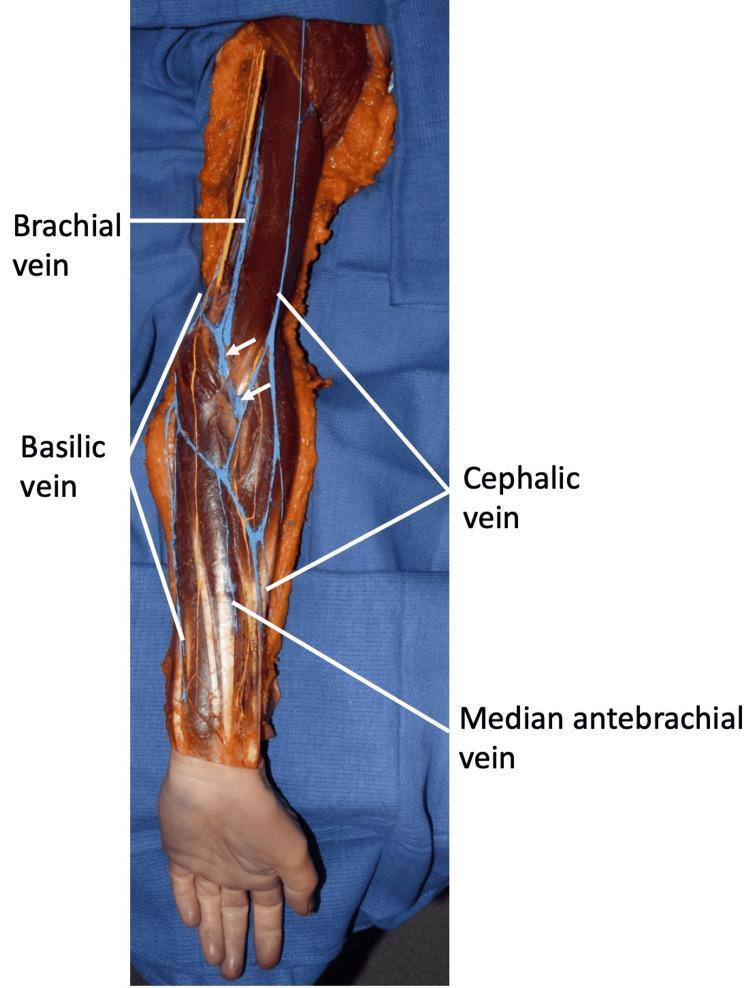
Cephalic Vein
- Begins at the radial side of the dorsal venous network of the hand
- Ascends along the lateral (radial) forearm and arm
- Runs in the deltopectoral groove
- Pierces the clavipectoral fascia and drains into the axillary vein
- Clinically important: often used for PICC lines and venipuncture
Basilic Vein
- Begins at the ulnar side of the dorsal venous network
- Ascends along the medial forearm
- Pierces the deep fascia at the mid-arm level
- Joins the brachial venae comitantes to form the axillary vein
- Often used as the graft vessel in forearm fistulas
Median Antebrachial (Median Cubital) Vein
- Drains the palmar venous plexus
- Ascends on the anterior forearm
- At the cubital fossa, the median cubital vein connects cephalic and basilic veins (the classic venipuncture site)
- Lies superficial to the bicipital aponeurosis (which protects the brachial artery beneath)
Deep Veins
- Run as venae comitantes (paired veins flanking each artery): radial veins, ulnar veins, brachial veins
- Radial and ulnar venae comitantes unite to form brachial veins
- Brachial veins + basilic vein → Axillary vein
Axillary Vein
- Formed at the lower border of teres major
- Receives the cephalic vein and thoracoepigastric veins
- Becomes the subclavian vein at the lateral border of rib 1

Summary Flow Chart
Subclavian A. → Axillary A. → Brachial A. → Radial A. → Deep palmar arch
                                           ↘ Ulnar A.  → Superficial palmar arch
                                                          ↓
                                               Digital arteries (fingers)

Hand venous plexus → Cephalic V. (lateral) ↘
                  → Basilic V. (medial)     → Axillary V. → Subclavian V.
Deep: Radial/Ulnar venae comitantes → Brachial V. ↗
Key clinical points:
- The median cubital vein is the preferred venipuncture site — it is broad, superficial, and the bicipital aponeurosis protects underlying vessels
- The brachial artery can be ligated below the profunda brachii origin — collateral circulation via the anastomotic network around the elbow maintains distal perfusion
- The cephalic vein terminates at an acute angle into the axillary vein, making it technically challenging for central catheter advancement
- The superficial palmar arch lies more distal than the deep arch; it is at the level of the outstretched thumb
This is a shared conversation. Sign in to Orris to start your own chat.