
Feedback control system for homestatis
I'll answer this medical/physiology topic. Let me first read the medical library skill, then search for relevant content.
Quick Answer: Homeostasis is maintained through feedback control systems - primarily negative feedback, where a deviation from a set point triggers a corrective response that opposes the change (e.g., body temperature, blood glucose). Positive feedback amplifies a change toward completion (e.g., childbirth, blood clotting). The system has three components: a sensor/receptor, a control center, and an effector.
Searching sources...
Reading File
Now let me search the library for homeostasis and feedback control content in parallel:
Finding Sources
Finding Sources
Excellent! Three top physiology textbooks have content. Let me read all three in parallel:
Reading File
Reading File
Reading File
Let me get more content on positive feedback, gain calculation, and fetch any available diagrams:
Reading File
Finding Sources
Finding Sources
Now let me get the key section on positive feedback and the gain formula from Guyton, plus the Ganong feedback diagram:
Reading File
Reading File
I have rich content from three top physiology textbooks. Let me now fetch the two key diagrams (endocrine feedback axes and osmolality feedback loop) from Ganong's:
Loading Image
Loading Image
Excellent! I have comprehensive textbook content and both diagrams. Here is the full, well-structured answer:
Feedback Control Systems for Homeostasis
What is Homeostasis?
Homeostasis is the active maintenance of a stable internal environment (the milieu intérieur) despite changes in the external environment. As described by Claude Bernard, the "fixité du milieu intérieur" is the condition of free, independent life - each organ system (cardiovascular, respiratory, renal, endocrine, GI) contributes to compensating and equilibrating against external changes.
Tightly regulated parameters include:
-
Arterial blood pressure
-
Body core temperature
-
Plasma O₂, CO₂, glucose
-
K⁺, Ca²⁺, H⁺ concentrations
-
Blood osmolality (normal: 275-299 mOsm)
-
Guyton and Hall Textbook of Medical Physiology
-
Medical Physiology (Boron & Boulpaep)
Components of a Feedback Control System
Every homeostatic feedback system has four essential elements (Medical Physiology, p. 15):
| Component | Role | Example |
|---|---|---|
| Sensor / Receptor | Detects the vital parameter | Osmoreceptors in hypothalamus, baroreceptors in aortic arch |
| Control Center | Compares input to a set-point; generates an error/difference signal | Hypothalamus, medullary vasomotor center |
| Gain / Amplifier | Multiplies the error signal by a proportionality factor | Magnitude of hormone release or nerve firing |
| Effector | Opposes the source of the input signal; drives the parameter back toward set-point | Kidneys (water reabsorption), heart and blood vessels (vasoconstriction/dilation) |
Negative Feedback (the dominant mechanism)
In negative feedback, any deviation from the set-point triggers a corrective response that opposes the deviation and pushes the variable back toward normal. It is by far the most common homeostatic control mechanism in the body.
Classic example - CO₂ regulation:
High CO₂ → increased pulmonary ventilation → CO₂ blown off → CO₂ falls back toward normal. If CO₂ falls too low, the reverse occurs. The response is always negative to the initiating stimulus.
Classic example - Arterial pressure (baroreceptor reflex):
- Pressure rises → baroreceptors in aortic arch detect stretch → signals sent to medullary vasomotor center → sympathetic activity reduced → heart pumping decreases + vasodilation → pressure falls back toward normal
- Pressure falls → baroreceptors less active → vasomotor center more active → vasoconstriction + increased heart rate → pressure rises back toward normal
Gain of a Control System
The effectiveness of a feedback system is quantified by its gain (Guyton & Hall):
Gain = Correction / Error
Worked example (baroreceptor system):
- Without baroreceptors: blood transfusion raises pressure by 75 mmHg (100 → 175 mmHg)
- With baroreceptors: same transfusion raises pressure by only 25 mmHg
- Correction achieved = 175 - 125 = -50 mmHg
- Remaining error = +25 mmHg
- Gain = -50 / +25 = -2
This means the baroreceptor system corrects ~two-thirds of the disturbance; arterial pressure changes are only one-third of what they would be without the system.
The temperature control system in cold weather has a gain of approximately -33 - far more effective than the baroreceptor system.
- Guyton and Hall Textbook of Medical Physiology, p. 26
Feed-Forward and Adaptive Control
Not all control is reactive. When movements occur too rapidly for nerve signals to travel to and from the brain, the nervous system uses feed-forward control - it anticipates the required action and sends pre-emptive commands to effectors (e.g., cerebellar control of rapid limb movements). If the movement is incorrect, the brain corrects the feed-forward signals for next time. This iterative correction is called adaptive control - essentially a form of delayed negative feedback.
Positive Feedback - Vicious Cycles and Physiological Completion
Positive feedback amplifies a deviation rather than correcting it. It leads to instability and is therefore used only in situations that require a process to gather momentum toward an all-or-nothing completion.
Physiological examples:
- Parturition (childbirth): Uterine contractions → pressure on cervix → oxytocin release → more contractions, until delivery completes
- Blood clotting cascade: Each step amplifies the next until a clot forms
- LH surge at ovulation: Rising estrogen triggers a surge of LH that completes follicular rupture
Pathological positive feedback (vicious cycle) - hemorrhagic shock:
Massive blood loss → reduced blood volume → heart pumps less effectively → reduced coronary blood flow → weakened heart → even less pumping → further loss of pressure → death. Without intervention, this cycle is irreversible.
This is why the vast majority of homeostatic control systems use negative, not positive, feedback.
- Guyton and Hall Textbook of Medical Physiology, p. 26
Endocrine Feedback Axes
The endocrine system provides a clear structural model of negative feedback:
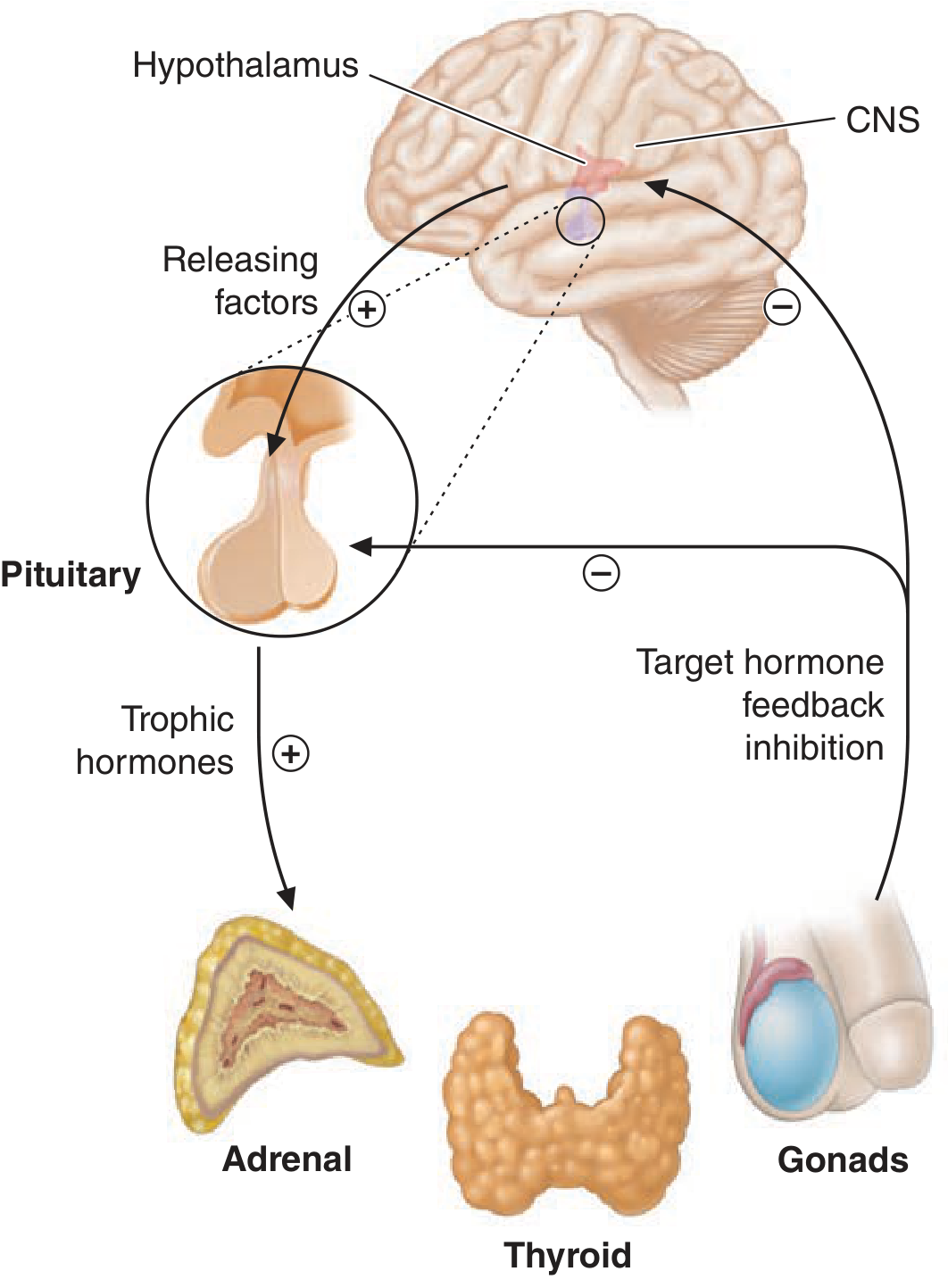
Feedback loops regulating endocrine axes (Ganong's Review of Medical Physiology, Fig. 16-3)
The CNS and hypothalamus release factors (+) that stimulate the pituitary, which releases trophic hormones (+) to target glands (adrenal, thyroid, gonads). The resulting target hormones then feed back negatively (-) to the hypothalamus and pituitary to inhibit further stimulation - classic multi-level negative feedback.
Worked Example: Blood Osmolality Regulation
Blood osmolality must stay at 275-299 mOsm. Here is how the negative feedback loop works:
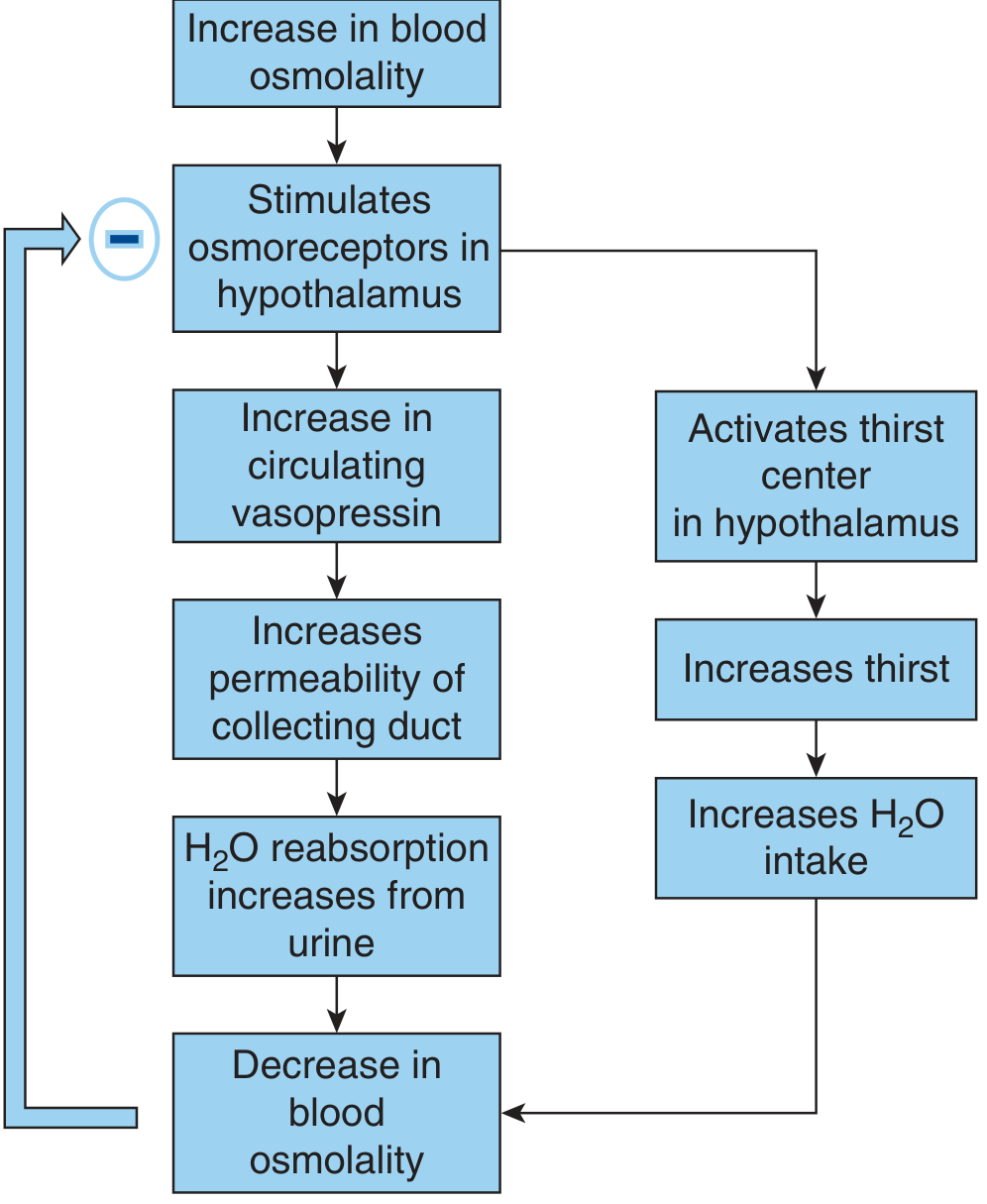
Negative feedback loop maintaining blood osmolality (Ganong's Review, Fig. 16-4)
- Dehydration → osmolality rises → osmoreceptors in hypothalamus detect it → vasopressin released from posterior pituitary → collecting duct aquaporins inserted → water reabsorbed from urine into blood → osmolality falls back to normal → vasopressin release inhibited
- Simultaneously, the thirst center is activated → water intake increases → further dilution of blood
Hierarchy and Interaction of Feedback Loops
A single feedback loop rarely operates in isolation. Complex interplay exists among loops:
-
Synergistic loops: Vasopressin and the thirst mechanism both lower osmolality, working together
-
Antagonistic loops: Insulin lowers blood glucose; epinephrine and cortisol raise it - the net glucose level reflects competition between these loops
-
Hierarchical loops: Hypothalamus → anterior pituitary → adrenal cortex → cortisol → blood glucose (a cascade where higher centers govern lower ones)
-
Medical Physiology (Boron & Boulpaep), p. 15
Summary Table
| Feature | Negative Feedback | Positive Feedback |
|---|---|---|
| Direction | Opposes the change | Amplifies the change |
| Effect on stability | Stabilizes (restores set-point) | Destabilizes (escalates) |
| Frequency | Very common | Rare |
| Biological purpose | Maintain homeostasis | Complete all-or-nothing events |
| Examples | Blood pressure, temperature, blood glucose, osmolality, CO₂ | Parturition, LH surge, blood clotting, hemorrhagic shock (pathological) |
| Clinical relevance | Dysregulation causes chronic disease (hypertension, diabetes) | Runaway loops cause death (shock, cytokine storm) |
Did not understand, explain in understanding way
Feedback Control Systems for Homeostasis - Simply Explained
Let me break this down using everyday analogies first, then connect it to physiology.
Start Here: What Problem is the Body Solving?
Your body's cells need a very specific environment to survive - the right temperature, the right amount of sugar, the right amount of water, the right pH. Even small deviations can kill cells.
The body's solution? Constant monitoring + constant correction. This is homeostasis.
Think of it like a thermostat in your room.
The Thermostat Analogy (Most Important Concept)
Imagine you set your AC thermostat to 25°C.
| Step | What Happens |
|---|---|
| Room gets hot (30°C) | Thermostat senses the temperature |
| Compares to 25°C target | Detects a difference (error = +5°C) |
| Sends signal to AC | Effector turns ON |
| Room cools back to 25°C | Problem solved, AC turns OFF |
This is exactly how your body works. Every homeostatic system is just a biological thermostat.
The 4 Parts of Every Feedback System
  DISTURBANCE
      ↓
  [SENSOR] → detects the change
      ↓
  [CONTROL CENTER] → compares to normal (set-point), decides what to do
      ↓
  [EFFECTOR] → carries out the correction
      ↓
  [RESULT] → parameter returns to normal → sensor quiets down
Real body example (body temperature):
| Part | What it is |
|---|---|
| Sensor | Temperature receptors in skin + hypothalamus |
| Control Center | Hypothalamus (the brain's thermostat) |
| Effector | Sweat glands (if hot), shivering muscles (if cold) |
| Set-point | 37°C |
Type 1: Negative Feedback ✅ (The Good One - Used 99% of the Time)
"Negative" does NOT mean bad. It means the response goes in the opposite direction of the problem.
Simple Rule:
Too much of something → body reduces it Too little of something → body increases it
3 Easy Examples:
1. Blood Sugar (Glucose)
You eat a meal
    ↓
Blood glucose RISES (too high)
    ↓
Pancreas senses this
    ↓
Releases INSULIN
    ↓
Cells absorb glucose → blood sugar FALLS back to normal
    ↓
Insulin secretion STOPS (negative feedback complete)
2. Blood Pressure
You get scared / exercise
    ↓
Blood pressure RISES
    ↓
Baroreceptors in aorta sense the stretch
    ↓
Signal to brain → reduce heart rate + dilate vessels
    ↓
Blood pressure FALLS back to normal ✓
3. Body Temperature (Fever)
You go out in the cold
    ↓
Body temperature FALLS
    ↓
Hypothalamus detects it
    ↓
Commands: shiver, constrict blood vessels, feel cold (put on a jacket)
    ↓
Temperature RISES back to 37°C ✓
The KEY pattern: The correction always goes in the opposite direction to the problem. That's why it's called negative feedback - it negates the change.
Type 2: Positive Feedback ⚠️ (Rare - Amplifies the Change)
"Positive" does NOT mean good. It means the response goes in the same direction as the change - it accelerates things rather than reversing them.
The body uses this ONLY when it needs to complete something quickly and fully - like finishing a process all the way.
Simple Rule:
More of something → even more of it → keeps going until the job is DONE
2 Easy Examples:
1. Childbirth (Parturition)
Baby pushes on cervix
    ↓
Cervix stretches → triggers oxytocin release
    ↓
Oxytocin causes stronger uterine contractions
    ↓
Baby pushes harder on cervix
    ↓
Even MORE oxytocin → even stronger contractions
    ↓
... keeps escalating ...
    ↓
BABY IS BORN → loop ends ✓
Why positive feedback here? Because labor needs to keep intensifying until delivery is complete. You don't want contractions to "settle back to normal" midway through!
2. Blood Clotting
Blood vessel is cut
    ↓
Clotting factors activated
    ↓
Each factor activates more factors (amplification cascade)
    ↓
Clot forms quickly and completely ✓
Again - you need the clot to form fast and fully. A half-formed clot is useless.
Why Positive Feedback Can Be Dangerous (Vicious Cycle)
When positive feedback happens without an endpoint, it becomes catastrophic:
Hemorrhagic Shock (massive bleeding):
Massive blood loss
    ↓
Heart has less blood to pump → pressure drops
    ↓
Less blood reaches the heart muscle itself
    ↓
Heart gets WEAKER → pumps even less
    ↓
Even less coronary blood flow → heart weaker still
    ↓
↓↓↓ spiraling downward ↓↓↓
    ↓
DEATH (if not treated)
This is why doctors rush IV fluids in bleeding patients - to break the positive feedback loop before it becomes irreversible.
The "Gain" Concept - How Good is the System?
Not all control systems are equally effective. Gain measures how well a system corrects a problem.
Gain = How much was corrected ÷ How much error remains
Simple analogy: Imagine you overshoot a target by 75 points.
- A bad system brings you to within 25 points of target (corrected 50, missed 25) → Gain = 50/25 = 2
- A great system brings you to within 2 points → Gain = 33
| Body System | Gain | Meaning |
|---|---|---|
| Baroreceptor (blood pressure) | -2 | Corrects 2/3 of blood pressure changes |
| Temperature regulation | -33 | Extremely effective - corrects most temperature changes |
The temperature system is ~16× more powerful than the blood pressure system. That's why your temperature barely fluctuates (36.5-37.5°C) while blood pressure varies much more.
Feed-Forward Control - The Body Predicting Problems
Sometimes the body doesn't wait for a problem to occur - it anticipates and acts in advance.
Real life analogy: You see a ball flying toward your face. You blink before it hits you - not because it already hit you, but because your brain predicted it would.
Body example: Before you start exercising, just thinking about exercise causes your heart rate and breathing to increase slightly. The body is pre-loading the cardiovascular system before the demand arrives.
This is faster than waiting for CO₂ to rise and then correcting it.
The Big Picture - One Diagram to Remember
        DISTURBANCE
        (↑ blood sugar)
              ↓
         [SENSOR]
      (β cells of pancreas)
              ↓
      [CONTROL CENTER]
    (detects high glucose)
              ↓
         [EFFECTOR]
      (releases insulin)
              ↓
        CORRECTION
      (glucose absorbed)
              ↓
    ← ← ← ← ← ← ← ← ← ←
    ↑   NEGATIVE FEEDBACK  ↑
    (correction turns OFF   )
    (insulin when glucose   )
    (is back to normal      )
Quick Comparison - Side by Side
| Negative Feedback | Positive Feedback | |
|---|---|---|
| What it does | Reverses the change | Amplifies the change |
| Goal | Maintain stability | Complete a process |
| How common | Very common (99%) | Rare |
| Examples | Blood pressure, temperature, glucose, CO₂ | Childbirth, blood clotting, LH surge |
| If uncontrolled | System stays stable | Can cause death (shock, cytokine storm) |
One-Line Memory Tricks
- Negative feedback = "The body says STOP, go back to normal!"
- Positive feedback = "The body says KEEP GOING until it's DONE!"
- Homeostasis = The body's obsession with staying in the middle, always correcting, never settling for too much or too little.
In short and simple
Feedback Control & Homeostasis - Short & Simple
Homeostasis = Body keeping everything "just right"
Your body has a normal range for everything - temperature, blood sugar, blood pressure. It constantly works to stay within that range.
How? Using Feedback Loops
Think of it like a thermostat:
- Room too hot → AC turns ON → cools down → AC turns OFF
- That's it. Your body does the same thing.
Every feedback system has 3 parts:
Sensor → Control Center → Effector
Sensor detects the problem → Brain decides what to do → Organ fixes it
2 Types of Feedback
🔵 Negative Feedback - "Undo the change"
Most common. Corrects problems by reversing them.
| Problem | Body's Response |
|---|---|
| Blood sugar too HIGH | Insulin released → sugar goes DOWN |
| Body too HOT | You sweat → cool DOWN |
| Blood pressure too HIGH | Heart slows + vessels widen → pressure goes DOWN |
Rule: Too much → reduce it. Too little → increase it.
🔴 Positive Feedback - "Keep going until done"
Rare. Amplifies a change until a process is complete.
| Example | What happens |
|---|---|
| Childbirth | Contractions get stronger and stronger → baby born → stops |
| Blood clotting | Clotting factors multiply rapidly → clot formed → stops |
Rule: Used only to finish something quickly. Has a clear endpoint.
Key Difference in One Line:
Negative feedback = Stabilizes. Positive feedback = Completes.
Why it matters:
- When negative feedback fails → disease (e.g., diabetes = insulin feedback broken)
- When positive feedback has no endpoint → death (e.g., hemorrhagic shock)
Do you know souman manna?
I don't have any information about a person named Souman Manna in my knowledge base.
Could you tell me a bit more about who they are? For example:
- A professor or teacher?
- A researcher or doctor?
- A public figure?
That way I can either search for information or let you know honestly if I simply don't have any data on them.
Astigmatism
Astigmatism is a refractive error caused by an irregularly shaped cornea (or lens) - instead of being perfectly spherical, it is curved more in one meridian than another, like a rugby ball rather than a football. This causes light to focus at two different points on the retina, producing blurred or distorted vision at all distances.
Searching sources...
Reading File
Finding Sources
Finding Sources
Reading File
Reading File
Finding Sources
Reading File
Finding Sources
Finding Sources
Loading Image
I now have comprehensive information from Goldman-Cecil Medicine and Kanski's Clinical Ophthalmology. Here is a clear, simple explanation:
Astigmatism
What is it? (The Simple Version)
A normal eye is shaped like a perfect football (sphere) - it bends light evenly from all directions onto a single point on the retina.
An astigmatic eye is shaped like a rugby ball - curved more steeply in one direction than another. This causes light to focus at two different points instead of one, making vision blurry or distorted.
The Core Problem
Normal eye (sphere):
All light → focuses at ONE point on retina → CLEAR vision

Astigmatic eye (oval/rugby ball):
Light in one meridian → focuses here  ──┐
                                         → TWO points = BLURRY vision
Light in other meridian → focuses here ──┘
Causes
The irregularity comes from either:
-
The cornea (most common) - not perfectly round
-
The lens inside the eye - curved unevenly
-
Goldman-Cecil Medicine
2 Types
| Type | What it is | Correctable with? |
|---|---|---|
| Regular astigmatism | Uniform difference between two meridians at 90° to each other. NOT a disease - just an anatomical variation. Most people have some. | Glasses, contact lenses, laser surgery |
| Irregular astigmatism | Random, unpredictable distortion - usually from corneal scarring (infection, trauma), pterygium, or keratoconus | Rigid contact lenses (glasses won't fully correct) |
Symptoms
- Blurry vision at all distances (near AND far)
- "Shadowing" - objects appear to have a ghost/double image
- Difficulty seeing fine detail
- Eye strain and headaches (from squinting to compensate)
- In children - can cause amblyopia (lazy eye) if uncorrected
Related Condition: Keratoconus
Keratoconus is the most important cause of irregular astigmatism. The cornea progressively thins and bulges forward into a cone shape.
- Starts in adolescence, progresses over 5-10 years
- Usually affects both eyes (but not equally)
- Causes worsening vision that glasses can't fully fix
- Treatment: Rigid contact lenses for mild cases; corneal collagen cross-linking stops progression; corneal transplant for severe cases
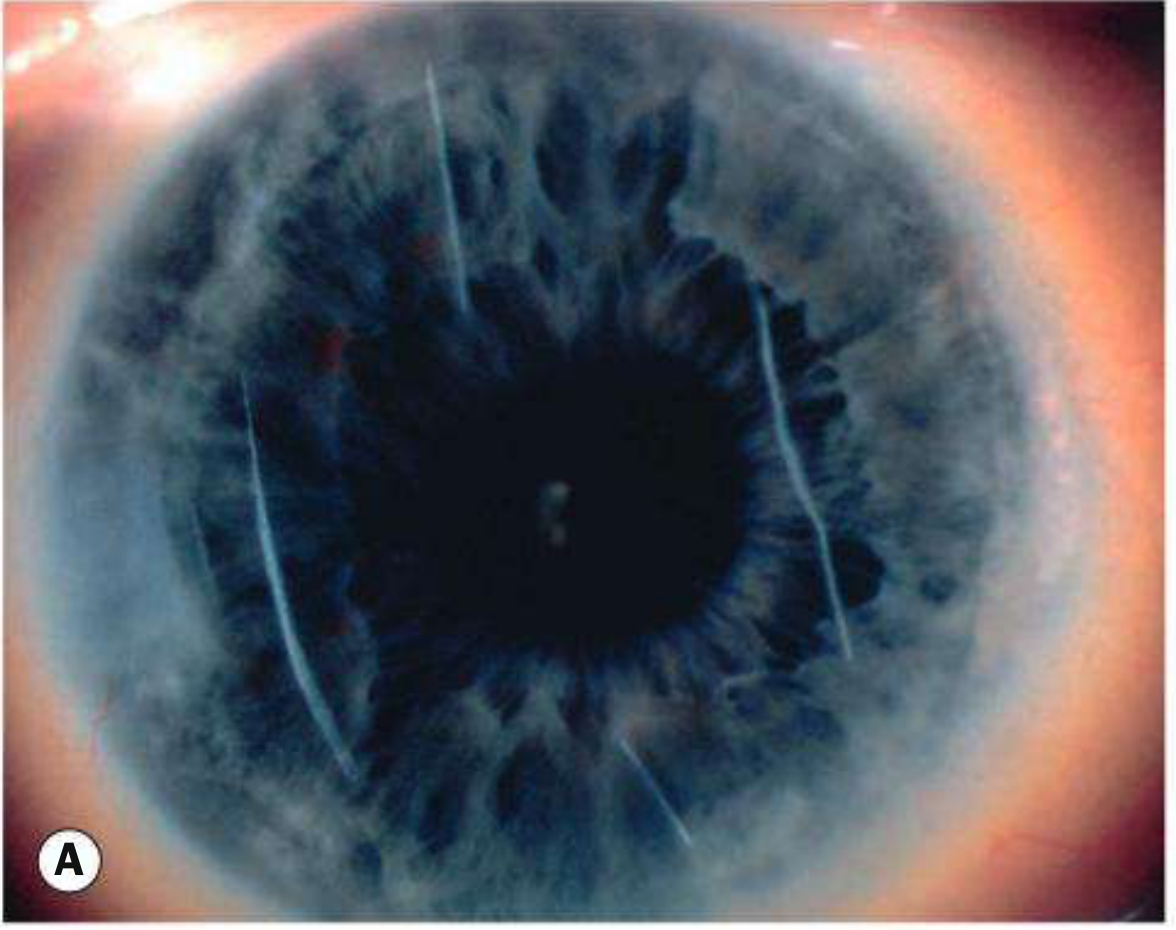
Arcuate keratotomy - surgical correction of astigmatism (Kanski's Clinical Ophthalmology, Fig. 8.14A)
Treatment Options
| Method | What it does | Corrects up to |
|---|---|---|
| Glasses (cylindrical lens) | Compensates for the unequal curvature | All regular astigmatism |
| Soft toric contact lenses | Specially shaped lens that stays oriented on the eye | Most regular astigmatism |
| Rigid contact lenses | Creates a smooth spherical surface over the cornea | Regular AND irregular |
| PRK / LASEK (laser) | Ablates cornea to reshape it | Up to 3 D |
| LASIK (laser) | Flap + ablation | Up to 5 D |
| Arcuate keratotomy | Paired cuts in the steep meridian to flatten it | Used especially post-corneal transplant |
| Toric IOL (intraocular lens) | Implant with built-in astigmatic correction | High degrees |
- Kanski's Clinical Ophthalmology, 10th ed.
Quick Summary
Astigmatism = unequal corneal curvature → light focuses in two places → blurry vision. Regular type is very common and easily corrected with glasses or laser. Irregular type (from scarring or keratoconus) needs rigid lenses or surgery.
How different is this from myopia and hypermetropia
All three are refractive errors - the eye fails to focus light correctly on the retina. The difference is how and where the focus goes wrong.
Searching sources...
Finding Sources
Finding Sources
Finding Sources
Finding Sources
Reading File
Reading File
I have all the content needed. Here is the comparison, simply explained:
Myopia vs Hypermetropia vs Astigmatism
The One Thing They All Share
All three are refractive errors - the eye does NOT focus light correctly onto the retina. That's where the similarity ends.
The Core Difference - Where Does Light Focus?
Think of the retina as a cinema screen at the back of your eye. The image must land exactly ON the screen to be clear.
NORMAL EYE:
Light → Lens → focuses EXACTLY on retina → Clear vision ✅

MYOPIA:
Light → Lens → focuses IN FRONT of retina → Blurry far vision ❌

HYPERMETROPIA:
Light → Lens → focuses BEHIND retina → Blurry near vision ❌

ASTIGMATISM:
Light → Lens → focuses at TWO DIFFERENT POINTS → Blurry/distorted ALL distances ❌
Side-by-Side Comparison
| Feature | Myopia (Nearsightedness) | Hypermetropia (Farsightedness) | Astigmatism |
|---|---|---|---|
| What's wrong | Eye is too long OR cornea too steep | Eye is too short OR cornea too flat | Cornea is oval shaped (unequal curvature) |
| Where light focuses | In front of retina | Behind retina | Two different points (no single focus) |
| Blurry vision | Far objects | Near objects | Both near AND far |
| Extra symptom | None (near vision fine) | Eye strain, headaches (lens overworks) | Shadowing, ghosting, distortion |
| Discovered when | Child can't see blackboard | Eye strain at near work | Blurry + distorted vision at any distance |
| Progression | Worsens until age 20-25 | May self-correct in youth (lens compensates until ~40) | Mostly stable (unless keratoconus) |
| Correction lens | Concave (minus) lens | Convex (plus) lens | Cylindrical lens |
| LASIK correction | Up to high degrees | Up to 4-5 D | Up to 5 D |
- Goldman-Cecil Medicine; Kanski's Clinical Ophthalmology, 10th ed.
The Simplest Visual Explanation
🔵 MYOPIA - Eye TOO LONG
   [Light] ──→ focuses ✦ ···· [Retina]
                  (in front)

🔴 HYPERMETROPIA - Eye TOO SHORT
   [Light] ──→ ···· [Retina] ···· ✦ focuses
                              (behind)

🟡 ASTIGMATISM - Cornea UNEVEN (oval not round)
   [Light] ──→ ✦ focuses here (one meridian)
            ──→ ···✦ focuses here (other meridian)
                (two different spots = blurry + distorted)
What Causes Each?
| Main Cause | |
|---|---|
| Myopia | Eyeball too long (axial length >24 mm). Genetic + screen time in childhood |
| Hypermetropia | Eyeball too short. Mostly genetic. Young people partially self-correct using the lens |
| Astigmatism | Cornea not perfectly spherical. Very common, usually just an anatomical variation |
Can You Have More Than One?
Yes - very commonly. A person can have:
- Myopia + Astigmatism (most common combo) - blurry far vision AND distortion
- Hypermetropia + Astigmatism - blurry near vision AND distortion
- All three together
This is why prescriptions have three numbers:
Sphere (myopia/hypermetropia) + Cylinder (astigmatism) + Axis (direction of astigmatism)
Memory Trick
Myopia = My eye is too long → far things blurry Hypermetropia = Hyper (over) = eye overshoots → near things blurry Astigmatism = A-stigma = no single point of focus → everything slightly off
This is a shared conversation. Sign in to Orris to start your own chat.