
I have an 83 year old male patient complaining of polyuria since the last three days. I
It looks like your message got cut off! Could you please complete your question? For example, are you looking for:
Asking for Preferences
What would you like to know about this patient with polyuria?
I'll cover the full clinical approach — differential diagnosis, workup, and management — for an 83-year-old male with 3 days of polyuria. Let me pull from the medical library now.
Reading File
Now let me search the medical library and PubMed in parallel for comprehensive coverage.
Finding Sources
Finding Sources
Searching PubMed
polyuria elderly evaluation
Excellent sources found. Let me read the key sections from Harrison's, Goldman-Cecil, and Brenner & Rector in parallel.
Reading File
Reading File
Reading File
Reading File
Now let me fetch the diagnostic algorithm image and read the elderly-specific considerations.
Loading Image
Loading Image
Finding Sources
Finding Sources
I now have comprehensive, authoritative information. Here is a complete clinical guide for your patient:
Polyuria in an 83-Year-Old Male — Clinical Approach
Step 1: Define It First
Polyuria = urine output >3 L/day. This must be distinguished from urinary frequency (frequent voiding of small volumes), which is common in elderly men due to benign prostatic hyperplasia. A 24-hour urine collection clarifies this.
Harrison's 22E: "It is often difficult for patients to distinguish urinary frequency from true polyuria, and a quantification of volume by 24-h urine collection may be needed."
Step 2: The Two Pathophysiologic Categories
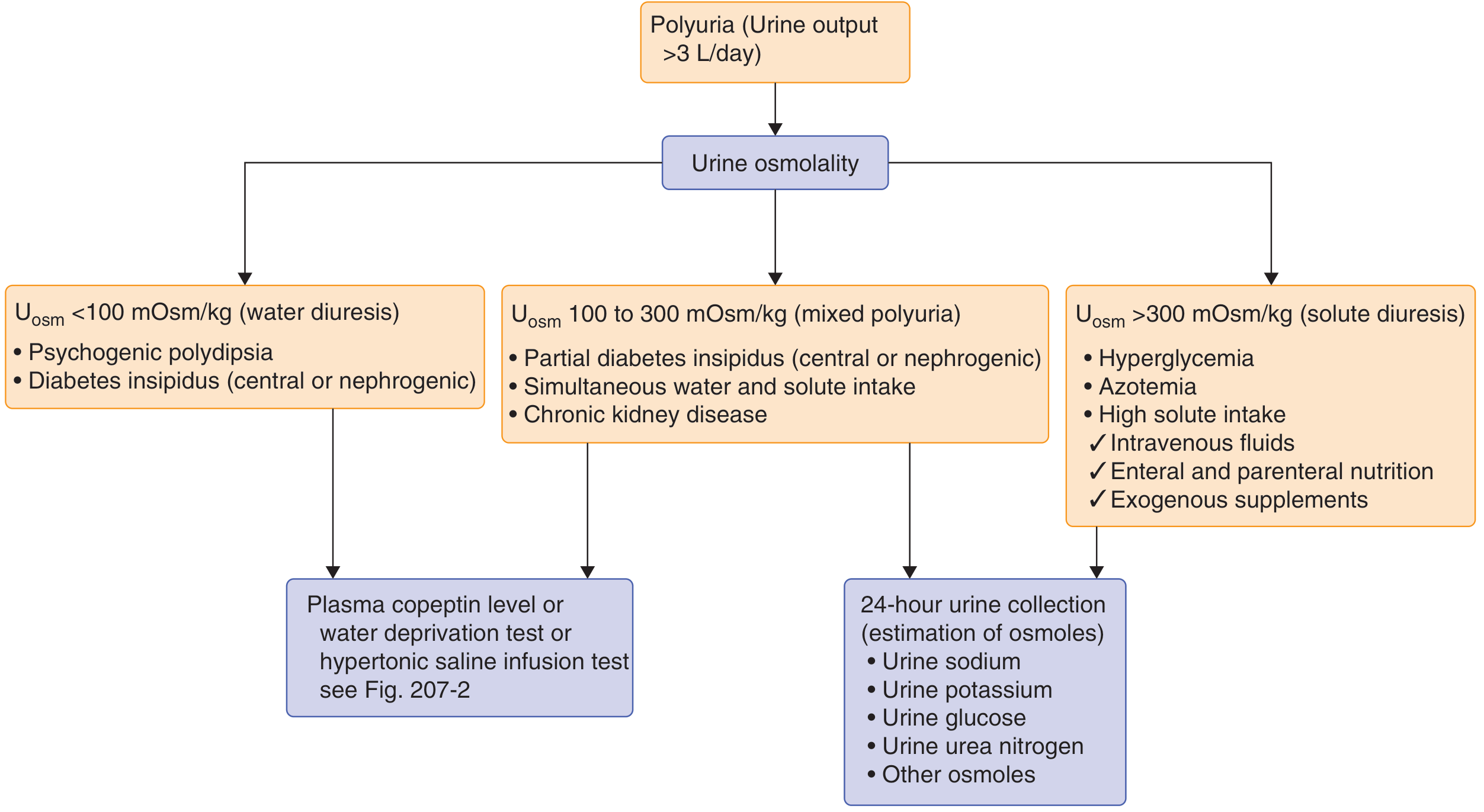
| Category | Urine Osmolality | Mechanism |
|---|---|---|
| Solute (osmotic) diuresis | >300 mOsm/kg | Poorly reabsorbable solute (glucose, urea, Na⁺) |
| Water diuresis | <100–250 mOsm/kg | Deficient or ineffective AVP (vasopressin) |
| Mixed | 100–300 mOsm/kg | Partial DI, CKD, simultaneous water + solute |
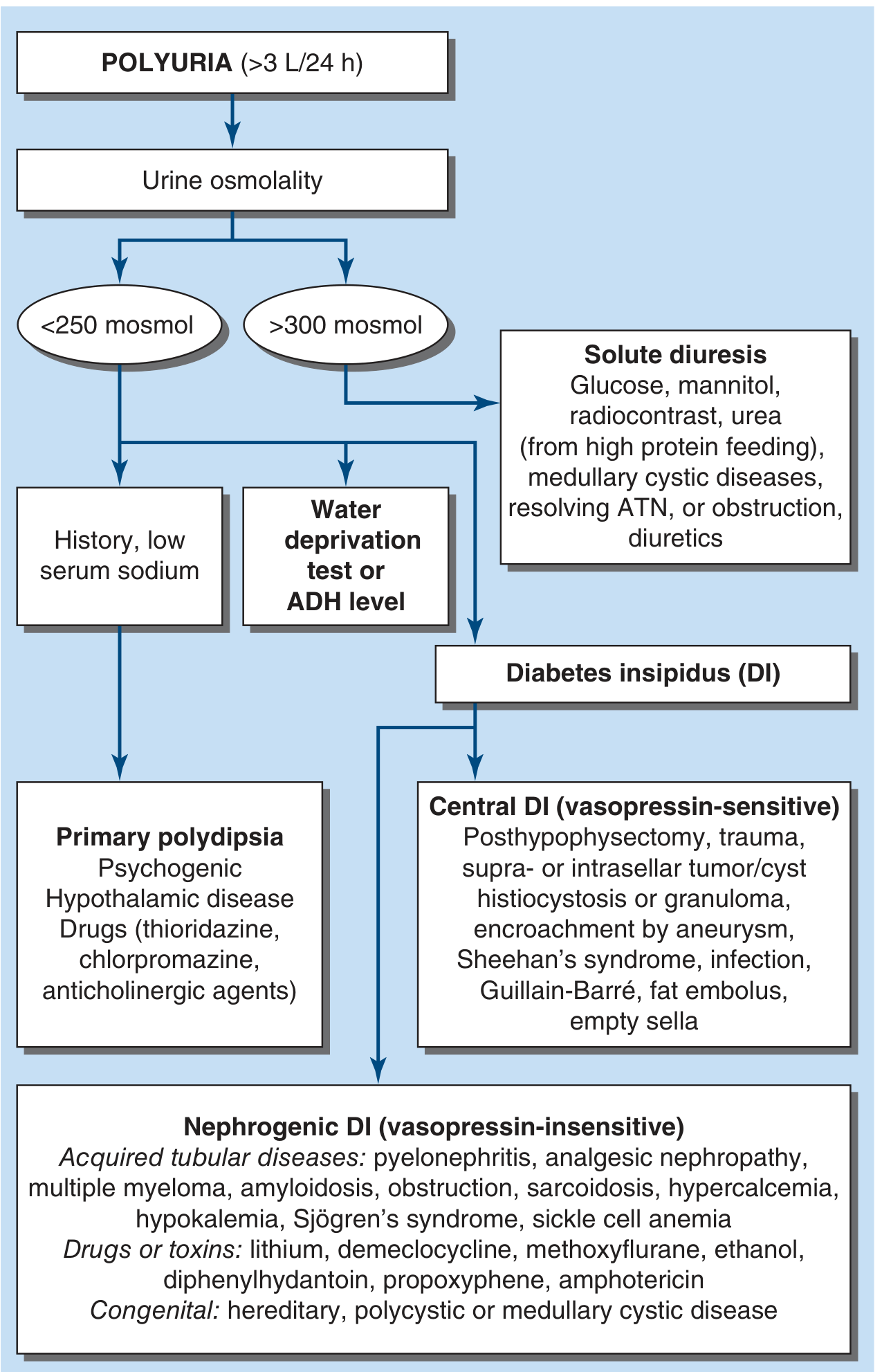
The pivotal first investigation is urine osmolality.
Step 3: Diagnostic Algorithm
Step 4: Differential Diagnosis
A. Solute (Osmotic) Diuresis — Urine Osm >300 mOsm/kg (Most common in elderly)
| Cause | Key Features in this Patient |
|---|---|
| Uncontrolled Diabetes Mellitus / Hyperglycemia ⭐ | Most common cause; glucosuria triggers osmotic diuresis; check BGL, HbA1c |
| Post-obstructive diuresis | Elderly male with BPH → acute urinary retention relieved → massive diuresis |
| Recovering AKI (resolving ATN) | Salt-wasting, obligatory polyuria during diuretic phase |
| High protein feeding / Urea load | Enteral nutrition, high protein diet → increased urea excretion |
| Mannitol / Radiocontrast | Recent procedural history? |
| Hypercalcemia | Malignancy, primary hyperparathyroidism (common in elderly) |
B. Water Diuresis — Urine Osm <250 mOsm/kg
| Cause | Key Features |
|---|---|
| Nephrogenic Diabetes Insipidus (NDI) | AVP-resistant; acquired tubular disease, drugs (lithium, demeclocycline), hypokalemia, hypercalcemia, CKD, myeloma |
| Central Diabetes Insipidus (CDI) | AVP-deficient; hypothalamic/pituitary pathology, head trauma, tumor, granuloma, inflammation |
| Primary Polydipsia | Compulsive water drinking; psychiatric disease or drugs (thioridazine, chlorpromazine, anticholinergics) |
Goldman-Cecil: "Nephrogenic DI can be caused by a mutation in the vasopressin V2 receptor or aquaporin-2 water channel. Drugs such as lithium commonly cause polyuria, which can be quite severe."
Step 5: Age-Specific Considerations at 83 Years
In this patient, prioritize these causes:
- Uncontrolled DM2 / new hyperglycemia — most prevalent
- Drugs: diuretics, lithium, demeclocycline — thorough medication review essential
- BPH with partial obstruction → post-obstructive diuresis
- Hypercalcemia from malignancy or hyperparathyroidism
- CKD with isosthenuria (urine Osm fixed ~300 mOsm/kg)
- Central DI from a new CNS lesion (metastasis, stroke) — always consider in acute onset
⚠️ Elderly caution: thirst perception is blunted in older adults. If AVP deficiency is present and the thirst mechanism is also impaired, severe hypernatremia and irreversible brain damage can rapidly supervene.
Step 6: Investigations
Initial (Essential)
| Test | Purpose |
|---|---|
| 24-hour urine volume | Confirm true polyuria (>3 L/day) |
| Urine osmolality (spot or 24h) | Pivotal branch point |
| Serum Na⁺, K⁺, Cl⁻, HCO₃⁻ | Electrolyte disturbance, hypernatremia, hypokalemia |
| Serum osmolality | Compare with urine Osm; calculate osmolar gap |
| Blood glucose / HbA1c | Rule out DM/hyperglycemia (most common) |
| Serum BUN / Creatinine / eGFR | Assess CKD, azotemia |
| Serum calcium | Rule out hypercalcemia |
| Urine dipstick + microscopy | Glycosuria, proteinuria, casts |
| Medication review | Lithium, diuretics, demeclocycline, contrast, mannitol |
Secondary (Based on Initial Results)
| Test | When to Order |
|---|---|
| Plasma copeptin (preferred) or water deprivation test | Urine Osm <250 mOsm/kg; distinguishes CDI vs NDI vs primary polydipsia |
| DDAVP (desmopressin) test (2 µg SC) | Suspected CDI — check urine Osm before and after; >50% rise = CDI |
| Serum PTH, PTHrP | Hypercalcemia found |
| MRI brain/pituitary | Suspected CDI |
| PSA, post-void residual ultrasound | Suspected obstructive uropathy/BPH |
| Serum protein electrophoresis / Bence-Jones | Suspected myeloma |
Harrison's 22E: "If sodium levels are above the normal reference range, the diagnosis of AVP deficiency or resistance is likely, and a test with desmopressin (2 µg) followed by a repeat measurement of urine osmolality will determine if hypotonic polyuria is due to AVP deficiency or AVP resistance."
Step 7: Management Principles
| Cause | Treatment |
|---|---|
| DM / Hyperglycemia | Glycemic control; insulin if HHS; hydration |
| Central DI | Desmopressin (DDAVP) intranasally or SC; treat underlying cause |
| Nephrogenic DI | Remove offending drug (lithium); thiazide diuretics + low-Na diet (paradoxical antidiuresis); NSAIDs (indomethacin) as adjunct |
| Primary polydipsia | Fluid restriction; treat underlying psychiatric disorder |
| Hypercalcemia | IV fluids, bisphosphonates, treat underlying cause |
| Post-obstructive diuresis | Careful IV fluid replacement (~50% of hourly output) to prevent hypovolemia |
Summary
Polyuria in 83M (3 days)
        ↓
First: Confirm with 24h urine volume
        ↓
Urine osmolality
   ├── >300 mOsm/kg → Solute diuresis → Check BG, Ca²⁺, medications, renal function
   ├── <250 mOsm/kg → Water diuresis → Copeptin/water deprivation test → CDI vs NDI vs polydipsia
   └── 100–300 mOsm/kg → Mixed → CKD, partial DI
Most likely diagnosis in an 83-year-old male: osmotic diuresis from uncontrolled diabetes mellitus — but a full panel is mandatory before anchoring.
Sources: Harrison's Principles of Internal Medicine, 22E (2025); Goldman-Cecil Medicine; Brenner & Rector's The Kidney; Campbell-Walsh Urology
This is a shared conversation. Sign in to Orris to start your own chat.