
Cardiac cycle
Reading File
Finding Sources
Searching Images
cardiac cycle phases pressure volume diagram
Reading File
Reading File
Reading File
Reading File
Reading File
Loading Image
Loading Image
Reading File
Now I have comprehensive information from multiple authoritative sources. Let me compile the full answer.
The Cardiac Cycle
The cardiac cycle refers to the sequence of mechanical and electrical events that repeats with every heartbeat — from the beginning of one heartbeat to the beginning of the next. At a heart rate of 72 beats/min, one complete cycle lasts ~0.833 seconds. — Guyton and Hall Textbook of Medical Physiology
Overview: Systole and Diastole
The cycle is divided into two broad phases:
- Systole — ventricular contraction (phases 2 + 3)
- Diastole — ventricular relaxation and filling (phases 1 + 4)
At 72 bpm, systole occupies ~40% of the cycle. At very high heart rates, diastole shortens disproportionately, limiting ventricular filling.
The Four Core Phases (Valve-Based)
Medical Physiology defines the cycle in four phases based on valve positions:
| Phase | Inlet Valve (Mitral/Tricuspid) | Outlet Valve (Aortic/Pulmonary) |
|---|---|---|
| 1. Ventricular filling (inflow) | Open | Closed |
| 2. Isovolumetric contraction | Closed | Closed |
| 3. Ventricular ejection (outflow) | Closed | Open |
| 4. Isovolumetric relaxation | Closed | Closed |
Seven Phases in Detail (Costanzo Physiology)
Costanzo Physiology describes seven phases correlated with ECG, pressures, volumes, and heart sounds:
A — Atrial Systole
- Triggered by the P wave (atrial depolarization)
- Left atrium contracts → raises atrial pressure → reflected as the a wave on the venous pulse
- Blood actively ejected into the already-filling left ventricle through the open mitral valve
- Produces the 4th heart sound (S4) — not normally audible, but heard in ventricular hypertrophy (reduced compliance)
B — Isovolumetric Ventricular Contraction
- Triggered by the QRS complex (ventricular depolarization)
- Ventricular pressure rises sharply
- Mitral valve closes (LV pressure > LA pressure) → produces S1 (1st heart sound)
- All valves closed → volume is constant (isovolumetric)
- No blood enters or leaves the ventricle
C — Rapid Ventricular Ejection
- Ventricular pressure exceeds aortic pressure → aortic valve opens
- Rapid ejection of blood; ventricular pressure peaks; ventricular volume drops steeply
- Aortic pressure rises rapidly to its maximum (systolic BP ~120 mmHg)
- Corresponds to the ST segment on ECG
D — Reduced Ventricular Ejection
- Ejection continues but slows; ventricular volume reaches its minimum (end-systolic volume ~50 mL)
- Both ventricular and aortic pressures begin to fall
- Corresponds to the T wave (ventricular repolarization)
E — Isovolumetric Ventricular Relaxation
- Retrograde blood flow causes aortic valve closure → produces S2 (2nd heart sound)
- The dicrotic notch (incisura) appears on the aortic pressure trace at valve closure
- All valves closed; ventricular pressure falls rapidly; volume unchanged
F — Rapid Ventricular Filling
- Ventricular pressure falls below atrial pressure → mitral valve opens
- Blood flows passively from atrium into ventricle; ventricular volume rises rapidly
- Produces the 3rd heart sound (S3) — normal in children and young adults; pathological in adults (suggests ventricular dilation/heart failure)
G — Reduced Ventricular Filling (Diastasis)
- Filling slows as pressures equilibrate; ventricle continues filling passively
- Ends when the next atrial systole (P wave) begins the cycle again
Pressure–Volume Loop
The relationship between LV pressure and volume throughout the cycle is summarized in the pressure–volume (PV) loop:

Key landmarks:
- Bottom-right corner = end-diastole (high volume ~120 mL, low pressure) → mitral valve closes
- Top-left corner = end-systole (low volume ~50 mL, high pressure) → aortic valve closes
- Horizontal width of the loop = stroke volume (~70 mL)
- Vertical limbs = isovolumetric phases (no volume change)
Cardiac Cycle — Right vs. Left Heart
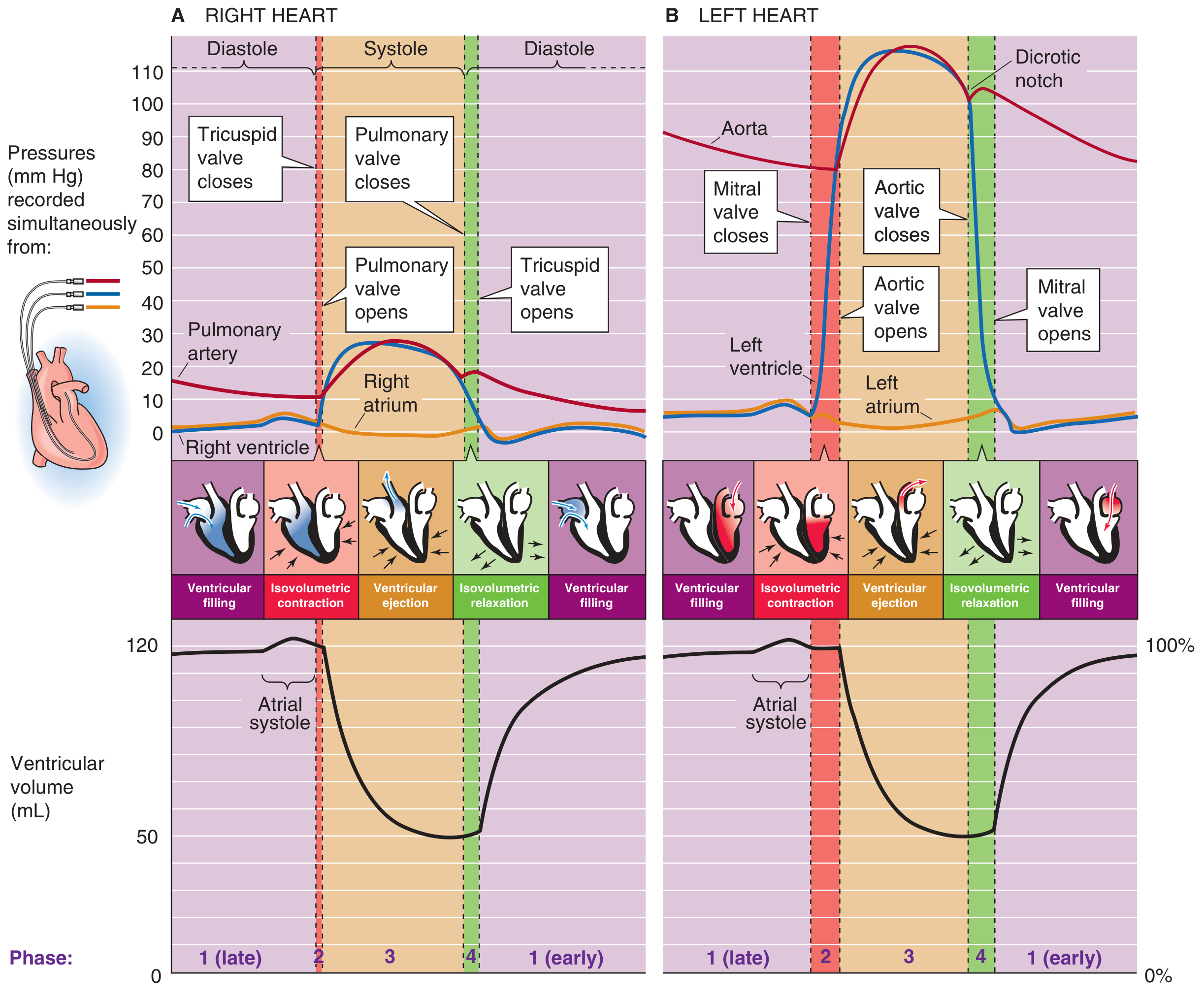
The right and left hearts go through the same four phases simultaneously, but at different pressure ranges:
- Right heart pressures are much lower (pulmonary artery systolic ~25 mmHg vs. aortic ~120 mmHg)
- Slight differences in timing of depolarization and valve events exist
Key Values at a Glance
| Parameter | Typical Value |
|---|---|
| Heart rate | 72 beats/min |
| Cycle duration | ~0.833 s |
| End-diastolic volume (EDV) | ~120 mL |
| End-systolic volume (ESV) | ~50 mL |
| Stroke volume (SV = EDV − ESV) | ~70 mL |
| Ejection fraction (EF = SV/EDV) | ~58% |
| Aortic systolic pressure | ~120 mmHg |
| Aortic diastolic pressure | ~80 mmHg |
Correlation: ECG ↔ Mechanical Events
| ECG Event | Mechanical Correlate |
|---|---|
| P wave | Atrial depolarization → atrial contraction |
| PR interval | AV conduction delay (~0.1 s) |
| QRS complex | Ventricular depolarization → isovolumetric contraction begins |
| ST segment | Ventricular ejection |
| T wave | Ventricular repolarization → reduced ejection → relaxation begins |
The ~0.1 s AV conduction delay is physiologically important — it allows the atria to contract and top off ventricular filling before ventricular contraction begins (atria act as "primer pumps"). — Guyton and Hall
Sources: Costanzo Physiology 7th Ed. | Medical Physiology (Boron & Boulpaep) | Guyton and Hall Textbook of Medical Physiology
This is a shared conversation. Sign in to Orris to start your own chat.