
development of placenta for MBBS ist prof exam
Development of the Placenta
Overview
- Fetal part - derived from the chorionic sac (villous chorion / chorion frondosum)
- Maternal part - derived from the decidua basalis (endometrium)
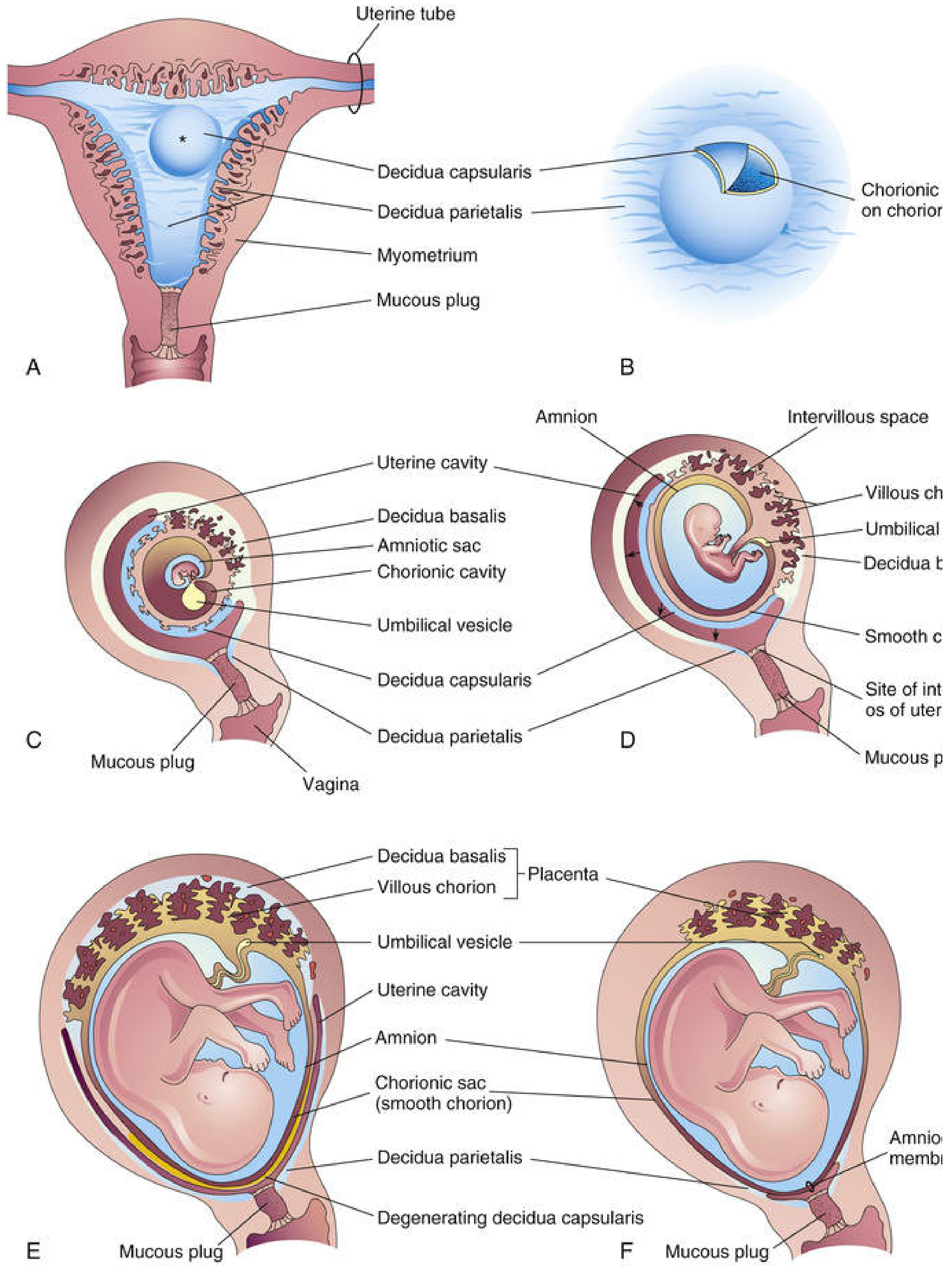
The Decidua (Maternal Component)
| Region | Location | Role |
|---|---|---|
| Decidua basalis | Deep to the conceptus | Forms the maternal part of the placenta |
| Decidua capsularis | Overlying (superficial to) the conceptus | Disappears by ~22 weeks |
| Decidua parietalis | All remaining endometrium | Fuses with smooth chorion later |
Development of the Chorionic Villi
- Villi associated with decidua capsularis lose blood supply, compress, and degenerate → form the smooth, bare chorion laeve (smooth chorion)
- Villi associated with decidua basalis proliferate, branch profusely, and enlarge → form the chorion frondosum (villous chorion) - this is the fetal part of the placenta
Structure of the Mature Placenta
Shape and Size
- Discoid shape (circular, due to the shape of the persistent villous area)
- At term: covers 15-30% of the decidua; weighs ~1/6 of the fetus
- Growth continues until fetus is ~18 weeks old
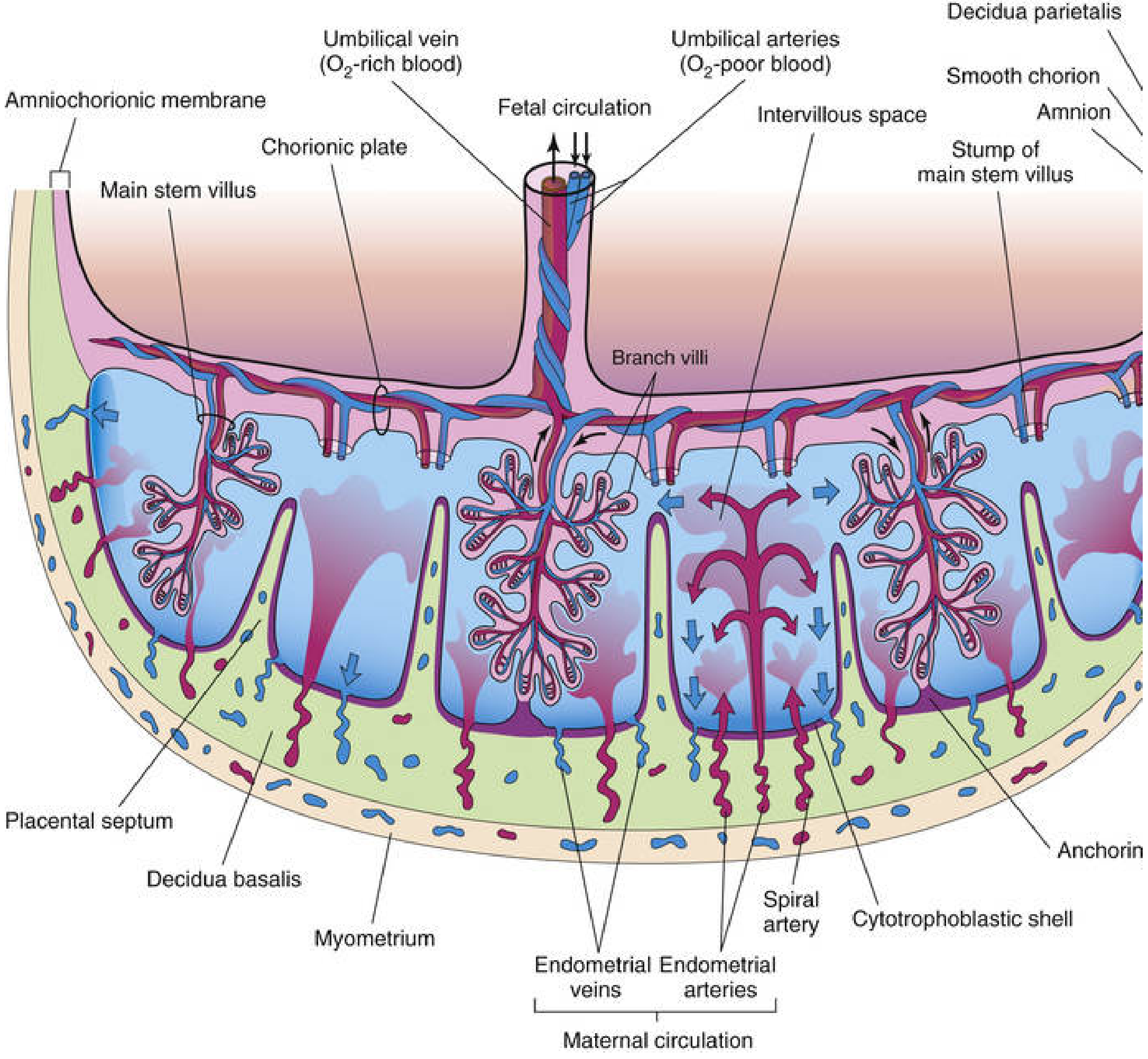
The Cytotrophoblastic Shell
Cotyledons and Placental Septa
- Each cotyledon = 2 or more stem villi + many branch villi
- By the end of the 4th month, the decidua basalis is almost entirely replaced by cotyledons (~15-30 cotyledons total)
- Septa do NOT reach the chorionic plate, so there is free communication between cotyledons
Placental Circulation
Fetal Placental Circulation
- Umbilical arteries (2) carry deoxygenated blood from fetus to placenta
- At the umbilical cord insertion, they branch into chorionic arteries on the chorionic plate
- These branch into the arteriocapillary-venous system within chorionic villi
- After gas/nutrient exchange, oxygenated blood returns via veins → converge to form the single umbilical vein
- The umbilical vein carries oxygen-rich blood back to the fetus
Maternal Placental Circulation
- 80-100 spiral endometrial arteries in the decidua basalis discharge blood into the intervillous space through gaps in the cytotrophoblastic shell
- Blood spurts toward the chorionic plate (the "roof"), then flows slowly over branch villi → exchange occurs
- Blood drains via endometrial veins back to maternal circulation
- The intervillous space at term contains ~150 mL of blood, replenished 3-4 times per minute
Key principle: Fetal and maternal blood do NOT normally mix. They are separated by the placental membrane.
Placental Membrane (Placental Barrier)
Before ~20 weeks (4 layers):
- Syncytiotrophoblast (outermost)
- Cytotrophoblast (layer of cells)
- Connective tissue (mesenchyme of villus)
- Fetal capillary endothelium (innermost)
After ~20 weeks (2-3 layers remain):
- The cytotrophoblast cells thin out and nearly disappear
- The membrane becomes very thin, greatly increasing efficiency of exchange
- At term: essentially just syncytiotrophoblast + fetal endothelium
Note: The term "placental barrier" is a misnomer - it is selective, not absolute. Many substances (drugs, viruses, antibodies) can cross it.
Functions of the Placenta
1. Respiration
- O₂ and CO₂ cross by simple diffusion
- Fetal hypoxia results from reduced uterine blood flow (not diffusion limitation)
2. Nutrition / Transfer of Substances
| Substance | Mechanism |
|---|---|
| Water | Simple diffusion |
| Glucose | Facilitated diffusion (via GLUT-1 transporter) |
| Amino acids | Active transport |
| Free fatty acids | Simple diffusion |
| Large proteins (e.g., IgG) | Pinocytosis |
| O₂, CO₂, CO | Simple diffusion |
| Electrolytes (Na⁺, K⁺) | Active transport |
3. Excretion
- Fetal waste products (urea, uric acid, creatinine, bilirubin) pass to maternal blood
4. Metabolism
- Synthesizes glycogen, cholesterol, fatty acids in early pregnancy
- Serves as energy/nutrient source for the embryo
5. Endocrine Secretion (Hormones)
| Hormone | Function |
|---|---|
| hCG (human chorionic gonadotropin) | Maintains corpus luteum; basis of pregnancy test; peaks at ~8-10 weeks |
| hPL (human placental lactogen) | Promotes fetal growth; mammary gland development; anti-insulin effect |
| Progesterone | Maintains pregnancy; produced from 10-12 weeks onward (after corpus luteum declines) |
| Estrogens (mainly estriol) | Uterine growth; mammary gland development |
| Relaxin | Relaxes pubic symphysis and uterine myometrium |
6. Immunological Functions
- Transfers maternal IgG antibodies to fetus (passive immunity) - by pinocytosis
- Acts as an allograft (semi-foreign tissue) - the placenta expresses non-classical HLA molecules (HLA-G, HLA-E) that prevent maternal immune rejection
Clinically Important Points (Exam Focus)
| Condition | Mechanism |
|---|---|
| Placenta previa | Implantation over the internal os; causes painless antepartum hemorrhage |
| IUGR | Reduced uteroplacental circulation → fetal hypoxia and growth restriction |
| Preterm labor | Premature rupture of amniochorionic membrane (<37 weeks) |
| Hydatidiform mole | Abnormal trophoblastic proliferation; elevated hCG |
| Transplacental infections | TORCH organisms (Toxoplasma, Rubella, CMV, Herpes) cross the membrane |
| Rh incompatibility | Minute fetal RBCs enter maternal circulation at delivery → maternal sensitization |
| Drug transfer | Most drugs cross by diffusion - thalidomide, alcohol, cocaine are teratogens |
Summary Table: Key Timelines
| Time | Key Event |
|---|---|
| Week 2 | Lacunae form in syncytiotrophoblast |
| Week 3 | Tertiary villi with blood vessels; vascular exchange begins |
| Week 4 | Complex vascular network established |
| Week 8 | Smooth chorion (chorion laeve) begins forming; villous chorion (chorion frondosum) develops |
| Weeks 11-14 | Trophoblastic plugs break down; maternal blood flow into IVS |
| Week 16-18 | Rapid placental growth; decidua basalis replaced by cotyledons |
| Week 20 | Cytotrophoblast thins; placental membrane now 2-3 layers |
| Week 36-40 | Full-term placenta: discoid, ~500g, ~15-30 cotyledons |
Create a summary presentation on placenta for quick revision
mkdir -p /home/daytona/workspace/placenta-pptx && ls /home/daytona/workspace/placenta-pptx
node /home/daytona/skills/shared/scripts/fetch_images.js "https://cdn.orris.care/cdss_images/ed2f7b3e657cf9ca61e6633743af7f0f642fe51fcb50148d53cce55911bfdecc.png" "https://cdn.orris.care/cdss_images/cf95d6bd3489d76433b2efd015ea28fdcc52726adb283d5a02565701ca44b53b.png" 2>/dev/null | node -e "const d=require('fs');const r=require('stream').Readable;process.stdin.resume();let b='';process.stdin.on('data',c=>b+=c);process.stdin.on('end',()=>{const arr=JSON.parse(b);arr.forEach((x,i)=>{if(x.base64){d.writeFileSync('/home/daytona/workspace/placenta-pptx/img'+i+'.b64',x.base64);}console.log(i,x.error||'OK',x.base64?x.base64.substring(0,40):'FAIL');});})"
~/placenta-pptx/generate.js
const pptxgen = require("pptxgenjs");
const fs = require("fs");

// Load pre-fetched images
const img0 = fs.readFileSync("/home/daytona/workspace/placenta-pptx/img0.b64", "utf8"); // decidua/fetal membranes
const img1 = fs.readFileSync("/home/daytona/workspace/placenta-pptx/img1.b64", "utf8"); // full-term placenta cross-section

let pres = new pptxgen();
pres.layout = "LAYOUT_16x9";
pres.title = "Development of the Placenta";
pres.author = "Orris Medical";

// ─── COLOUR PALETTE ───────────────────────────────────────────
// Deep teal/navy + warm rose accent + cream
const C = {
  navyDark:  "0D1B2A",  // dominant dark bg
  navy:      "1A3A52",  // section bg
  teal:      "1B6CA8",  // header bars
  tealLight: "2E90D4",  // accent shapes
  rose:      "C0392B",  // warm accent (highlight)
  gold:      "F0B429",  // callout accent
  cream:     "F5F0E8",  // light bg
  white:     "FFFFFF",
  offWhite:  "EDF2F7",
  textDark:  "1A1A2E",
  textMid:   "2C3E50",
  border:    "3A6B8A",
};

// ─── HELPER FUNCTIONS ─────────────────────────────────────────
function addSlideTitle(slide, title, subtitle) {
  // Top bar
  slide.addShape(pres.shapes.RECTANGLE, {
    x: 0, y: 0, w: 10, h: 0.72,
    fill: { color: C.teal }, line: { color: C.teal }
  });
  slide.addText(title, {
    x: 0.3, y: 0.04, w: 9.4, h: 0.64,
    fontSize: 20, bold: true, color: C.white, valign: "middle", margin: 0
  });
  if (subtitle) {
    slide.addText(subtitle, {
      x: 0.3, y: 0.73, w: 9.4, h: 0.35,
      fontSize: 11, color: C.teal, italic: true, margin: 0
    });
  }
}

function addFooter(slide, pageNum) {
  slide.addShape(pres.shapes.RECTANGLE, {
    x: 0, y: 5.32, w: 10, h: 0.305,
    fill: { color: C.navyDark }, line: { color: C.navyDark }
  });
  slide.addText("Development of the Placenta  |  MBBS 1st Prof  |  Moore's Embryology", {
    x: 0.3, y: 5.33, w: 8.5, h: 0.28,
    fontSize: 8, color: "8AAFC0", margin: 0
  });
  slide.addText(`${pageNum}`, {
    x: 9.2, y: 5.33, w: 0.6, h: 0.28,
    fontSize: 8, color: C.gold, bold: true, align: "right", margin: 0
  });
}

function cardBg(slide, x, y, w, h, col) {
  slide.addShape(pres.shapes.RECTANGLE, {
    x, y, w, h,
    fill: { color: col || C.offWhite },
    line: { color: C.border, pt: 0.8 },
    shadow: { type: "outer", color: "000000", blur: 5, offset: 2, angle: 135, opacity: 0.12 }
  });
}

function accentBar(slide, x, y, h, col) {
  slide.addShape(pres.shapes.RECTANGLE, {
    x, y, w: 0.07, h,
    fill: { color: col || C.rose }, line: { color: col || C.rose }
  });
}

// ══════════════════════════════════════════════════════════════
// SLIDE 1 — TITLE SLIDE
// ══════════════════════════════════════════════════════════════
{
  let s = pres.addSlide();
  // Full dark bg
  s.addShape(pres.shapes.RECTANGLE, { x:0,y:0,w:10,h:5.625, fill:{color:C.navyDark}, line:{color:C.navyDark} });

  // Decorative top stripe
  s.addShape(pres.shapes.RECTANGLE, { x:0,y:0,w:10,h:0.18, fill:{color:C.teal}, line:{color:C.teal} });
  // Bottom stripe
  s.addShape(pres.shapes.RECTANGLE, { x:0,y:5.44,w:10,h:0.185, fill:{color:C.rose}, line:{color:C.rose} });

  // Big vertical accent bar
  s.addShape(pres.shapes.RECTANGLE, { x:0.3,y:1.0,w:0.12,h:2.8, fill:{color:C.tealLight}, line:{color:C.tealLight} });

  // Title
  s.addText("DEVELOPMENT OF THE PLACENTA", {
    x:0.6, y:1.05, w:8.8, h:1.1,
    fontSize: 38, bold: true, color: C.white,
    charSpacing: 2, valign: "middle", margin: 0
  });

  // Subtitle
  s.addText("Fetomaternal Organ  |  Structure, Circulation & Functions", {
    x: 0.6, y: 2.2, w: 8.5, h: 0.5,
    fontSize: 16, color: C.tealLight, italic: false, margin: 0
  });

  // Tags row
  const tags = ["MBBS 1st Prof", "Embryology", "Moore's", "Quick Revision"];
  tags.forEach((t, i) => {
    s.addShape(pres.shapes.ROUNDED_RECTANGLE, {
      x: 0.6 + i*2.1, y: 2.88, w: 1.85, h: 0.32,
      fill: { color: C.teal }, line: { color: C.tealLight }, rectRadius: 0.08
    });
    s.addText(t, { x: 0.6 + i*2.1, y: 2.88, w: 1.85, h: 0.32, fontSize: 9, color: C.white, align: "center", valign: "middle", margin: 0 });
  });

  // Bottom source note
  s.addText("Source: The Developing Human — Moore, Persaud & Torchia", {
    x: 0.6, y: 5.05, w: 8, h: 0.28,
    fontSize: 9, color: "6A8FA0", italic: true, margin: 0
  });
}

// ══════════════════════════════════════════════════════════════
// SLIDE 2 — OVERVIEW: What is the Placenta?
// ══════════════════════════════════════════════════════════════
{
  let s = pres.addSlide();
  s.addShape(pres.shapes.RECTANGLE, { x:0,y:0,w:10,h:5.625, fill:{color:C.cream}, line:{color:C.cream} });
  addSlideTitle(s, "What is the Placenta?", "A fetomaternal organ essential for embryo/fetal survival");

  // Left column - definition card
  cardBg(s, 0.2, 1.15, 4.5, 1.5, C.navyDark);
  s.addText("DEFINITION", { x:0.3, y:1.2, w:4.3, h:0.3, fontSize:9, bold:true, color:C.gold, charSpacing:2, margin:0 });
  s.addText("A fetomaternal organ with two components:\n• Fetal part — from the chorionic sac (chorion frondosum)\n• Maternal part — from the decidua basalis", {
    x:0.3, y:1.5, w:4.3, h:1.1, fontSize:11, color:C.white, margin:0
  });

  // Right column - two mini cards
  cardBg(s, 4.95, 1.15, 4.8, 0.7, "D6EAF8");
  s.addText("SIZE AT TERM", { x:5.05, y:1.2, w:4.5, h:0.25, fontSize:9, bold:true, color:C.teal, charSpacing:2, margin:0 });
  s.addText("Covers 15–30% of decidua  |  Weighs ~1/6 of fetus  |  Discoid shape", {
    x:5.05, y:1.45, w:4.5, h:0.35, fontSize:10, color:C.textMid, margin:0
  });

  cardBg(s, 4.95, 2.0, 4.8, 0.7, "FDEBD0");
  s.addText("GROWTH", { x:5.05, y:2.05, w:4.5, h:0.25, fontSize:9, bold:true, color:C.rose, charSpacing:2, margin:0 });
  s.addText("Rapid growth until fetus is ~18 weeks  |  Uses 40–60% of O₂/glucose arriving at uterus", {
    x:5.05, y:2.3, w:4.5, h:0.35, fontSize:10, color:C.textMid, margin:0
  });

  // Functions strip
  cardBg(s, 0.2, 2.85, 9.6, 0.5, C.navy);
  s.addText("FUNCTIONS:", { x:0.35, y:2.87, w:1.4, h:0.45, fontSize:10, bold:true, color:C.gold, valign:"middle", margin:0 });
  const fns = ["Protection", "Nutrition", "Respiration", "Excretion", "Hormone Production", "Immunological"];
  fns.forEach((f,i)=>{
    s.addShape(pres.shapes.ROUNDED_RECTANGLE, { x:1.8+i*1.3, y:2.93, w:1.22, h:0.32, fill:{color:C.tealLight}, line:{color:C.tealLight}, rectRadius:0.06 });
    s.addText(f, { x:1.8+i*1.3, y:2.93, w:1.22, h:0.32, fontSize:8.5, color:C.white, align:"center", valign:"middle", margin:0 });
  });

  // Homeobox genes note
  cardBg(s, 0.2, 3.5, 9.6, 0.55, "EBF5FB");
  accentBar(s, 0.2, 3.5, 0.55, C.teal);
  s.addText("Homeobox genes HLX, MSX2, DLX3 expressed in trophoblast — induce trophoblastic invasion & regulate placental development", {
    x:0.45, y:3.52, w:9.2, h:0.48, fontSize:10, color:C.textMid, italic:true, margin:0
  });

  addFooter(s, 2);
}

// ══════════════════════════════════════════════════════════════
// SLIDE 3 — THE DECIDUA
// ══════════════════════════════════════════════════════════════
{
  let s = pres.addSlide();
  s.addShape(pres.shapes.RECTANGLE, { x:0,y:0,w:10,h:5.625, fill:{color:C.cream}, line:{color:C.cream} });
  addSlideTitle(s, "The Decidua — Maternal Component", "Endometrium of the pregnant uterus (functional layer that separates at parturition)");

  // Three region cards
  const regions = [
    { name:"Decidua BASALIS", loc:"Deep to the conceptus", role:"Forms the MATERNAL PART of placenta", col:"1A3A52", accent:C.gold },
    { name:"Decidua CAPSULARIS", loc:"Overlying (superficial to) the conceptus", role:"Disappears by ~22 weeks as chorionic sac enlarges", col:"154360", accent:C.tealLight },
    { name:"Decidua PARIETALIS", loc:"All remaining endometrium", role:"Fuses with smooth chorion later in pregnancy", col:"1B2631", accent:C.rose },
  ];
  regions.forEach((r, i) => {
    let x = 0.2 + i * 3.27;
    cardBg(s, x, 1.12, 3.1, 2.2, r.col);
    // Accent top band
    s.addShape(pres.shapes.RECTANGLE, { x, y:1.12, w:3.1, h:0.25, fill:{color:r.accent}, line:{color:r.accent} });
    s.addText(r.name, { x:x+0.1, y:1.38, w:2.9, h:0.45, fontSize:12, bold:true, color:C.white, margin:0 });
    s.addText("Location:", { x:x+0.1, y:1.84, w:2.9, h:0.22, fontSize:8.5, bold:true, color:r.accent, margin:0 });
    s.addText(r.loc, { x:x+0.1, y:2.05, w:2.9, h:0.4, fontSize:9.5, color:"C8D6DF", margin:0 });
    s.addText("Role:", { x:x+0.1, y:2.5, w:2.9, h:0.22, fontSize:8.5, bold:true, color:r.accent, margin:0 });
    s.addText(r.role, { x:x+0.1, y:2.7, w:2.9, h:0.5, fontSize:9.5, color:C.white, margin:0 });
  });

  // Decidual reaction box
  cardBg(s, 0.2, 3.45, 9.6, 0.7, "FDFEFE");
  accentBar(s, 0.2, 3.45, 0.7, C.rose);
  s.addText("DECIDUAL REACTION", { x:0.45, y:3.48, w:9.1, h:0.25, fontSize:9, bold:true, color:C.rose, charSpacing:1, margin:0 });
  s.addText("Rising progesterone → connective tissue cells enlarge, accumulate glycogen & lipid → become DECIDUAL CELLS. Syncytiotrophoblast digests decidual cells near the chorionic sac for embryo nutrition.", {
    x:0.45, y:3.73, w:9.1, h:0.38, fontSize:9.5, color:C.textMid, margin:0
  });

  // image
  s.addImage({ data: img0, x:9.62, y:1.12, w:0.001, h:0.001 }); // hidden (too small to show text is placeholder)

  addFooter(s, 3);
}

// ══════════════════════════════════════════════════════════════
// SLIDE 4 — DEVELOPMENT OF CHORIONIC VILLI (Timeline)
// ══════════════════════════════════════════════════════════════
{
  let s = pres.addSlide();
  s.addShape(pres.shapes.RECTANGLE, { x:0,y:0,w:10,h:5.625, fill:{color:C.navyDark}, line:{color:C.navyDark} });
  addSlideTitle(s, "Development of Chorionic Villi — Timeline", "From fertilisation to full-term placenta");

  // Horizontal timeline line
  s.addShape(pres.shapes.RECTANGLE, { x:0.4, y:2.75, w:9.2, h:0.08, fill:{color:C.tealLight}, line:{color:C.tealLight} });

  const events = [
    { wk:"Wk 2", label:"Lacunae form in\nsyncytiotrophoblast", y:1.2, dot:C.gold },
    { wk:"Wk 3", label:"Tertiary villi with\nblood vessels formed;\nexchange begins", y:1.1, dot:C.tealLight },
    { wk:"Wk 4", label:"Complex vascular\nnetwork established", y:1.2, dot:C.rose },
    { wk:"Wk 8", label:"Smooth chorion forms;\nVillous chorion\n(chorion frondosum)\ndevelops", y:0.95, dot:C.gold },
    { wk:"Wk 11-14", label:"Trophoblastic plugs\nbreak down; maternal\nwhole blood enters IVS", y:1.1, dot:C.tealLight },
    { wk:"Wk 20+", label:"Cytotrophoblast thins;\nplacental membrane\nnow 2-3 layers only", y:1.1, dot:C.rose },
  ];

  events.forEach((e, i) => {
    let x = 0.55 + i * 1.5;
    // dot
    s.addShape(pres.shapes.OVAL, { x:x+0.25, y:2.66, w:0.18, h:0.18, fill:{color:e.dot}, line:{color:e.dot} });
    // week label below line
    s.addText(e.wk, { x:x, y:2.88, w:0.7, h:0.3, fontSize:10, bold:true, color:e.dot, align:"center", margin:0 });
    // text card above
    cardBg(s, x-0.08, e.y, 0.88, 2.75-e.y-0.15, "1E3A50");
    s.addText(e.label, { x:x-0.02, y:e.y+0.08, w:0.82, h:2.75-e.y-0.28, fontSize:8.5, color:C.white, margin:0 });
  });

  // Chorion types
  cardBg(s, 0.2, 3.28, 4.5, 0.8, "1E2D3D");
  accentBar(s, 0.2, 3.28, 0.8, C.gold);
  s.addText("Chorion LAEVE (Smooth Chorion)", { x:0.42, y:3.3, w:4.1, h:0.28, fontSize:10, bold:true, color:C.gold, margin:0 });
  s.addText("Villi of decidua capsularis lose blood → degenerate → bare, avascular area", { x:0.42, y:3.57, w:4.1, h:0.46, fontSize:9, color:"B8C9D3", margin:0 });

  cardBg(s, 5.0, 3.28, 4.8, 0.8, "1E2D3D");
  accentBar(s, 5.0, 3.28, 0.8, C.rose);
  s.addText("Chorion FRONDOSUM (Villous Chorion)", { x:5.22, y:3.3, w:4.4, h:0.28, fontSize:10, bold:true, color:C.rose, margin:0 });
  s.addText("Villi of decidua basalis → proliferate, branch profusely → FETAL PART of placenta", { x:5.22, y:3.57, w:4.4, h:0.46, fontSize:9, color:"B8C9D3", margin:0 });

  addFooter(s, 4);
}

// ══════════════════════════════════════════════════════════════
// SLIDE 5 — MATURE PLACENTA STRUCTURE (with image)
// ══════════════════════════════════════════════════════════════
{
  let s = pres.addSlide();
  s.addShape(pres.shapes.RECTANGLE, { x:0,y:0,w:10,h:5.625, fill:{color:C.cream}, line:{color:C.cream} });
  addSlideTitle(s, "Structure of the Mature Placenta", "Cotyledons, septa, and the cytotrophoblastic shell");

  // Image (placenta cross-section) on right
  s.addImage({ data: img1, x:5.5, y:0.85, w:4.3, h:3.6,
    shadow: { type:"outer", color:"000000", blur:8, offset:3, angle:135, opacity:0.25 }
  });
  s.addText("Moore's Embryology, Fig. 7.5", {
    x:5.5, y:4.47, w:4.3, h:0.22, fontSize:7.5, color:"888888", italic:true, align:"center", margin:0
  });

  // Left: structure bullets
  const structs = [
    { title:"Cytotrophoblastic Shell", body:"External layer of trophoblastic cells; anchors chorionic sac to decidua basalis; contains gaps for endometrial vessels", col:C.teal },
    { title:"Chorionic Plate", body:"Roof of the intervillous space; stem villi arise from here", col:C.tealLight },
    { title:"Placental Septa", body:"Wedge-shaped decidual projections; divide fetal part into cotyledons; do NOT reach chorionic plate (free communication)", col:C.rose },
    { title:"Cotyledons (~15–30)", body:"Each = 2+ stem villi + many branch villi. Regulated by MAP2K1, MAP2K2, Gcm1. By 4th month, replace entire decidua basalis", col:C.gold },
  ];
  let cy = 1.1;
  structs.forEach(st => {
    cardBg(s, 0.2, cy, 5.1, 0.82, "FFFFFF");
    accentBar(s, 0.2, cy, 0.82, st.col);
    s.addText(st.title, { x:0.42, y:cy+0.05, w:4.75, h:0.28, fontSize:10, bold:true, color:st.col, margin:0 });
    s.addText(st.body, { x:0.42, y:cy+0.33, w:4.75, h:0.44, fontSize:8.8, color:C.textMid, margin:0 });
    cy += 0.9;
  });

  addFooter(s, 5);
}

// ══════════════════════════════════════════════════════════════
// SLIDE 6 — PLACENTAL CIRCULATION
// ══════════════════════════════════════════════════════════════
{
  let s = pres.addSlide();
  s.addShape(pres.shapes.RECTANGLE, { x:0,y:0,w:10,h:5.625, fill:{color:C.navyDark}, line:{color:C.navyDark} });
  addSlideTitle(s, "Placental Circulation", "Fetal and maternal circulations — separated, never mixed");

  // Two large columns
  // FETAL
  cardBg(s, 0.2, 1.1, 4.65, 3.5, "0E2236");
  s.addShape(pres.shapes.RECTANGLE, { x:0.2, y:1.1, w:4.65, h:0.3, fill:{color:C.tealLight}, line:{color:C.tealLight} });
  s.addText("FETAL PLACENTAL CIRCULATION", { x:0.3, y:1.11, w:4.45, h:0.28, fontSize:9.5, bold:true, color:C.white, charSpacing:1, margin:0 });

  const fetalPts = [
    "Umbilical ARTERIES (2) carry O₂-poor blood FROM fetus TO placenta",
    "Divide into chorionic arteries on the chorionic plate",
    "Branch into arteriocapillary-venous system inside chorionic villi",
    "Exchange O₂ & nutrients across placental membrane",
    "Oxygenated blood returns via veins → merge into single umbilical VEIN",
    "Umbilical VEIN carries O₂-rich blood BACK TO fetus",
  ];
  fetalPts.forEach((pt, i) => {
    s.addShape(pres.shapes.OVAL, { x:0.35, y:1.55+i*0.38, w:0.12, h:0.12, fill:{color:C.tealLight}, line:{color:C.tealLight} });
    s.addText(pt, { x:0.55, y:1.5+i*0.38, w:4.15, h:0.35, fontSize:9, color:"C8D6DF", margin:0 });
  });

  // MATERNAL
  cardBg(s, 5.15, 1.1, 4.65, 3.5, "1E0A0A");
  s.addShape(pres.shapes.RECTANGLE, { x:5.15, y:1.1, w:4.65, h:0.3, fill:{color:C.rose}, line:{color:C.rose} });
  s.addText("MATERNAL PLACENTAL CIRCULATION", { x:5.25, y:1.11, w:4.45, h:0.28, fontSize:9.5, bold:true, color:C.white, charSpacing:1, margin:0 });

  const matPts = [
    "80–100 spiral endometrial arteries in decidua basalis",
    "Pass through gaps in cytotrophoblastic shell",
    "Blood SPURTS toward chorionic plate (higher pressure)",
    "Flows slowly over branch villi → exchange occurs",
    "Drains via endometrial veins back to maternal circulation",
    "IVS contains ~150 mL blood, replenished 3–4×/min",
  ];
  matPts.forEach((pt, i) => {
    s.addShape(pres.shapes.OVAL, { x:5.3, y:1.55+i*0.38, w:0.12, h:0.12, fill:{color:C.rose}, line:{color:C.rose} });
    s.addText(pt, { x:5.5, y:1.5+i*0.38, w:4.15, h:0.35, fontSize:9, color:"DFC8C8", margin:0 });
  });

  // Key callout
  cardBg(s, 0.2, 4.68, 9.6, 0.5, "1A2A1A");
  accentBar(s, 0.2, 4.68, 0.5, C.gold);
  s.addText("KEY: Fetal & maternal blood do NOT normally mix — separated by the placental membrane. Trophoblastic plugs (Wks 1–11) allow only plasma into IVS, maintaining low-O₂ for early development.", {
    x:0.45, y:4.7, w:9.1, h:0.44, fontSize:9, color:C.gold, italic:true, margin:0
  });

  addFooter(s, 6);
}

// ══════════════════════════════════════════════════════════════
// SLIDE 7 — PLACENTAL MEMBRANE (BARRIER)
// ══════════════════════════════════════════════════════════════
{
  let s = pres.addSlide();
  s.addShape(pres.shapes.RECTANGLE, { x:0,y:0,w:10,h:5.625, fill:{color:C.cream}, line:{color:C.cream} });
  addSlideTitle(s, "Placental Membrane (Placental Barrier)", "Composite extrafetal tissue separating maternal & fetal blood");

  // Before 20 wks — 4 layers (left)
  cardBg(s, 0.2, 1.1, 4.5, 2.5, C.navyDark);
  s.addShape(pres.shapes.RECTANGLE, { x:0.2, y:1.1, w:4.5, h:0.3, fill:{color:C.rose}, line:{color:C.rose} });
  s.addText("BEFORE ~20 WEEKS  —  4 LAYERS", { x:0.3, y:1.11, w:4.3, h:0.28, fontSize:9.5, bold:true, color:C.white, margin:0 });

  const layers4 = [
    { n:"1.", lyr:"Syncytiotrophoblast", note:"Outermost; continuous layer; no cell boundaries" },
    { n:"2.", lyr:"Cytotrophoblast", note:"Layer of individual trophoblastic cells" },
    { n:"3.", lyr:"Connective tissue", note:"Mesenchyme of the villus (with Hofbauer cells)" },
    { n:"4.", lyr:"Fetal capillary endothelium", note:"Innermost layer" },
  ];
  layers4.forEach((l, i) => {
    s.addText(l.n, { x:0.3, y:1.52+i*0.5, w:0.25, h:0.4, fontSize:11, bold:true, color:C.rose, margin:0 });
    s.addText(l.lyr, { x:0.55, y:1.52+i*0.5, w:3.9, h:0.22, fontSize:10, bold:true, color:C.white, margin:0 });
    s.addText(l.note, { x:0.55, y:1.73+i*0.5, w:3.9, h:0.26, fontSize:8.5, color:"B0BEC5", margin:0 });
  });

  // After 20 wks — 2-3 layers (right)
  cardBg(s, 4.9, 1.1, 4.9, 2.5, C.navy);
  s.addShape(pres.shapes.RECTANGLE, { x:4.9, y:1.1, w:4.9, h:0.3, fill:{color:C.gold}, line:{color:C.gold} });
  s.addText("AFTER ~20 WEEKS  —  2–3 LAYERS", { x:5.0, y:1.11, w:4.7, h:0.28, fontSize:9.5, bold:true, color:C.navyDark, margin:0 });
  s.addText("Cytotrophoblast cells thin out and largely disappear.", { x:5.05, y:1.48, w:4.65, h:0.35, fontSize:10, color:C.white, margin:0 });
  s.addText("Remaining layers:", { x:5.05, y:1.85, w:4.65, h:0.25, fontSize:9.5, bold:true, color:C.gold, margin:0 });
  const rem = ["Syncytiotrophoblast", "Thin connective tissue", "Fetal capillary endothelium (very thin)"];
  rem.forEach((r,i)=>{
    s.addShape(pres.shapes.OVAL, { x:5.1, y:2.16+i*0.38, w:0.1, h:0.1, fill:{color:C.gold}, line:{color:C.gold} });
    s.addText(r, { x:5.28, y:2.12+i*0.38, w:4.4, h:0.3, fontSize:10, color:C.white, margin:0 });
  });
  s.addText("→ Much thinner = increased efficiency of exchange", { x:5.05, y:3.28, w:4.65, h:0.28, fontSize:9.5, color:C.gold, italic:true, margin:0 });

  // Hofbauer cells + barrier note
  cardBg(s, 0.2, 3.72, 4.5, 0.55, "EBF5FB");
  accentBar(s, 0.2, 3.72, 0.55, C.teal);
  s.addText("Hofbauer Cells: Fetal macrophages in chorionic villi; present throughout pregnancy; involved in placental development & immune defense.", {
    x:0.42, y:3.74, w:4.2, h:0.49, fontSize:9, color:C.textMid, margin:0
  });

  cardBg(s, 4.9, 3.72, 4.9, 0.55, "FDEDEC");
  accentBar(s, 4.9, 3.72, 0.55, C.rose);
  s.addText("'Placental Barrier' is a MISNOMER — it is SELECTIVE, not absolute. Drugs, viruses, IgG, & many substances cross freely.", {
    x:5.12, y:3.74, w:4.6, h:0.49, fontSize:9.5, color:C.rose, bold:false, margin:0
  });

  addFooter(s, 7);
}

// ══════════════════════════════════════════════════════════════
// SLIDE 8 — TRANSPORT ACROSS PLACENTAL MEMBRANE
// ══════════════════════════════════════════════════════════════
{
  let s = pres.addSlide();
  s.addShape(pres.shapes.RECTANGLE, { x:0,y:0,w:10,h:5.625, fill:{color:C.navyDark}, line:{color:C.navyDark} });
  addSlideTitle(s, "Placental Transfer — Mechanisms & Substances", "How substances cross the placental membrane");

  // Mechanism cards - top row
  const mechs = [
    { name:"Simple Diffusion", eg:"O₂, CO₂, CO, Water, Fatty acids, Urea, Alcohol", col:C.teal },
    { name:"Facilitated Diffusion", eg:"Glucose — via GLUT-1 transporter (no energy needed, uses transporter)", col:C.tealLight },
    { name:"Active Transport", eg:"Amino acids, Iron (Fe), Calcium, Electrolytes (Na⁺, K⁺)", col:C.rose },
    { name:"Pinocytosis", eg:"Large proteins e.g. IgG (maternal antibodies → fetal passive immunity)", col:C.gold },
  ];
  mechs.forEach((m,i) => {
    let x = 0.2 + i*2.42;
    cardBg(s, x, 1.08, 2.3, 1.55, "1A2E3D");
    s.addShape(pres.shapes.RECTANGLE, { x, y:1.08, w:2.3, h:0.28, fill:{color:m.col}, line:{color:m.col} });
    s.addText(m.name, { x:x+0.07, y:1.09, w:2.15, h:0.27, fontSize:9.5, bold:true, color:C.navyDark, margin:0 });
    s.addText(m.eg, { x:x+0.07, y:1.4, w:2.15, h:1.18, fontSize:8.8, color:C.white, margin:0 });
  });

  // Special transfer
  cardBg(s, 0.2, 2.75, 9.6, 0.55, "1A1A2E");
  s.addShape(pres.shapes.RECTANGLE, { x:0.2, y:2.75, w:9.6, h:0.28, fill:{color:"2C3E6B"}, line:{color:"2C3E6B"} });
  s.addText("3 OTHER TRANSFER MECHANISMS", { x:0.3, y:2.76, w:9.3, h:0.26, fontSize:9, bold:true, color:C.white, charSpacing:1, margin:0 });
  const other = [
    "① Microscopic breaks in placental membrane → fetal RBCs enter maternal blood (Rh sensitisation)",
    "② Cells cross under own power — maternal leukocytes, Treponema pallidum (syphilis)",
    "③ Some bacteria/protozoa (e.g. Toxoplasma gondii) create lesions and cross through defects",
  ];
  other.forEach((o,i) => {
    s.addText(o, { x:0.3, y:3.05+i*0.28, w:9.4, h:0.26, fontSize:9, color:"B0C8D8", margin:0 });
  });

  // Key substances box
  cardBg(s, 0.2, 3.92, 9.6, 0.8, "111E2A");
  s.addText("GASES:", { x:0.35, y:3.96, w:1.0, h:0.25, fontSize:9, bold:true, color:C.teal, margin:0 });
  s.addText("O₂, CO₂, CO — simple diffusion | Fetal hypoxia = flow-limited, not diffusion-limited", { x:1.35, y:3.96, w:8.3, h:0.25, fontSize:9, color:C.white, margin:0 });
  s.addText("DRUGS:", { x:0.35, y:4.24, w:1.0, h:0.25, fontSize:9, bold:true, color:C.rose, margin:0 });
  s.addText("Most drugs cross by diffusion — Thalidomide, Alcohol, Cocaine, Warfarin = teratogens | Infections: TORCH organisms", { x:1.35, y:4.24, w:8.3, h:0.25, fontSize:9, color:C.white, margin:0 });
  s.addText("IMMUNITY:", { x:0.35, y:4.52, w:1.2, h:0.25, fontSize:9, bold:true, color:C.gold, margin:0 });
  s.addText("IgG crosses via pinocytosis → neonatal passive immunity lasting 3–6 months | IgM, IgA do NOT cross", { x:1.55, y:4.52, w:8.1, h:0.25, fontSize:9, color:C.white, margin:0 });

  addFooter(s, 8);
}

// ══════════════════════════════════════════════════════════════
// SLIDE 9 — HORMONES PRODUCED BY PLACENTA
// ══════════════════════════════════════════════════════════════
{
  let s = pres.addSlide();
  s.addShape(pres.shapes.RECTANGLE, { x:0,y:0,w:10,h:5.625, fill:{color:C.cream}, line:{color:C.cream} });
  addSlideTitle(s, "Placental Endocrine Function — Hormones Produced", "The placenta is a major endocrine organ from early pregnancy");

  const hormones = [
    {
      name:"hCG", full:"Human Chorionic Gonadotrophin",
      when:"Detectable from wk 2; peaks wk 8–10; falls by wk 20",
      action:"Maintains corpus luteum → sustains progesterone production in 1st trimester. BASIS OF PREGNANCY TEST.",
      col:C.teal
    },
    {
      name:"hPL", full:"Human Placental Lactogen",
      when:"Rises throughout pregnancy",
      action:"Promotes fetal growth; mammary gland development; anti-insulin effect (↑ maternal blood glucose for fetus)",
      col:C.rose
    },
    {
      name:"Progesterone", full:"Progestogen",
      when:"Corpus luteum → placenta takes over at 10–12 wks (luteo-placental shift)",
      action:"Maintains pregnancy; prevents uterine contractions; stimulates decidual reaction",
      col:C.gold
    },
    {
      name:"Estrogens", full:"Mainly Estriol (E₃)",
      when:"Rises throughout; estriol useful index of fetoplacental health",
      action:"Uterine growth; mammary gland development; softens ligaments (with relaxin)",
      col:"8E44AD"
    },
    {
      name:"Relaxin", full:"Peptide hormone",
      when:"Throughout pregnancy",
      action:"Relaxes pubic symphysis; inhibits uterine myometrial contractions",
      col:"1B7A4E"
    },
  ];

  hormones.forEach((h, i) => {
    let x = i < 3 ? 0.2 + i*3.27 : 0.2 + (i-3)*5.0;
    let y = i < 3 ? 1.1 : 3.18;
    let w = i < 3 ? 3.1 : 4.7;
    cardBg(s, x, y, w, 1.9, "FFFFFF");
    s.addShape(pres.shapes.RECTANGLE, { x, y, w, h:0.3, fill:{color:h.col}, line:{color:h.col} });
    s.addText(h.name, { x:x+0.1, y:y+0.01, w:1.5, h:0.28, fontSize:13, bold:true, color:C.white, margin:0 });
    s.addText(h.full, { x:x+0.1, y:y+0.34, w:w-0.2, h:0.25, fontSize:8.5, bold:true, color:h.col, margin:0 });
    s.addText(h.when, { x:x+0.1, y:y+0.58, w:w-0.2, h:0.35, fontSize:8, color:"555555", italic:true, margin:0 });
    s.addText(h.action, { x:x+0.1, y:y+0.92, w:w-0.2, h:0.88, fontSize:8.8, color:C.textMid, margin:0 });
  });

  addFooter(s, 9);
}

// ══════════════════════════════════════════════════════════════
// SLIDE 10 — CLINICAL CORRELATES
// ══════════════════════════════════════════════════════════════
{
  let s = pres.addSlide();
  s.addShape(pres.shapes.RECTANGLE, { x:0,y:0,w:10,h:5.625, fill:{color:C.navyDark}, line:{color:C.navyDark} });
  addSlideTitle(s, "Clinical Correlates — High-Yield for Exams", "Important applied embryology concepts");

  const clinics = [
    { cond:"Placenta Previa", mech:"Implantation over internal os", sign:"Painless antepartum haemorrhage (PAH)", col:C.rose },
    { cond:"IUGR", mech:"↓ Uteroplacental blood flow", sign:"Fetal hypoxia, growth restriction, death if severe", col:"E67E22" },
    { cond:"Preterm Labour", mech:"Premature rupture of amniochorionic membrane (<37 wks)", sign:"Amniotic fluid escapes vaginally", col:C.tealLight },
    { cond:"Hydatidiform Mole", mech:"Abnormal trophoblastic proliferation", sign:"Markedly ↑↑ hCG; grapelike vesicles; no fetal parts", col:C.gold },
    { cond:"Rh Incompatibility", mech:"Fetal RBCs enter maternal blood (esp. at delivery)", sign:"Maternal sensitisation → anti-D IgG attacks fetal RBCs in next Rh+ pregnancy", col:"9B59B6" },
    { cond:"TORCH Infections", mech:"Organisms cross placental membrane via lesions or actively", sign:"Toxoplasma, Rubella, CMV, Herpes → congenital defects", col:"1A8C6B" },
  ];

  clinics.forEach((c, i) => {
    let col = i < 3 ? 0 : 1;
    let row = i % 3;
    let x = col === 0 ? 0.2 : 5.1;
    let y = 1.1 + row * 1.42;
    cardBg(s, x, y, 4.65, 1.3, "0F1D2A");
    s.addShape(pres.shapes.RECTANGLE, { x, y, w:4.65, h:0.28, fill:{color:c.col}, line:{color:c.col} });
    s.addText(c.cond, { x:x+0.1, y:y+0.01, w:4.4, h:0.27, fontSize:10.5, bold:true, color:C.white, margin:0 });
    s.addText("Mechanism: ", { x:x+0.1, y:y+0.34, w:1.2, h:0.24, fontSize:8.5, bold:true, color:c.col, margin:0 });
    s.addText(c.mech, { x:x+1.3, y:y+0.34, w:3.2, h:0.24, fontSize:8.5, color:"C8D6DF", margin:0 });
    s.addText("Sign/Result: ", { x:x+0.1, y:y+0.62, w:1.25, h:0.24, fontSize:8.5, bold:true, color:c.col, margin:0 });
    s.addText(c.sign, { x:x+1.35, y:y+0.62, w:3.15, h:0.55, fontSize:8.5, color:C.white, margin:0 });
  });

  addFooter(s, 10);
}

// ══════════════════════════════════════════════════════════════
// SLIDE 11 — KEY TIMELINES + QUICK RECAP TABLE
// ══════════════════════════════════════════════════════════════
{
  let s = pres.addSlide();
  s.addShape(pres.shapes.RECTANGLE, { x:0,y:0,w:10,h:5.625, fill:{color:C.cream}, line:{color:C.cream} });
  addSlideTitle(s, "Key Timelines & Quick Recap", "At-a-glance review for revision");

  const rows = [
    ["Week 2", "Lacunae form in syncytiotrophoblast → precursors of IVS"],
    ["Week 3", "Tertiary villi with blood vessels; physiological exchange established"],
    ["Week 4", "Complex vascular network in placenta"],
    ["Week 8", "Smooth chorion + Villous chorion differentiated"],
    ["Wk 11–14", "Trophoblastic plugs break down; whole maternal blood enters IVS"],
    ["Wk 10–12", "Luteo-placental shift — placenta takes over progesterone production"],
    ["Wk 18", "Rapid placental growth complete; cytotrophoblast thinning"],
    ["Wk 20+", "Placental membrane now only 2–3 layers"],
    ["Term", "Discoid placenta; 15–30 cotyledons; ~500g; 80–100 spiral arteries"],
  ];

  // Table header
  s.addShape(pres.shapes.RECTANGLE, { x:0.2, y:1.08, w:9.6, h:0.32, fill:{color:C.teal}, line:{color:C.teal} });
  s.addText("WEEK / TIMING", { x:0.3, y:1.09, w:1.6, h:0.3, fontSize:9, bold:true, color:C.white, margin:0 });
  s.addText("KEY EVENT", { x:2.05, y:1.09, w:7.6, h:0.3, fontSize:9, bold:true, color:C.white, margin:0 });

  rows.forEach((r, i) => {
    let bg = i % 2 === 0 ? "FFFFFF" : "EDF2F7";
    s.addShape(pres.shapes.RECTANGLE, { x:0.2, y:1.4+i*0.38, w:9.6, h:0.38, fill:{color:bg}, line:{color:bg} });
    s.addText(r[0], { x:0.3, y:1.41+i*0.38, w:1.6, h:0.36, fontSize:9.5, bold:true, color:C.teal, valign:"middle", margin:0 });
    s.addText(r[1], { x:2.05, y:1.41+i*0.38, w:7.6, h:0.36, fontSize:9.5, color:C.textMid, valign:"middle", margin:0 });
  });

  addFooter(s, 11);
}

// ══════════════════════════════════════════════════════════════
// SLIDE 12 — SUMMARY / CLOSING SLIDE
// ══════════════════════════════════════════════════════════════
{
  let s = pres.addSlide();
  s.addShape(pres.shapes.RECTANGLE, { x:0,y:0,w:10,h:5.625, fill:{color:C.navyDark}, line:{color:C.navyDark} });

  // Top bar
  s.addShape(pres.shapes.RECTANGLE, { x:0,y:0,w:10,h:0.18, fill:{color:C.teal}, line:{color:C.teal} });
  s.addShape(pres.shapes.RECTANGLE, { x:0,y:5.44,w:10,h:0.185, fill:{color:C.rose}, line:{color:C.rose} });

  s.addText("PLACENTA — EXAM SUMMARY", {
    x:0.5, y:0.4, w:9, h:0.7, fontSize:28, bold:true, color:C.white, align:"center", charSpacing:3, margin:0
  });

  const summaryPts = [
    { icon:"🔵", pt:"FETAL PART = Chorion frondosum (villous chorion) from chorionic sac" },
    { icon:"🔴", pt:"MATERNAL PART = Decidua basalis (3 regions: basalis, capsularis, parietalis)" },
    { icon:"⚡", pt:"Vascular exchange begins week 3 | Mature network by week 4" },
    { icon:"🧱", pt:"Placental membrane: 4 layers before 20 wks → 2–3 layers after (thins for efficiency)" },
    { icon:"🩸", pt:"Fetal blood NEVER mixes with maternal blood (separated by placental membrane)" },
    { icon:"💊", pt:"Transport: Simple diffusion | Facilitated diffusion (glucose) | Active transport | Pinocytosis (IgG)" },
    { icon:"⚗️", pt:"Hormones: hCG (corpus luteum maintenance) | hPL | Progesterone | Estrogens | Relaxin" },
    { icon:"⚠️", pt:"Clinical: Previa (PAH), IUGR, Preterm labour, Mole (↑↑hCG), Rh incompatibility, TORCH" },
  ];

  summaryPts.forEach((sp, i) => {
    let col = i % 2 === 0 ? "1A2E3D" : "0F1D2A";
    s.addShape(pres.shapes.RECTANGLE, { x:0.2, y:1.22+i*0.5, w:9.6, h:0.48, fill:{color:col}, line:{color:col} });
    s.addText(sp.icon + "  " + sp.pt, {
      x:0.35, y:1.23+i*0.5, w:9.3, h:0.46,
      fontSize:9.8, color:C.white, valign:"middle", margin:0
    });
  });
}

// ─── WRITE FILE ──────────────────────────────────────────────
pres.writeFile({ fileName: "/home/daytona/workspace/placenta-pptx/Placenta_Revision.pptx" })
  .then(() => console.log("✅ Saved: /home/daytona/workspace/placenta-pptx/Placenta_Revision.pptx"))
  .catch(e => { console.error("❌ Error:", e); process.exit(1); });
cd /home/daytona/workspace/placenta-pptx && node generate.js 2>&1
ls -lh /home/daytona/workspace/placenta-pptx/Placenta_Revision.pptx
Placenta Revision
Presentation · PPTX
| Slide | Content |
|---|---|
| 1 | Title slide |
| 2 | What is the Placenta? (overview, functions) |
| 3 | The Decidua — 3 regions + decidual reaction |
| 4 | Development of chorionic villi — visual timeline (Wk 2 → Term) |
| 5 | Mature placenta structure — cotyledons, septa, cytotrophoblastic shell + Moore's diagram |
| 6 | Placental circulation — fetal + maternal (dark theme, color-coded) |
| 7 | Placental membrane / "barrier" — 4 layers vs 2-3 layers + Hofbauer cells |
| 8 | Transport mechanisms — diffusion, active, pinocytosis + TORCH/drugs table |
| 9 | Placental hormones — hCG, hPL, Progesterone, Estrogens, Relaxin |
| 10 | Clinical correlates — Previa, IUGR, Preterm, Mole, Rh incompatibility, TORCH |
| 11 | Key timelines table (Wk 2 → Term) |
| 12 | Exam summary — all 8 key takeaways at a glance |