
Give me a notes about irritable bowel syndrome
Reading File
Finding Sources
Searching PubMed
"irritable bowel syndrome"[MeSH Terms] AND management
Now let me read the most comprehensive sources in parallel:
Reading File
Reading File
Excellent — the Goldman-Cecil block has very rich content. Let me read more of it and also the Sleisenger chapter on IBS specifically:
Reading File
Finding Sources
Let me read the main IBS chapter from Goldman-Cecil (around line 2172):
Reading File
Let me read the dedicated IBS chapter from Goldman-Cecil at line 2172:
Reading File
Reading File
Reading File
Reading File
Reading File
Reading File
Reading File
Reading File
Reading File
Reading File
I now have comprehensive information to write detailed notes on IBS. Let me compile everything:
Irritable Bowel Syndrome (IBS)
Source: Goldman-Cecil Medicine, Sleisenger & Fordtran's GI and Liver Disease
Definition
IBS is a functional bowel disorder characterized by chronic or recurrent abdominal pain associated with alterations in stool form and/or frequency (diarrhea, constipation, or both). It is attributable to the middle or lower GI tract and exists on a spectrum with related disorders: functional constipation, functional diarrhea, and functional abdominal bloating/distention. Subtypes can transition over time in the same patient.
Epidemiology
| Parameter | Data |
|---|---|
| Global prevalence (Rome IV) | ~4.1% |
| US/UK/Canada prevalence | ~4.6% |
| Female vs male | 5.2% vs 2.9% |
| Incidence | ~38 per 10,000 person-years |
| Most common age | Under 50 years |
| Annual physician visits (US) | ~4.4 million |
Subtypes (Rome IV distribution):
- IBS-D (diarrhea-predominant): 35–40%
- IBS-M (mixed bowel habits): 35–40%
- IBS-C (constipation-predominant): ~25%
- IBS-U (unclassified): <5%
Up to 50% of sufferers never seek medical care.
Pathobiology
IBS is a multifactorial disorder of dysregulated gut-brain interaction (GBI), resulting in alterations across multiple domains:
1. Familial & Genetic Factors
- Family clustering: 1.75–2.75× higher odds in relatives of affected persons
- Susceptibility loci on chromosome 9q31.2 (especially in women)
- Six independent GWAS loci identified — four overlap with mood/anxiety disorders, reinforcing brain-gut axis importance
- Rare genetic variants (~2–3%): SCN5A channelopathy, sucrase-isomaltase variants, 5-HTTLPR (serotonin transporter), 5-HT3 receptor polymorphisms
2. Post-Infectious IBS
- Acute GI infection (bacterial, viral, or protozoal) increases IBS risk ~4-fold at 12 months
- Strongest risk factor for IBS-D
- Risk especially elevated in: younger patients, females, those with prior GERD, dyspepsia, anxiety, or depression
3. Stressful Life Events
- Physical, sexual, or emotional/verbal abuse
- Severe illness, parental death or mental illness, wartime exposure
4. Increased Visceral Perception
- Visceral stimuli are processed via primary afferents → dorsal horn → thalamus → cortical regions
- Peripheral sensitization: mediators (histamine, substance P) from mast cells/epithelial cells activate sensory nerves
- Central sensitization: central amplification of afferent input
- Patients show lowered thresholds to rectal/colonic balloon distension (visceral hypersensitivity) — seen in a subset of IBS patients
5. Altered CNS Processing
- Greater sensorimotor cortex volume and thickness (correlates with symptom severity)
- Alterations in resting-state insula/amygdala connectivity
- Decreased corticolimbic inhibitory feedback
- Greater engagement of salience detection and emotional arousal networks
6. Gut Transit & Motility
- Increased colonic motility during fasting, postprandially, and with stress
- ~50% of IBS-D patients have accelerated colon transit
7. Peripheral GI Factors
- Increased colonic mucosal nerves expressing substance P, TRPV1, protease-activated receptors
- Altered mucosal barrier: decreased tight junction protein expression → increased permeability → greater abdominal pain
- Mast cell activation: histamine release → afferent nerve activation
- Immune activation: mast cells, T lymphocytes
8. Gut Microbiota Dysbiosis
- Increased: Enterobacteriaceae, Lactobacillaceae, Bacteroides
- Decreased: Clostridiales I, Faecalibacterium, Bifidobacterium
- ~25% of IBS patients have bile acid diarrhea
9. Dysregulated Stress Responsiveness
- HPA axis dysregulation in IBS patients (vs. healthy controls)
- Stress increases visceral sensitivity, motility, permeability, and immune responses
Clinical Manifestations
Core symptom: Chronic or recurrent abdominal pain associated with diarrhea, constipation, or both.
Postprandial symptoms (in ~2/3 patients): pain, bloating, flatulence — triggered by large meals, high-fat/carbohydrate foods, coffee, alcohol, spicy foods.
Gender differences: Women more commonly have constipation; symptoms worsen premenstrually (declining estrogen/progesterone).
Extraintestinal associations:
- Temporomandibular joint disorder
- Interstitial cystitis/painful bladder syndrome
- Dysmenorrhea
- Migraine headaches
- Fibromyalgia
- Chronic fatigue syndrome
- Anxiety and depression
- Somatization
- Sleep disturbances
~1/3 of patients have coexisting functional dyspepsia or functional heartburn.
Diagnosis
Rome IV Diagnostic Criteria
Criterion A — Recurrent abdominal pain, ≥1 day/week on average in the last 3 months, with symptoms onset ≥6 months, plus two or more of:
- Related to defecation
- Associated with change in stool frequency
- Associated with change in stool form/appearance
Criterion B — Supportive symptoms:
- Stool frequency: ≤3/week or >3/day
- Abnormal stool form (lumpy/hard or loose/watery — Bristol Scale)
- Straining, urgency, incomplete evacuation, mucus, bloating/distention
Alarm Features ("Red Flags") — prompt targeted investigation:
- New-onset symptoms at age ≥50 years
- Unintentional weight loss
- Hematochezia or melena (not from hemorrhoids)
- Nocturnal diarrhea
- Anemia
- Palpable abdominal mass or lymphadenopathy
- Family history of colorectal cancer, IBD, or celiac disease
Diagnostic Testing
| Recommended | Not Recommended |
|---|---|
| CBC, CRP, fecal calprotectin/lactoferrin | Routine stool testing |
| Celiac serologies (IgA anti-tTG + total IgA) | Routine colonoscopy <45–50 yrs without alarm features |
| Colonoscopy if new onset ≥50 years | Food allergy/intolerance testing |
| Giardia stool antigen (endemic areas) | Lactose or glucose hydrogen breath tests |
| Bile acid diarrhea testing (IBS-D if suspected) | |
| Anorectal physiology (if pelvic floor dysfunction suspected) |
Differential diagnosis: Celiac disease, IBD (Crohn's, UC), microscopic/collagenous colitis, colorectal cancer, bile acid diarrhea, food intolerances.
Treatment
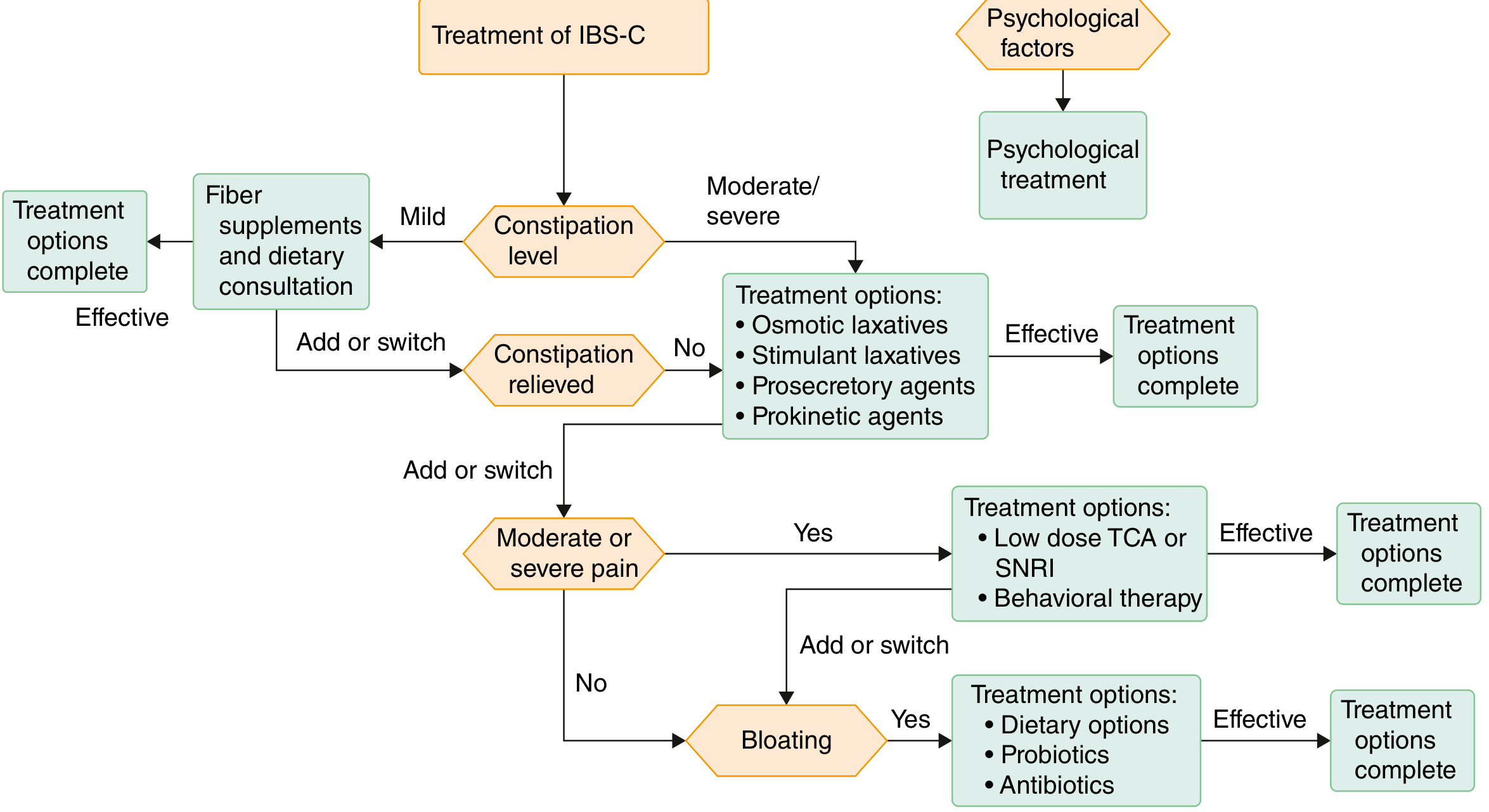
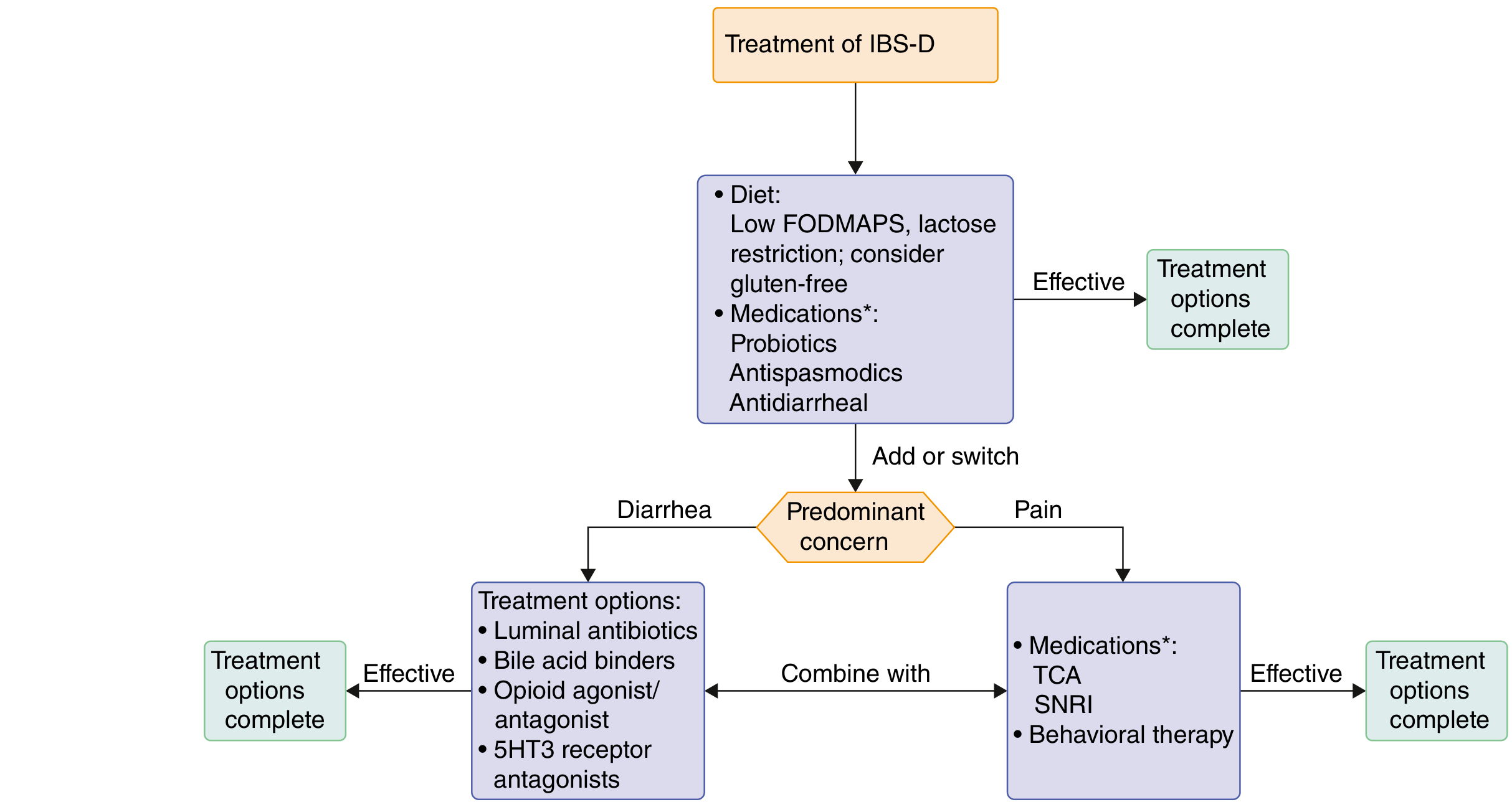
Treatment is stratified by symptom severity and subtype:
- Mild: education, reassurance, dietary advice, OTC medications
- Moderate: add pharmacotherapy
- Severe: integrated pharmacologic + behavioral approach
Diet (First-Line)
- Low-FODMAP diet (fermentable Oligosaccharides, Disaccharides, Monosaccharides, and Polyols): improves global symptoms, especially in IBS-D — best supervised by a dietitian
- Soluble fiber (psyllium, up to 25–35 g/day): especially for IBS-C; start low, titrate up
- Insoluble fiber (wheat bran) is not recommended
- Keep a 1–2 week food/symptom diary to identify triggers
Pharmacotherapy — by symptom
For Pain/Spasm:
| Drug | Dose | Side Effects |
|---|---|---|
| Peppermint oil | 1–2 capsules TID | Heartburn, nausea |
| Hyoscyamine (antispasmodic) | 0.125 mg TID–QID | Dry mouth, blurred vision, constipation |
| Dicyclomine (antispasmodic) | 10 mg TID–QID | Dry mouth, blurred vision |
Central Brain-Gut Neuromodulators (used for pain, not necessarily for depression):
| Drug | Dose |
|---|---|
| Amitriptyline (TCA) | 10–25 mg QHS (up to 100 mg) |
| Desipramine / Nortriptyline (TCA) | 10–25 mg QHS (up to 100 mg) |
| SSRIs (citalopram, fluoxetine, paroxetine, sertraline) | Standard low doses |
For IBS-C:
| Drug | Mechanism | Dose |
|---|---|---|
| Polyethylene glycol (osmotic laxative) | Osmotic | 17 g daily |
| Lubiprostone | Cl⁻ channel activator | 8 μg BID with food |
| Linaclotide | Guanylate cyclase-C agonist | 290 μg daily |
| Plecanatide | Guanylate cyclase-C agonist | 3 mg daily |
| Tenapanor | NHE3 inhibitor (↓ Na/H₂O reabsorption) | 50 mg BID |
For IBS-D:
| Drug | Mechanism | Notes |
|---|---|---|
| Loperamide | μ-opioid agonist | Reduces stool frequency; does NOT improve global symptoms or pain |
| Eluxadoline | μ/κ-opioid agonist + δ-antagonist | 100 mg BID; CI: no gallbladder, hepatic impairment, pancreatic disease, alcohol use disorder |
| Rifaximin | Minimally absorbed antibiotic | 550 mg TID × 14 days; up to 3 retreatment courses |
| Alosetron | 5-HT3 antagonist | Reserved for severe IBS-D in women only; risk of ischemic colitis — REMS program |
| Bile acid sequestrants | Bind bile acids | If bile acid diarrhea confirmed/suspected |
Probiotics: Combination products may reduce global symptoms by ~20%; evidence is mixed — most useful for bloating/flatulence.
Psychological Interventions
Indicated for severe/refractory symptoms or significant psychological comorbidity. Associated with ~30% symptom reduction:
- Cognitive-behavioral therapy (CBT) — most evidence-based
- Gut-directed hypnotherapy
- Relaxation training
- Mindfulness meditation
- Psychotherapy, stress management
Integrated care models (physician + dietitian + psychologist + pelvic floor therapist) are beneficial for complex cases.
Prognosis
- 30–45% of patients have persistent symptoms for up to 12 years
- Predictors of persistent symptoms: anxiety, negative perception of stressful life events, female gender, younger age, prior anxiety/depression
- IBS subtypes can transition over time
- Significant impact on quality of life, work productivity, and healthcare utilization
📊 Treatment Algorithm Diagrams
Recent Evidence (2024–2025)
- A 2025 network meta-analysis in Lancet Gastroenterology & Hepatology (PMID 40258374) evaluated dietary interventions in IBS, providing updated comparative evidence on low-FODMAP and other diets.
- A 2024 systematic review in Nutrients (PMID 38999862) found that combination probiotic products and synbiotics outperformed single-strain probiotics and FMT for global IBS symptom reduction.
- A 2025 meta-analysis in European Journal of Gastroenterology & Hepatology (PMID 40359286) reported global IBS prevalence of ~3.8% using Rome IV criteria across 2006–2024 studies, with female sex and younger age as key risk factors.
Goldman-Cecil Medicine, 27th Ed. (Ch. 123) | Sleisenger & Fordtran's Gastrointestinal and Liver Disease
This is a shared conversation. Sign in to Orris to start your own chat.