
Ace inhibitors
Reading File
ACE inhibitors (ACEIs) block the renin-angiotensin-aldosterone system by inhibiting angiotensin-converting enzyme, preventing the conversion of angiotensin I to angiotensin II. They reduce blood pressure, decrease afterload and preload, and are cardio- and renoprotective.
Searching sources...
Finding Sources
Finding Sources
Searching PubMed
"ACE inhibitors" AND "heart failure"
Now let me read the key sections from Lippincott Pharmacology and Goodman & Gilman for comprehensive coverage:
Reading File
Reading File
Now let me read the main ACE inhibitor pharmacology section from Lippincott:
Reading File
Reading File
Let me read the adverse effects section and fetch the RAAS diagram image:
Reading File
Loading Image
I now have comprehensive information to give a thorough answer. Let me also fetch the adverse effects diagram:
Loading Image
Here is a comprehensive overview of ACE inhibitors, drawn from authoritative pharmacology textbooks.
ACE Inhibitors (Angiotensin-Converting Enzyme Inhibitors)
Mechanism of Action
ACE inhibitors block the enzyme angiotensin-converting enzyme (ACE), which normally cleaves angiotensin I (inactive) into angiotensin II (potent vasoconstrictor). ACE is also responsible for the breakdown of bradykinin - a peptide that stimulates the production of nitric oxide and prostacyclin (both vasodilators).
The net result:
- Decreased angiotensin II → less vasoconstriction, less aldosterone secretion
- Increased bradykinin → enhanced vasodilation, nitric oxide release
- Decreased aldosterone → reduced Na⁺ and water retention → decreased preload
- Efferent arteriolar dilation → reduced intraglomerular pressure → renoprotection
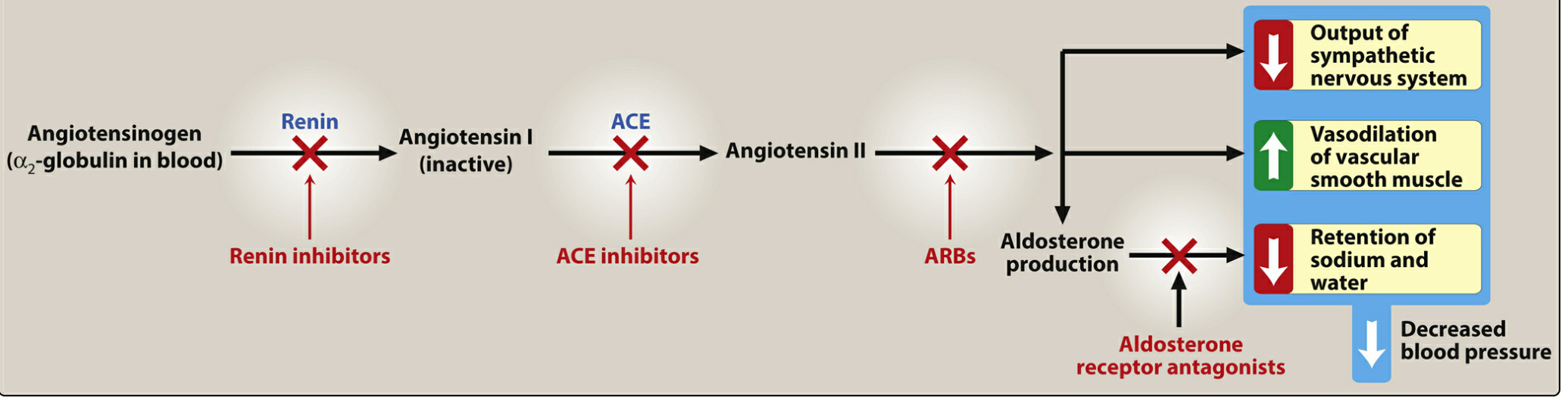
Figure: The renin-angiotensin-aldosterone system (RAAS) and the sites of action of renin inhibitors, ACE inhibitors, ARBs, and aldosterone antagonists. - Lippincott Illustrated Reviews: Pharmacology
Drugs in This Class
| Generic Name | Brand Name |
|---|---|
| Captopril | Generic only |
| Enalapril | Vasotec |
| Lisinopril | Prinivil, Zestril |
| Ramipril | Altace |
| Quinapril | Accupril |
| Fosinopril | Generic only |
| Benazepril | Lotensin |
| Perindopril | Generic only |
| Trandolapril | Generic only |
| Enalaprilat | IV form only |
Therapeutic Uses
ACE inhibitors are a first-line drug class for multiple conditions:
- Hypertension - all agents equally effective at equivalent doses
- Heart failure with reduced ejection fraction (HFrEF) - reduce preload and afterload, improve ventricular remodeling
- Post-myocardial infarction - standard of care; improve ventricular remodeling
- Diabetic nephropathy - slow progression, reduce albuminuria; preferred in diabetics with proteinuria
- Chronic kidney disease - first-line for hypertensive CKD patients
- Coronary artery disease - reduce risk in high-risk patients
"ACE inhibitors are first-line drugs for treating heart failure, hypertensive patients with chronic kidney disease, and patients at increased risk of coronary artery disease." - Lippincott Illustrated Reviews: Pharmacology
Pharmacokinetics
- All ACE inhibitors are orally bioavailable as drug or prodrug
- Most (except captopril and lisinopril) require hepatic conversion to active metabolites - captopril and lisinopril are preferred in severe hepatic impairment
- Fosinopril is the only ACE inhibitor with dual renal/hepatic elimination - does NOT require dose adjustment in renal impairment
- Enalaprilat is the only IV formulation available
Adverse Effects
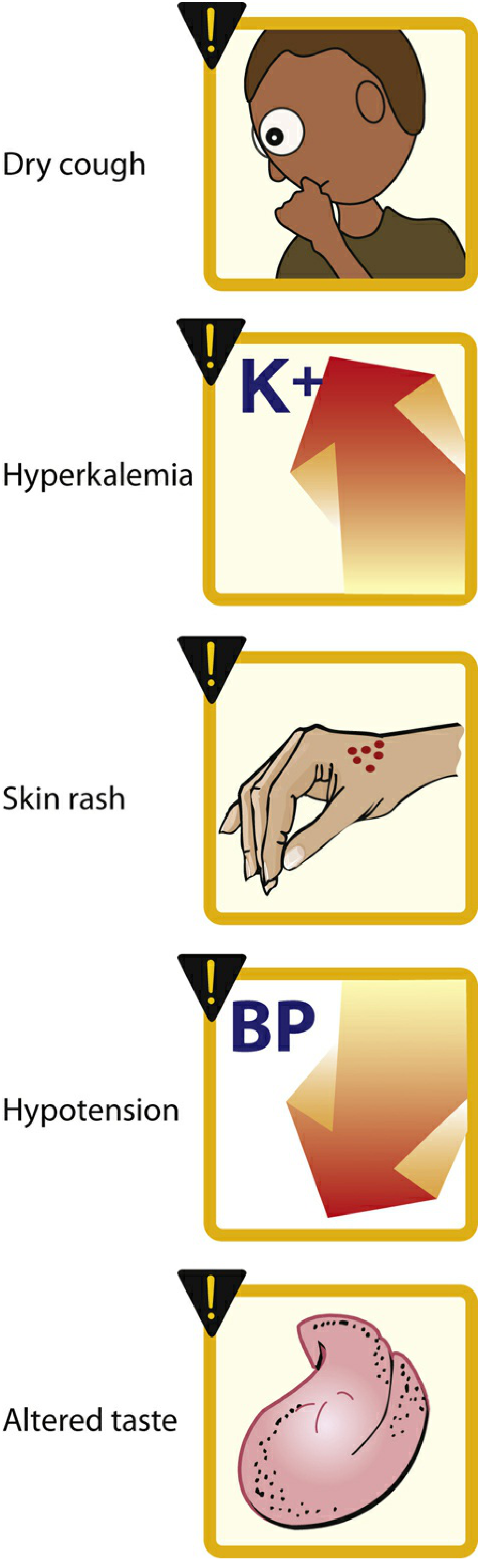
Figure: Common adverse effects of ACE inhibitors - Lippincott Illustrated Reviews: Pharmacology
| Adverse Effect | Mechanism | Notes |
|---|---|---|
| Dry cough | Accumulation of bradykinin and substance P in the pulmonary tree | Occurs in ~10% of patients; more common in women; resolves on discontinuation |
| Angioedema | Increased bradykinin → swelling of lips, oral mucosa, throat | Rare but life-threatening; 5x more frequent in people of African ancestry |
| Hyperkalemia | Decreased aldosterone → reduced K⁺ excretion | Monitor K⁺; avoid K⁺ supplements/K⁺-sparing diuretics |
| Hypotension | Vasodilation; first-dose effect | Especially in volume-depleted patients |
| Elevated creatinine | Reduced efferent arteriolar tone | Rise of up to 30% above baseline is acceptable and not a reason to stop |
| Skin rash / altered taste | Captopril-related (sulfhydryl group) | Less common with newer agents |
| Teratogenicity | Fetal renal hypoperfusion | Contraindicated in pregnancy |
Contraindications
- Pregnancy (category D in 2nd/3rd trimester - causes fetal renal dysgenesis, oligohydramnios, skull hypoplasia)
- Bilateral renal artery stenosis (can precipitate acute renal failure)
- History of angioedema with any ACE inhibitor
- Hyperkalemia (K⁺ >5.5 mEq/L)
- Concurrent use with aliskiren in diabetics or CKD patients
Drug Interactions
- Potassium-sparing diuretics / K⁺ supplements → hyperkalemia
- NSAIDs → blunted antihypertensive effect, increased nephrotoxicity
- Lithium → ACE inhibitors increase lithium levels (reduced renal clearance)
- ARBs → combination not recommended (increased adverse effects without added benefit)
- Aliskiren → combination contraindicated in DM or CKD
ACE Inhibitors vs ARBs - Key Distinction
ARBs block the AT₁ receptor directly and do not increase bradykinin levels, which is why:
- ARBs have a much lower incidence of cough (~1-2% vs ~10%)
- ARBs have lower risk of angioedema (though not zero, since AT₂-mediated bradykinin also rises)
- ARBs are the preferred alternative when ACE inhibitors cause intolerable cough
"Bradykinin contributes to many of the protective effects of ACE inhibitors... A rare side effect of ACE inhibitors is angioedema, which is likely due to the inhibition of kinin metabolism." - Goodman & Gilman's Pharmacological Basis of Therapeutics
Sources:
- Lippincott Illustrated Reviews: Pharmacology, Chapter 8 (Antihypertensives)
- Goodman & Gilman's Pharmacological Basis of Therapeutics, Chapter 43 (Kinins)
This is a shared conversation. Sign in to Orris to start your own chat.