
Leif bowel wall thickening infective etiology treatment
Reading File
Now I'll search the medical library in parallel for bowel wall thickening with infective etiology and treatment.
Finding Sources
Finding Sources
Finding Sources
Searching PubMed
bowel wall thickening infectious etiology treatment
Good - found a dedicated section in Yamada's Gastroenterology. Let me read it along with searching for specific infectious causes.
Reading File
Finding Sources
Finding Sources
Excellent - I have key references. Now let me read the dedicated infectious colitis treatment sections and also the section on bowel wall thickening etiologies from the relevant blocks.
Reading File
Reading File
Finding Sources
Let me now read the key infectious colitis section from Yamada's block 7 and the Sleisenger IBD vs infection section for treatment details.
Reading File
Reading File
Now let me get the actual colitis treatment section from Yamada block 7, and also search for specific antibiotic treatments per organism.
Finding Sources
Finding Sources
Now let me get the detailed treatment table for infectious colitis from Tintinalli's and the C. difficile classification table from Fischer's.
Reading File
Reading File
Let me get the treatment table from Tintinalli's and then the C. difficile treatment classification table.
Reading File
Reading File
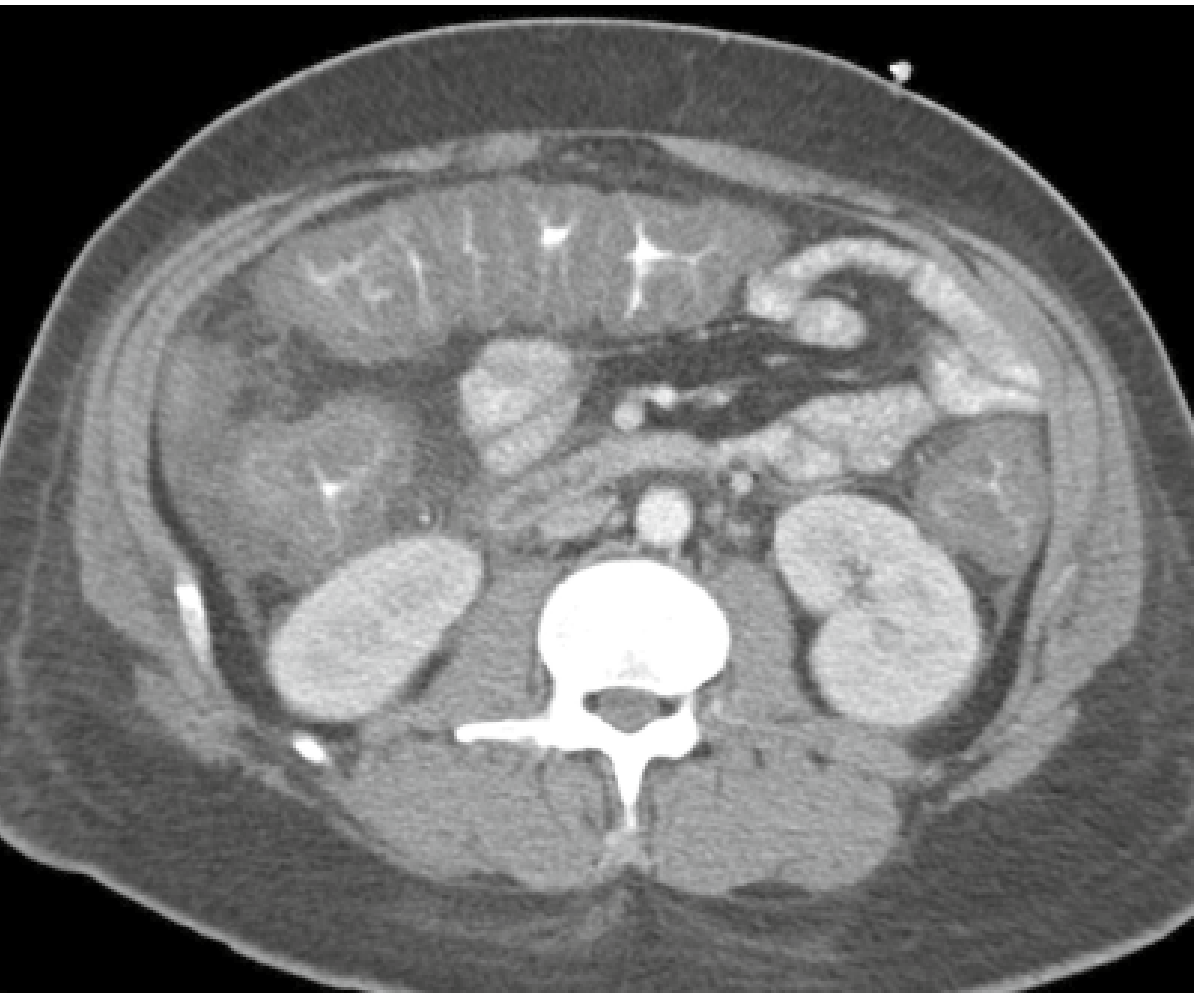
I now have comprehensive data to write a detailed response. Let me also quickly fetch the CT image of C. difficile colitis that was referenced.
Loading Image
I now have all the necessary information for a comprehensive answer. Here is the complete response:
Bowel Wall Thickening - Infective Etiology and Treatment
Overview
Bowel wall thickening is a non-specific imaging finding. On CT, infectious colitis is characterized by mural thickening, submucosal edema, mucosal hyperenhancement, and pericolonic fat stranding. The degree of thickening, distribution of bowel involvement, and associated mesenteric changes are key to differentiating infectious from inflammatory (IBD) or ischemic causes. Treatment is medical; endoscopic management generally has no role in infectious colitis. Antibiotic choice depends on the causative organism.
- Yamada's Textbook of Gastroenterology, 7th ed.
Imaging Patterns by Organism
| Feature | Infectious Colitis | Ulcerative Colitis | Crohn's | Ischemic |
|---|---|---|---|---|
| Distribution | Variable; C. diff = pancolitis | Rectum extending proximally | Terminal ileum + colon | Watershed (splenic/hepatic flexure, rectosigmoid) |
| Wall thickening | Moderate | Moderate | Transmural, focal | May be mild |
| Associated findings | Pericolonic stranding | Continuous mucosal involvement | Skip lesions, fistulae | Thumbprinting |
C. difficile most often presents with pancolonic thickening on CT - a distribution uncommon in ischemic or IBD. - Yamada's Textbook of Gastroenterology, 7th ed.
Common Infective Causes & Treatment
In studies of bloody diarrhea, bacterial pathogens account for ~31% of cases: Shigella (49%), Campylobacter (20%), Salmonella (19%), E. coli O157:H7 (8%). - Fischer's Mastery of Surgery, 8th ed.
Bacterial Causes
| Organism | Key Epidemiology | Presentation | Treatment |
|---|---|---|---|
| Salmonella | Foodborne, reptile/amphibian exposure, age <4 y | Fever, abdominal pain, diarrhea | Supportive; antibiotics only if enteric fever, sepsis, age <3 months, or immunosuppressed |
| Shigella | Childcare centers, travelers, age <5 y | Fever, bloody diarrhea, cramping | Supportive + antibiotics (unless very mild disease); reduces duration and shedding |
| Campylobacter jejuni | Unpasteurized milk, undercooked poultry, contaminated water | Fever, abdominal pain, 10-20% have severe/prolonged illness | Supportive; antibiotics (azithromycin or fluoroquinolone) |
| Yersinia | Livestock/foodborne, pseudoappendicitis presentation | RLQ pain, often self-limited | Supportive; antibiotics for neonates, immunosuppressed, sepsis, or extraintestinal disease. Benefit not established in uncomplicated cases |
| E. coli O157:H7 (STEC) | Ground beef, petting zoos, raw fruits | Hemorrhagic enterocolitis, risk of HUS | Supportive ONLY; antibiotics not proven beneficial and may increase HUS risk |
| Enteroinvasive E. coli | Foodborne, travelers | Fever, vomiting, dysentery | Supportive; antibiotics |
| Entamoeba histolytica | Resource-limited countries, travelers | Gradually worsening diarrhea, tenesmus, lower abdominal pain | Metronidazole (tissue amebicide) followed by luminal amebicide (paromomycin or iodoquinol) |
| Aeromonas hydrophila | Warm weather, waterborne | Chronic diarrhea | Antibiotics only in special populations |
- Tintinalli's Emergency Medicine, Table 134-5
Clostridioides (Clostridium) difficile - Detailed Treatment Protocol
C. difficile is the most common infectious colitis identified on CT (presenting as pancolitis). It results from disruption of colonic flora by antibiotic use. Diagnosis: stool toxin assay. Metronidazole is no longer first-line due to increased treatment failure rates.
| Severity | Criteria | Treatment |
|---|---|---|
| Mild/Moderate | Cr <1.5 mg/dL AND WBC <15,000/mL | Vancomycin 125 mg PO QID x10 days OR fidaxomicin 200 mg PO BID x10 days; metronidazole 500 mg PO TID x10 days only if vancomycin/fidaxomicin unavailable or contraindicated |
| Severe | Cr >1.5 mg/dL OR WBC >15,000/mL | Same as mild/moderate |
| Complicated/Fulminant | Hypotension/shock, sepsis, toxic megacolon, ileus | Vancomycin 500 mg PO QID x10 days + metronidazole 500 mg IV TID x10 days; if ileus present: vancomycin 500 mg/100 mL NS enema QID |
- Fischer's Mastery of Surgery, 8th ed., Table 289.2
Recurrent CDI: Bezlotoxumab (antitoxin B monoclonal antibody) reduces recurrence risk by ~40% when given during an initial episode. Fecal microbiota transplant is an option for refractory/recurrent cases.
Special Scenario: Neutropenic Enterocolitis (Typhlitis)
An opportunistic infection of the bowel by the patient's own intestinal flora, most commonly affecting the caecum (typhlitis) but extending to the distal ileum in some cases. Presents as bowel wall thickening with or without proximal bowel dilatation. Ultrasound is the investigation of choice for diagnosis and follow-up; CT is used to assess complications (wall ischaemia, perforation). Treatment involves broad-spectrum antibiotics and bowel rest; surgery for perforation.
- Grainger & Allison's Diagnostic Radiology
Yersinia - Note on Bowel Wall Thickening
Yersinia infection specifically can cause bowel wall thickening and heaped-up masses in the terminal ileum and right colon, mimicking Crohn's disease radiologically. Histologically, it may show marked inflammation with granulomas. Clinical context is essential to avoid misdiagnosis as Crohn's. - Yamada's Textbook of Gastroenterology, 7th ed.
General Principles
- Most bacterial infectious colitis is self-limiting - supportive care (hydration, electrolyte correction) is the cornerstone.
- Antibiotics are not universally indicated - organism, severity, and host immune status determine the need.
- Endoscopic management has no role in typical infectious colitis.
- Stool cultures should be obtained in bloody diarrhea before empiric antibiotics when possible.
- Immunosuppressed patients (HIV, chemotherapy, transplant) have a broader differential including CMV colitis, mycobacterial infection, and fungal causes - requiring targeted therapy.
Tablet?
I want to make sure I give you exactly what you need. Are you asking about:
Asking for Preferences
What do you mean by 'Tablet'?
Here are the tablet/oral formulations and doses for the key drugs used in infective bowel wall thickening treatment:
Oral Tablet/Capsule Formulations & Doses
Clostridioides difficile
| Drug | Formulation | Dose | Duration | Indication |
|---|---|---|---|---|
| Vancomycin | 125 mg capsules | 125 mg PO QID (4x/day) | 10 days | Mild/moderate/severe |
| Vancomycin (fulminant) | 125 mg capsules | 500 mg PO QID (4x/day) | 10 days | Complicated/fulminant |
| Fidaxomicin | 200 mg tablets | 200 mg PO BID (2x/day) | 10 days | Mild/moderate/severe (preferred - lower recurrence) |
| Metronidazole | 200 mg / 400 mg / 500 mg tablets | 500 mg PO TID (3x/day) | 10 days | Only if vancomycin/fidaxomicin unavailable; or IV in fulminant |
Metronidazole is no longer first-line for C. difficile - use only when vancomycin and fidaxomicin are unavailable or contraindicated.
Other Bacterial Enteropathogens (when antibiotics are indicated)
| Organism | Drug | Tablet/Formulation | Dose | Duration |
|---|---|---|---|---|
| Shigella | Azithromycin | 250 mg / 500 mg tablets | 500 mg OD x1 day, then 250 mg OD x4 days or 1 g single dose | 1-5 days |
| Shigella | Ciprofloxacin | 250 mg / 500 mg tablets | 500 mg PO BID | 3 days |
| Campylobacter | Azithromycin | 250 mg / 500 mg tablets | 500 mg OD | 3 days (drug of choice - increasing fluoroquinolone resistance) |
| Campylobacter | Ciprofloxacin | 500 mg tablets | 500 mg PO BID | 3 days (if susceptible) |
| Salmonella (if treatment needed) | Ciprofloxacin | 500 mg tablets | 500 mg PO BID | 5-7 days |
| Salmonella (if treatment needed) | Azithromycin | 500 mg tablets | 500 mg OD | 7 days |
| Yersinia (if treatment needed) | Ciprofloxacin | 500 mg tablets | 500 mg PO BID | 7-10 days |
| Entamoeba histolytica | Metronidazole | 400 mg / 500 mg tablets | 400-800 mg PO TID | 5-10 days |
| E. histolytica (luminal) | Paromomycin | 250 mg capsules | 25-35 mg/kg/day in 3 divided doses | 7 days (after metronidazole) |
Key Points on Tablet Use
- Vancomycin oral acts locally in the gut lumen - it is NOT systemically absorbed, so oral dosing is appropriate for C. difficile regardless of severity (except ileus, where enema is needed).
- Fidaxomicin has minimal systemic absorption and concentrates in the colon - associated with lower recurrence rates than vancomycin, especially for non-NAP1 strains.
- Azithromycin is generally preferred over fluoroquinolones for Campylobacter due to rising ciprofloxacin resistance globally.
- E. coli O157:H7 (STEC) - no antibiotic tablets; supportive care only (antibiotics may precipitate HUS).
- For amoebiasis: always follow metronidazole with a luminal agent (paromomycin or iodoquinol) to eradicate intraluminal cysts and prevent relapse.
This is a shared conversation. Sign in to Orris to start your own chat.