
Key nasofacial angles and metrics with respect to facial aesthetics. Ms ent university exam pattern for 20 marks.
Reading File
Finding Sources
Finding Sources
Reading File
Reading File
Finding Sources
Reading File
Reading File
Loading Image
I now have comprehensive, exam-ready content from two authoritative ENT textbooks (Cummings and KJ Lee), plus the key diagram. Let me now compose a thorough 20-mark answer.
Nasofacial Angles and Metrics in Facial Aesthetics
(MS ENT University Exam - 20 Marks)
Introduction
Facial aesthetic analysis is the systematic evaluation of facial proportions and angular relationships to define harmony and guide surgical planning. Powell and Humphreys (1984) formulated the classical framework of nasofacial relationships, which remains the cornerstone of rhinoplasty and facial cosmetic surgery assessment. Analysis is performed in standardised clinical photographs (frontal, lateral, and base views).
I. Facial Proportions - The Foundation
Before angular analysis, facial proportions must be established.
A. Vertical Thirds (Horizontal Thirds of Height)
The face is divided into three equal horizontal thirds by the following landmarks:
- Upper third: Trichion (hairline) to Glabella
- Middle third: Glabella to Subnasale
- Lower third: Subnasale to Menton (Gnathion)
B. Lower Third Subdivision
The lower third is further divided:
- Upper 1/3 of lower third: Subnasale to Stomion
- Lower 2/3 of lower third: Stomion to Menton
C. Vertical Fifths (Width)
Facial width is divided into five equal vertical fifths, demarcated by:
- Lateral auricle → Lateral canthus → Medial canthus (each side)
- Each fifth = width of one eye = intercanthal distance
D. Ideal Width-to-Length Ratio
Face: 3:4
II. Powell and Humphreys' Nasofacial Angles
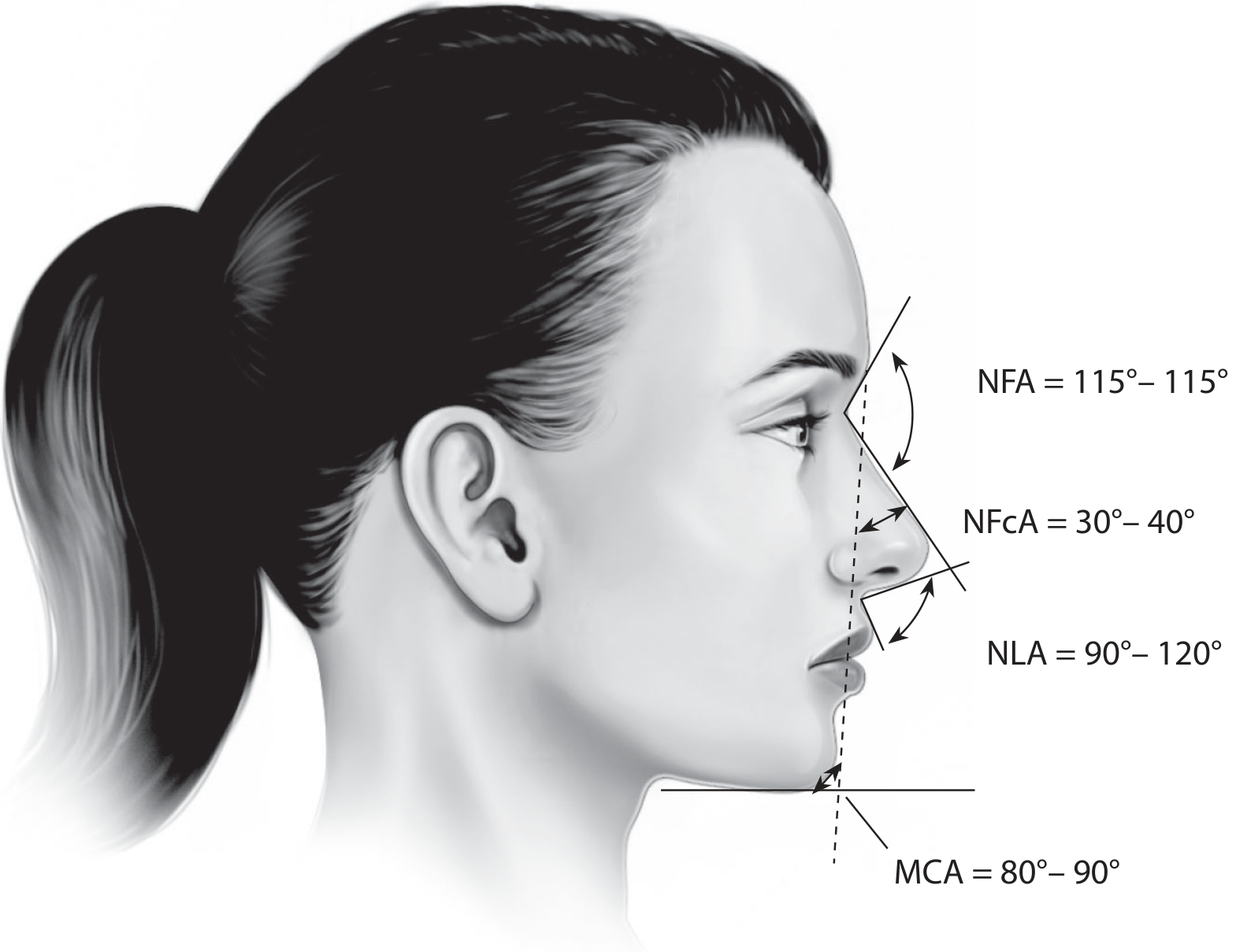
All four angles are assessed on the lateral (profile) view.
1. Nasofrontal Angle (NFA)
| Feature | Detail |
|---|---|
| Definition | Angle between the glabella-to-nasion line and the nasion-to-tip (nasal dorsal) line |
| Landmarks | Glabella, Nasion, Nasal Tip |
| Normal Range | 115° to 130° (some sources: 125°-147° in white females) |
| Clinical significance | A shallow angle gives a prominent, projecting nose; a wider angle gives a scooped or concave dorsum appearance |
| Ideal nasion position | Level with the upper eyelid's superior palpebral fold |
2. Nasofacial Angle (NFcA)
| Feature | Detail |
|---|---|
| Definition | Angle formed by the intersection of the facial plane (glabella to pogonion line) with the nasal dorsal line (nasion to nasal tip) |
| Landmarks | Glabella, Pogonion (chin), Nasion, Nasal Tip |
| Normal Range | 30° to 40° (ideal = 36°) |
| Clinical significance | Represents the incline of the nasal dorsum relative to the face; directly correlates with nasal projection - a smaller angle = over-projected nose |
Goode's method for projection assessment: A perpendicular line is drawn from the alar groove to the nasal tip; the ratio of this perpendicular length to nasal length (nasion-to-tip) should be 0.55 to 0.60, which corresponds to a nasofacial angle of ~36°.
Crumley and Lanser use a 3-4-5 triangle where the hypotenuse = nasal length and the shortest arm = projection.
3. Nasolabial Angle (NLA)
| Feature | Detail |
|---|---|
| Definition | Angle formed at the subnasale between: a line tangent to the labrale superius-subnasale (upper lip) and a line tangent to the subnasale-columella point (columella axis) |
| Landmarks | Subnasale, Most anterior point of columella, Vermillion border of upper lip |
| Normal Range (Men) | 90° to 95° (KJ Lee) / 90-95° (Cummings) |
| Normal Range (Women) | 95° to 120° (KJ Lee) / 95-110° (Cummings) |
| Clinical significance | Defines columellar inclination; a large angle = over-rotated tip (pig-snout deformity); a small acute angle = ptotic/drooping tip. Women tolerate a higher angle due to alar base flare differences |
4. Nasomental Angle (NMA)
| Feature | Detail |
|---|---|
| Definition | Angle formed by the intersection of the nasal dorsal line (nasion to tip) with the nasomental line (tip to pogonion) |
| Landmarks | Nasion, Nasal Tip, Pogonion |
| Normal Range | 120° to 132° |
| Clinical significance | This angle is easily distorted by chin and lip disharmony. The lips should fall just posterior to this line: upper lip 4 mm behind, lower lip 2 mm behind. An obtuse angle may indicate chin deficiency (microgenia/retrognathia) |
5. Mentocervical Angle (MCA)
| Feature | Detail |
|---|---|
| Definition | Angle formed by the intersection of the glabella-to-pogonion line (facial plane) with the menton-to-cervical point line |
| Normal Range | 80° to 95° |
| Clinical significance | Reflects submental definition and cervicomental aesthetics; widens in submental fat excess or submandibular ptosis |
III. Nasal Tip: Rotation and Projection
Tip Rotation
- Rotation occurs along an arc with radius centred at the external auditory canal
- Rotation increases along the upper arc, decreases along the lower arc
Tip Projection Methods
| Method | Description | Ideal Value |
|---|---|---|
| Simons' method | Tip projection : upper lip length | 1:1 ratio |
| Goode's method | Perpendicular alar groove-to-tip : nasal length (nasion-to-tip) | 0.55 : 0.60 |
| Crumley-Lanser | 3-4-5 right triangle (hypotenuse = nasal length) | Shortest arm = projection |
IV. Alar-Columellar Complex
| Metric | Normal Value |
|---|---|
| Alar-to-lobule ratio (lateral view) | 1:1 (lobule: alar portion = 1:1) |
| Columellar show | 3 to 5 mm (basal/lateral view) |
| Alar width : Intercanthal distance | 1:1 (Caucasian standard) |
| Nasal base shape (basal view) | Triangular, divided into three equal units |
V. Lip and Chin Relationships
- Upper lip: Subnasale to Stomion superius
- Lower lip + chin: Stomion inferius to Menton
- Ideal chin position (women): 1-2 mm posterior to a vertical line dropped from lower lip vermillion border
- Ideal chin position (men): At or slightly anterior to this line
VI. The Aesthetic Line (Brow-Tip Line)
An unbroken aesthetic line should flow continuously from the eyebrow to the nasal tip - this represents ideal brow-dorsal continuity.
VII. Ethnic Variation in Nasofacial Angles
| Angle | White | African-American | Latino (Caribbean) | Latino (Central/South) | Southern Chinese |
|---|---|---|---|---|---|
| Nasofrontal | 125°-147° | ~127-137° | 110° | 137°/136° | ~138° |
| Nasofacial | 31°-40° | 33-39° | 41° | 44°/46° | ~36° |
| Nasolabial | 90°-120° | ~74-90° | 110° | 99°/100° | ~88° |
| Alar width:Intercanthal | 1:1 | 1.2:1 | 1.2:1 | 1:1 | >1:1 |
Ethnic variation is clinically important - surgical goals must respect the patient's ethnic norms rather than impose a Caucasian standard.
VIII. Summary Table of Key Angles (High-Yield for Exam)
| Angle | Landmarks | Normal Range | Ideal |
|---|---|---|---|
| Nasofrontal | Glabella-Nasion / Nasion-Tip | 115°-130° | ~120° |
| Nasofacial | Glabella-Pogonion / Nasion-Tip | 30°-40° | 36° |
| Nasolabial | Columella axis / Upper lip line at subnasale | 90-95° (M), 95-120° (F) | - |
| Nasomental | Nasion-Tip / Tip-Pogonion | 120°-132° | - |
| Mentocervical | Facial plane / Menton-Cervical | 80°-95° | - |
IX. Clinical Relevance / Surgical Implications
- Rhinoplasty planning: Nasofacial and nasolabial angles guide dorsal hump reduction, tip rotation, and tip projection decisions.
- Genioplasty/chin augmentation: Corrects abnormal nasomental and mentocervical angles. Retrognathia vs. microgenia must be distinguished.
- Combined procedures: Chin augmentation simultaneously improves the nasomental angle, making the nose appear less prominent without touching it.
- Photography standards: All preoperative analysis requires standardised photos - true lateral (90°), frontal, and basal views - using Frankfurt horizontal plane as reference.
- Ethnic aesthetics: Goals should be patient-specific and culturally appropriate.
Sources:
- Cummings Otolaryngology: Head and Neck Surgery, Ch. 16 - Nasofacial Relationships, p. 336
- KJ Lee's Essential Otolaryngology, Ch. 54 - Facial Angles, p. 1057
- Dermatology 2-Volume Set 5e - Facial Analysis of Women of Different Ethnic Groups (Powell & Humphreys / Wen et al., PLoS One 2015)
This is a shared conversation. Sign in to Orris to start your own chat.