
DLMS AND ALS PATHWAY OF SPINAL CORD
Reading File
Now let me search the medical library for DLMS (Dorsal Lemniscal/Medial Lemniscal System) and ALS (Anterolateral System) pathways in parallel.
Finding Sources
Finding Sources
Searching Images
dorsal column medial lemniscal pathway spinal cord diagram
Finding Sources
Finding Sources
Loading Image
Good results. Now let me read the key textbook sections in parallel for comprehensive content.
Reading File
Reading File
Reading File
Reading File
Reading File
Loading Image
I now have comprehensive textbook content and excellent diagrams. Let me also get the ALS thalamic targets and clinical correlations from Kandel's Principles of Neural Science.
Reading File
Reading File
I now have all the comprehensive information needed. Let me compile the full answer.
DLMS and ALS Pathways of the Spinal Cord
Overview
The two principal ascending somatosensory systems of the spinal cord are:
| Feature | DLMS (Dorsal Lemniscal / Medial Lemniscal System) | ALS (Anterolateral System / Spinothalamic) |
|---|---|---|
| Full name | Dorsal Column–Medial Lemniscal System | Anterolateral System |
| Modalities | Fine touch, vibration, proprioception, two-point discrimination, stereognosis | Pain, temperature, itch, crude touch |
| 1st order neuron | Large-diameter myelinated Aβ fibers | Small myelinated Aδ and unmyelinated C fibers |
| Where 1st synapse occurs | Medulla (dorsal column nuclei) | Spinal cord dorsal horn |
| Decussation site | Lower medulla (sensory decussation) | Spinal cord (via anterior white commissure, 1–2 segments above entry) |
| Ascending column | Ipsilateral dorsal funiculus | Contralateral ventrolateral funiculus |
| Thalamic relay | VPL nucleus (contralateral) | VPL + posterior complex + intralaminar nuclei |
| Cortical destination | Primary somatosensory cortex (postcentral gyrus, areas 3b, 1, 2) | Somatosensory cortex + cingulate gyrus + insular cortex + frontal lobe |
Pathway Diagrams
Combined Ascending Sensory Pathways (DLMS solid black, ALS dashed):
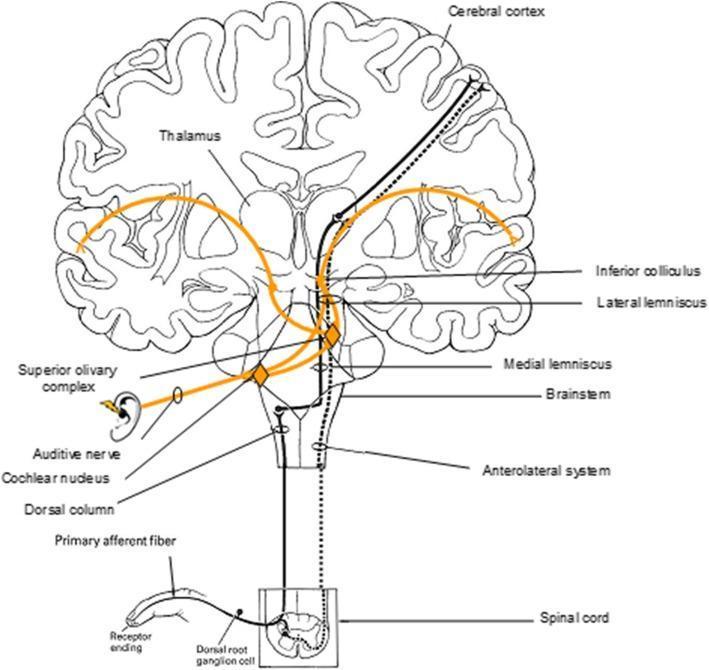
Ganong's Comparison of DLMS (A) and Spinothalamic (B) Pathways:
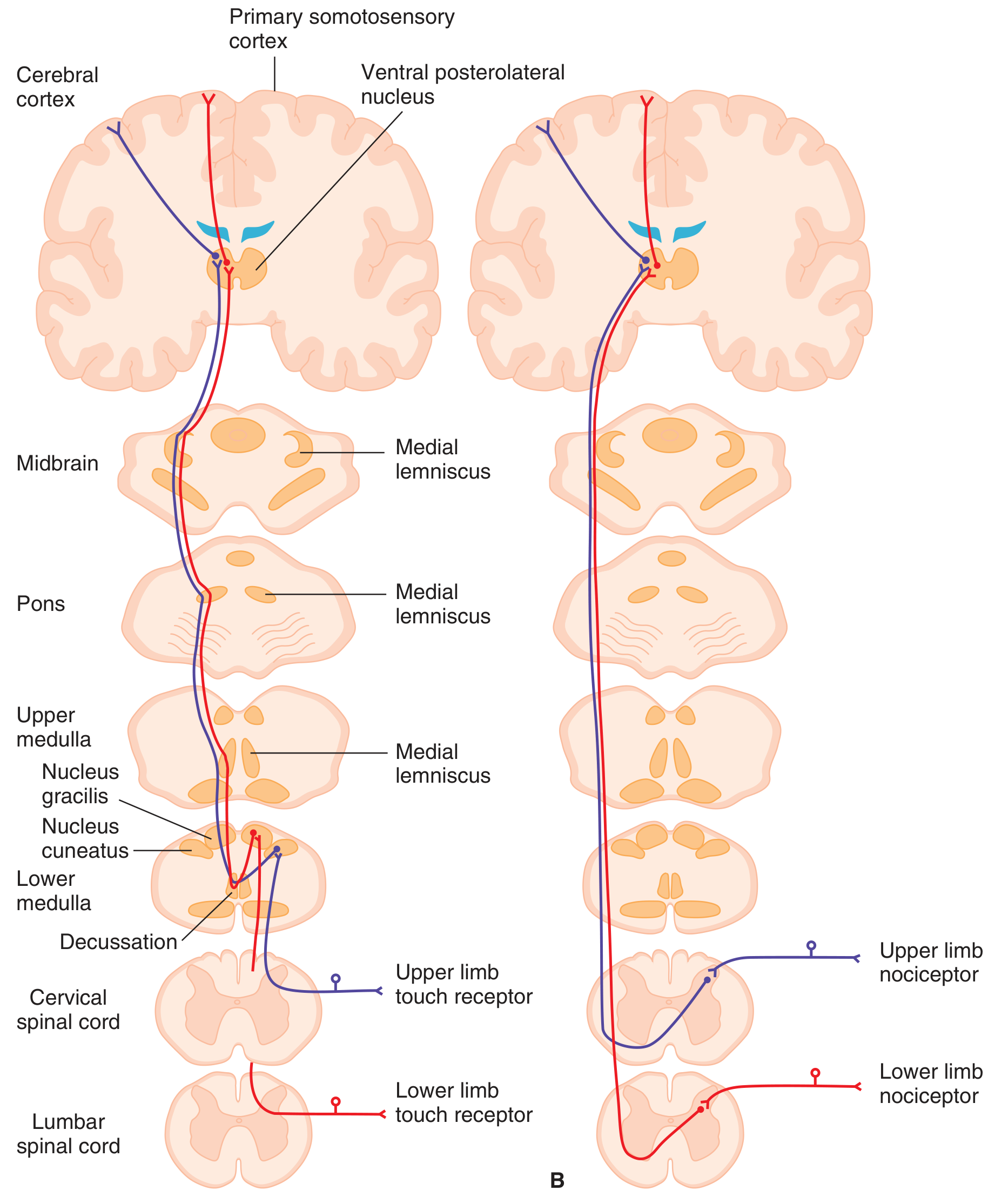
1. DLMS — Dorsal Column–Medial Lemniscal System
Receptors and First-Order Neurons
- Subserve fine/discriminative touch, vibration, proprioception, weight perception, and two-point discrimination
- Receptors: Meissner's corpuscles, Merkel discs, Pacinian corpuscles, Ruffini endings, muscle spindles, Golgi tendon organs
- First-order neurons have cell bodies in the dorsal root ganglion (DRG); large-diameter, heavily myelinated Aα/β axons
Spinal Cord (First-Order Ascent — Ipsilateral)
- Axons enter the spinal cord via the medial bundle of the dorsal root and pass directly into the dorsal funiculus (posterior white column) without synapsing in the dorsal horn
- Somatotopic arrangement in the dorsal columns:
- Fasciculus gracilis (Goll's column) — medial position; carries fibers from the lower body (sacral, lumbar, lower 6 thoracic levels)
- Fasciculus cuneatus (Burdach's column) — lateral position; carries fibers from the upper body (upper 6 thoracic + cervical levels)
- Fibers ascend ipsilaterally all the way to the medulla
Brainstem — First Synapse (Second-Order Neurons)
- Fasciculus gracilis → Nucleus gracilis (lower medulla)
- Fasciculus cuneatus → Nucleus cuneatus (lower medulla)
- Second-order axons from these nuclei decussate (internal arcuate fibers / sensory decussation) in the lower medulla → form the medial lemniscus
- The medial lemniscus ascends through the medulla, pons, and midbrain (somatotopically: dorsal = neck, ventral = foot)
- Also joined by trigeminal lemniscus fibers (head/face sensation)
Thalamus (Third-Order Neurons)
- Terminates in the Ventral Posterior Lateral (VPL) nucleus of the thalamus (contralateral)
- VPL = limbs and trunk
- VPM = face (via trigeminal lemniscus)
- VPS (ventral posterior superior) = proprioception → projects to area 3a
Cortex (Final Projection)
- VPL/VPM → Primary somatosensory cortex (S-I), postcentral gyrus (Brodmann areas 3a, 3b, 1, 2)
- Somatotopic organization: legs on top, head at foot of gyrus (sensory homunculus)
- Area 3b receives cutaneous touch; area 3a receives proprioceptive input
- S-I projects to sensory association cortex (parietal) and secondary somatosensory cortex (S-II, in the wall of the lateral sulcus)
2. ALS — Anterolateral System
Receptors and First-Order Neurons
- Subserve pain, temperature, itch, and crude touch
- Free nerve endings in skin/viscera
- First-order neurons: cell bodies in DRG; small-diameter fibers:
- Aδ (thinly myelinated) — sharp/fast pain, cool temperature → Rexed laminae I, IIo, V
- C fibers (unmyelinated) — slow/burning pain, warmth, itch → Rexed lamina II (substantia gelatinosa)
Entry and Lissauer's Tract
- Fibers enter via the lateral bundle of the dorsal root
- Bifurcate into short ascending and descending branches in Lissauer's tract (dorsolateral fasciculus)
- Aδ: ascend 3–4 segments before synapsing
- C fibers: ascend ~1 segment before synapsing
- Synapse on dorsal horn neurons (second-order neurons)
Spinal Cord — Decussation (Immediate, at Cord Level)
- Second-order axons immediately cross the midline via the anterior white commissure (at the same spinal level or 1–2 segments above entry)
- Ascend in the contralateral ventrolateral funiculus as the spinothalamic tract
- Somatotopic arrangement in the anterolateral column: sacral fibers lie most superficially/laterally; cervical fibers lie most medially (clinically important — intrinsic cord lesions can spare sacral sensation)
Subdivisions of the ALS
The ALS contains three major tracts:
| Tract | Destination | Function |
|---|---|---|
| Lateral spinothalamic (neospinothalamic) | VPL thalamus | Sharp, well-localized pain; temperature |
| Anterior spinothalamic (ventral) | VPL thalamus | Crude/light touch, pressure |
| Spinoreticular (paleospinothalamic) | Brainstem reticular formation → intralaminar thalamic nuclei | Dull, poorly localized, aching pain |
| Spinomesencephalic | Periaqueductal gray (PAG) | Modulation of pain; arousal |
Brainstem Ascent
- Fibers ascend through the medulla, pons, and midbrain without synapsing (lateral spinothalamic), running in the anterolateral quadrant
- They come to lie alongside but separate from the medial lemniscus in the upper brainstem
- Spinoreticular fibers synapse in the reticular formation of the brainstem
Thalamus (Third-Order Neurons)
- Lateral spinothalamic → VPL nucleus (discriminative pain)
- Spinoreticular → centrolateral (intralaminar) nuclei → frontal lobe, limbic system
- Also projects to the posterior complex of the thalamus
Cortex (Final Projection)
- VPL → Primary somatosensory cortex (S-I) — discriminative/localizing component of pain
- Intralaminar nuclei → Cingulate gyrus, insular cortex, frontal lobe, amygdala — motivational-affective component of pain
- This dual system explains why pain has both a sensory-discriminative dimension (where it is, how intense) and an emotional-affective dimension (suffering, unpleasantness)
Key Differences Summary
| Feature | DLMS | ALS |
|---|---|---|
| Fiber type | Large myelinated Aβ | Small Aδ and unmyelinated C |
| 1st synapse | Medulla | Spinal cord dorsal horn |
| Decussation level | Medulla | Spinal cord (at/near entry level) |
| Direction of ascent | Ipsilateral dorsal column → then crosses | Immediately contralateral ventrolateral column |
| Thalamic target | VPL (+ VPM for face) | VPL + intralaminar nuclei |
| Cortical spread | Focused on S-I | S-I + cingulate + insula + frontal + amygdala |
| Speed | Fast, precise | Slower, diffuse |
| Clinical test | Vibration (tuning fork), proprioception, 2-point discrimination | Pinprick, temperature (hot/cold test tube) |
Clinical Correlation: Brown-Séquard Syndrome
Hemisection of the spinal cord (e.g., from a stab wound or MS plaque) produces a predictable dissociation because of the different decussation levels:
- Ipsilateral to the lesion: Loss of fine touch, vibration, proprioception (DLMS fibers haven't crossed yet)
- Contralateral to the lesion: Loss of pain and temperature (ALS fibers already crossed in the cord)
- Ipsilateral: Motor loss (UMN signs) below the lesion
This "crossed" pattern is pathognomonic and directly results from the anatomical difference in where each pathway decussates.
Sources:
- Ganong's Review of Medical Physiology, 26th Ed., pp. 177–179
- Neuroscience: Exploring the Brain, 5th Ed., pp. 1207–1210
- Localization in Clinical Neurology, 8th Ed., pp. 41–45, 244–245
- Kandel: Principles of Neural Science, 6th Ed., pp. 497–499
This is a shared conversation. Sign in to Orris to start your own chat.