
How creatine and creatinine forms in body
Reading File
Finding Sources
Finding Sources
Reading File
Reading File
Reading File
Loading Image
Reading File
Loading Image
Loading Image
Here is a comprehensive explanation of how creatine and creatinine are formed in the body:
Creatine Synthesis
Creatine biosynthesis is a two-step process occurring in two different organs:
Step 1 — Transamidation (Kidneys)
Arginine + Glycine → Guanidinoacetate (guanidinoacetic acid) + Ornithine
The enzyme amidinotransferase in the kidneys transfers the guanidino group from arginine to glycine, producing guanidinoacetate as an intermediate. Ornithine is released as a byproduct.
Step 2 — Methylation (Liver)
Guanidinoacetate + S-Adenosylmethionine (SAM) → Creatine + S-Adenosylhomocysteine
In the liver (and to some extent the pancreas), the enzyme guanidinoacetate methyltransferase adds a methyl group from SAM to guanidinoacetate, producing creatine.
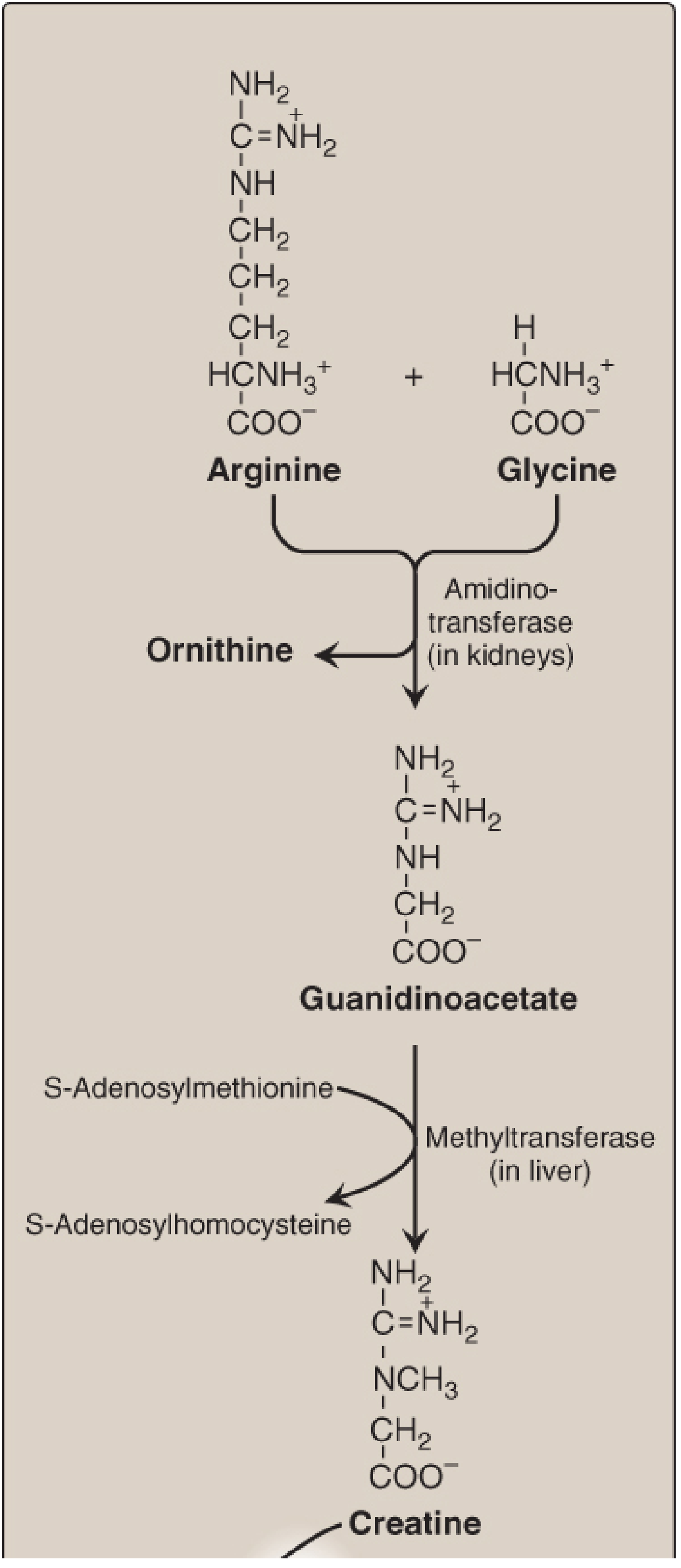
Substrates: Glycine, Arginine, and Methionine (via SAM) are the three amino acids contributing to creatine synthesis. Dietary creatine from animal products also contributes.
Creatine Phosphate (Phosphocreatine) Formation
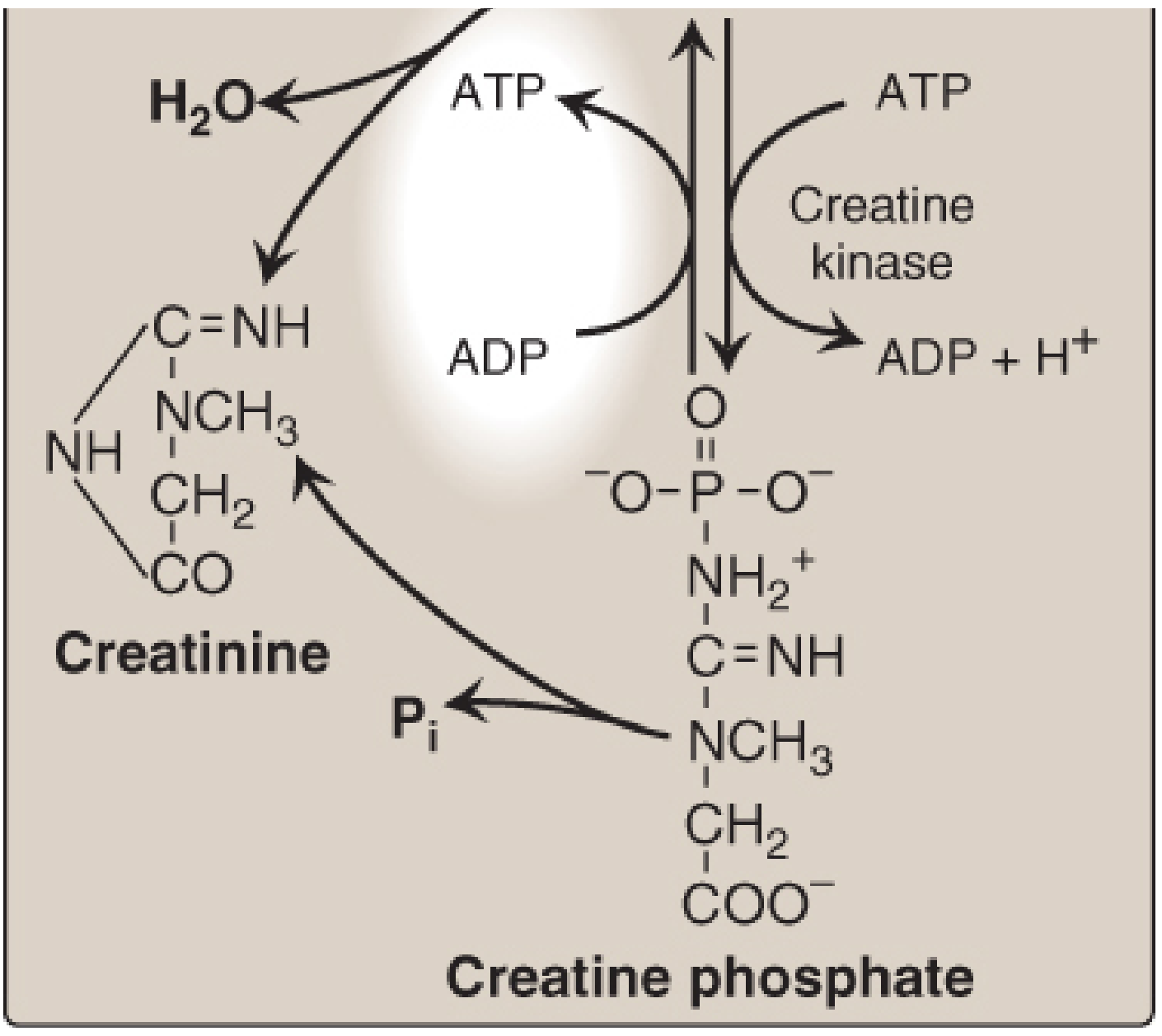
Creatine is transported via blood to muscle and brain, where it is phosphorylated by creatine kinase (CK) using ATP:
Creatine + ATP ⇌ Creatine phosphate + ADP (reversible)
Creatine phosphate acts as a rapidly mobilized high-energy phosphate reserve — it buffers ATP levels during the first few seconds/minutes of intense muscular contraction by donating its phosphate back to ADP to regenerate ATP.
The amount of creatine phosphate in the body is proportional to muscle mass.
Creatinine Formation
Creatinine forms from the spontaneous, irreversible, nonenzymatic cyclization of creatine and creatine phosphate:
Creatine phosphate → Creatinine + Inorganic phosphate (Pᵢ) + H₂O
Key facts:
- This is a nonenzymatic dehydration reaction — no enzyme is required
- Approximately 1–2% of total creatine/creatine phosphate is converted to creatinine per day
- The rate is slow but constant, meaning creatinine production is steady
- Creatinine is the waste/anhydride end-product — it cannot be converted back to creatine under normal conditions
Summary Flow
Arginine + Glycine  →[Kidneys]→  Guanidinoacetate
Guanidinoacetate + SAM  →[Liver]→  Creatine
Creatine + ATP  ⇌[Creatine Kinase, in muscle]⇌  Creatine Phosphate + ADP
Creatine / Creatine Phosphate  →[Spontaneous, nonenzymatic]→  Creatinine  →  Excreted in urine
Clinical Significance
| Parameter | Significance |
|---|---|
| Daily creatinine excretion (~1–2 g/day in adult males) | Proportional to muscle mass — used to verify complete 24-hour urine collection |
| Serum creatinine rises | Indicates reduced GFR / kidney dysfunction — creatinine is freely filtered, not reabsorbed |
| Creatine kinase (CK-MB isoform) in plasma | Marker of myocardial infarction (heart muscle damage) |
| Muscle wasting (paralysis, dystrophy) | Urinary creatinine falls as muscle mass decreases |
| Cooked meat meal | Converts creatine → creatinine in gut, transiently raising serum creatinine by up to 25% |
— Lippincott's Illustrated Reviews: Biochemistry, 8th ed, p. 812–813
— Basic Medical Biochemistry: A Clinical Approach, 6th ed
— Tietz Textbook of Laboratory Medicine, 7th ed, p. 1077
— Harper's Illustrated Biochemistry, 32nd ed, p. 323
— Basic Medical Biochemistry: A Clinical Approach, 6th ed
— Tietz Textbook of Laboratory Medicine, 7th ed, p. 1077
— Harper's Illustrated Biochemistry, 32nd ed, p. 323
This is a shared conversation. Sign in to Orris to start your own chat.