
pnf pattern demonstarrtion properly
Reading File
Finding Sources
Searching Images
PNF proprioceptive neuromuscular facilitation pattern demonstration
Finding Sources
Loading Image
Loading Image
Loading Image
PNF Patterns — Complete Guide with Demonstration
What is PNF?
Proprioceptive Neuromuscular Facilitation (PNF) is a therapeutic approach that uses diagonal, spiral movement patterns to facilitate neuromuscular responses. Developed by Kabat, Knott, and Voss, it is based on the principle that muscles work in synergistic groups along functional diagonal planes rather than in isolated straight-line movements.
Core Principles
| Principle | Description |
|---|---|
| Diagonal planes | All patterns move across the body's midline diagonally |
| Spiral component | Rotation is combined with every pattern |
| Irradiation | Resistance to strong muscles facilitates weaker ones |
| Successive induction | Preceding antagonist contraction enhances agonist response |
| Manual contact | Pressure on skin/muscle activates proprioceptors |
| Verbal command | "Push!", "Pull!" reinforces motor learning |
The Four Diagonal Patterns
PNF has two diagonals (D1 and D2), each with a flexion and extension component.
Upper Extremity Patterns
D1 Flexion — "Reaching across to opposite ear"
- Shoulder: Flexion + Adduction + External Rotation
- Elbow: Flexion or extension (depending on variant)
- Wrist/Fingers: Flexion + Radial deviation
D1 Extension — "Pushing away toward ipsilateral hip"
- Shoulder: Extension + Abduction + Internal Rotation
- Wrist/Fingers: Extension + Ulnar deviation
D2 Flexion — "Drawing sword"
- Shoulder: Flexion + Abduction + External Rotation
- Wrist/Fingers: Extension + Radial deviation
D2 Extension — "Sheathing sword"
- Shoulder: Extension + Adduction + Internal Rotation
- Wrist/Fingers: Flexion + Ulnar deviation
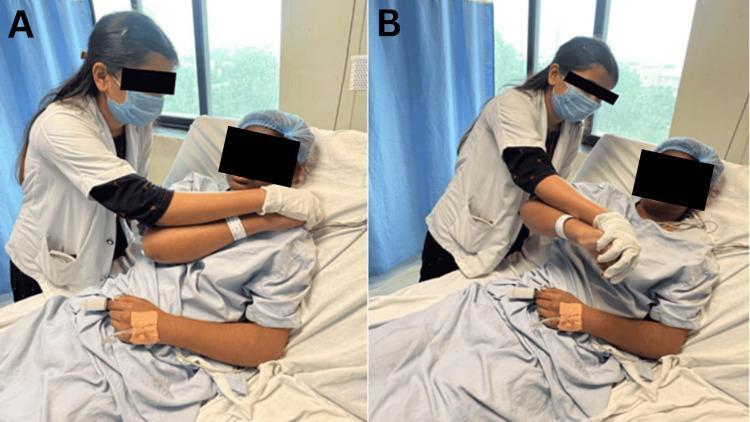
Upper Limb D1 Pattern — Clinical Demonstration
Panel A (D1 Flexion): shoulder flexion + adduction + ER, arm brought toward contralateral ear
Panel B (D1 Extension): shoulder extension + abduction + IR, arm pushed away toward ipsilateral hip
Lower Extremity Patterns
D1 Flexion (Lower)
- Hip: Flexion + Adduction + External Rotation
- Ankle: Dorsiflexion + Inversion + Toe extension
D1 Extension (Lower)
- Hip: Extension + Abduction + Internal Rotation
- Ankle: Plantarflexion + Eversion + Toe flexion
D2 Flexion (Lower)
- Hip: Flexion + Abduction + Internal Rotation
- Ankle: Dorsiflexion + Eversion
D2 Extension (Lower)
- Hip: Extension + Adduction + External Rotation
- Ankle: Plantarflexion + Inversion
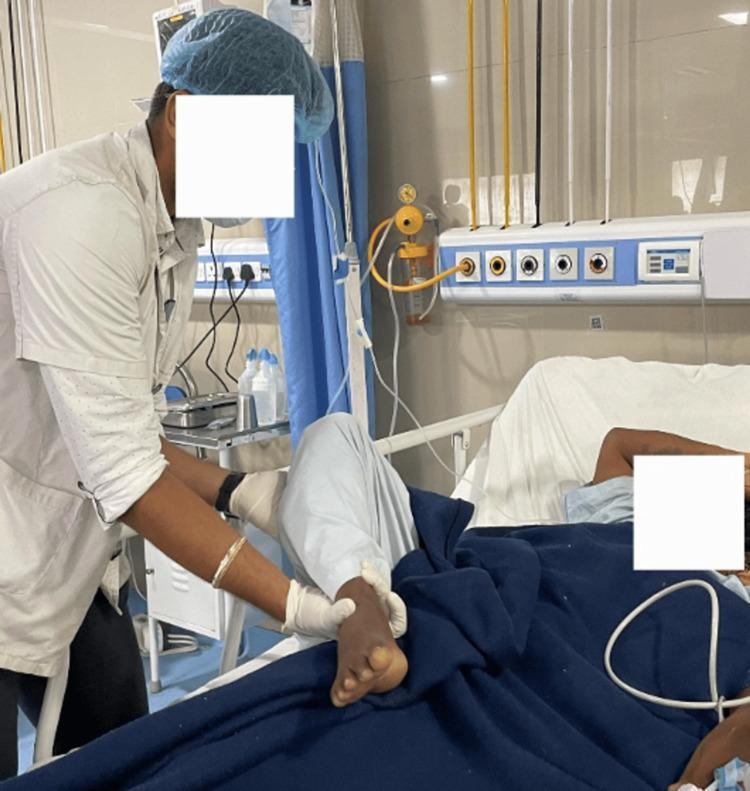
Lower Limb D2 Flexion — Clinical Demonstration
Hip flexion + abduction + IR with ankle dorsiflexion and eversion — guided manually in supine patient
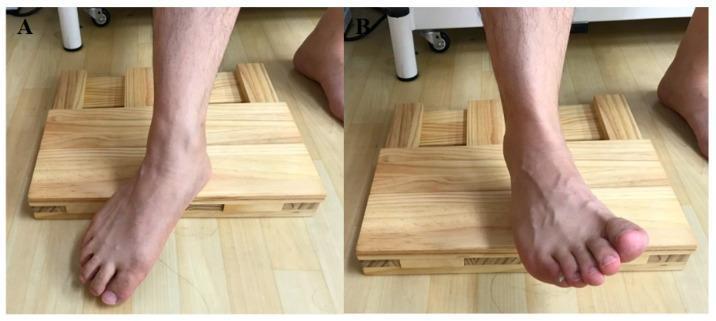
Foot & Ankle PNF Patterns
A = D1 Extension: plantarflexion + eversion + toe flexion
B = D1 Flexion: dorsiflexion + inversion + toe extension
Therapist Hand Placement
| Pattern | Proximal Hand | Distal Hand |
|---|---|---|
| UE D1 Flexion | Posterior deltoid / humerus | Palm / wrist |
| UE D2 Flexion | Anterior deltoid | Dorsum of hand |
| LE D1 Flexion | Medial thigh | Medial foot |
| LE D2 Flexion | Lateral thigh | Dorsolateral foot |
Key rule: Lumbrical grip — fingers guide, thumb opposes. Never use a tight grasp.
PNF Techniques (Applied Within Patterns)
| Technique | Mechanism | Use |
|---|---|---|
| Rhythmic Initiation | Passive → active assisted → resisted | Hypertonia, initiation deficits |
| Contract-Relax | Strong isotonic contraction of tight muscle → relax → stretch | Increasing ROM |
| Hold-Relax | Isometric contraction at end range → relax → stretch | Pain-limited ROM |
| Repeated Contractions | Repeated stretch reflex at weak point | Weak muscles |
| Slow Reversal | Alternating agonist/antagonist | Coordination, endurance |
| Rhythmic Stabilization | Simultaneous isometric co-contraction | Stability, balance |
Clinical Applications
- Stroke / Hemiplegia — re-educate motor patterns, inhibit spasticity
- Spinal Cord Injury — maximise available muscle recruitment via irradiation
- Orthopaedic rehab — post-surgical shoulder/hip strengthening
- Sports rehabilitation — functional diagonal movement retraining
- Parkinson's disease — initiation and coordination via rhythmic techniques
Summary Quick Reference
D1 UE: Flexion = across to opposite ear | Extension = away to same hip
D2 UE: Flexion = draw sword          | Extension = sheath sword
D1 LE: Flexion = flex/adduct/ER      | Extension = extend/abduct/IR
D2 LE: Flexion = flex/abduct/IR      | Extension = extend/adduct/ER
All patterns combine three planes: sagittal + frontal + transverse (rotation), making them functionally superior to uniplanar exercises for neuromuscular rehabilitation.
proper instruction each pTTERN STEP BY STEP
Searching Images
PNF D1 flexion extension upper extremity step by step hand placement
Searching Images
PNF D2 flexion extension lower extremity diagonal pattern instructions
Loading Image
Loading Image
Loading Image
Here is a complete step-by-step instruction guide for all four PNF patterns — upper and lower extremity.
PNF Patterns — Step-by-Step Instructions
UPPER EXTREMITY — D1 PATTERN
Pattern D1 Flexion (UE)
Motion: Extension → Flexion/Adduction/External Rotation
"Reaching across to the opposite ear"
Patient position: Supine or sitting
Starting position (end range):
- Shoulder: extended, abducted, internally rotated
- Elbow: extended
- Wrist: extended + ulnar deviated
- Fingers: extended + spread
- Forearm: pronated
- Palm faces downward-outward
Therapist hand placement:
- Proximal hand: Posterior-lateral aspect of the humerus / posterior deltoid
- Distal hand: Dorsum of hand/fingers (lumbrical grip — fingertips on dorsum, thumb under palm)
Step-by-step execution:
- Set the starting position as above — full elongation of the pattern
- Give a stretch stimulus at the starting position to activate stretch reflex
- Verbal command: "Squeeze my fingers and pull up and across!"
- Patient initiates: fingers flex + wrist flexes + forearm supinates simultaneously
- As movement continues: elbow flexes (if used) or extends in the straight pattern
- Shoulder moves into flexion → adduction → external rotation
- Motion crosses the body midline — hand ends near the contralateral ear
- End position: shoulder flexed ~130°, adducted, ER; wrist flexed; fingers flexed
Resistance: Proximal hand guides direction, distal hand gives graded resistance throughout
Pattern D1 Extension (UE)
Motion: Flexion → Extension/Abduction/Internal Rotation
"Pushing away toward the same-side hip"
Starting position:
- Same as D1 Flexion end position: arm across body near opposite ear
Therapist hand placement:
- Proximal hand: Anterior shoulder / anterior deltoid
- Distal hand: Palm (thenar eminence) of patient's hand
Step-by-step execution:
- Start at D1 Flexion end position (arm crossed near opposite ear)
- Give stretch stimulus in this position
- Verbal command: "Open your hand and push down and out!"
- Patient initiates: fingers extend + wrist extends + forearm pronates
- Elbow extends
- Shoulder moves into extension → abduction → internal rotation
- Motion sweeps away from midline toward the ipsilateral hip
- End position: arm extended, abducted, internally rotated at side
UPPER EXTREMITY — D2 PATTERN
Pattern D2 Flexion (UE)
Motion: Extension → Flexion/Abduction/External Rotation
"Drawing a sword"
Patient position: Supine or sitting
Starting position (end range):
- Shoulder: extended, adducted across body, internally rotated
- Elbow: extended
- Wrist: flexed + ulnar deviated
- Fingers: flexed
- Forearm: pronated
- Hand in front of contralateral hip
Therapist hand placement:
- Proximal hand: Posterior shoulder / posterior deltoid
- Distal hand: Dorsum of hand (lumbrical grip)
Step-by-step execution:
- Position arm across body — hand near opposite hip (sword in sheath)
- Stretch stimulus at starting position
- Verbal command: "Open your hand and lift up and out!"
- Patient initiates: fingers extend + wrist extends + forearm supinates
- Elbow extends (straight D2) or flexes (spiral variant)
- Shoulder moves into flexion → abduction → external rotation
- Arm sweeps upward and outward away from midline
- End position: arm elevated ~120–130°, abducted, ER; wrist extended; fingers extended
- Thumb points upward and backward
Pattern D2 Extension (UE)
Motion: Flexion → Extension/Adduction/Internal Rotation
"Sheathing the sword"
Starting position:
- Same as D2 Flexion end position: arm up and out
Therapist hand placement:
- Proximal hand: Anterior-superior shoulder
- Distal hand: Palm of patient's hand
Step-by-step execution:
- Start at D2 Flexion end position (arm up and out, ER)
- Stretch stimulus
- Verbal command: "Close your hand and push down and across!"
- Patient initiates: fingers flex + wrist flexes + forearm pronates
- Shoulder moves into extension → adduction → internal rotation
- Arm sweeps downward across the body
- End position: arm extended, adducted across to opposite hip
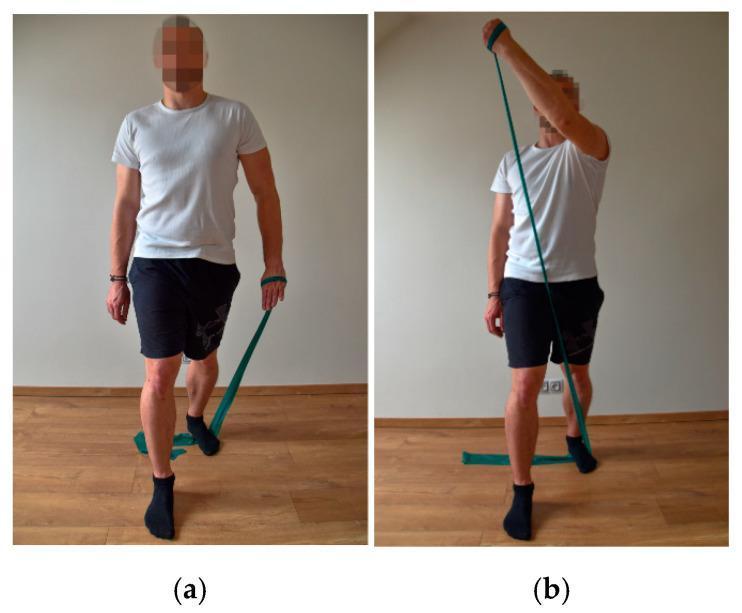
Self-exercise with band:
LOWER EXTREMITY — D1 PATTERN
Pattern D1 Flexion (LE)
Motion: Extension → Flexion/Adduction/External Rotation
Patient position: Supine
Starting position (end range):
- Hip: extended, abducted, internally rotated
- Knee: extended (or flexed in variant)
- Ankle: plantarflexed + everted
- Toes: flexed
Therapist hand placement:
- Proximal hand: Medial thigh (above knee), palm facing the direction of motion
- Distal hand: Medial dorsum of foot / great toe side
Step-by-step execution:
- Position leg in full D1 extension starting position
- Apply stretch stimulus — slight additional plantarflexion + eversion
- Verbal command: "Pull your foot up and in, and lift your leg up and across!"
- Patient initiates: toes extend + ankle dorsiflexes + foot inverts (supinates)
- Knee flexes (if flexion pattern used)
- Hip moves into flexion → adduction → external rotation
- Leg crosses midline — foot ends above and across the body
- End position: hip flexed, adducted, ER; ankle dorsiflexed + inverted
Pattern D1 Extension (LE)
Motion: Flexion → Extension/Abduction/Internal Rotation
Starting position:
- Hip: flexed, adducted, ER (leg across midline)
- Ankle: dorsiflexed + inverted
Therapist hand placement:
- Proximal hand: Lateral thigh
- Distal hand: Lateral/plantar surface of foot
Step-by-step execution:
- Start at D1 Flexion end position
- Stretch stimulus — slight additional dorsiflexion + inversion
- Verbal command: "Push your foot down and out, and push your leg down and out!"
- Patient initiates: toes flex + ankle plantarflexes + foot everts (pronates)
- Knee extends
- Hip moves into extension → abduction → internal rotation
- Leg sweeps outward and downward
- End position: hip extended, abducted, IR; ankle plantarflexed + everted
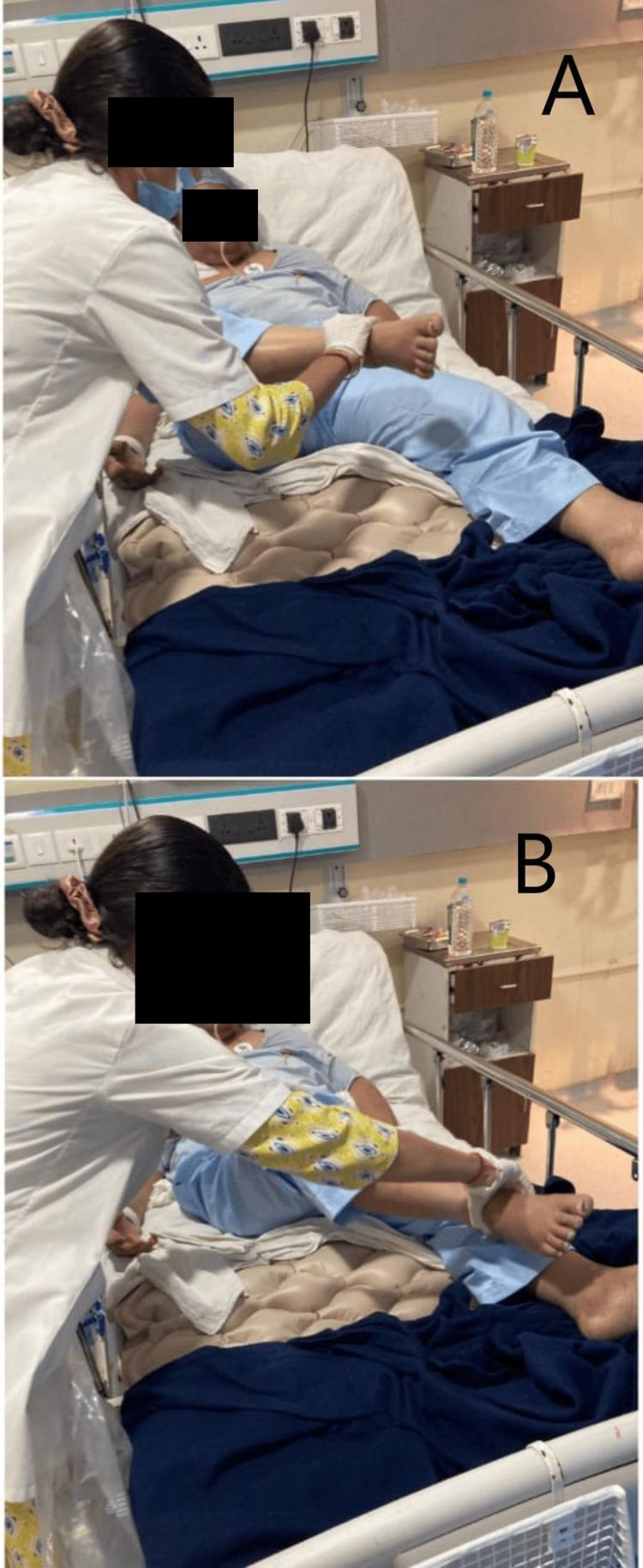
LOWER EXTREMITY — D2 PATTERN
Pattern D2 Flexion (LE)
Motion: Extension → Flexion/Abduction/Internal Rotation
Patient position: Supine
Starting position (end range):
- Hip: extended, adducted, externally rotated
- Knee: extended
- Ankle: plantarflexed + inverted
- Toes: flexed
Therapist hand placement:
- Proximal hand: Lateral thigh (anterolateral aspect)
- Distal hand: Lateral dorsum of foot / little toe side
Step-by-step execution:
- Position leg in full D2 extension (adducted, ER, plantarflexed)
- Stretch stimulus
- Verbal command: "Pull your foot up and out, and lift your leg up and out!"
- Patient initiates: toes extend + ankle dorsiflexes + foot everts (pronates)
- Knee flexes (if flexion-knee variant)
- Hip moves into flexion → abduction → internal rotation
- Leg sweeps upward and outward away from midline
- End position: hip flexed, abducted, IR; ankle dorsiflexed + everted
Pattern D2 Extension (LE)
Motion: Flexion → Extension/Adduction/External Rotation
Starting position:
- Hip: flexed, abducted, IR
- Ankle: dorsiflexed + everted
Therapist hand placement:
- Proximal hand: Medial thigh
- Distal hand: Medial plantar surface of foot
Step-by-step execution:
- Start at D2 Flexion end position (leg up and out)
- Stretch stimulus
- Verbal command: "Push your foot down and in, and push your leg down and in!"
- Patient initiates: toes flex + ankle plantarflexes + foot inverts (supinates)
- Knee extends
- Hip moves into extension → adduction → external rotation
- Leg sweeps downward and across midline
- End position: hip extended, adducted, ER; ankle plantarflexed + inverted
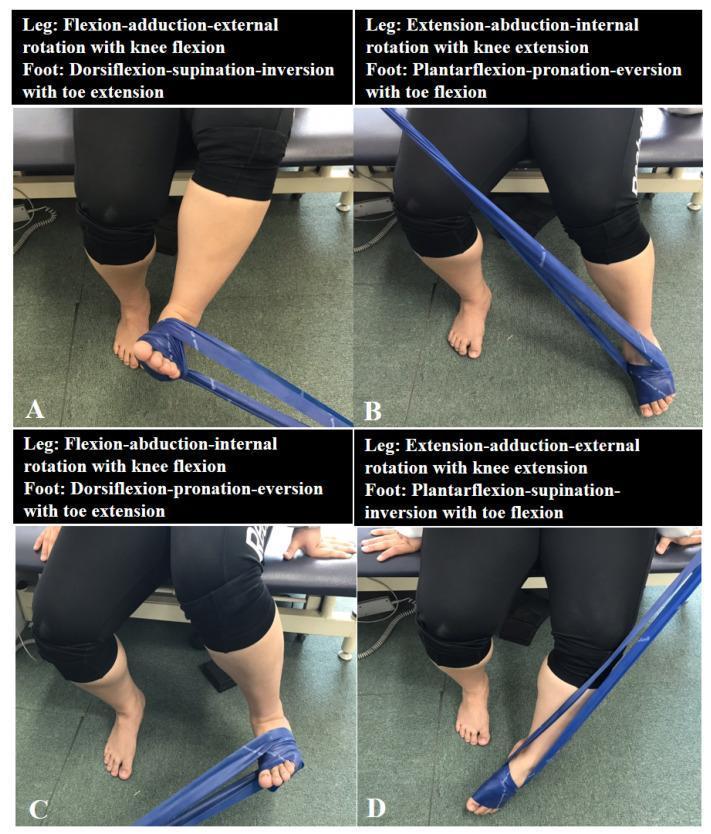
Key Rules for ALL Patterns
| Rule | Detail |
|---|---|
| Distal initiates | Fingers/toes always move FIRST before proximal joints |
| Rotation is continuous | Rotation begins at start and continues throughout — never stops mid-pattern |
| Diagonal line | Therapist positions themselves along the diagonal line of movement |
| Lumbrical grip | Never grip tightly — use fingertips and thenar eminence |
| Verbal commands | Short, sharp, timed to initiation — "Push!", "Pull!", "Hold!" |
| Stretch reflex | Quick stretch at start position amplifies motor recruitment |
| Eye contact/gaze | Patient looks toward the direction of movement (visual reinforcement) |
| Resistance grading | Maximum resistance that still allows smooth, full-range movement |
Pattern Summary Table
| Pattern | Hip/Shoulder | Rotation | Ankle/Wrist | Initiates |
|---|---|---|---|---|
| UE D1 Flex | Flex + ADD | ER | Flex + Radial | Finger flex |
| UE D1 Ext | Ext + ABD | IR | Ext + Ulnar | Finger ext |
| UE D2 Flex | Flex + ABD | ER | Ext + Radial | Finger ext |
| UE D2 Ext | Ext + ADD | IR | Flex + Ulnar | Finger flex |
| LE D1 Flex | Flex + ADD | ER | DF + Inversion | Toe ext |
| LE D1 Ext | Ext + ABD | IR | PF + Eversion | Toe flex |
| LE D2 Flex | Flex + ABD | IR | DF + Eversion | Toe ext |
| LE D2 Ext | Ext + ADD | ER | PF + Inversion | Toe flex |
ADD = adduction | ABD = abduction | ER = external rotation | IR = internal rotation | DF = dorsiflexion | PF = plantarflexion
This is a shared conversation. Sign in to Orris to start your own chat.