
6 yr old kid with focal swollen gums over upper premolar, on pressing it little pus is coming out
Reading File
Now let me search the medical library for this clinical scenario in parallel:
Finding Sources
Finding Sources
Finding Sources
Finding Sources
Finding Sources
Finding Sources
Good, I found relevant sections. Let me read the key dental content from Tintinalli's and Roberts & Hedges:
Reading File
Reading File
I now have excellent clinical content. Let me also fetch the parulis image referenced in Tintinalli's and read the antibiotic table:
Reading File
I have all the information needed. Let me also fetch the parulis clinical image:
Loading Image
Now I have everything needed for a comprehensive answer.
Diagnosis: Parulis (Gum Boil) — from a Periapical/Periradicular Abscess
This is a classic presentation. The focal gingival swelling with expressible pus overlying a tooth in a 6-year-old is called a parulis — a small draining fistula on the gingiva that marks the exit point of a periapical abscess. The upper "premolar" in a 6-year-old is actually a primary (deciduous) molar (true premolars haven't erupted yet at this age), pointing to an infected primary maxillary molar.
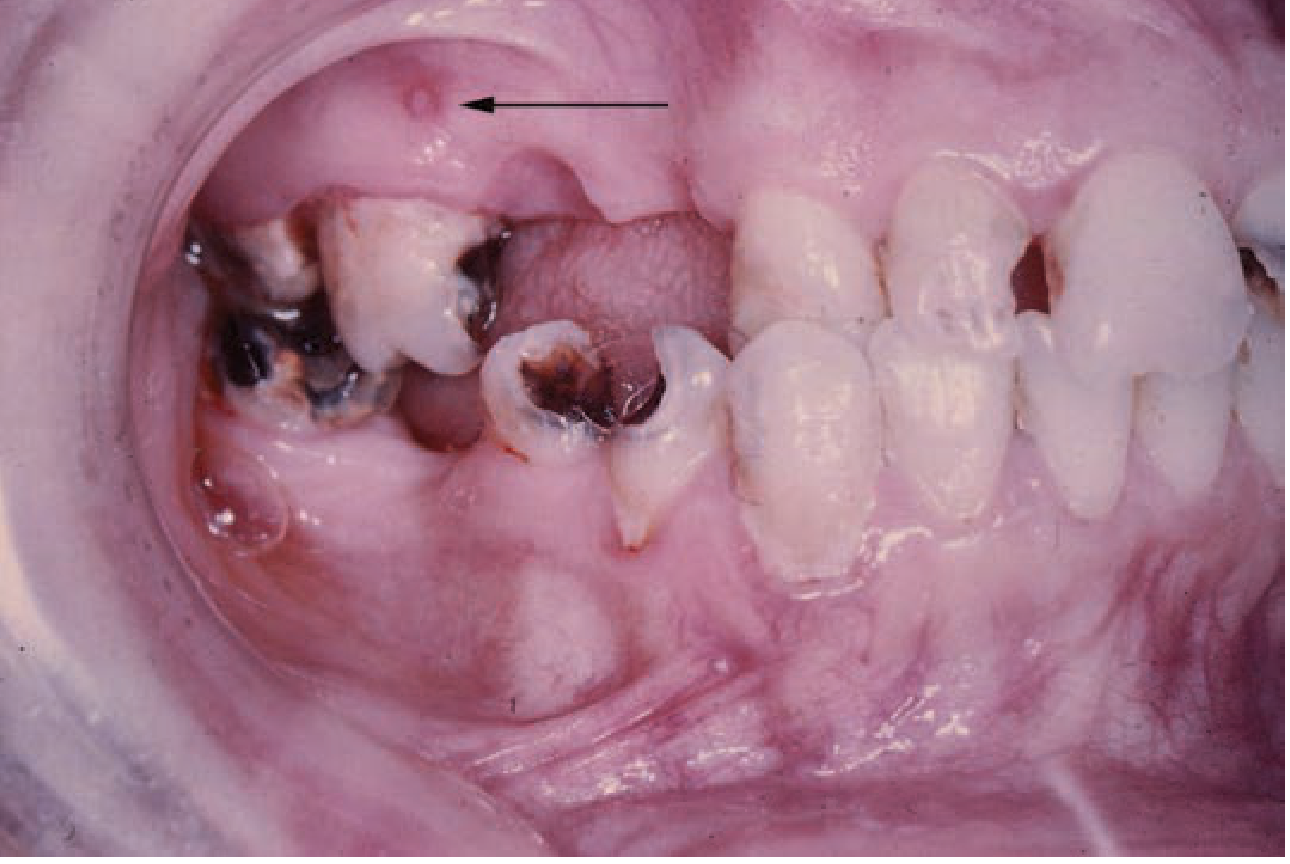
Pathophysiology
- Dental caries → enamel breakdown → invasion of dentinal tubules → pulpitis
- If untreated: irreversible pulpitis → pulp necrosis
- Infection spreads apically → periapical abscess
- Abscess follows path of least resistance through alveolar bone → perforates cortex → drains through gingiva = parulis
The pus that exudes on pressing is the fistula draining the periapical collection. This actually indicates partial spontaneous drainage, which is why the child may not have severe pain.
Key Examination Points
| Finding | Significance |
|---|---|
| Focal gingival swelling with pus | Parulis = draining sinus from periapical abscess |
| Tooth tenderness to percussion | Confirms periapical/periradicular involvement |
| Caries or tooth discoloration | Identifies the offending tooth |
| No facial swelling/trismus | Infection localized (not in deep fascial spaces) |
| Fever/lymphadenopathy | Assess for systemic spread |
Investigations
- Periapical dental X-ray (intraoral): look for periapical radiolucency (dark halo around root apex), widening of periodontal ligament space, or loss of lamina dura. This confirms the diagnosis and guides treatment.
Management
Immediate (ED/clinic):
- Antibiotics — Amoxicillin is first-line in children (penicillin, amoxicillin, metronidazole, or clindamycin for penicillin allergy). Cover typical oral flora.
- Analgesia — Ibuprofen ± paracetamol (NSAIDs preferred over opioids per ADA guidelines). Avoid injecting local anesthetic directly at the infected/fluctuant site; use a regional block away from the infected tissue if needed.
- The parulis itself is already draining, so formal I&D is not required here. Encourage saline mouth rinses to promote drainage.
Definitive (Pediatric Dentistry referral — urgent within 24–48 hours):
- Primary tooth with abscess in a 6-year-old: options are pulpectomy + stainless steel crown (if tooth is restorable and root resorption is not advanced) or extraction.
- Extraction is often preferred for primary teeth close to natural exfoliation time or with extensive root resorption — check the X-ray and the child's dental development stage.
- Space maintainer may be needed after extraction if the permanent successor is not ready to erupt.
Red Flags Requiring Urgent Escalation
- Facial swelling, trismus, or difficulty swallowing → spread to fascial spaces (risk of Ludwig's angina or cavernous sinus thrombosis via infraorbital space)
- Fever, malaise, or elevated WBC → systemic involvement → IV antibiotics/hospital admission
- Periorbital swelling (maxillary teeth) → infraorbital space infection
Bottom line for this child: Parulis from a primary upper molar periapical abscess. Start amoxicillin + ibuprofen, and refer urgently to a pediatric dentist for X-ray and definitive treatment (pulpectomy or extraction with space management consideration).
Sources: Tintinalli's Emergency Medicine (9th ed.), Roberts and Hedges' Clinical Procedures in Emergency Medicine
Rct procedure
Finding Sources
Finding Sources
Finding Sources
Finding Sources
Reading File
Reading File
Searching the Web
root canal treatment RCT procedure steps access cavity instrumentation obturation
I have enough from the textbooks and my core knowledge to give a thorough, well-structured answer.
Root Canal Treatment (RCT) — Step-by-Step Procedure
RCT (endodontic therapy) involves opening the pulp chamber, removing all pulp tissue, cleaning and shaping the root canal system, and sealing it to prevent reinfection. Here's the full procedure:
Step 1 — Diagnosis & Pre-op Assessment
- Clinical examination: tenderness to percussion, palpation, cold/heat testing
- Periapical X-ray: assess root length, number of canals, periapical status, root curvature, root resorption
- Confirm irreversible pulpitis or pulp necrosis (± periapical abscess)
Step 2 — Local Anesthesia
- Infiltration (maxillary teeth) or inferior alveolar nerve block (mandibular teeth)
- For necrotic pulp with acute abscess: anesthesia may be difficult due to lowered local pH; consider intraosseous or intrapulpal injection as supplement
- Long-acting agent (e.g., bupivacaine) reduces post-op discomfort
Step 3 — Rubber Dam Isolation
- Mandatory — prevents contamination of the canal with saliva, protects the patient from irrigants and instruments
- Rubber dam clamp placed on the tooth; dam punched and stretched over the tooth
Step 4 — Access Cavity Preparation
- Objective: straight-line access to all root canal orifices
- High-speed bur used to open the crown through:
- Anterior teeth: lingual/palatal surface
- Premolars: occlusal surface
- Molars: occlusal surface
- Remove entire roof of pulp chamber; locate all canal orifices
- Trephination with an endodontic explorer
Step 5 — Working Length Determination
- Electronic apex locator (preferred) measures distance from access opening to the apical constriction (~0.5–1 mm short of radiographic apex)
- Confirmed with a working length X-ray (file in canal, correlated with radiograph)
- Working length = prevents over-instrumentation beyond the apex
Step 6 — Canal Cleaning & Shaping (Chemo-mechanical Preparation)
a. Mechanical instrumentation
- Manual K-files or H-files (ISO sizes 06–140) OR rotary NiTi files (e.g., ProTaper, WaveOne, Reciproc)
- Technique options:
- Step-back: start small (size 10/15), work toward apex, then step back in 1 mm increments with progressively larger files
- Crown-down: start coronal, work toward apex (preferred with rotary NiTi)
- Goal: remove infected dentin, shape the canal to a tapering funnel form
b. Irrigation (chemical cleaning)
| Irrigant | Purpose |
|---|---|
| Sodium hypochlorite (NaOCl) 2.5–5.25% | Dissolves organic tissue, antimicrobial (primary irrigant) |
| EDTA 17% | Chelates calcium, removes smear layer |
| Chlorhexidine 2% | Antimicrobial (final rinse option) |
| Saline | Flushing between irrigants |
- Irrigate copiously between each file; needle kept loose in canal (never wedged)
Step 7 — Canal Drying
- Paper points (ISO-sized, matching the master apical file size) inserted to working length to absorb all moisture
Step 8 — Intracanal Medication (if multi-visit)
- Calcium hydroxide paste placed in canal between appointments
- Action: raises pH → kills residual bacteria, dissolves tissue, promotes healing of periapical lesion
- Sealed with temporary restoration (e.g., Cavit, IRM)
- Wait 1–2 weeks before obturation (especially if abscess present, as in this child's case)
In single-visit RCT (no active infection, non-vital tooth), steps 8 and obturation happen in the same appointment.
Step 9 — Obturation (Sealing the Canal)
Objective: 3-dimensional seal of the entire canal system at the apical constriction
Materials:
- Gutta-percha (GP) — primary filling material (semi-solid rubber)
- Root canal sealer (e.g., AH Plus, zinc oxide eugenol–based, calcium silicate–based)
Techniques:
| Technique | Description |
|---|---|
| Cold lateral condensation | Master GP cone + sealer to WL; spreader used to condense laterally; accessory cones added until canal full |
| Warm vertical compaction (Schilder) | GP softened with heat, compacted vertically; superior 3D fill |
| Single-cone technique | One cone matched to taper of rotary preparation; used with bioceramic sealers |
- Excess GP cut at canal orifice with a heated instrument
- Check with post-obturation X-ray: fill should be 0.5–1 mm short of radiographic apex, homogeneous, with no voids
Step 10 — Coronal Restoration
- Crucial step — the most common cause of RCT failure is coronal leakage, not poor obturation
- Temporary restoration placed immediately
- Permanent restoration (composite, full-coverage crown) placed within 2–4 weeks
- Posterior teeth (premolars, molars) must receive a crown — RCT makes the tooth brittle and prone to fracture
Post-op Care
- Mild soreness for 24–72 hours (periapical inflammation) — ibuprofen ± paracetamol
- Avoid chewing on the tooth until crown placed
- Review X-ray at 6 months and 1 year to confirm periapical healing
RCT vs. Pulpectomy in Primary (Deciduous) Teeth
In a 6-year-old child (as in the previous case), the procedure is called a pulpectomy, which follows the same principles but with modifications:
- Only resorbable filling materials used (e.g., zinc oxide eugenol paste, Metapex) — because the roots must resorb naturally as the permanent tooth erupts
- Gutta-percha is not used in primary teeth (it doesn't resorb)
- Instrumentation is more conservative to avoid damage to the permanent tooth bud below
Sources: Rosen's Emergency Medicine (10th ed.); Harrison's Principles of Internal Medicine (22nd ed.); Roberts & Hedges' Clinical Procedures in Emergency Medicine
This is a shared conversation. Sign in to Orris to start your own chat.