
Histopathology of hairy leukoplakia in oral path bds 3rd year university like answer
Reading File
Now let me search the library for hairy leukoplakia histopathology:
Finding Sources
Finding Sources
The Robbins Pathologic Basis of Disease has the most relevant section. Let me read it along with the oral pathology-focused content:
Reading File
Reading File
Finding Sources
Excellent - I have the key histology image and comprehensive content. Let me also read Andrews' Diseases of the Skin for more histological details, and fetch the histology image:
Reading File
Loading Image
I now have comprehensive information from authoritative textbooks. Here is the complete BDS 3rd year university-style answer:
Histopathology of Hairy Leukoplakia
Definition
Hairy leukoplakia (HL), also called Oral Hairy Leukoplakia (OHL), is a distinctive oral mucosal lesion caused by Epstein-Barr virus (EBV) infection of the oral epithelium, occurring almost exclusively in immunocompromised patients.
Etiology
- Causative agent: Epstein-Barr virus (EBV) - a herpesvirus (Human Herpesvirus type 4)
- Most commonly associated with HIV infection / AIDS
- Also seen in organ transplant recipients, patients on chemotherapy/immunosuppressants, steroid inhaler users, and elderly immunocompromised individuals
Clinical Features (Brief)
- Site: Almost always on the lateral border of the tongue (bilateral), occasionally on buccal mucosa
- Appearance: White, fluffy ("hairy"), corrugated or shaggy plaques
- Cannot be scraped off (unlike thrush/candidiasis - important distinguishing feature)
- Presence in an otherwise asymptomatic patient is a strong indicator of HIV infection with moderate-to-severe immunosuppression
Histopathological Features
This is the core of the answer. The microscopic picture is very characteristic:
1. Hyperparakeratosis
- The surface epithelium shows marked hyperparakeratosis (thickening of the keratin layer with retained nuclei)
- This produces the "hairy" or shaggy clinical surface appearance
- The keratin layer may show irregular projections resembling hairs
2. Acanthosis
- There is acanthosis - thickening of the spinous (prickle cell) layer
- The epithelium is significantly thickened overall
3. "Balloon Cells" (Koilocyte-like cells) - Most Characteristic Feature
- In the upper spinous cell layer, there are large cells with:
- Clear, vacuolated cytoplasm ("balloon cells")
- Pyknotic or wrinkled ("raisinoid") nuclei
- These cells are sometimes called koilocytes and represent EBV-infected keratinocytes undergoing viral cytopathic effect
- They show perinuclear halo due to cytoplasmic clearing
4. Minimal Subepithelial Inflammation
- Unlike many other white lesions, the underlying lamina propria shows minimal inflammatory infiltrate
- This relative absence of inflammation is a diagnostic clue
5. Absence of Dysplasia
- No epithelial dysplasia - this is a benign, non-premalignant condition
- No nuclear atypia, abnormal mitoses, or loss of polarity
6. EBV Detection
- EBV RNA transcripts (EBER) and EBV proteins can be demonstrated in lesional cells by in situ hybridization or immunohistochemistry
- EBV replication occurs in the upper (superficial) layers of the epithelium
7. Superimposed Candidal Infection (Variable)
- Candidal hyphae may be seen in the superficial keratin layer in some cases
- This can add to the clinical "hairiness"
- Demonstrated by PAS stain
Histopathology Summary Table
| Feature | Findings |
|---|---|
| Surface | Hyperparakeratosis |
| Epithelium | Acanthosis (thickened) |
| Spinous layer | Balloon cells (clear/vacuolated cells) |
| Nuclear changes | Pyknotic/raisinoid nuclei in balloon cells |
| Inflammation | Minimal / absent |
| Dysplasia | Absent |
| EBV | Demonstrable by EBER in situ hybridization |
Histopathology Image
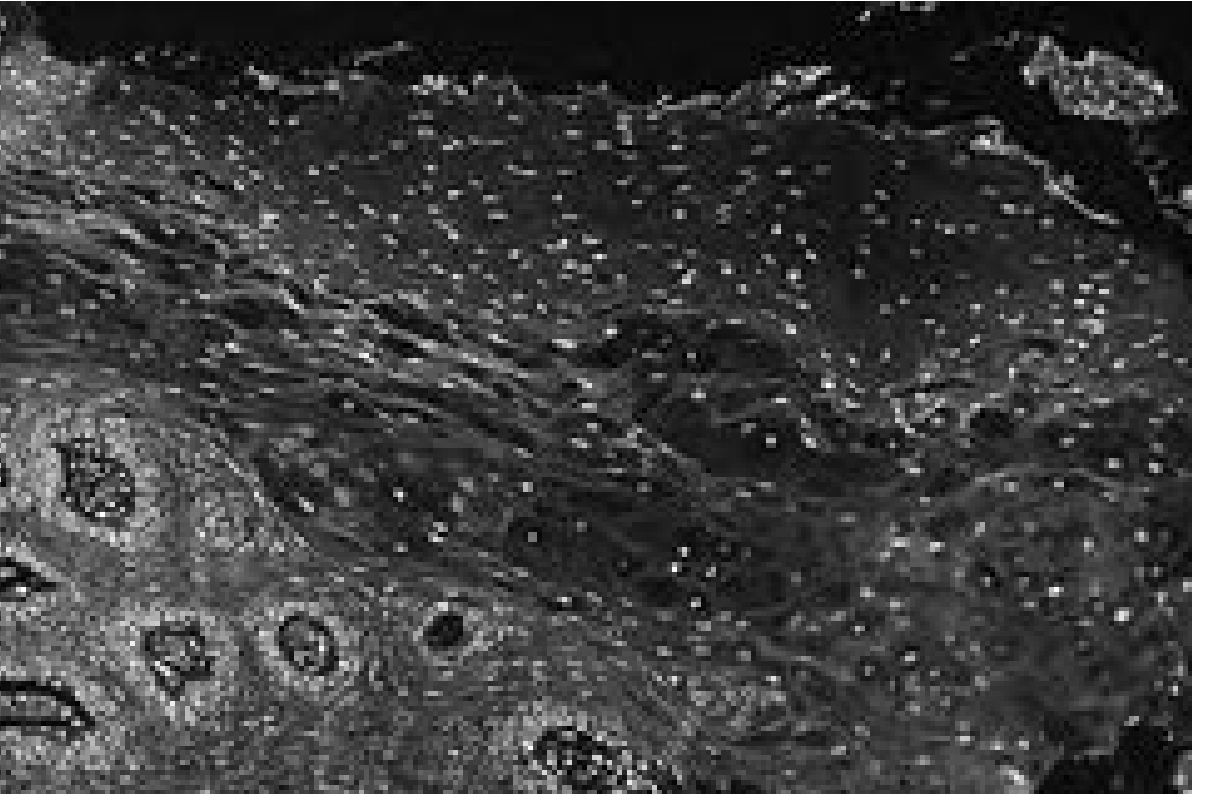
Characteristic hyperparakeratosis with balloon cells in the upper spinous cell layer - (Cummings Otolaryngology; Courtesy Dr. Russel Corio)
Differential Diagnosis (Histopathological)
| Condition | Differentiating Feature |
|---|---|
| Candidiasis (Thrush) | PAS-positive hyphae; can be scraped off; inflammatory infiltrate |
| Leukoplakia (ordinary) | May show dysplasia; no balloon cells; no EBV |
| Lichen planus | Band-like lymphocytic infiltrate; saw-tooth rete pegs; Civatte bodies |
| White sponge nevus | Parakeratosis; clear cells but no EBV; familial |
| Carcinoma in situ | Epithelial dysplasia throughout full thickness |
Diagnosis
Biopsy is confirmed by:
- Characteristic histological findings (hyperparakeratosis + acanthosis + balloon cells + minimal inflammation)
- EBV detection by in situ hybridization (EBER staining) or immunohistochemistry
Important Points for Exams
- Caused by EBV, not Candida
- Site: lateral border of tongue
- Cannot be scraped off
- Key histological hallmark: hyperparakeratosis + acanthosis + balloon cells in upper spinous layer + minimal inflammation
- No malignant potential - does not undergo malignant transformation
- Strong marker of cellular immunodeficiency (especially HIV/AIDS)
- Treatment usually not required as it is asymptomatic; systemic antivirals (acyclovir) used when needed
Sources: Robbins, Cotran & Kumar - Pathologic Basis of Disease, p. 683; Cummings Otolaryngology Head and Neck Surgery; Andrews' Diseases of the Skin
This is a shared conversation. Sign in to Orris to start your own chat.