
Reasons for chapped lips with crusting on mouth edges plus slight bleed from lips in 25 year old male
Reading File
Finding Sources
Finding Sources
Reading File
Reading File
Reading File
Now let me read the Angular Cheilitis section from Andrews' dermatology for more detail, and also get the nutritional deficiency content:
Reading File
Reading File
I now have comprehensive information from multiple authoritative textbooks. Let me fetch the angular cheilitis image for the answer:
Loading Image
Here is a thorough breakdown of causes for chapped lips with crusting, mouth-corner involvement, and minor bleeding in a 25-year-old male.
Cheilitis — Causes in a 25-Year-Old Male
The clinical picture you describe — dry/chapped lips, crusting, fissures/bleeding at the mouth edges — spans two overlapping entities: cheilitis exfoliativa (affecting the whole lip vermilion) and angular cheilitis (specifically at the commissures/corners). Both can coexist.
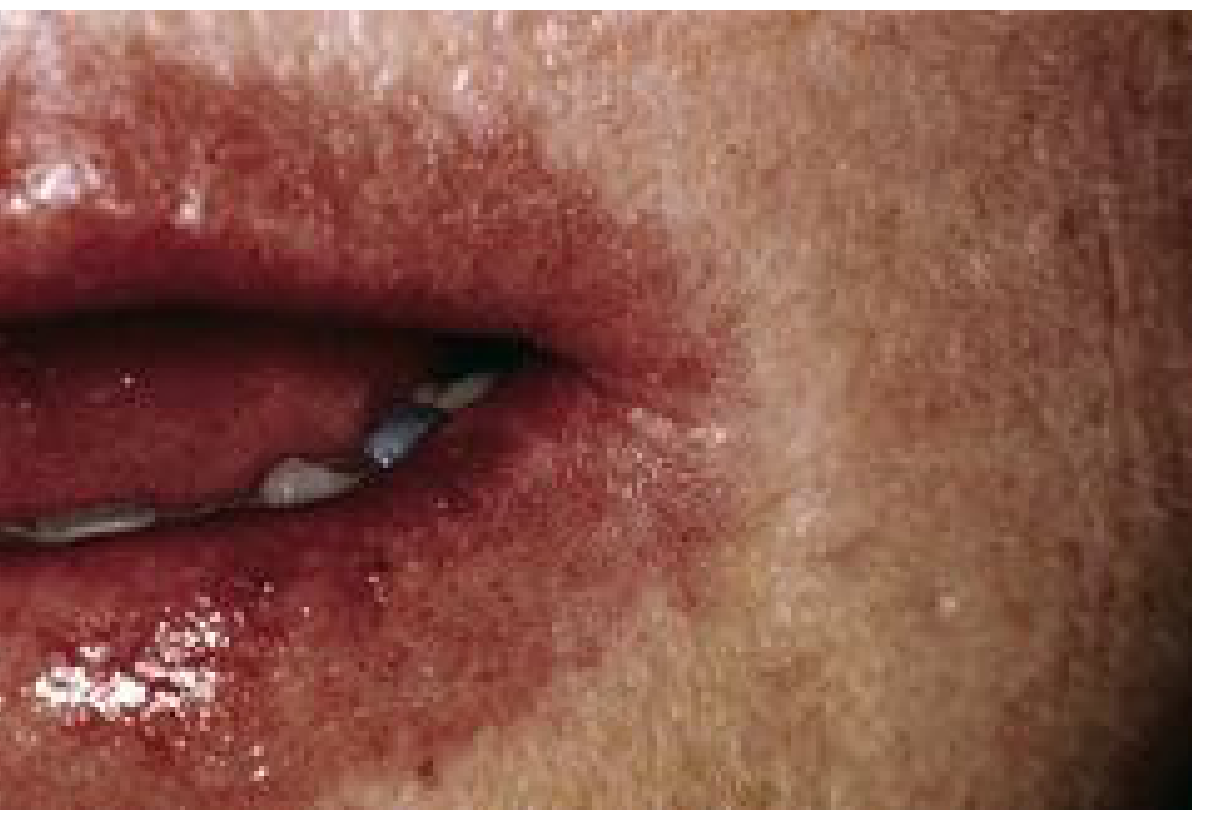
1. Habit-Related (Most Common in Young Adults)
| Habit | Mechanism |
|---|---|
| Lip licking | Saliva evaporates → repeated wetting/drying cycle → intertriginous dermatitis |
| Lip biting / picking | Direct trauma to vermilion → fissures, bleeding, crusting |
| Mouth breathing | Continuous airflow desiccates the lips |
"Oral habits like lip licking and lip biting may also predispose patients to angular cheilitis." — Sleisenger & Fordtran's GI and Liver Disease
2. Nutritional Deficiencies
These are important to exclude in a young male, especially with dietary restrictions:
| Deficiency | Lip Finding |
|---|---|
| Riboflavin (Vitamin B2) | Angular cheilitis, burning pain of lips and mouth |
| Iron deficiency | Angular cheilitis, atrophic glossitis |
| Folate | Angular cheilitis, hyperkeratotic mucosal lesions |
| Vitamin B6 (pyridoxine) | Angular cheilitis |
| Zinc | Taste changes, oral mucosal involvement |
"Vitamin B2 (riboflavin) or iron deficiency may cause cheilitis... folate and iron: angular cheilitis, hyperkeratotic oral mucosal lesions." — KJ Lee's Essential Otolaryngology
3. Candidal / Microbial Infection
- Candida albicans is a very common secondary infecting agent at the mouth corners, producing fissures, maceration, and erythema at the labial commissures
- Staphylococcus aureus can co-infect or independently cause angular cheilitis with crusting
- Intraoral candidiasis (thrush) may extend to the commissures
"Angular cheilitis is generally considered to be a Candida-related condition, although a supervening infection or coinfection with staphylococcal species may be noted. In such instances, the labial commissures can appear fissured, macerated, or erythematous, often with extension onto the adjacent skin." — Cummings Otolaryngology
4. Inflammatory / Dermatological Conditions
- Atopic dermatitis (eczema) — cheilitis may be the initial or sole manifestation; lips are chronically inflamed
- Seborrhoeic dermatitis — particularly affects the face including perioral area
- Psoriasis — can involve the lips with crusting and scaling
- Contact dermatitis — from toothpastes, mouthwashes, lip balms, or foods (e.g., mango, cinnamon)
"The cheilitis may be secondary to seborrhoeic dermatitis, atopic dermatitis, psoriasis, retinoid therapy... irritating or allergenic substances in lipsticks, dentifrices, and mouthwashes may be causative factors." — Andrews' Diseases of the Skin
5. Allergic Contact Cheilitis
- Allergens: fragrance mix, balsam of Peru, lanolin, dodecyl gallate, nickel, sunscreen agents in lip balms
- Though lipsticks are the most common trigger, males can react to lip balms, dental products, or food
- Presents with dryness, fissuring, edema, and crusting
6. Drug-Induced
- Isotretinoin / retinoids (commonly prescribed in young males for acne) — extremely common cause; causes chapped, fissured, bleeding lips
- Protease inhibitors (HIV therapy)
- Drugs causing xerostomia (antihistamines, anticholinergics) → dry lips
7. Systemic / Immunological Causes
Less likely but worth considering if features are persistent or recurrent:
- Sjögren syndrome (dry mouth/eyes + cheilitis)
- Crohn disease / Melkersson-Rosenthal syndrome — granulomatous cheilitis with lip swelling
- HIV/AIDS — cheilitis is a known oral manifestation
- Plummer-Vinson syndrome — iron deficiency triad (cheilitis + dysphagia + anaemia)
Practical Approach in a 25-Year-Old Male
Ask about:
- Isotretinoin or any acne medication use (very common trigger in this demographic)
- Lip-licking or biting habit
- Diet quality / possible vegan or restricted diet (B2, iron, folate, B12 deficiency)
- Dental products, toothpaste brand, lip balms
- History of eczema, psoriasis, or allergies
- Recent antibiotic use (predisposes to candidiasis)
- HIV risk factors
Investigations to consider:
- FBC, serum iron, ferritin, folate, B12, B2, zinc levels
- Swab of mouth corners for Candida and bacterial culture
- Patch testing if allergic contact cheilitis suspected
Sources: Andrews' Diseases of the Skin (Clinical Dermatology); Cummings Otolaryngology Head and Neck Surgery; Sleisenger & Fordtran's Gastrointestinal and Liver Disease; KJ Lee's Essential Otolaryngology
This is a shared conversation. Sign in to Orris to start your own chat.