
Coagulopathy management incld evidences
Reading File
Coagulopathy management covers a broad clinical domain. Let me search the library and recent evidence simultaneously.
Searching sources...
Finding Sources
Searching PubMed
"coagulopathy" AND "management"
Good - I have key textbook sections and recent evidence. Let me read all the relevant textbook sections in parallel.
Reading File
Reading File
Reading File
Finding Sources
Excellent content found. Let me read the more detailed sections from Schwartz's and Current Surgical Therapy in parallel.
Reading File
Reading File
Finding Sources
Let me get the DIC treatment table from Goldman-Cecil and the remaining detailed content from Current Surgical Therapy.
Reading File
Reading File
Finding Sources
Let me fetch the key flowchart image and also read the TXA section and Rosen's DIC section.
Reading File
Reading File
Loading Image
I now have comprehensive data from multiple textbooks. Let me also get the TEG/ROTEM viscoelastic monitoring section and the remaining blood product details from Current Surgical Therapy to ensure completeness.
Reading File
Finding Sources
I now have excellent, comprehensive data. Let me compile the full answer.
Coagulopathy Management - Comprehensive Guide with Evidence
1. Definition and Classification
Coagulopathy is a failure of normal hemostasis leading to impaired clot formation, excessive bleeding, or a combination of bleeding and thrombosis. It is classified by etiology:
| Type | Key Mechanism |
|---|---|
| Trauma-Induced Coagulopathy (TIC) | Acute Traumatic Coagulopathy (ATC) + dilution + hypothermia + acidosis |
| Disseminated Intravascular Coagulation (DIC) | Uncontrolled systemic thrombin generation |
| Dilutional Coagulopathy | Massive crystalloid/colloid resuscitation depletes clotting factors |
| Liver Disease Coagulopathy | Synthetic failure of factors II, V, VII, IX, X, fibrinogen |
| Drug-Induced (anticoagulant reversal) | Warfarin, DOAC, heparin |
| Obstetric Coagulopathy | Amniotic fluid embolism, abruption, PPH |
2. Pathophysiology of Trauma-Induced Coagulopathy (TIC)
TIC arises from two overlapping phases:
Acute Traumatic Coagulopathy (ATC) - occurs within minutes of injury:
- Characterized by systemic hyperfibrinolysis, low fibrinogen, and platelet dysfunction
- Driven by tissue hypoperfusion, activated Protein C pathway, and endothelial release of tPA
- Present in up to 25-35% of major trauma patients on arrival
The "Lethal Triad" (worsens ATC into full TIC):
- Hypothermia - impairs enzymatic activity of coagulation cascade
- Acidosis - reduces thrombin generation
- Hypocalcemia - calcium is required for vitamin K-dependent factors (II, VII, IX, X)
Bailey & Love's, p. 1046: "ATC is characterised by systemic hyperfibrinolysis, low fibrinogen levels and platelet dysfunction. ATC evolves into a more complex, multifactorial 'trauma-induced coagulopathy' owing to further derangements induced by resuscitation."
3. Assessment of Coagulopathy
Conventional Lab Tests
- PT/INR - extrinsic pathway (factors VII, X, V, II, fibrinogen)
- aPTT - intrinsic pathway (VIII, IX, XI, XII)
- Platelet count - thrombocytopenia <100,000/mm³ is coagulopathic
- Fibrinogen (Clauss assay) - first factor to fall critically low in hemorrhage
- D-dimer / FDPs - markers of fibrinolysis (elevated in DIC)
Viscoelastic Tests (VET) - Point-of-Care (POC)
TEG (Thromboelastography) and ROTEM (Rotational Thromboelastometry) assess global coagulation and clot dynamics in real time. These guide targeted hemostatic therapy:
| Parameter | Reflects | TEG Normal | ROTEM Normal | Treatment |
|---|---|---|---|---|
| R time / Clot Time | Factor concentration | 3-8 min | EXTEM 42-74 sec | Plasma (FFP) |
| K time / CFT | Fibrinogen kinetics | 1-5 min | EXTEM 46-148 sec | Cryoprecipitate / Fibrinogen concentrate |
| Alpha angle | Fibrin clot formation rate | 55-79° | EXTEM 63-81° | Cryoprecipitate / Fibrinogen concentrate |
| MA / MCF | Fibrin-platelet interaction | 51-69 mm | EXTEM 50-71 mm | Platelets / cryoprecipitate |
| LY30 / CLI30 | Fibrinolysis | <3% | <15% | Tranexamic acid |
Current Surgical Therapy 14e: Use of these point-of-care tests may reduce transfusion requirements. VET-guided therapy allows targeted treatment rather than empirical transfusion.
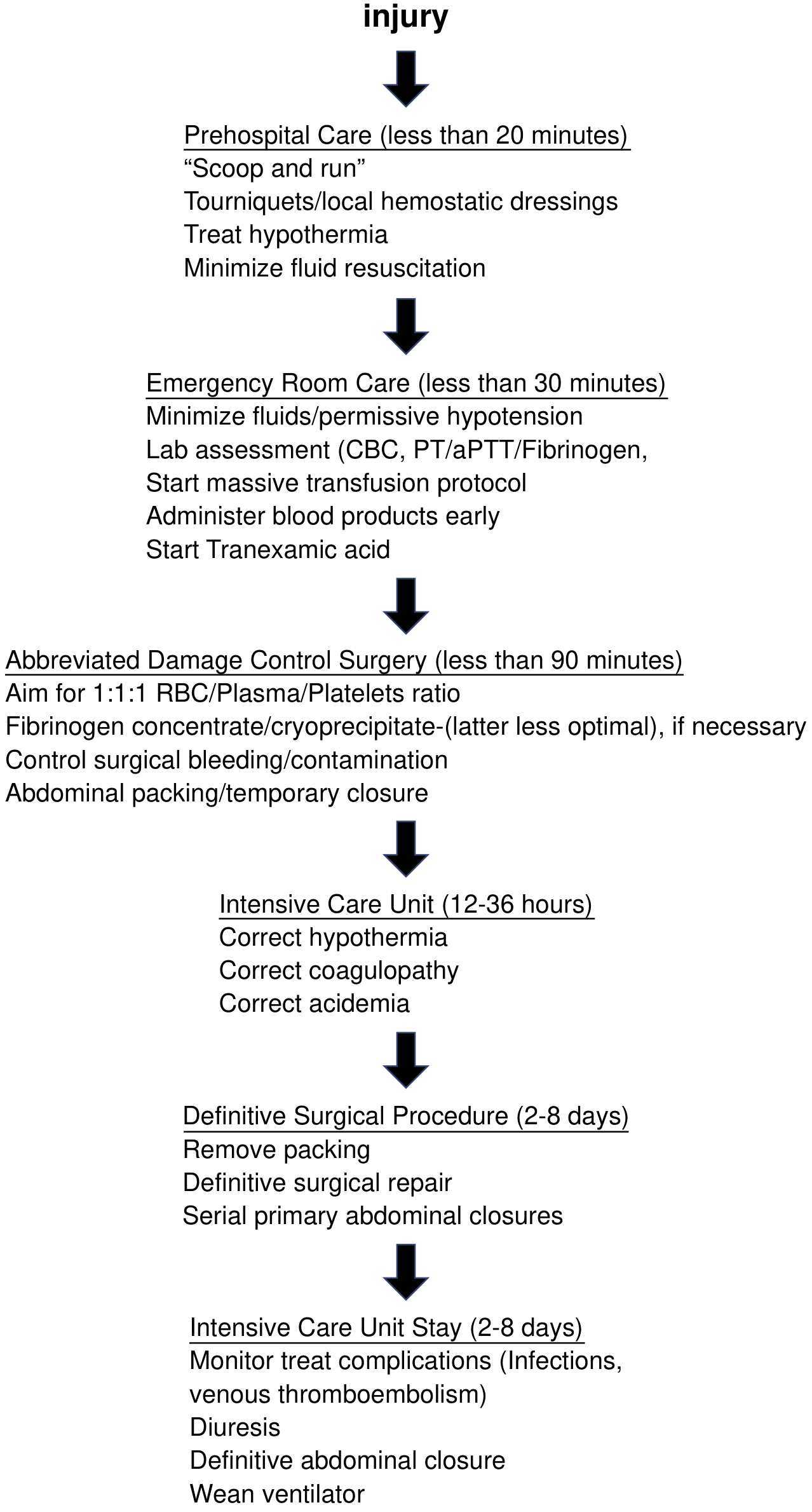
4. Damage Control Resuscitation (DCR) - Core Framework
The modern approach to TIC centers on Damage Control Resuscitation (DCR), with four simultaneous strategies:
4.1 Permissive Hypotension
- Target MAP ~50 mmHg, SBP 80-100 mmHg in hemorrhagic shock
- Rationale: higher pressures disrupt early hemostatic plugs and worsen rebleeding
- Exception: TBI patients require MAP ≥80 mmHg to maintain cerebral perfusion pressure
- Avoid crystalloids and colloids - both worsen dilutional coagulopathy
Current Surgical Therapy 14e, p. 1651: "Patients whose MAP was maintained above 50 mmHg required less IV fluids, fewer blood products, and had lower mortality than patients with a MAP target of 65 mmHg."
4.2 Preventing Hypothermia
- Passive: warm blankets, warm ambient temperature, remove wet/cold clothing
- Active: forced-air warming devices, warmed IV fluids and blood products
4.3 Correcting Acidosis
- Bicarbonate and THAM do not significantly improve hemostasis
- Best treated with hemorrhage control and blood products
- THAM preferred over bicarbonate when reversal of severe acidosis is needed (avoids excess sodium and CO2)
4.4 Correcting Hypocalcemia
- Ionized calcium should be monitored during massive transfusion
- Calcium must be supplemented early - preferably with the first unit of blood (not after several units)
- Citrated blood products combined with hepatic hypoperfusion rapidly cause hypocalcemia
- 2019 European Trauma Guideline recommends regular ionized calcium monitoring and supplementation
5. Blood Product Management
5.1 Massive Transfusion Protocol (MTP)
- Activated early in severe hemorrhage
- Delivers blood components in a 1:1:1 ratio (pRBC : Plasma : Platelets)
- Military experience from Iraq War confirmed 1:1:1 is associated with improved outcomes
- Reduces total blood product use, organ failure, and mortality compared to delayed/unguided transfusion
Bailey & Love's: "Prevention of dilutional coagulopathy is central to the damage control resuscitation of patients who are actively bleeding... delivering balanced transfusion regimes that approximate whole blood. In most practice this means delivering matched units of red blood cells, plasma and platelets in a 1:1:1 ratio."
5.2 Individual Components
Packed Red Blood Cells (pRBCs)
- Volume ~250 mL, hematocrit ~70%
- Raises Hb by ~1 g/dL per unit
- RBCs also actively participate in thrombin generation via phosphatidylserine expression
- RBC "margination" shifts platelets to vessel periphery, enhancing adhesion
- Shelf life 42 days (cryopreserved: 10 years)
- Group O pRBC and AB plasma used as universal donors
Fresh Frozen Plasma (FFP)
- Contains all coagulation factors including fibrinogen (~500 mg per 250 mL unit)
- Must be ABO compatible; Rh compatibility not required
- Thaw time ~30 min (rapid thawers: ~2 min for 2 units)
- Once thawed, use within 24 hours (or refrigerate for up to 5 days)
- Lyophilized/freeze-dried plasma (Lyoplas N-w): room-temperature storage for 2 years, reconstituted in minutes - promising for trauma/prehospital use
Platelets
- Given for thrombocytopenia or observed platelet dysfunction
- Target platelet count >50,000/mm³ in active bleeding; >100,000/mm³ in TBI
- Spontaneous hemorrhage risk when count <20,000/mm³
Cryoprecipitate
- Contains high concentrations of fibrinogen, factor VIII, vWF, factor XIII
- Given empirically or guided by VET/lab tests
- First-line fibrinogen replacement in many centers
Fibrinogen Concentrate
- Standardized fibrinogen content (advantage over cryoprecipitate)
- Fibrinogen is the first coagulation factor depleted in major hemorrhage
- Values below 229 mg/dL independently associated with significantly increased mortality
- A 2025 meta-analysis (PMID: 39715048) confirmed efficacy of coagulation factor concentrates (including fibrinogen concentrate) in trauma-induced coagulopathy
Fresh Whole Blood (FWB)
- 500 mL unit: Hct 38-50%, platelets 15-40×10⁵/µL, 100% clotting factor activity
- Cold-stored low-titer group O whole blood (LTOWB) used in civilian settings
- ~50% reduction in post-ED blood product use vs component therapy
- Questions remain on leukoreduction and large-volume transfusion
6. Tranexamic Acid (TXA) - Key Evidence
Mechanism: Antifibrinolytic - blocks plasmin and prevents fibrin degradation
Dosing:
- 1 g IV loading dose within 3 hours of injury, followed by 1 g over 8 hours (CRASH-2 protocol)
- Administration after 3 hours is NOT recommended (may increase mortality)
- Prehospital (Committee on Tactical Combat Casualty Care): single 2 g dose
- ACS-COT/ACEP guidelines: give when HR >120 bpm and/or SBP <90 mmHg
Key Evidence - CRASH-2 Trial (Lancet 2010, n=20,211):
- Largest RCT on TXA in trauma
- TXA given within 3 hours reduced all-cause mortality by 9% (RR 0.91)
- Mortality from hemorrhage reduced by 15%
- Administration after 3 hours was associated with increased mortality
- Tintinalli's EM: "Based on the CRASH-2 trial, the risk of death was most reduced with tranexamic acid administration within 1 hour of injury"
Caution: TXA may increase incidence of VTE; outcomes documentation essential
7. DIC Management
Pathophysiology: Uncontrolled systemic thrombin activation → simultaneous thrombosis and hemorrhage (consumption of clotting factors and platelets)
Causes: Sepsis, trauma, obstetric emergencies (abruption, AFE), malignancy, major burns, acute pancreatitis
Treatment Principles (Goldman-Cecil Medicine, Table 161-2):
| Priority | Action |
|---|---|
| 1st | Identify and eliminate the underlying cause |
| 2 | No treatment if mild, asymptomatic, self-limited |
| 3 | Hemodynamic support in severe cases |
| Blood components | FFP + platelets for active bleeding / high bleeding risk |
| Adjuncts | Cryoprecipitate for profound hypofibrinogenemia; Antithrombin III |
| VTE prophylaxis | Maintain platelets >20,000 in critically ill DIC; switch to mechanical prophylaxis if bleeding |
Heparin in DIC:
- Generally reserved for DIC manifested by thrombosis, acrocyanosis, or in cancer/vascular malformations where active bleeding is absent
- A meta-analysis confirmed: anticoagulant therapy in sepsis-DIC reduces mortality in DIC patients, though with increased bleeding risk
- Use unfractionated heparin by continuous infusion (short half-life, reversible); monitor by clinical response rather than aPTT (unreliable in DIC)
Antifibrinolytics in DIC:
- TXA and aminocaproic acid are generally contraindicated in DIC - block secondary fibrinolysis and can precipitate thrombosis
- Exception: life-threatening hemorrhage refractory to blood components - use with simultaneous low-dose heparin
Antithrombin III / Recombinant Thrombomodulin:
- Improve laboratory parameters but neither reduces mortality significantly
Japan DIC Guidelines 2024 (PMID: 39890756):
- Covers trauma, burn, obstetric, pancreatitis, and liver failure-associated DIC
- Recommends individualized management based on the dominant phenotype (bleeding vs thrombotic)
8. Anticoagulant Reversal
| Agent | Antidote | Notes |
|---|---|---|
| Warfarin | Vitamin K + 4-factor PCC (25-50 units/kg) | PCC faster than FFP; vitamin K for sustained reversal |
| Warfarin (severe) | Activated PCC or rFVIIa if 4-factor PCC fails | |
| Dabigatran (direct thrombin inhibitor) | Idarucizumab (Praxbind) | Specific reversal agent |
| Rivaroxaban / Apixaban (FXa inhibitors) | Andexanet alfa (AndexXa) | 4-factor PCC also used if unavailable |
| Unfractionated heparin | Protamine sulfate | 1 mg per 100 units heparin |
| LMWH | Protamine (partial) | ~60% reversal of anti-Xa activity |
Harrison's (2025): "Four-factor prothrombin complex concentrate (25-50 units/kg) is effective at restoring hemostasis. If there is continued bleeding, activated PCC (50 units/kg) or recombinant factor VIIa (90 µg/kg) can be considered."
9. Liver Disease Coagulopathy
- Synthetic failure of factors II, V, VII, IX, X, fibrinogen, Protein C/S
- Additionally: thrombocytopenia from portal hypertension / hypersplenism
- Management:
- FFP for acute bleeding (not prophylactically)
- Platelet transfusion for thrombocytopenia with active bleeding
- Cryoprecipitate for low fibrinogen (<100 mg/dL)
- Vitamin K 10 mg IV for suspected vitamin K deficiency
- Avoid routine correction of INR without active bleeding (INR does not predict bleeding in cirrhosis - balanced coagulopathy)
10. Intraoperative Coagulopathy (Liver Transplantation)
Mulholland & Greenfield's Surgery 7e: Complex coagulopathy arises from synthetic deficiency + portal hypertension + thrombocytopenia. Worsened during anhepatic phase and post-reperfusion (release of tPA from graft causing fibrinolysis). Monitor with conventional tests AND VET (TEG/ROTEM). Maintain normal pH, calcium, and normothermia to support coagulation. Fibrinolysis after reperfusion typically resolves once graft function is restored.
11. Obstetric Coagulopathy / PPH
- Transfusion practices adapted from trauma data
- Hypothermia, acidosis, and coagulopathy occur in both traumatic and obstetric hemorrhage
- ROTEM-guided transfusion reduces unnecessary blood products
- PPH seems to require trauma-level transfusion strategy, particularly regarding fibrinogen levels (Henry's Clinical Diagnosis, Laboratory Methods)
- Postpartum hemorrhage + placenta accreta spectrum: conservative management associated with consumptive coagulopathy - 2024 systematic review (PMID: 38030960) confirms close monitoring and early fibrinogen replacement essential
12. Key Evidence Summary
| Study/Guideline | Finding |
|---|---|
| CRASH-2 (Lancet 2010, n=20,211) | TXA within 3 hours reduces trauma mortality; after 3 hours harmful |
| Holcomb et al. PROPPR Trial (JAMA 2015) | 1:1:1 ratio pRBC:plasma:platelets superior to 1:1:2 in achieving hemostasis and 24-hr survival |
| CRASH-3 (Lancet 2019) | TXA reduces head injury mortality if given within 3 hours of injury |
| Itagaki et al. (Shock 2025) PMID 39715048 | Meta-analysis confirms coagulation factor concentrates (fibrinogen concentrate, PCC) effective in trauma-induced coagulopathy |
| European Trauma Guideline (Lier et al. 2025) PMID 40576680 | Updated guideline on in-hospital coagulation management and fluid replacement in severe trauma |
| Japan DIC Guidelines 2024 PMID 39890756 | Individualized DIC management for trauma, burn, obstetric, and other etiologies |
| CRASH-2 Early TXA sub-analysis | Risk reduction greatest within 1st hour; benefit dissipates by 3 hours |
13. Practical Algorithm Summary
Step 1 - Prehospital (<20 min):
- "Scoop and run", tourniquets, hemostatic dressings, treat hypothermia, minimize fluids
Step 2 - Emergency Department (<30 min):
- Permissive hypotension (SBP 80-100 mmHg, MAP >50 mmHg)
- Labs: CBC, PT, aPTT, fibrinogen, ionized calcium, TEG/ROTEM
- Activate MTP early
- TXA 1 g IV within 3 hours of injury
- Calcium administration with first blood unit
Step 3 - Damage Control Surgery (<90 min):
- 1:1:1 pRBC:plasma:platelets
- Fibrinogen concentrate / cryoprecipitate for low fibrinogen
- Surgical hemorrhage control, abdominal packing if needed
Step 4 - ICU (12-36 hours):
- Correct hypothermia, acidosis, and residual coagulopathy
- VET-guided targeted transfusion
- Correct calcium, ionized Mg
Step 5 - Definitive Surgery (2-8 days):
- Remove packing, definitive repair once coagulopathy resolved and physiology restored
Sources: Bailey & Love's Short Practice of Surgery 28e | Current Surgical Therapy 14e | Goldman-Cecil Medicine | Mulholland & Greenfield's Surgery 7e | Miller's Anesthesia 10e | Harrison's Principles of Internal Medicine 22e (2025) | Tintinalli's Emergency Medicine | CRASH-2 (Lancet 2010) | PROPPR Trial (JAMA 2015) | Itagaki et al., Shock 2025 | Lier et al., Eur J Trauma Emerg Surg 2025 | Japan DIC Guidelines 2024
Coagulopathy in CLD management
Your credits are exhausted. You can purchase a top-up or subscribe to a plan to continue using Orris. If you're already subscribed, your daily credits will reset tomorrow.
This is a shared conversation. Sign in to Orris to start your own chat.