
hypertension
Reading File
The query is broad — "hypertension" covers definition/classification, pathophysiology, diagnosis, and management. Let me clarify scope before diving deep.
Asking for Preferences
What aspect of hypertension are you interested in?
Finding Sources
Searching PubMed
hypertension management guidelines
Good — found rich textbook sources and the 2025 AHA/ACC guideline. Now reading the most relevant sections in parallel.
Reading File
Finding Sources
Finding Sources
The first read gave PAD content — wrong offset. Let me read the correct sections from Harrison's (best comprehensive source) and Family Medicine textbook, plus the hypertensive emergency section and secondary HTN from Harrison's, in parallel.
Finding Sources
Reading File
Reading File
Excellent — the Harrison's block30 file has huge amounts of content. Let me now read the definition/classification/pathophysiology section and drug treatment sections from Harrison's, which is the primary source here.
Reading File
Reading File
Excellent — rich content collected. Let me fetch the treatment flowchart image and read the pathophysiology/drug treatment sections.
Loading Image
Reading File
I now have comprehensive content. Let me read the pathophysiology and drug classes sections to complete the picture.
Reading File
I now have comprehensive content from Harrison's 22E (2025) covering all aspects. Let me also fetch the BP category management flowchart and compile the full answer.
Loading Image
Here is a comprehensive overview of hypertension across all requested domains.
Hypertension
Primary sources: Harrison's Principles of Internal Medicine 22E (2025), Brenner & Rector's The Kidney, Textbook of Family Medicine 9e
1. Definition & Classification
Blood pressure (BP) classification per the ACC/AHA system used in the United States:
| Category | SBP (mmHg) | DBP (mmHg) | |
|---|---|---|---|
| Normal | < 120 | and | < 80 |
| Elevated BP | 120–129 | and | < 80 |
| Stage 1 Hypertension | 130–139 | or | 80–89 |
| Stage 2 Hypertension | ≥ 140 | or | ≥ 90 |
Correct classification requires averaging ≥2 readings on ≥2 separate occasions; when SBP and DBP are in different categories, the higher category applies.
Special patterns:
- White-coat hypertension — office BP meets hypertension criteria but out-of-office readings are normal (prevalence ~15–25%). CVD risk is closer to normotensive; treat with nonpharmacologic measures and monitor.
- Masked hypertension — office BP is normal but out-of-office readings are hypertensive (prevalence ~15–25%). CVD risk is similar to sustained hypertension; drug therapy is often warranted.
— Harrison's Principles of Internal Medicine 22E, Ch. 288
2. Epidemiology
- Over 103 million U.S. adults have hypertension (~46% of adults overall)
- Prevalence rises sharply with age: ~20–30% at ages 20–44 → 80–85% at ≥75 years
- Non-Hispanic Black adults have the highest prevalence (59%), with earlier onset and greater end-organ damage
- Globally, using SBP ≥140 criteria: ~1.04 billion in low/middle-income countries; ~349 million in high-income countries
3. Pathophysiology
Primary (essential) hypertension accounts for ~90–95% of all cases. No single cause; it results from an interplay of:
- Genetic factors — polygenic predisposition affecting renal sodium handling, RAAS activity, sympathetic tone
- Excess dietary sodium — promotes volume expansion and directly raises SBP; the relationship is nearly linear
- Obesity & visceral adiposity — activates RAAS, sympathetic nervous system, and promotes insulin resistance
- Renin-angiotensin-aldosterone system (RAAS) activation — angiotensin II causes vasoconstriction and aldosterone-mediated sodium/water retention
- Sympathetic nervous system overactivity — increases heart rate, cardiac output, and peripheral vascular resistance
- Endothelial dysfunction — reduced nitric oxide bioavailability impairs vasodilation
- Age-related arterial stiffness — increases pulse pressure and isolated systolic hypertension in older adults
Migrant studies demonstrate that isolated populations who move to modern environments develop age-related BP rise, implicating dietary sodium, reduced potassium, weight gain, physical inactivity, and alcohol as key environmental drivers.
4. Diagnosis & Workup
Initial Laboratory Investigations
In all newly diagnosed hypertension, obtain:
- CBC, serum electrolytes (Na, K, Ca), serum creatinine + eGFR
- Lipid profile, hemoglobin A1c or fasting glucose
- Thyroid-stimulating hormone
- Urinalysis + urine albumin-to-creatinine ratio
- 12-lead ECG
Goals: detect target organ damage, identify secondary causes (e.g., hypokalemia → primary aldosteronism; proteinuria → CKD), recognize comorbidities, estimate ASCVD risk, and guide drug selection.
BP Measurement Pearls
- SBP is commonly overestimated by ~7 mmHg in routine practice → ~15–20% overestimation of hypertension prevalence
- Use clinically validated devices; trained non-physician staff improves accuracy
- Home BP monitoring: average readings over ~3 days prior to visit; same diagnostic threshold (≥130/80 mmHg) as office
5. Cardiovascular Risk Assessment
BP is associated with CVD risk in a continuous log-linear fashion from SBP as low as 90 mmHg. Risk doubles with every 20 mmHg increase in SBP or 10 mmHg increase in DBP above 115/75 mmHg. Estimate ASCVD risk using a validated calculator to guide treatment initiation thresholds.
6. Treatment
Management by BP Category
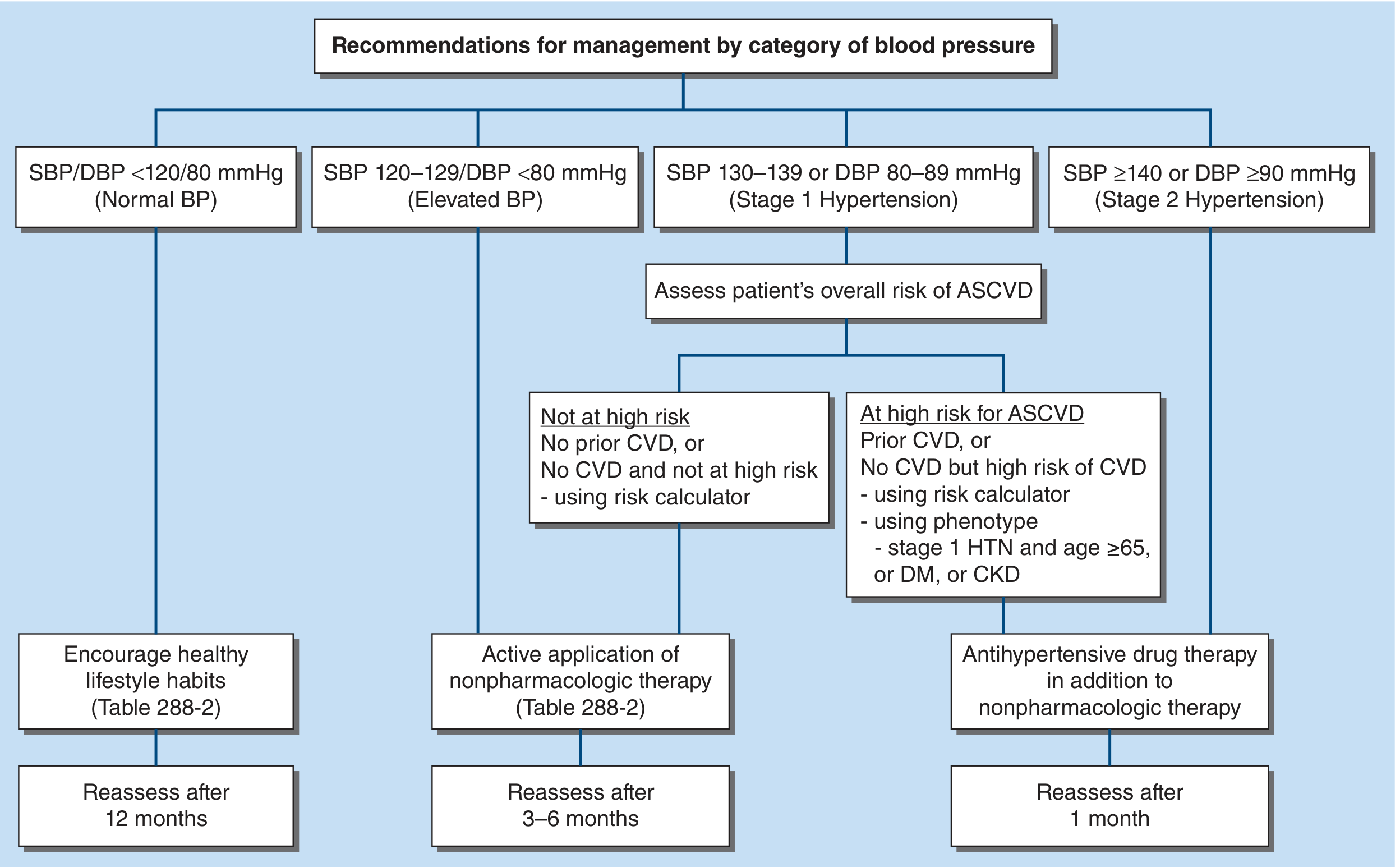
— Harrison's Principles of Internal Medicine 22E, Fig. 288-3
| BP Category | Action | Reassess |
|---|---|---|
| Normal (<120/80) | Encourage healthy lifestyle | 12 months |
| Elevated (120–129/<80) | Active nonpharmacologic therapy | 3–6 months |
| Stage 1 + not high ASCVD risk | Nonpharmacologic therapy | 3–6 months |
| Stage 1 + high ASCVD risk (CVD, DM, CKD, age ≥65) | Nonpharmacologic + drug therapy | 1 month |
| Stage 2 (≥140/90) | Nonpharmacologic + drug therapy | 1 month |
BP treatment goal: SBP/DBP <130/80 mmHg for most adults; SBP <130 mmHg in community-dwelling adults ≥65 years. For frail elderly with limited life expectancy, clinical judgment governs.
Nonpharmacologic Interventions
| Intervention | Expected SBP Reduction |
|---|---|
| DASH diet | ~5 mmHg (with HTN); ~2–3 mmHg (without) |
| Weight loss | ~1 mmHg per kg lost |
| Sodium reduction (~25%) | ~5 mmHg (with HTN); ~2–3 mmHg (without) |
| Potassium supplementation | ~4–5 mmHg |
| Physical activity | ~4–5 mmHg |
| Alcohol reduction | ~3–4 mmHg |
Antihypertensive Drug Therapy
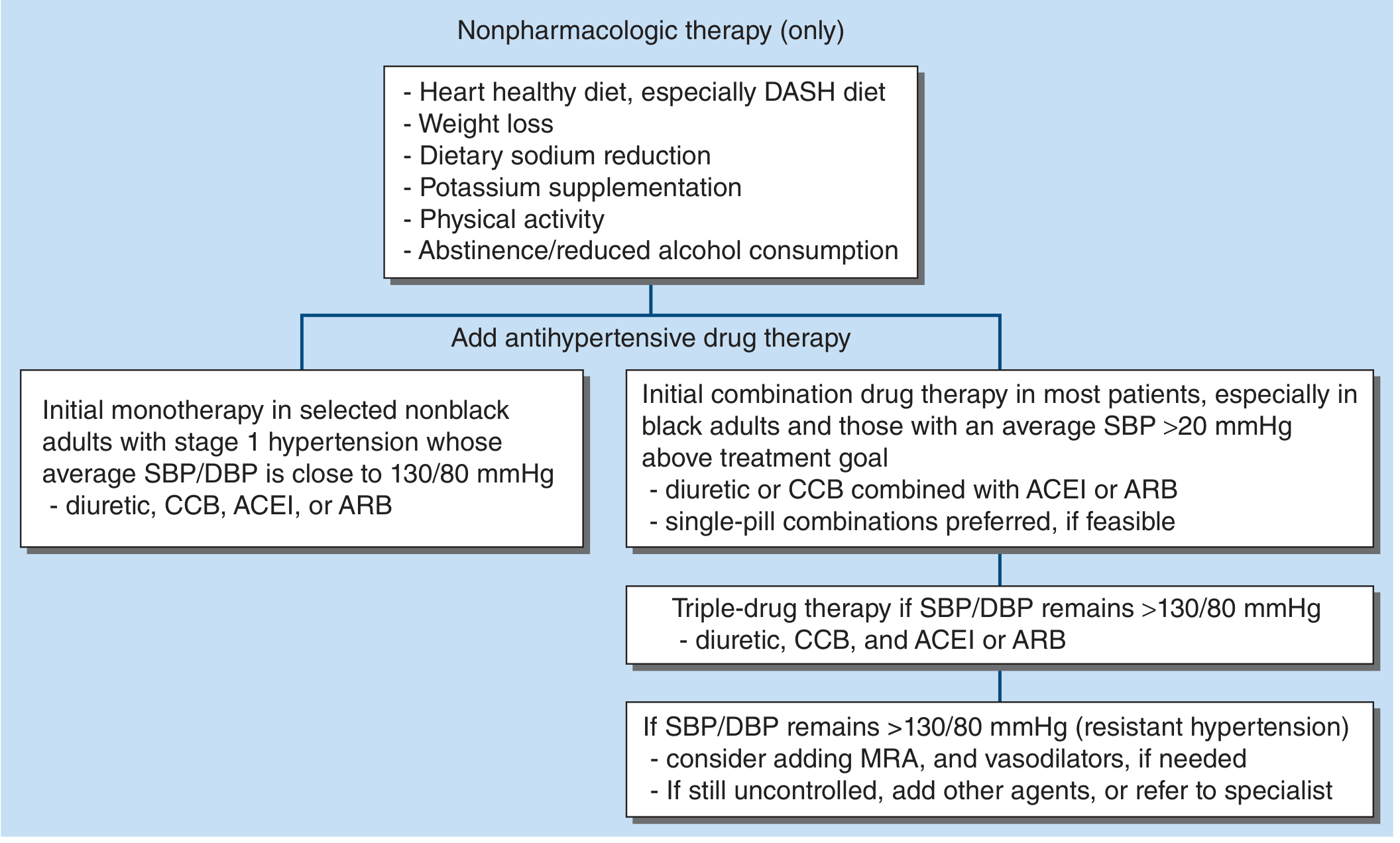
— Harrison's Principles of Internal Medicine 22E, Fig. 286-4
Four first-line drug classes:
| Class | Examples | Notes |
|---|---|---|
| Thiazide/thiazide-like diuretics | Chlorthalidone, hydrochlorothiazide, indapamide | Preferred in Black adults; inexpensive; watch for hypokalemia |
| Calcium channel blockers (CCB) | Amlodipine (DHP); diltiazem, verapamil (non-DHP) | Effective in Black adults; DHP preferred for HTN |
| ACE inhibitors (ACEI) | Lisinopril, enalapril, ramipril | Renoprotective in CKD; avoid in pregnancy; avoid combining with ARB |
| Angiotensin receptor blockers (ARB) | Losartan, valsartan, irbesartan | Preferred in ACEI-intolerant patients (cough) |
Combination strategy:
- Monotherapy: selected non-Black adults with stage 1 HTN whose SBP/DBP is close to 130/80 mmHg → diuretic, CCB, ACEI, or ARB
- Dual therapy (most patients): diuretic or CCB + ACEI or ARB; single-pill combinations improve adherence
- Triple therapy: diuretic + CCB + ACEI or ARB
- Average drugs needed to reach <140/90: 2; to reach <130/80: 3
Special considerations:
- Beta-blockers — not first-line for uncomplicated HTN but preferred with co-existent heart failure with reduced EF, post-MI, or atrial fibrillation; safe in PAD/intermittent claudication (contrary to older case reports)
- ACE inhibitors in PAD — may offer atherosclerotic benefit beyond BP lowering (HOPE, EUROPA trials)
- MRA (spironolactone/eplerenone) — add-on for resistant hypertension
Resistant Hypertension
Defined as failure to control SBP/DBP to <130/80 mmHg on 3 antihypertensive medications (ideally including a diuretic), or requiring ≥4 medications to achieve control. Evaluate for secondary causes; consider adding MRA or vasodilators; refer to specialist.
7. Complications & Target Organ Damage
Hypertension is the leading modifiable cardiovascular risk factor. Target organs:
| Organ | Complications |
|---|---|
| Heart | Left ventricular hypertrophy (LVH), heart failure (HFpEF and HFrEF), coronary artery disease, atrial fibrillation |
| Brain | Ischemic stroke, hemorrhagic stroke, hypertensive encephalopathy, vascular dementia |
| Kidney | Hypertensive nephrosclerosis, CKD progression, proteinuria, ESRD |
| Eyes | Hypertensive retinopathy (AV nicking, copper/silver wiring, flame hemorrhages, papilledema in emergencies) |
| Aorta & vessels | Aortic dissection (especially with acute BP crisis), peripheral arterial disease |
HTN confers a 2.5× (men) to 3.9× (women) age-adjusted risk for peripheral arterial disease.
Unprovoked hypokalemia, proteinuria, or LVH disproportionate to BP level should raise suspicion for a secondary cause.
8. Secondary Hypertension
Accounts for ~5–10% of cases. Should be actively sought when:
- Treatment-resistant hypertension
- Abrupt worsening of previously controlled BP
- Disproportionate target organ damage
- Suggestive lab/clinical findings (unprovoked hypokalemia, proteinuria, LVH)
| Cause | Prevalence | Key Features | Screening Test |
|---|---|---|---|
| Obstructive sleep apnea (OSA) | Most common | Overweight/obese, snoring, daytime somnolence, resistant HTN | Polysomnography |
| Primary aldosteronism | ~5–15% of referred HTN | Hypokalemia, high aldosterone/renin ratio | Aldosterone-to-renin ratio |
| Renal parenchymal disease | Common | Proteinuria, elevated creatinine, hematuria | eGFR, urinalysis, renal US |
| Renovascular HTN | ~1–2% | Abdominal bruit, flash pulmonary edema, young women (FMD), older smokers (atherosclerotic) | Renal duplex Doppler, CTA/MRA |
| Pheochromocytoma | Rare | Episodic headache, palpitations, diaphoresis | 24-hr urine/plasma metanephrines |
| Cushing's syndrome | Rare | Central obesity, striae, hyperglycemia | 24-hr UFC, dexamethasone suppression |
| Thyroid disease | Variable | Hypo/hyperthyroidism both can affect BP | TSH |
2025 Endocrine Society Guideline (PMID 40658480): Updated clinical practice guideline specifically for primary aldosteronism — now recommend screening in a broader population including all patients with HTN and unprovoked hypokalemia.
9. Hypertensive Emergencies & Urgencies
Hypertensive emergency: Elevated BP with acute, ongoing target organ damage (hypertensive encephalopathy, acute coronary syndrome, aortic dissection, acute heart failure, acute kidney injury, eclampsia, grade III–IV retinopathy). Requires ICU admission and IV antihypertensives.
Hypertensive urgency: Markedly elevated BP without acute target organ damage. Evidence does not support aggressive acute in-hospital treatment; retrospective data show very low morbidity with expedited outpatient follow-up.
IV Agents for Hypertensive Emergencies
| Drug | Notes |
|---|---|
| Sodium nitroprusside | Least expensive; requires protection from light; metabolized to cyanide (caution with prolonged infusion) |
| Fenoldopam (DA-1 agonist) | Improves renal perfusion parameters; useful with renal impairment |
| Clevidipine (DHP CCB) | Hydrolyzed by serum esterases; hepatic/renal impairment does not alter elimination; avoid in soy/egg allergy |
| Nicardipine | CCB; used in coronary disease (reflex tachycardia offset by coronary vasodilation) |
| Nimodipine | Reserved specifically for subarachnoid hemorrhage |
| Labetalol/esmolol | Beta-blockers; first-line for aortic dissection (reduce shear stress) |
Condition-specific targets:
- Aortic dissection: Lower SBP to <120 mmHg within 20 minutes using β-blocker + vasodilator
- Ischemic stroke (thrombolysis candidate): Lower BP if >180/110 mmHg before tPA
- All other emergencies: Reduce BP by ~10–15% in the first hour, then 10–20% over the next hour (total ~25%); avoid precipitous drops
10. Recent Evidence
2025 AHA/ACC Hypertension Guideline (PMID 40811516): Published in Hypertension, Oct 2025 — the most current U.S. guideline from AHA/ACC and 12 other societies covering prevention, detection, evaluation, and management. This supersedes the 2017 guideline.
Key updates include refinements to BP targets, broader criteria for pharmacotherapy initiation, and updated combination therapy strategies aligned with the content above.
— Harrison's Principles of Internal Medicine 22E (2025), Ch. 288; Brenner & Rector's The Kidney (2018), Ch. 46; Textbook of Family Medicine 9eThis covers all aspects you requested. Here's a quick orientation to the sections above:
- Section 1–2: ACC/AHA classification table, white-coat vs. masked HTN, epidemiology
- Section 3: Pathophysiology of primary HTN (RAAS, SNS, sodium, obesity, arterial stiffness)
- Section 4: Diagnostic workup — which labs to order and why, plus BP measurement pearls
- Section 5: CVD risk quantification
- Section 6: Full treatment algorithm with both flowcharts, nonpharmacologic BP reduction table, and four first-line drug classes with combination strategies
- Section 7: Target organ damage across heart, brain, kidneys, eyes, vessels
- Section 8: Six causes of secondary HTN with screening tests; flagged the new 2025 primary aldosteronism guideline
- Section 9: Emergency vs. urgency distinction, IV drugs with specific indications, condition-specific BP targets
- Section 10: The October 2025 AHA/ACC guideline (most current U.S. guidance)
Let me know if you want to go deeper on any specific area — drug pharmacology, pediatric HTN, pregnancy-related HTN, renal denervation, or anything else.
This is a shared conversation. Sign in to Orris to start your own chat.